


WEEX Cross Margin vs Isolated Margin: Which Mode Should Futures Traders Use?
Cross margin and isolated margin are the two core margin management methods for perpetual futures trading on WEEX, and the mode you choose materially changes how much you can lose on any single trade, how liquidation is triggered, and how much manual management your positions need. This guide breaks down how each mode actually works, how liquidation differs between them, and how to decide which one fits your trading style.
Futures trading is leveraged and high-risk. Regardless of which margin mode you choose, you can lose your entire position margin, and in cross margin, potentially more of your account balance. Nothing in this guide is investment advice — always assess your own risk tolerance before opening a leveraged position.
What Is Isolated Margin?
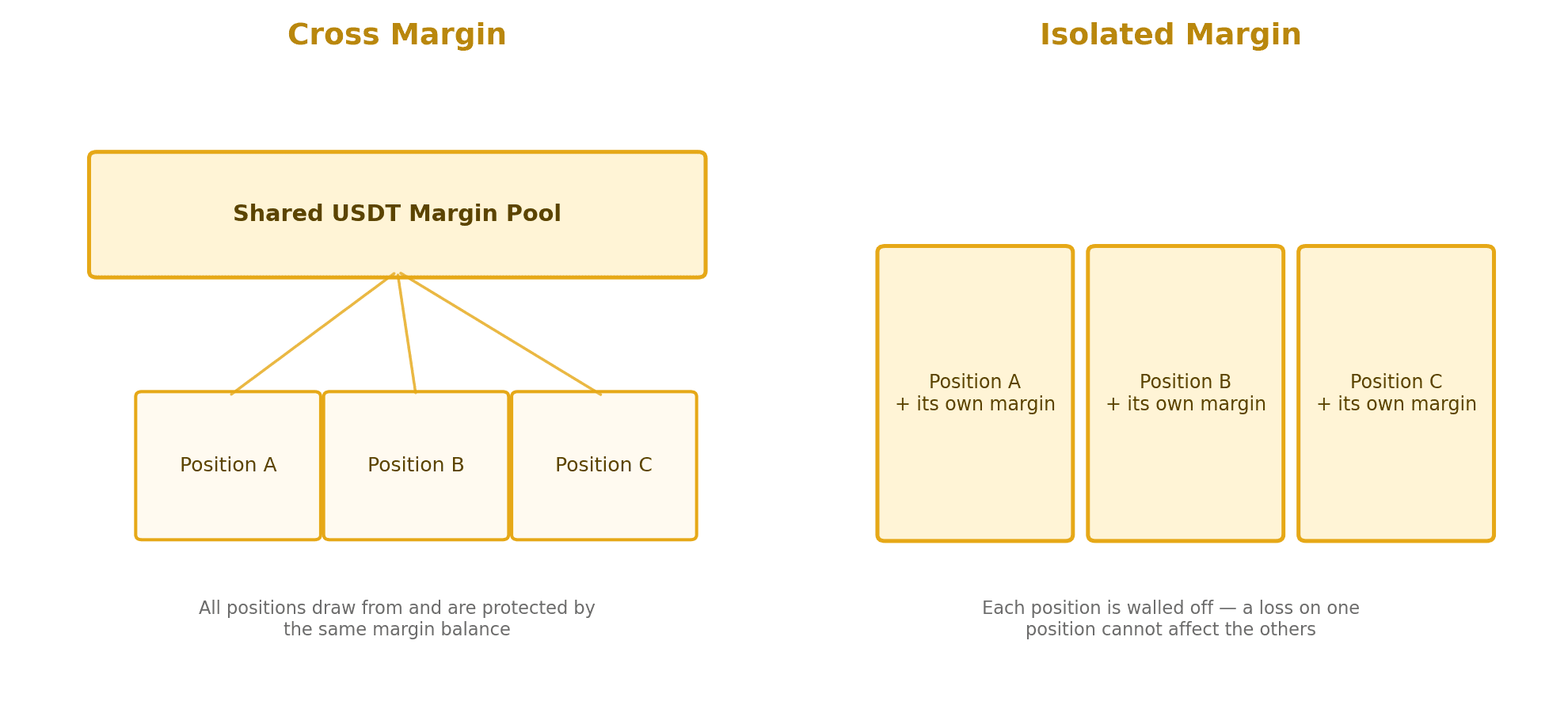
Isolated margin lets you allocate a specific, fixed amount of margin to each individual position, containing risk to that position alone. A loss on one isolated position only affects the margin assigned to it — the rest of your futures balance and any other open positions remain untouched. You can also manually add or remove margin from an isolated position at any time.
Example: Say you have 1,000 USDT in your futures account. You open a 10× leveraged position with a notional value of 1,000 USDT, which requires 100 USDT as margin. If that position gets liquidated, your maximum loss is capped at 100 USDT — the remaining 900 USDT and any other positions stay safe.
What Is Cross Margin?
Cross margin shares your entire USDT-M futures account balance as margin across all open positions. This gives each position more of a buffer against liquidation, since it can draw on your full available balance rather than just what's assigned to it individually — but the trade-off is that a liquidation event under cross margin can affect your entire futures balance, not just one position.
Combined vs. Separated: A Sub-Setting Within Each Mode
Beyond the basic cross/isolated choice, WEEX also lets you choose between "Combined" and "Separated" position handling within each mode:
| Setting | How It Works |
|---|---|
| Cross Combined | Orders in the same direction and trading pair merge into a single position (max one long, one short per pair). Leverage applies uniformly, and margin is shared. |
| Cross Separated | Orders in the same direction can open multiple distinct positions on the same pair without merging into existing ones, while still sharing margin under cross mode. |
| Isolated Combined | Same-direction orders on the same pair merge into a single position (max one long, one short), with margin calculated separately per position. |
| Isolated Separated | Same-direction orders can open multiple distinct positions on the same pair, each with its own isolated margin. |
WEEX also offers a one-click batch setting that applies your chosen margin mode to all futures trading pairs at once, rather than configuring each pair individually. This only applies to pairs without open positions or pending orders — pairs you're actively trading need to be adjusted individually to protect existing positions, and you can re-run the batch setting at any time.
How Liquidation Actually Differs Between the Two Modes
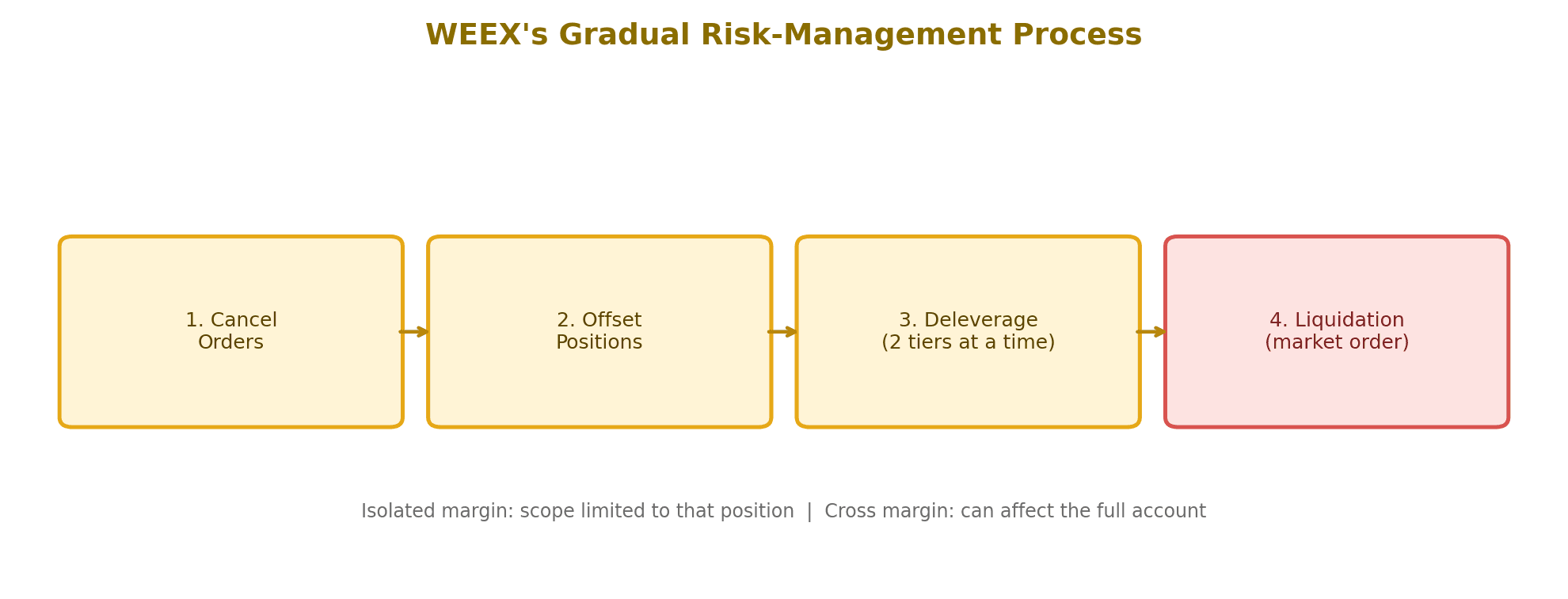
This is where the practical difference between cross and isolated margin matters most. WEEX uses a gradual, staged risk-management process rather than closing a position outright the moment things go wrong:
- Canceling orders. Under isolated margin, only open/close orders for the affected trading pair and direction are cancelled. Under cross margin, all open/close orders across your account are cancelled, including isolated positions.
- Offsetting positions. The system offsets two-sided positions where applicable (excluding isolated margin positions).
- Deleveraging. Position size is reduced in stages — roughly two tiers at a time — rather than closed all at once (excluding isolated margin positions).
- Liquidation. A market order is triggered for any remaining position that still doesn't meet margin requirements.
Both modes are governed by the same underlying concept — the maintenance margin rate, calculated as:
Margin rate = (Position margin + Unrealized P/L) ÷ Position value
When your margin rate falls to or below the required maintenance margin rate (plus the closing fee rate), liquidation or forced closing is triggered. The key structural difference is scope: under isolated margin, this calculation and its consequences are contained to that single position; under cross margin, the calculation draws on your entire account balance, and a severe enough move can trigger liquidation across multiple positions at once. In either mode, your maximum loss on a liquidated position is capped at the margin allocated to it — under cross margin, that "allocated margin" can effectively be your whole account balance if you haven't limited your exposure.
Cross vs. Isolated: Side-by-Side Comparison
| Cross Margin | Isolated Margin | |
|---|---|---|
| Margin source | Shared across all open positions | Fixed amount per position |
| Liquidation risk scope | Can affect entire futures balance | Limited to that position's margin |
| Buffer against liquidation | Generally larger (uses full balance) | Limited to what you've allocated |
| Manual margin adjustment | Not position-specific | Can add/remove margin per position |
| Best suited for | Experienced traders managing multiple correlated positions | Traders who want a hard cap on position-level risk |
| Order cancellation on risk trigger | Account-wide | Limited to the affected pair/direction |
Which Mode Should You Use?
Isolated margin tends to suit traders who want a predictable, capped downside on each individual trade — since you decide up front exactly how much you're willing to risk on that position, it's a natural starting point for anyone newer to leveraged futures trading, or anyone running several independent, unrelated trade ideas at once where they don't want one bad trade to threaten the others.
Cross margin tends to suit more experienced traders who are actively managing a portfolio of related positions and want the added liquidation buffer that comes from sharing margin across them — the trade-off being that it requires closer monitoring, since a large adverse move can put your entire futures balance at risk rather than just one position's worth.
Neither mode eliminates risk — they simply change where that risk is contained. Reviewing WEEX's official liquidation process documentation and Futures Trading Terms of Use in full is worth doing before you rely on either mode for a live position.
Final Thoughts
Cross and isolated margin solve the same underlying problem — managing risk on a leveraged position — in different ways. Isolated margin trades a smaller liquidation buffer for a hard ceiling on loss per position; cross margin trades a larger buffer for account-wide exposure. WEEX's Isolated Margin Mode documentation and the one-click margin mode setup guide are both worth reading if you're setting this up for the first time or managing multiple trading pairs.
Trading futures involves substantial risk and may result in the loss of your invested capital, regardless of margin mode. Assess your own risk tolerance and financial situation before trading, and seek independent advice if you're unsure.
WEEX does not offer services to users in the United States, its territories, or certain other restricted jurisdictions. Please review the Terms of Use for the current list of excluded jurisdictions and eligibility requirements before trading futures.

Gainers


