
Dell Earnings: $95B AI Backlog Now Dwarfs Its Own Guidance

 Prefer us on Google


Dell Technologies reported fiscal Q2 2027 results after the close on Sept. 1, 2026, and the headline was not the earnings beat — it was the order book. Dell booked $60.9 billion of AI server orders in a single quarter and exited with a record $95 billion backlog, a figure that now exceeds the company's entire raised full-year AI server revenue target. Revenue hit a record $46.97 billion, up 58% year over year, and management lifted FY2027 guidance by $25 billion to roughly $192 billion. Below: what the Dell earnings actually showed, why the backlog number is more complicated than it looks, the cash-flow line most coverage skipped, and how traders are positioning around DELL on a 24/7 venue.
Dell Q2 FY2027 earnings: The numbers that moved DELL
For the quarter ended July 31, 2026, reported Sept. 1:
- Revenue: $46.97 billion, up 58% from $29.78 billion a year earlier
- GAAP diluted EPS: $6.34, up 273%; non-GAAP diluted EPS $7.04, up 203% and roughly $2.17 above the consensus estimate near $4.87
- Infrastructure Solutions Group: $31.78 billion, up 89%, with operating margin expanding from 8.8% to 15.0%
- AI-optimized servers: $16.40 billion, exactly double the $8.21 billion booked in Q2 FY2026
- Traditional servers and networking: $10.53 billion, up 122% — the fastest-growing line in the quarter, and one almost nobody was modeling
- Storage: $4.85 billion, up 26%
- Client Solutions Group: $15.03 billion, up 20%, with commercial up 22% and consumer up just 7%
That last split matters. The market has been treating Dell as a pure AI-server proxy, but traditional compute growing 122% says the enterprise refresh cycle Dell has been promising for two years finally arrived at the same time as the AI buildout. Two engines, not one.
Shares had already slid about 4.5% to near $435 during Tuesday's regular session ahead of the print, on tariff worries and a broad tech pullback. They then popped as much as 10% in after-hours trade once the guidance raise landed.
Why a $95 billion AI backlog is bigger than it sounds
Dell recognized $16.4 billion of AI server revenue in Q2 and booked $60.9 billion of new orders against it. That is a book-to-bill ratio of roughly 3.7 to 1. For context, Dell's AI backlog was around $14.4 billion in Q1 FY2026 and $51.3 billion two quarters ago. It has roughly doubled again.
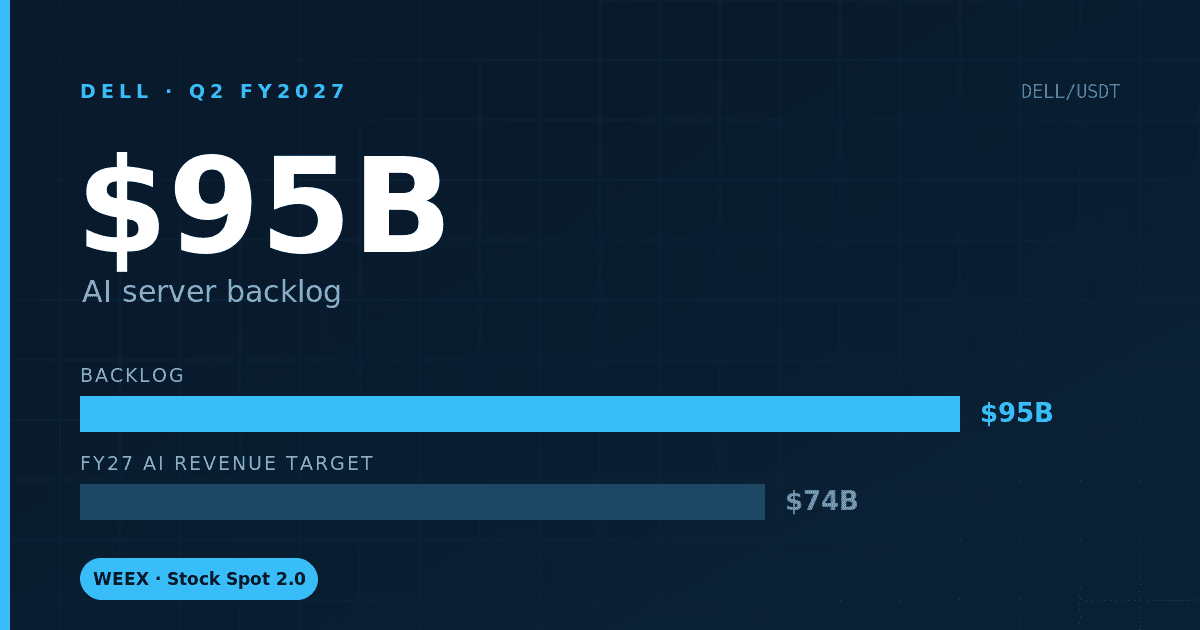
The more useful comparison is backlog against guidance. Dell raised its FY2027 AI-optimized server revenue target from $60 billion to $74 billion. The backlog alone — $95 billion — is now 28% larger than a full year of guided AI revenue at the raised number. In practical terms, Dell has already sold more AI infrastructure than it plans to ship in the next twelve months.
That is a demand statement, but it is also an admission. CEO Jeff Clarke's team has been unusually blunt that Dell does not have a demand problem; it has a supply problem. Management named DRAM, NAND, CPUs, disk drives, mature-node components, and AI-specific parts as active constraints. Backlog that large is partly a queue of customers who cannot get parts.
Are Dell's AI servers actually profitable?
This was the bear case going into the print, and the answer is more nuanced than either side wanted.
At the consolidated level, the margin math went Dell's way. GAAP gross margin expanded to 20.9% from 18.3%, and GAAP operating margin jumped 5.5 points to 11.5%, because gross profit grew 80% while operating expenses grew only 21%. R&D rose 41% and SG&A only 15% — both well below the 58% revenue growth. That is textbook operating leverage.
But the composition is worth watching. ISG now produces 81% of reportable segment operating income, up from 65% a year ago. Dell's profit engine has concentrated hard into one segment inside twelve months. And the cost side is moving against it: server DRAM prices are projected to rise 13% to 18% sequentially in Q3 2026, and management has consistently guided AI systems toward mid-single-digit operating margins rather than the fatter margins storage and services carry. This quarter's margin expansion came with favorable timing on memory inventory. Next quarter's may not.
The better reading is that Dell earned its multiple this quarter on operating leverage, not on AI server profitability per se. Those are different things, and the second one still hasn't been proven at scale.
-- Price
The number the headlines skipped: cash flow fell 13%
Net income rose 255%. GAAP operating cash flow fell 13%, to $2.23 billion from $2.54 billion. That divergence is the single most under-covered line in the release.
The balance sheet explains why. Over the first six months of the fiscal year, inventory more than doubled from $10.44 billion to $21.29 billion. Accounts receivable rose from $17.59 billion to $22.92 billion, and short-term financing receivables climbed from $8.46 billion to $12.81 billion. Accounts payable also swelled, from $33.63 billion to $49.72 billion, which offsets some of the drag — Dell is financing a meaningful share of the buildout on supplier terms.
Meanwhile, Dell returned a record $4.3 billion via buybacks and dividends in a quarter that generated $2.23 billion of operating cash, and total debt rose from roughly $31.50 billion to $34.47 billion. Dell also reported $8.15 billion in adjusted free cash flow, a non-GAAP figure that diverges sharply from the GAAP line without a full reconciliation in the release.
None of this is a red flag on its own — hypergrowth hardware businesses consume working capital, and that is what growth looks like on a cash flow statement. It is a red flag if AI demand cools while $21 billion of inventory is sitting on the books. That is the specific way this trade goes wrong, and it is worth more attention than another headline about the backlog.
Can Dell hit $74 billion in AI server revenue this year?
Dell recognized $32.53 billion of AI-optimized server revenue in the first half. Hitting $74 billion requires roughly $41.5 billion in the back half — a step up of about 28% over the first six months, in a period when memory is scarcer and more expensive.
Three things determine whether that lands:
- Component supply. DRAM and NAND availability is the binding constraint, not customer appetite.
- Customer deployment readiness. Dell's AI customer base has passed 6,500 accounts across neocloud operators, sovereign deployments, and traditional enterprises. Sovereign and neocloud projects in particular slip on data center power and construction timelines that Dell does not control.
- Order durability. Backlog is not contractually identical to revenue. Large AI orders can be rescheduled.
The Q3 guide — about $49 billion in revenue and $6.50 non-GAAP EPS — implies management thinks the ramp holds. The full-year non-GAAP EPS guide went to $25.50 from $17.90.
How to trade DELL as a tokenized stock on WEEX
Here is a practical wrinkle earnings traders keep running into: Dell reported after the US close, and the meaningful repricing happened while regular-hours markets were shut. As of Sept. 2, 2026, the DELL/USDT tokenized stock pair on WEEX was quoting 459.02 — roughly 5% above where DELL changed hands during Tuesday's regular session, before US markets reopened.
That is the core argument for tokenized equities: earnings do not respect exchange hours, and neither does the reaction. WEEX Stock Spot 2.0 lets you take spot exposure to US equity price action in USDT, around the clock, without a brokerage account or settlement cycle.
To trade a stock pair on WEEX:
- Open the WEEX app, tap Trade, then select the Stocks tab. On web, go to Spot Trading and choose the Stocks tab.
- Search for the ticker — DELL, or a related AI-supply-chain name like NVDA or MU.
- Choose Buy or Sell and set a limit price rather than a market order; tokenized stock books can be thinner than major crypto spot pairs, and slippage on a market order into an earnings gap is the most common way traders give back the move.
- Place the order and manage it like any spot position — no leverage, no funding rate, no liquidation.
The WEEX Stock Spot 2.0 rewards campaign is running alongside this, with first-trade protection and a $100,000 shared prize pool. Eligible pairs currently include SNDK, SKHY, MU, SPCX, TSLA, AMD, QQQ, MSTR, NVDA, and NBIS — heavily weighted toward the same AI infrastructure and memory complex that Dell's results just repriced. If you think Dell's $95 billion backlog is a read-through to memory suppliers, the instruments to express that are on the same screen.
One caution specific to tokenized stocks: they track reference prices from third-party data, and execution prices can differ from the underlying listed market. Treat quoted prices as reference, not as a guaranteed match to NYSE prints.
What matters most from this Dell earnings report
Strip out the noise and three things carry: the backlog is real and enormous, the operating leverage is genuine, and the cash conversion is the thing to watch next. Dell earnings this quarter turned the company from an AI-adjacent hardware vendor into one of the largest single points of exposure to enterprise AI capex outside the chipmakers themselves. That cuts both ways. If AI infrastructure spending holds, Dell's raised $192 billion guide is conservative. If it wobbles, Dell carries $21 billion of inventory and a segment producing 81% of its operating income into the downturn.
Track the DELL/USDT price on WEEX and trade it around the clock, or use the Stock Spot 2.0 campaign to build exposure to the wider AI hardware complex.
FAQ
1. When did Dell report Q2 FY2027 earnings and what were the headline numbers?
Dell reported on Sept. 1, 2026, for the quarter ended July 31, 2026. Revenue was $46.97 billion (up 58%), GAAP diluted EPS was $6.34 (up 273%), and non-GAAP diluted EPS was $7.04 (up 203%).
2. How big is Dell's AI server backlog?
$95 billion as of the end of Q2 FY2027 — a record. Dell booked $60.9 billion of new AI server orders during the quarter while recognizing $16.4 billion of AI server revenue.
3. Why did Dell stock move after earnings?
Shares rose as much as 10% in after-hours trading on Sept. 1 after Dell raised full-year FY2027 revenue guidance by $25 billion to about $192 billion and lifted its AI-optimized server revenue target from $60 billion to $74 billion. The stock had fallen about 4.5% during the regular session ahead of the report.
4. Are AI servers hurting Dell's margins?
Not at the consolidated level this quarter — GAAP operating margin expanded to 11.5% from 6.0%. But AI systems carry mid-single-digit operating margins, ISG now generates 81% of segment operating income, and server DRAM prices are projected to rise 13%–18% sequentially in Q3 2026, which pressures the mix going forward.
5. Can I trade Dell stock with crypto on WEEX?
Yes. WEEX Stock Spot 2.0 offers DELL/USDT as a spot tokenized stock pair, tradable 24/7 in USDT via the Stocks tab in spot trading. It is spot exposure only — no leverage or funding rates — and prices are reference-based rather than direct exchange executions.
6. What is the biggest risk in Dell's results?
Cash conversion. Net income rose 255% while GAAP operating cash flow fell 13%, and inventory doubled to $21.29 billion in six months. That working capital build is normal in a supply-constrained ramp, but it becomes a problem quickly if AI demand slows.
Risk Warning
Trading tokenized stocks and crypto assets involves substantial risk, including the possible partial or total loss of your capital. DELL/USDT and other stock pairs on WEEX track reference prices supplied by third-party data providers; actual execution prices may differ from the underlying listed market, and quotes may diverge during US market closures, halts, or corporate actions such as splits and dividends. Tokenized equity pairs can carry thinner order books than major crypto markets, so slippage risk around earnings gaps is elevated — use limit orders. You do not hold shares, voting rights, or shareholder claims when trading a tokenized stock pair. Company-specific risks discussed above — AI backlog conversion, component supply constraints, memory cost inflation, working capital and inventory build, and segment concentration in ISG — can all move the underlying price sharply and without warning. Past performance does not indicate future results. Availability of stock pairs and promotional campaigns varies by jurisdiction and is subject to change. Assess your own risk tolerance and never trade with funds you cannot afford to lose.
This content is provided for general informational purposes only and doesn't constitute financial, investment, legal, or tax advice. Any events, rewards, online promotions, or related information mentioned herein should not be considered a recommendation, solicitation, or invitation to purchase, sell, trade, or otherwise deal in any crypto assets. Crypto assets are highly volatile and may result in loss. The availability of WEEX services, products, and related events may vary by region. You are responsible for ensuring that your participation is in accordance with applicable local laws and regulations.
You may also like

How to Install and Set Up MetaMask (2026 Updated Guide)

Fable 5.1: What Anthropic's New Model Means for AI Tokens

"We're Back": Why Strategy's Return to Bitcoin Buying Is Moving More Than Just MSTR Stock

SpaceX Stock Price Holds Near $141: Why Isn't a $100 Billion Spaceport Plan Moving It?

Salesforce Stock Price Targets Are Rising Fast: What Wall Street Actually Sees

Marvell Stock (MRVL) Beat Earnings and Raised Guidance: Why Did It Fall Anyway?

What Is the WEEX Mini App? A Lightweight Way to Trade Inside Telegram

CRMON After Salesforce's 23% Post-Earnings Surge: The Catch
XST Coin Price Crosses Into Deep Capitulation Territory: What a 90%+ Decline Actually Signals
A Breakup Became "我的女友景甜" Token in Hours: What That Says About Crypto's Attention Economy
PONS After 200% Rally: Overvalued or Still a Growth Story?
Micron (MU) Earnings Date: When Q4 FY2026 Reports and What to Watch
Why USDT Still Dominates Crypto Buying in Pakistan Today

Bank Account Freeze Risk for Crypto Traders in Pakistan 2026
PKR to USDT Rate: How to Spot a Bad P2P Spread in Pakistan
Is Crypto Legal in Pakistan? PVARA Rules Traders Must Know

Crypto Tax in Pakistan: What FBR Rules Mean for PKR Traders
Bitcoin Price Over 10 Years: Historical Recap and Long-Horizon Outlook
How to Buy USDT with JazzCash in Pakistan Safely in 2026
JazzCash Crypto Guide: How PKR-to-USDT P2P Payments Work in Pakistan
Why Is DGrid AI (DGAI) Trending After Its Exchange Debut?
SOXSB Explained: Why the 3x Chip Bear ETF Resets Without You
Crude Oil Price Holds Its Iran Premium as Hormuz Stays Shut
ADI After Strong Q3 Earnings: Overvalued or Still Undervalued?

Choosing a Crypto Exchange in Pakistan Before the Sept 5 Deadline
How to Buy Crypto in Pakistan With PKR After the Bank Rule Change
Is IMX crypto a Good Investment After Falling to Multi-Month Lows?
Is XST a Good Investment After Falling More Than 60% From Its All-Time High? What Buying the Dip Actually Requires
XST Coin Is Down More Than 25% This Week as Bitcoin Climbs to $77,000: What the Divergence Actually Means
Trump XST: How to Tell a Real Trump Token From a Fake Link
How to Install and Set Up MetaMask (2026 Updated Guide)
Fable 5.1: What Anthropic's New Model Means for AI Tokens
"We're Back": Why Strategy's Return to Bitcoin Buying Is Moving More Than Just MSTR Stock
SpaceX Stock Price Holds Near $141: Why Isn't a $100 Billion Spaceport Plan Moving It?
Salesforce Stock Price Targets Are Rising Fast: What Wall Street Actually Sees
Marvell Stock (MRVL) Beat Earnings and Raised Guidance: Why Did It Fall Anyway?


