
Is Arbitrum (ARB) Worth Buying After Its 30% Rally? An Analysis About Utility, Supply and Risks

 Prefer us on Google



Arbitrum's token just had one of its loudest weeks in months. ARB jumped more than 30% in a single 24-hour stretch in early September 2026, breaking out of the tight $0.07–$0.10 range it had been trapped in since June and briefly touching the $0.11–$0.12 area on volume that dwarfed its recent average. For a token that had spent most of the summer drifting sideways and losing value against a quiet altcoin market, that kind of move immediately raises the obvious question: is ARB worth buying now, or is this a classic case of chasing a pump that's already run its course?
This article walks through what actually drove the rally, what ARB's real-world utility looks like today, how its supply and unlock schedule could affect price going forward, and the specific risks anyone considering a position should weigh before deciding whether to buy Arbitrum now.
What Actually Triggered the Arbitrum (ARB) 30% Rally?
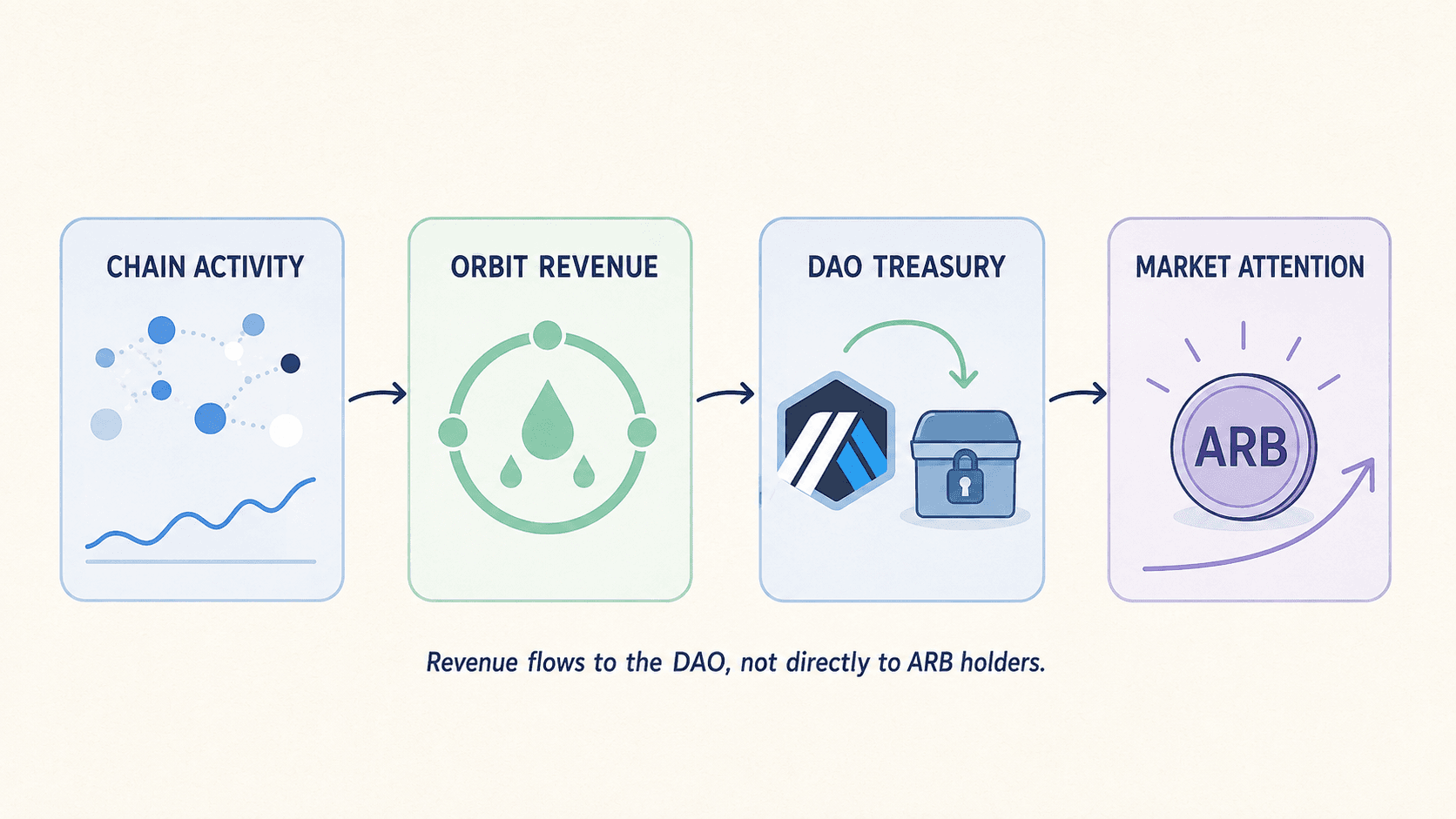
Unlike many altcoin spikes that trace back to nothing more than social media hype, this move has a fairly identifiable catalyst: Robinhood Chain. Robinhood's Ethereum layer-2 network, built on Arbitrum's Orbit framework and launched July 1, 2026, saw a sudden surge in on-chain activity in late August and early September. Daily revenue on Robinhood Chain climbed to roughly $1.9 million in a single 24-hour period — a dramatic jump from its average of around $100,000 per day — and trading volume across the chain reached nearly $7 billion for the week, an increase of close to 90%.
Because Arbitrum takes a percentage-based cut of activity generated on Orbit chains like Robinhood Chain, that spike in usage translated directly into higher protocol revenue for Arbitrum itself, with tens of thousands of dollars flowing into the Arbitrum DAO treasury in a single day. As ARK Invest analyst Lorenzo Valente noted, this revenue-sharing structure means Arbitrum's take scales up meaningfully on high-activity days in a way that a flat, fee-based model would not.
Markets responded quickly. ARB's daily trading volume jumped roughly eightfold, order books thickened noticeably around the new price level, and futures volume on Arbitrum contracts spiked by more than 700% alongside a 60%+ increase in open interest. Arbitrum also pulled in more bridged assets than any competing network over the same 24-hour window, with total value locked climbing by roughly $170 million over a two-week stretch.
Notably, much of the fee activity driving the headline numbers came from trading bots and a token launchpad operating on Robinhood Chain — not from the tokenized equities trading that Robinhood originally built the chain to support. That distinction matters, and we'll come back to it in the risks section below.
ARB's Core Utility: What Is the Token Actually For?
Before deciding whether ARB deserves a spot in a portfolio, it's worth being clear-eyed about what the token does and doesn't do. Arbitrum is one of the largest optimistic rollup networks built on top of Ethereum, offering faster and cheaper transactions while inheriting security from Ethereum's base layer. The ecosystem is split into Arbitrum One, aimed at DeFi and applications that need maximum security, and Arbitrum Nova, designed for higher-throughput, lower-cost use cases like gaming and social applications.
ARB itself functions primarily as a governance token. Holders can vote on proposals related to the Arbitrum DAO treasury, protocol upgrades, and how ecosystem funds get allocated — including grants that support the very kind of infrastructure that Robinhood Chain represents. This is an important nuance: unlike many layer-1 tokens, ARB is not required to pay gas fees on Arbitrum One (those are typically paid in ETH), so its value proposition rests more on governance rights and its connection to the broader revenue-generating Arbitrum ecosystem than on direct network-fee utility.
That said, the Arbitrum Expansion Program has increasingly tied ARB's fortunes to real economic activity. A portion of net revenue generated by Orbit chains — including Robinhood Chain — flows back into the Arbitrum DAO treasury, which the token's governance rights ultimately oversee. This is part of why the Robinhood Chain revenue spike moved ARB's price so directly: for the first time in a while, growth on an Arbitrum-based chain was visibly showing up in dollar terms that traders could point to.
Supply Dynamics: How Diluted Is ARB, and What's Still Coming?
Token supply is where a lot of the real risk in this trade lives, and it's worth understanding in some detail.
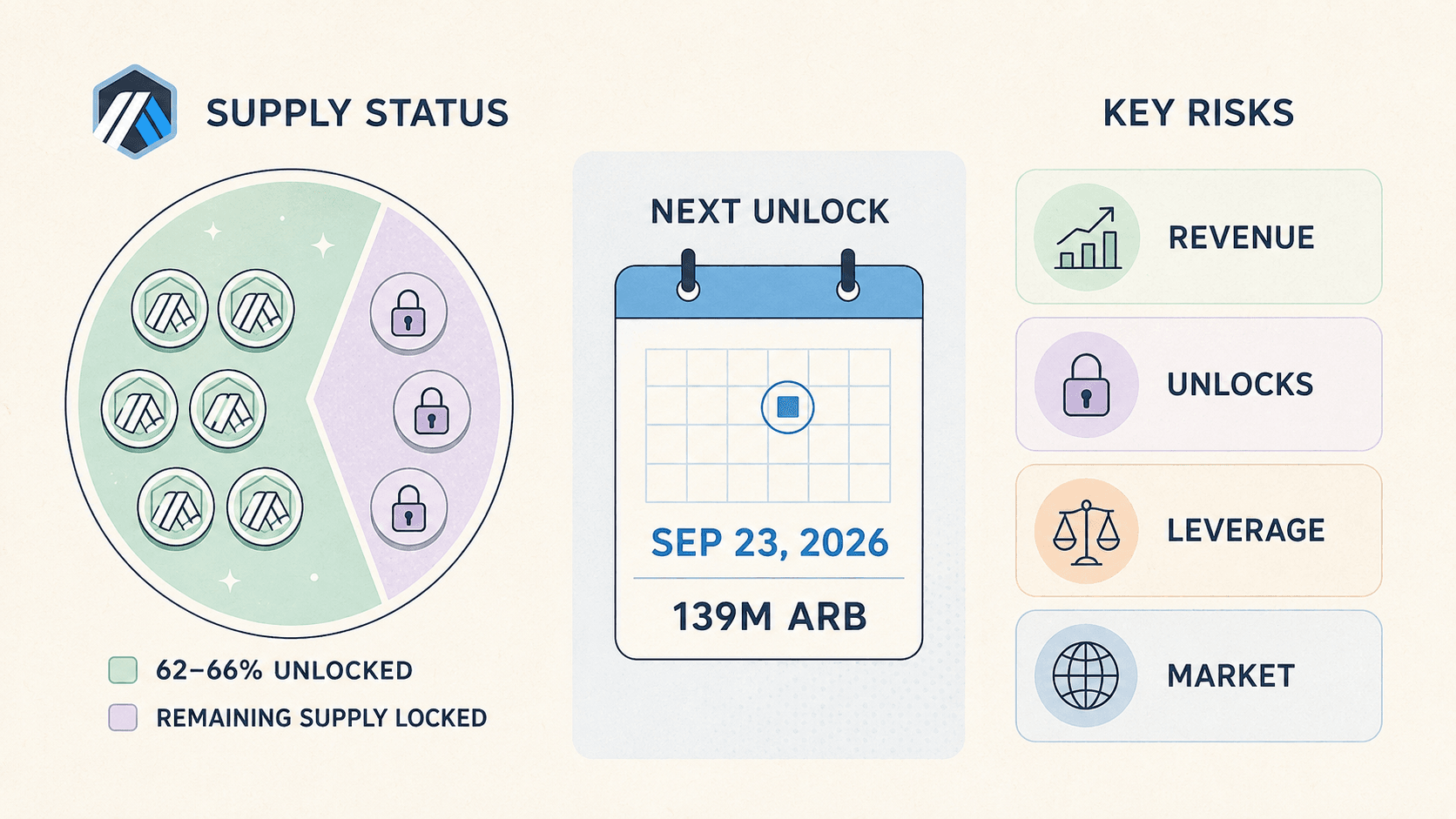
ARB has a total supply cap of 10 billion tokens. As of recent tracking data, roughly 62–66% of that total supply has been unlocked and is in circulation, putting circulating supply somewhere in the 6.2–6.6 billion token range depending on the exact date measured. The remaining allocation is distributed across a handful of categories:
- Arbitrum DAO Treasury: approximately 42.8% of total supply — the largest single bucket, controlled by DAO governance
- Team, Future Team & Advisors: approximately 26.9%
- Investors: approximately 17.5%
- Individual Wallets (Airdrop): approximately 11.6%
- DAOs in the Arbitrum Ecosystem: approximately 1.1%
Most of these allocations vest through a cliff mechanism, meaning tokens sit fully locked for a set period and then release in scheduled tranches rather than dripping out continuously. Team, investor, and contributor tokens began unlocking on a four-year vesting schedule starting in March 2024, with monthly releases continuing on a set cadence — a structure that will keep adding meaningfully to circulating supply through 2027, when the full unlock schedule is expected to complete.
The next scheduled unlock lands on September 23, 2026, and it's a sizable one: approximately 139 million ARB tokens, worth roughly $15–16 million at recent prices, split primarily between team/insider allocations (around 53.8%) and private investors (around 35%) — the two categories most commonly associated with generating sell pressure, since insiders and early backers are typically the participants most likely to take profits rather than hold long term. That unlock alone represents somewhere around 1.4% of total supply hitting the market in a single tranche.
Historically, ARB's price has shown relatively muted volatility in the seven days following past unlock events, which is a reassuring data point. But it's worth remembering that context matters: an unlock landing during a period of strong bullish momentum and thick order-book liquidity tends to be absorbed more easily than one landing during a quiet or bearish stretch. Given that ARB just experienced a sharp, high-volume rally, the September 23 unlock will be a genuine test of whether the current buying interest can absorb fresh supply without giving back recent gains.
-- Price
Is ARB Worth Buying Right Now? Weighing the Case
The bull case rests on a few real, verifiable developments. Robinhood Chain represents a genuine new source of on-chain revenue for the Arbitrum ecosystem, and the revenue-sharing mechanism means Arbitrum benefits directly and proportionally as that activity grows — unlike Ethereum's more fixed data-posting fee structure. Bridge inflows and total value locked have both risen meaningfully in recent weeks, suggesting capital is genuinely rotating into the Arbitrum ecosystem rather than just speculating on the token in isolation. The breakout also came with a substantial increase in order book depth on both sides of the market, which is generally a healthier signal than a thin, low-liquidity pump.
The bear case is just as concrete. A meaningful share of the fee activity behind the revenue spike came from trading bots and a token launchpad rather than the tokenized equities trading Robinhood Chain was originally designed to host — raising a fair question about whether this activity is sustainable or a temporary burst of speculative trading that could fade as quickly as it appeared. ARB's market capitalization moved by a larger dollar amount than the actual revenue generated, which some analysts have flagged as a sign that the market may be pricing in future growth that hasn't been proven out yet. Layered on top of that is a large scheduled unlock in late September weighted heavily toward team and investor wallets — precisely the kind of unlock event that historically carries the highest risk of profit-taking. And derivatives markets have grown extremely active alongside the price move, with futures volume and open interest both spiking sharply, which tends to increase volatility in both directions rather than reduce it.
Put simply: ARB's rally has real substance behind it, but it's also arrived at a moment of elevated leverage, an unresolved question about the durability of the revenue driving it, and a significant supply unlock on the immediate horizon. That combination doesn't necessarily mean the rally is over, but it does mean the risk profile of buying after a 30% move looks meaningfully different than it would have a month ago at lower prices and with less leveraged positioning in the market.
ARB Investment Risks Worth Understanding Before Buying
Anyone weighing a position in ARB should be clear-eyed about the following risk factors:
- Revenue concentration and sustainability. A large share of the recent fee spike came from bot trading and launchpad activity rather than the core use case Robinhood Chain was built around. If that activity normalizes, the revenue growth that justified part of the rally could fade.
- Scheduled token unlocks. With roughly a third of total supply still locked and monthly cliff unlocks continuing through 2027, ARB faces ongoing dilution pressure. The September 23, 2026 unlock alone adds meaningful new supply from wallets historically prone to selling.
- Elevated leverage and derivatives activity. A more than sevenfold increase in futures volume and a sharp rise in open interest mean the current price is being supported by leveraged positioning as much as spot demand, which can amplify downside moves if sentiment shifts.
- Dependence on a single new growth driver. Much of the recent bullish narrative is tied specifically to Robinhood Chain. A token whose price action is closely linked to one external partner's activity carries concentration risk that a more diversified ecosystem might not.
- Broader crypto market conditions. Like virtually all altcoins, ARB remains highly correlated to overall crypto market sentiment and Ethereum's own price action, meaning macro shifts in risk appetite can override project-specific fundamentals.
Frequently Asked Questions About Arbitrum (ARB)
1. Is ARB worth buying after this rally?
There's no universal answer — it depends on your time horizon and risk tolerance. The rally is backed by a real increase in Arbitrum ecosystem revenue via Robinhood Chain, which is a more substantive catalyst than pure speculation. However, elevated leverage, a large token unlock scheduled for September 23, 2026, and questions about whether the recent fee activity is sustainable all argue for caution rather than chasing the move at its highs.
2. Should I buy Arbitrum now, or wait for a pullback?
Many analysts watching the breakout have pointed to the $0.091–$0.092 zone as a key support level to watch; holding above that range could signal the rally has legs toward $0.14–$0.15, while a failure to hold it could open the door to a deeper retracement. Given the proximity of the September 23 unlock, some investors may prefer to wait and see how the market absorbs that supply event before adding a full position.
3. What are the biggest ARB investment risks right now?
The most immediate risks are the scheduled September 23, 2026 unlock of roughly 139 million tokens (weighted toward team and investor wallets), heavy reliance on Robinhood Chain's still-unproven revenue durability, and sharply elevated futures leverage that can accelerate moves in either direction.
4. What gives ARB its value beyond speculation?
ARB is primarily a governance token for the Arbitrum DAO, giving holders a say over treasury allocation and protocol decisions. Its value is increasingly tied to the broader Arbitrum ecosystem's economic activity, since a share of revenue from Orbit chains like Robinhood Chain flows back into the DAO treasury that ARB governs.
5. How much of ARB's total supply is still locked?
As of the most recent data, roughly 62–66% of ARB's 10 billion total supply has been unlocked, leaving a meaningful portion — including large team, advisor, and investor allocations — still to be released on a vesting schedule that extends into 2027.
6. Does Arbitrum's token unlock always cause the price to drop?
Not necessarily. Historical data shows ARB has generally experienced relatively low volatility in the seven days following past unlocks. But outcomes vary with market conditions, and unlocks weighted toward team and investor wallets — like the upcoming September 2026 release — are generally considered higher-risk than unlocks going to a DAO treasury or ecosystem fund.
This content is provided for general informational purposes only and doesn't constitute financial, investment, legal, or tax advice. Any events, rewards, online promotions, or related information mentioned herein should not be considered a recommendation, solicitation, or invitation to purchase, sell, trade, or otherwise deal in any crypto assets. Crypto assets are highly volatile and may result in loss. The availability of WEEX services, products, and related events may vary by region. You are responsible for ensuring that your participation is in accordance with applicable local laws and regulations.
You may also like
How to Install and Set Up MetaMask (2026 Updated Guide)

Can You Trade U.S. Stocks With 5 USDT? Here's the Real Math
SpaceX Stock Price Holds Near $141: Why Isn't a $100 Billion Spaceport Plan Moving It?
Marvell Stock (MRVL) Beat Earnings and Raised Guidance: Why Did It Fall Anyway?

Where Is XST Actually Trading Now? A Look at Volume Distribution After the Crash
NVDA Stock Jumps 7% After Earnings: Is $250 Next?
Why Is Raini Studios Token (RST) Up Today Despite Low Trading Volume?
Before You Buy CyberLeek: You Should Know CYBERLEEK Token Risks First
Is CyberLeek (CYBERLEEK) Safe? Price Crash and Key Token Risks Explained
CyberLeek Price Prediction 2026: Can CYBERLEEK Recover After the Crash?

Why Is CyberLeek Price Falling Today? CYBERLEEK Crash Explained
SEC Sends Crypto Custody Rule to White House: What the Review Means for Investment Advisers
NVDA Earnings Call Recap: Revenue Guidance, AI Demand and Key Takeaways
Hamster Kombat Is Down 97% From Its Peak: What Happened to Crypto's Biggest Web3 Onboarding Experiment?
Nvidia Earnings Report Today: Did NVDA Beat Revenue and EPS Estimates?
Did Nvidia Beat Earnings? NVDA Q2 Results and Stock Reaction Explained

How to Buy USDT with Easypaisa Using PKR in 2026
Easypaisa Crypto Guide: How to Use the Mobile Wallet for P2P Trading in Pakistan
How to Log In to MetaMask: Unlock, Troubleshooting and Recovery (2026)
WEEX Mini App Launch Rewards: Trial Funds, BTC Airdrops, and an iPhone 17 Pro Giveaway Explained
How to Buy USDT with JazzCash in Pakistan Safely in 2026
JazzCash Crypto Guide: How PKR-to-USDT P2P Payments Work in Pakistan
H/USDT After the Unlock: What Humanity Protocol’s New Supply Means for Traders
Why Is DGrid AI (DGAI) Trending After Its Exchange Debut?
XSolut Coin Extends Its Decline to 7 Straight Days: What Continued Selling Pressure Actually Signals
MORTY After Viral Meme Rally: Overvalued or Growth Story?
SPCX Stock Keeps Swinging Around Its $135 IPO Price : What the Lockup Schedule Still Ahead Actually Means
What Is TermMax (TMX)? Inside the New Fixed-Rate DeFi Token Launching Today
What Is XST Coin? Why There Are Multiple Tokens Using the XSolut Name on Coinbase
What Is IMX Crypto? How Immutable's Layer 2 Became the Largest Web3 Gaming Blockchain
How to Install and Set Up MetaMask (2026 Updated Guide)
Can You Trade U.S. Stocks With 5 USDT? Here's the Real Math
SpaceX Stock Price Holds Near $141: Why Isn't a $100 Billion Spaceport Plan Moving It?
Marvell Stock (MRVL) Beat Earnings and Raised Guidance: Why Did It Fall Anyway?
Where Is XST Actually Trading Now? A Look at Volume Distribution After the Crash
NVDA Stock Jumps 7% After Earnings: Is $250 Next?


