
KSTR ETF Explained: Inside China's STAR 50 Chip Index Bet

 Prefer us on Google


KSTR, the KraneShares China Technology & Semiconductor STAR 50 Index ETF, is the only US-listed fund tracking the SSE STAR Market 50 Index — the 50 largest companies on Shanghai's science-and-technology board, China's answer to the Nasdaq and the primary listing venue for its domestic chip champions. That singularity is the reason to look at it and also the reason to look carefully: a fund with no direct peer offers concentrated exposure with no easy substitute if the concentration turns against you. As of 27 August 2026, KSTR traded around $24.51 after the STAR 50 fell from an all-time high of 2,207.86 on 30 June to 1,667.52 by 19 August — a roughly 24% index drawdown in under two months. Here is what sits inside, how the exposure is built, and what the 2026 round trip reveals about the risk profile.
What the STAR 50 index actually holds
The index selects the 50 largest companies on the Shanghai Stock Exchange's Science and Technology Innovation Board by market capitalisation and liquidity. That sounds diversified. It is not.
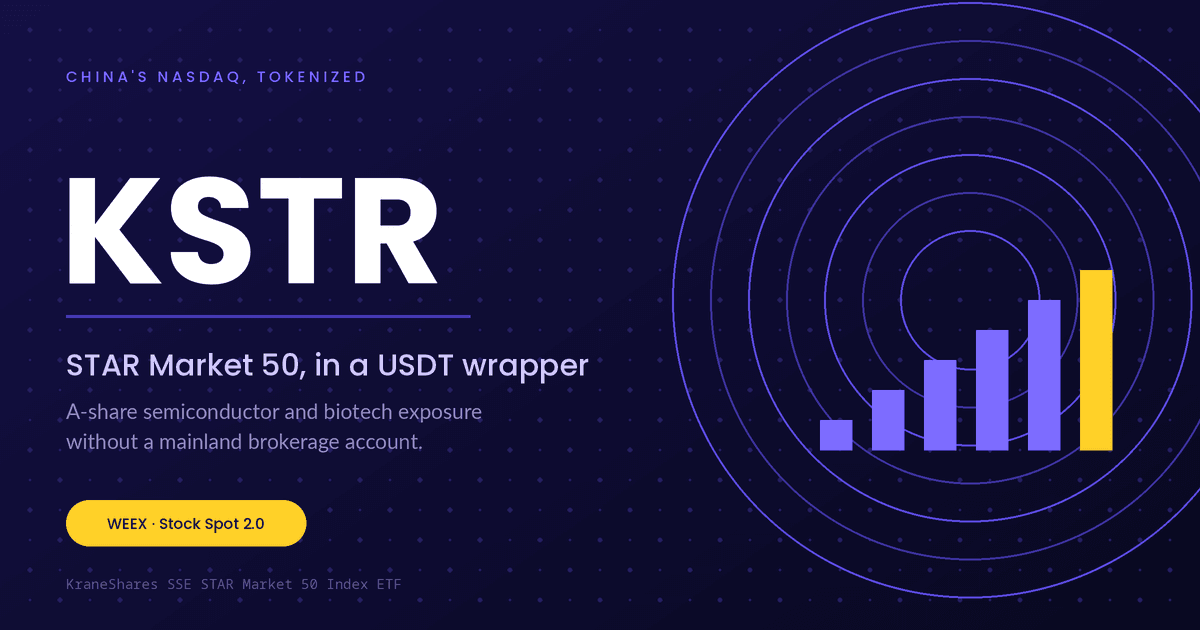
The STAR Market was created as a listing venue specifically for domestic hard-tech and semiconductor companies, so the index is a sector bet dressed as a broad-market product. SMIC — China's largest foundry — has carried a weighting above 10.5% of the index as a top holding. A single position at that size means one company's capex cycle, yield rates and export-control exposure drives a meaningful share of fund performance.
The practical read: KSTR is best understood as a leveraged expression of China's semiconductor self-sufficiency policy, not as a diversified China tech allocation. If that is the exposure you want, the concentration is a feature. If you thought you were buying broad Chinese innovation, you are underestimating the single-sector risk.
Fund mechanics worth knowing before you buy
The structural details determine what you actually get:
- Launch date: 26 January 2021, on NYSE Arca.
- Expense ratio: 0.89% gross, 0.65% net after a fee waiver. Confirm the waiver's expiry before assuming the net figure persists.
- Underlying market: Shanghai-listed A-shares, accessed through China's qualified-investor channels rather than freely tradable offshore lines.
- Uniqueness: No other US-listed ETF tracks this index, so there is no substitute fund to rotate into if you want the exposure but dislike this wrapper.
The expense ratio matters more here than on a mainstream index fund. A 0.65% net drag is defensible for hard-to-access exposure; it is expensive if held passively for years through a sideways market.
What the 2026 round trip actually showed
The first half of 2026 was extraordinary for the STAR Market. Across the board, 309 STAR-listed stocks gained and 290 fell, with the top decile of performers producing gains as large as 766%. The drivers were specific and identifiable: AI computing demand, overseas supply disruption pushing buyers toward domestic suppliers, and genuinely tight supply-demand conditions in niche memory segments.
Then the index gave back roughly a quarter of its value between 30 June and 19 August.
That sequence is the single most useful thing a prospective KSTR buyer can study, because it demonstrates the fund's behaviour rather than its brochure. A policy-driven, sector-concentrated, retail-heavy A-share index does not correct gently. The same conditions that produced 766% single-name gains — narrow supply narratives, momentum flows, limited institutional ballast — produce fast unwinds when the narrative pauses.
The more important point for position sizing: this is not equivalent volatility to a US semiconductor ETF. Mainland A-share sector indices routinely deliver moves that would be tail events in a developed market, and the STAR Market's own daily price limits and liquidity structure change how those moves propagate.
-- Price
The risks that are specific to this exposure
Four sit above the rest.
Concentration. With SMIC alone above 10.5%, and semiconductors dominating the top holdings, company-specific news is index news. A yield problem or an equipment-access issue at one foundry moves the whole fund.
Policy dependence. The STAR Market exists because of state industrial policy. That policy is currently a tailwind — the Shanghai Stock Exchange has actively promoted STAR semiconductor firms building a "reliable and controllable" domestic supply chain. Policy tailwinds can reverse, and the same centralisation that accelerates the sector can redirect it.
Export controls and geopolitics. Restrictions on advanced equipment and design tools affect the index's largest constituents directly. This is not a background macro risk; it is a specific, recurring catalyst.
Access-layer risk. Onshore A-share exposure through a US-listed wrapper depends on quota channels and cross-border settlement continuing to function. This has been reliable, but it is a dependency that a domestic ETF does not carry.
Trading KSTR on WEEX spot
WEEX lists KSTR/USDT on its Stock Spot 2.0 order book, the tokenized-equities line covering US-listed ETFs, single stocks, pre-IPO names and commodity trackers in USDT-quoted pairs. For a trader holding stablecoins, this reaches China semiconductor exposure without a US brokerage account, and without the mainland-access constraints that normally gate A-share products.
Steps:
- Open the WEEX app or website and go to spot trading.
- Select the Stocks tab.
- Search KSTR and open the pair.
- Place a limit buy or sell order.
The timing mismatch on this pair is unusually wide and deserves explicit attention. The chain runs Shanghai A-shares → NYSE Arca-listed ETF → tokenized pair. Shanghai and New York barely overlap, and the token trades continuously through both closures. During most hours, the quoted price reflects market-maker estimation across two shut markets rather than live NAV, which widens spreads and stacks gap risk at each reopen. A trader entering ahead of a Chinese policy announcement should assume the first tradable price after the news is not the price they modelled.
The pair supports up to 25x leverage on WEEX. Given the index has already delivered a 24% drawdown in seven weeks during 2026, high leverage on this exposure has a short expected survival time — spot sizing is the sensible default. Fee tiers are set out in the WEEX fee schedule, and the ongoing Stock Spot 2.0 campaign provides first-trade protection and a shared $100,000 reward pool for stock spot activity; its volume-task pair list is US-name weighted, so confirm the current terms on the event page.
Market view
The investable question is not whether China's domestic chip sector grows — the policy commitment and the AI demand pull both point the same way. It is whether the entry point compensates for the concentration. Buying KSTR near an index all-time high, as the 30 June 2026 level proved, means paying for the narrative at its most consensual. The August level offers a materially different risk-reward on identical fundamentals. For an exposure this concentrated and this policy-dependent, entry discipline does more work than thesis quality.
FAQ
1. What does KSTR track?
The SSE STAR Market 50 Index — the 50 largest and most liquid companies on the Shanghai Stock Exchange's Science and Technology Innovation Board, weighted toward domestic semiconductor and hard-tech firms.
2. How concentrated is the fund?
Substantially. SMIC alone has carried a weighting above 10.5%, and semiconductors dominate the top holdings. Company-specific developments at a single foundry can move the entire index.
3. What does KSTR cost to hold?
The expense ratio is 0.89% gross and 0.65% net after a fee waiver. The waiver is not permanent, so the net figure should be re-checked rather than assumed.
4. How volatile is the STAR 50?
Very. The index reached an all-time high of 2,207.86 on 30 June 2026 and fell to 1,667.52 by 19 August 2026, a roughly 24% decline in under two months, after a first half in which top constituents gained as much as 766%.
5. Are there alternative US-listed ETFs on the same index?
No. KSTR is the only US-listed ETF tracking the SSE STAR Market 50, which means there is no direct substitute wrapper for this specific exposure.
Risk Warning
KSTR provides concentrated exposure to Chinese onshore semiconductor and hard-tech equities and carries risks well above those of a diversified equity fund. A single holding has exceeded 10.5% of the index, so company-specific events can drive fund-level losses. The exposure depends on Chinese industrial policy continuing in its current direction and on export-control conditions affecting the largest constituents — both are active, changeable variables rather than background risks. The STAR 50 fell roughly 24% between 30 June and 19 August 2026, illustrating how quickly momentum in this market reverses. Because the tokenized pair trades 24/7 while both the Shanghai and US markets are closed for most hours, pricing is estimated during those windows, spreads widen, and gap risk concentrates at each reopen. Leverage on an exposure with this drawdown profile substantially raises liquidation risk. Digital assets and tokenized products are volatile and may result in partial or total loss of capital.
This content is provided for general informational purposes only and doesn't constitute financial, investment, legal, or tax advice. Any events, rewards, online promotions, or related information mentioned herein should not be considered a recommendation, solicitation, or invitation to purchase, sell, trade, or otherwise deal in any crypto assets. Crypto assets are highly volatile and may result in loss. The availability of WEEX services, products, and related events may vary by region. You are responsible for ensuring that your participation is in accordance with applicable local laws and regulations.
You may also like
BISCOTTI Crypto: Robot Dog Token Behind Emblem Vault's Debut
CRMON After Salesforce's 23% Post-Earnings Surge: The Catch
CYBERLINK or CYBERLEEK? Check the Ticker and Chain Before Trading
Is CyberLeek (CYBERLEEK) Safe? Price Crash and Key Token Risks Explained
No Official XST Announcement Explains the X2O Rebrand: What's Actually Confirmed

Why USDT Still Dominates Crypto Buying in Pakistan Today
How to Log In to MetaMask: Unlock, Troubleshooting and Recovery (2026)
Bybit Japan Service Termination: The Complete Timeline and What Happens on July 22, 2026

Nvidia Holds a $21 Billion Stake in SpaceX: What That Position Actually Tells Investors About Both Stocks
JazzCash P2P Trading: Merchant Vetting, Payment Limits, and the Hidden Account Freeze Risk
Who Gets the Next HUMA Tokens? Investors, Team Allocations and the PayFi Unlock Risk
PDD Q2 2026 Earnings Miss: Is the Stock Undervalued Now?
Best Futures Exchange in Pakistan for 2026? What Leverage, Liquidity, and Liquidation Risk Actually Require
Bitcoin Hits $70K: How Trump’s CLARITY Act Could Impact Crypto Markets
WEEX API Guide: From API Key to Your First Signed Order
XST Coin and Stargate: What XSolut's AI Infrastructure Narrative Has to Do With the $500 Billion OpenAI Project
SK Hynix (SKHY) Announces Record $28.6 Billion Buyback: 40 Trillion Won in Shares to Be Cancelled, Shareholder Return Target Raised Above 50%
QQQB and the Fed: What the FOMC Minutes Mean for Nasdaq-100

ETH to USDT: What the Converter Rate Leaves Out
What Is a Crypto Exchange API and Which Permissions to Enable
What Is Espresso (ESP)? The Rollup Confirmation Layer, Tokenomics and the 2027 Unlock
The XSolut (XST) Contract Address: How to Identify the Real XST Token on Solana 2026
Meta Stock Falls as 29 States Begin Federal Child Safety Trial: What the "Big Tobacco Moment" Warning Actually Means

Adobe Stock Jumps After BlackRock Raises Stake to Over 10%: What an $8.4 Billion Bet Actually Signals
Why Does XSolut (XST) Show Different Prices on CoinGecko, Phantom, and Solana DEXs? 2026 Guide
Nvidia Discloses a $21 Billion Stake in SpaceX: What the World's Largest AI Chipmaker Owning SPCX Actually Signals
How to Buy Niulai Coin: Where to Trade NIULAI and What to Check Before Buying
XST Coin vs Akash Network: How Two AI Infrastructure Tokens Compare
Tencent Stock (0700): Where the Shares Actually Trade, and What Each Venue Owes You
PROM on 12 August 2026: What Upbit Added and What the Price Did
BISCOTTI Crypto: Robot Dog Token Behind Emblem Vault's Debut
CRMON After Salesforce's 23% Post-Earnings Surge: The Catch
CYBERLINK or CYBERLEEK? Check the Ticker and Chain Before Trading
Is CyberLeek (CYBERLEEK) Safe? Price Crash and Key Token Risks Explained
No Official XST Announcement Explains the X2O Rebrand: What's Actually Confirmed
Why USDT Still Dominates Crypto Buying in Pakistan Today
Contents
Popular coins
Latest articles


