
When Can You Trade U.S. Stock Tokens? Trading Hours Explained

 Prefer us on Google


U.S. stock tokens do not trade around the clock, and that single fact catches out more new traders than any other feature of the product. On WEEX, stock tokens follow the U.S. equity calendar: a pre-market session, the regular session, an after-hours session, then a hard stop. Weekends and U.S. market holidays are closed — you cannot open, close, or fill an order. This guide sets out the exact trading hours in ET, UTC and UTC+8, explains what changes between sessions, and covers the weekend gap risk that comes with holding a tokenized stock rather than a coin.
U.S. stock token trading hours on WEEX: The full schedule
Stock tokens track the price of real U.S.-listed equities and ETFs, so their trading windows are inherited from Nasdaq and the NYSE rather than from crypto. According to WEEX's published stock token trading rules, the schedule breaks into three tradable sessions plus a closed period.
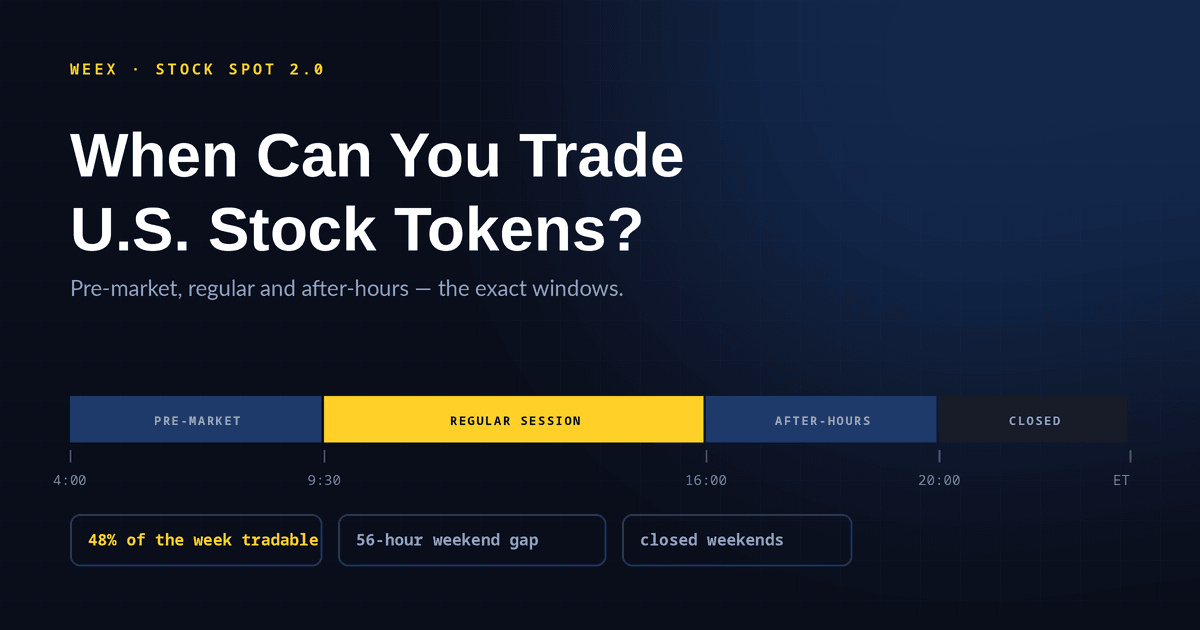
Pre-market — 4:00 AM to 9:30 AM ET. That is 08:00–13:30 UTC during U.S. daylight saving time, or 09:00–14:30 UTC under standard time. In UTC+8 terms: 4:00 PM–9:30 PM (DST) or 5:00 PM–10:30 PM (standard). Volume is low, spreads widen, and the order book is thin.
Regular session — 9:30 AM to 4:00 PM ET. That is 13:30–20:00 UTC (DST) or 14:30–21:00 UTC (standard); 9:30 PM–4:00 AM next day in UTC+8 (DST), or 10:30 PM–5:00 AM (standard). This is the deep-liquidity window: prices update fast, spreads are tightest, and execution tracks the underlying most closely.
After-hours — 4:00 PM to 8:00 PM ET. That is 20:00–00:00 UTC (DST) or 21:00–01:00 UTC (standard); 4:00 AM–8:00 AM next day in UTC+8 (DST), or 5:00 AM–9:00 AM (standard). Earnings usually land here. So do price gaps.
Closed — weekends and U.S. market holidays. WEEX suspends all stock token trading. Orders will not execute, and prices may stop updating or display for reference only.
Two practical notes. First, the U.S. switches between daylight saving time (second Sunday in March to the first Sunday in November) and standard time, so your local window shifts by an hour twice a year — in 2026, the clocks go back on 1 November. Second, WEEX's own product overview also refers to a night trading session alongside the pre-market and after-hours windows, and session coverage can be extended or adjusted; the in-app market status and countdown on the trading page is the authoritative source before you place an order.
Why stock tokens are not 24/7 even on a 24/7 exchange
This is where most explainers get it wrong. A lot of coverage of tokenized equities repeats the line that stock tokens "trade 24/7 unlike real shares." That is true of some venues and some products — and it is not true of WEEX stock tokens, which explicitly halt when the U.S. market is shut.
The reason is structural rather than technical. WEEX stock products are synthetic digital assets executed inside WEEX's internal trading system, supported by internal market makers or external hedging, with prices referenced from Futu and other external brokers and official market data. A market maker can only quote a two-sided price it can hedge. When the underlying share stops trading, the hedge disappears — so the quote disappears with it. Extending the session past the point where the underlying can be hedged would mean quoting a price with no way to lay off the risk, which is how venues end up with runaway spreads and unfillable orders.
The trade-off is worth stating plainly. You give up round-the-clock access, and in exchange the token stays tethered to a hedgeable reference price instead of drifting on a thin overnight order book. For a product settled in USDT with no brokerage account and no KYC requirement, that is a defensible design — but it does mean you are running a TradFi risk calendar inside a crypto account.
Do the arithmetic and the difference is stark. The tradable window runs 4:00 AM to 8:00 PM ET, a 16-hour day, five days a week — roughly 80 of the week's 168 hours, or about 48% of the time. BTC/USDT on the same exchange is tradable 100% of the time. If you are used to being able to exit any position at 3 AM on a Sunday, half your week just went dark.
The 56-hour weekend gap: The risk nobody plans for
From the Friday 8:00 PM ET close to the Monday 4:00 AM ET pre-market open is 56 continuous hours in which a stock token position cannot be reduced, hedged, or stopped out on WEEX. Add a Monday holiday and it stretches past 80.
That is the single most important operational fact in this article, and it changes how the position should be sized. In crypto, a stop-loss is a reasonable line of defence because the market is always there to fill it. In a stock token, a stop that would have triggered at 2:00 AM Saturday simply does not fire; it waits for the reopen and then executes into whatever price the market gaps to. Weekend news — an earnings pre-announcement, an export-control headline, a regulatory action, a geopolitical event — gets priced in all at once when the session resumes.
Circuit breakers create the same problem inside the session. If the underlying stock triggers a halt on its home exchange, WEEX trading in that token may be paused or restricted too: price updates slow, the book thins, and orders may not fill as expected. You can still cancel unfilled orders during a halt, which is worth remembering — cancelling is often the only action available.
Three habits worth adopting if you carry stock tokens over a close:
- Decide your Friday exposure on Friday afternoon, not Friday evening. Once 8:00 PM ET passes, the decision is made for you until Monday.
- Size the position to a weekend gap you could absorb, not to the intraday range. The relevant question is not "what does this move in a day" but "what did it do the last time it gapped on news."
- Check the U.S. market holiday calendar before long weekends. A Monday holiday turns a 56-hour closure into an 80-hour one.
-- Price
Which session should you actually trade in?
For most traders, the regular session is the correct default and the other two are for specific jobs.
The regular session gives you the narrowest spreads and the tightest tracking to the underlying, which matters more than it sounds: your effective cost on a round trip is the fee plus the spread plus slippage, and the last two both worsen sharply outside 9:30 AM–4:00 PM ET. If you are building or unwinding a position of any size, this is the window.
Pre-market is where overnight news from Asia and Europe gets absorbed, and where gap-up or gap-down positioning happens ahead of the open. It is genuinely useful for reacting to something that broke while the U.S. slept. It is a poor place to execute size, because the book is thin enough that a market order can walk several price levels.
After-hours is dominated by earnings. Most large-cap U.S. companies report after the close, and the first hour of after-hours trade is where the reaction happens. That makes it the highest-volatility, lowest-liquidity window of the day — the combination that does the most damage to market orders. Limit orders are the sane choice here, and WEEX notes that market orders may not be available for every product or session in the first place.
A useful discipline across all three: on WEEX stock tokens the minimum trade size is generally 0.0001 tokens, so fractional sizing is available. Use it. Taking a smaller clip in a thin session and adding in the regular session usually beats forcing the full size into a 5:00 AM book.
How to trade U.S. stock tokens on WEEX Stock Spot 2.0
WEEX Stock Spot 2.0 is the platform's spot stock token product: USDT-settled exposure to U.S. equities and ETFs, no external brokerage account, no separate asset conversion, and fractional sizing from 0.0001 tokens. Prices reference Futu and other external brokers and official market data. Holding a stock token does not make you a shareholder — no voting rights, no dividend entitlement, and corporate actions such as splits, reverse splits, suspensions and delistings are handled under WEEX's own rules and announcements rather than automatically mirroring the underlying.
Placing an order takes six steps:
- Open the WEEX app and tap Trade, or go to Spot Trading on the web platform.
- Select the Stocks tab.
- Search for the ticker you want — for example NVDA/USDT or TSLA/USDT.
- Choose Buy or Sell, then pick your order type. Limit gives you price control and may fill partially or not at all; market fills at the best available price and carries more slippage outside the regular session.
- Enter price and quantity, then review and confirm.
- Track the order under Open Orders, Order History, or Holdings.
Before you confirm, check the market status and session countdown on the trading page. That indicator is the difference between a working order and an order that sits unfilled until Monday.
The WEEX Stock Spot 2.0 rewards event is running alongside the product, with a $100,000 prize pool, a first-trade protection offer, and a new-user exclusive available only to accounts registered during the event period. As of 1 September 2026 the event's Task 2 eligible pairs are SNDK/USDT, SKHY/USDT, MU/USDT, SPCX/USDT, TSLA/USDT, AMD/USDT, QQQ/USDT, MSTR/USDT, NVDA/USDT and NBIS/USDT — a mix of single names, a Nasdaq-100 ETF proxy in QQQ, and thematic exposure such as SPCX. Task rewards are calculated independently and stack if you meet more than one, distributed first-come first-served while supplies last and within ten working days of the event ending. Two conditions are easy to miss: volume generated through the API does not count toward the event, and trial funds are valid for three days only.
For reference, WEEX quoted NVDA at $220.27 and TSLA at $367.42 on its stock token pages as of 1 September 2026. Those figures move with the underlying and are here to date the snapshot, not to anchor a decision.
What matters most
If you take one thing from this: the trading calendar is a position-sizing input, not a footnote. Stock tokens give you U.S. equity exposure inside a crypto account with USDT settlement and fractional sizing, which is a real convenience. What they do not give you is the crypto market's most underrated feature — the ability to get out at any hour. Trade the regular session by default, use limit orders when you stray outside it, and never carry a position through Friday's close that you would not be comfortable seeing gap on Monday morning.
FAQ
1. Can I trade U.S. stock tokens on weekends?
No. WEEX suspends stock token trading on weekends and U.S. market holidays. You cannot open positions, close positions, or have orders filled. Prices may stop updating or be shown for reference only until the market reopens.
2. What are WEEX stock token trading hours in UTC?
During U.S. daylight saving time, the full window runs 08:00 to 00:00 UTC — pre-market 08:00–13:30, regular 13:30–20:00, after-hours 20:00–00:00. Under U.S. standard time, add one hour to each: 09:00–14:30, 14:30–21:00, and 21:00–01:00 UTC.
3. Are tokenized stocks really 24/7?
Not on WEEX. Some venues offer extended or continuous tokenized-equity markets, but WEEX stock tokens follow U.S. session hours because the price is referenced to and hedged against the underlying market. Always check the specific platform's published rules rather than assuming 24/7 access.
4. What happens to my stock token position if a circuit breaker is triggered?
If the underlying market halts, trading in the corresponding token may be paused or restricted on WEEX. Expect slower price updates, a thinner order book, and orders that do not fill as expected. Cancelling unfilled orders generally remains possible, and prices can move sharply when trading resumes.
5. Do stock tokens give me shareholder rights or dividends?
No. Stock tokens track price performance only. They carry no voting rights, no dividend rights, and no other shareholder entitlements. Corporate actions such as splits and reverse splits are handled by the token issuer and WEEX under platform rules and announcements.
6. Which session has the best liquidity for stock tokens?
The regular session, 9:30 AM to 4:00 PM ET. Spreads are narrowest and price updates are fastest. Pre-market and after-hours carry lower volume, wider spreads, and higher slippage risk.
Risk Warning
Stock tokens are synthetic digital assets, not shares. Their prices are highly volatile and you may lose part or all of your capital. The specific risks in this product cluster around the trading calendar: because WEEX suspends stock token trading on weekends, U.S. holidays, and during underlying-market halts, positions cannot be exited during those periods and may gap significantly at the reopen — a 56-hour blind spot exists between Friday's 8:00 PM ET close and Monday's 4:00 AM ET pre-market open, longer around holidays. Liquidity is materially thinner in pre-market and after-hours sessions, which widens spreads and increases slippage on market orders. Holding a stock token confers no shareholder rights, no dividends, and no claim on the underlying company, and corporate actions are handled under WEEX's own rules rather than mirroring the equity market automatically. Availability may be restricted by jurisdiction, account information, or IP location. Session times, holiday schedules and product rules can change; verify the current schedule on the WEEX trading page and official announcements before placing an order, and trade only within your own risk tolerance.
This content is provided for general informational purposes only and doesn't constitute financial, investment, legal, or tax advice. Any events, rewards, online promotions, or related information mentioned herein should not be considered a recommendation, solicitation, or invitation to purchase, sell, trade, or otherwise deal in any crypto assets. Crypto assets are highly volatile and may result in loss. The availability of WEEX services, products, and related events may vary by region. You are responsible for ensuring that your participation is in accordance with applicable local laws and regulations.
You may also like

Can You Trade U.S. Stocks With 5 USDT? Here's the Real Math

PEP Stock Analysis: Why PEPon Trades Above PepsiCo Shares

"我的女友景甜" Days Later: What Happened to the Viral Meme Coin
What Is the WEEX Mini App? A Lightweight Way to Trade Inside Telegram

What Happened to Raini Studios Token? RST After the Game Shutdown
RST vs RAINI: Which Raini Studios Token Is Still Supported?

SEC Sends Crypto Custody Rule to White House: What the Review Means for Investment Advisers

SEC Crypto Custody Rules for Investment Advisers: A 2026 Guide

How to Buy USDT with Easypaisa Using PKR in 2026
Easypaisa Crypto Guide: How to Use the Mobile Wallet for P2P Trading in Pakistan
How to Choose a Crypto Exchange in Pakistan: 7 Real Checks
Is Crypto Legal in Pakistan? PVARA Rules Traders Must Know

NVIDIA (NVDA) Earnings Date: When Q2 FY2027 Reports and What to Watch
Who Gets the Next HUMA Tokens? Investors, Team Allocations and the PayFi Unlock Risk
SOXSB Explained: Why the 3x Chip Bear ETF Resets Without You
Choosing a Crypto Exchange in Pakistan Before the Sept 5 Deadline

How to Buy Crypto in Pakistan With PKR After the Bank Rule Change
Is XST a Good Investment After Falling More Than 60% From Its All-Time High? What Buying the Dip Actually Requires
XST Coin Is Down More Than 25% This Week as Bitcoin Climbs to $77,000: What the Divergence Actually Means

How to Buy USDT with JazzCash in Pakistan: P2P Trading and Safety Guide
Pakistan Crypto Exchange Comparison: Which Platform Works Best for PKR Traders in 2026
Crypto P2P Trading in Pakistan: Which Exchange Has the Best PKR Marketplace in 2026
CLARITY Act: What Happens in the Senate's September Window
XST Coin Rebounds From Its Post Peak Low: What the Recovery to a $45M Market Cap Actually Signals
ETH to USDT: What the Converter Rate Leaves Out
Telegram Airdrop Calendar: Hamster Daily Cards, Notcoin and New Mini-App Tokens
Broadcom (AVGO) Earnings Date: September 2, 2026 (Confirmed) — Japan Time and What to Watch
The XSolut (XST) Contract Address: How to Identify the Real XST Token on Solana 2026
Master Account vs Sub-Account: What the Difference Means for Crypto Broker Partners

Is OPAI.PVT OpenAI's Real Stock Symbol? What Investors Need to Know Before the IPO 2026
Can You Trade U.S. Stocks With 5 USDT? Here's the Real Math
PEP Stock Analysis: Why PEPon Trades Above PepsiCo Shares
"我的女友景甜" Days Later: What Happened to the Viral Meme Coin
What Is the WEEX Mini App? A Lightweight Way to Trade Inside Telegram
What Happened to Raini Studios Token? RST After the Game Shutdown
RST vs RAINI: Which Raini Studios Token Is Still Supported?
Contents
Popular coins
Latest articles


