
99% of Meme Coin Trades Are Doomed to Rekt, Whales Are the Real Winners





Original Title: If you are still in the memecoin trenches, pivot to Casino.
Original Author: Foxi (DeFi / AI)
Original Translation: Deep Tide TechFlow
My Meme trading account is currently down by -60%. Am I a terrible trader? Yes, indeed I am. But it's not just due to bad decisions; I would rather believe I am not worse than an average gambler. So, where exactly is the problem? Inspired by @0xngmi's data (who pointed out that the returns from playing Memecoin are even worse than a casino), I decided to delve deeper to see what the root of the issue is.
Firstly, I Admit: I Am a Terrible Meme Trader
Like many newcomers, I've been led by the market hype and emotions, chasing highs, selling lows, frequent trading leading to slippage, and even unknowingly handing money to insider traders in the market.
While this is not my first time in the cryptocurrency market, this experience made me feel like I was playing an unfair game. Worse still, the rules of this game seem to be constantly changing and always favoring those with more information.
@0xngmi calculated the comparison between the expected return (EV) of playing roulette in a casino and the expected return of Memecoin speculation (based solely on transaction fees).
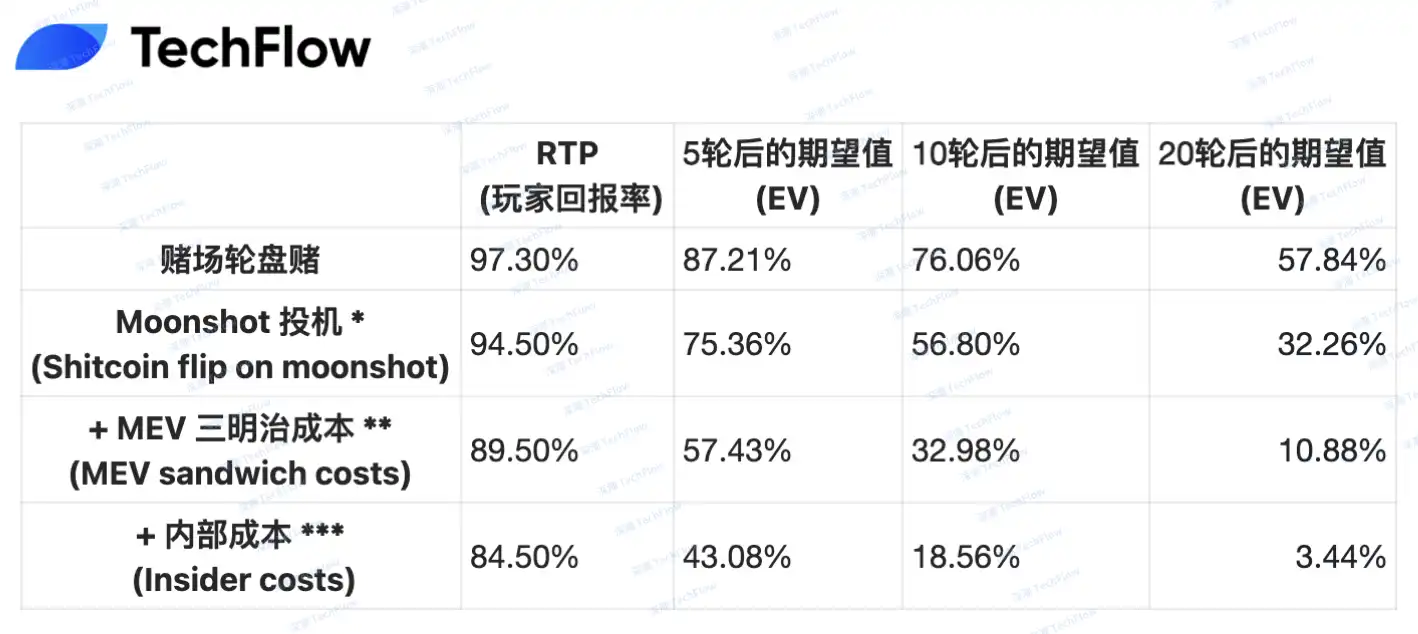
(Original image from @0xngmi, translated by Deep Tide TechFlow)
· The fee for small trades is 2.5%, while Raydium's fee is 0.25%. A speculation requires two transactions, so the fee must be multiplied by 2.
· Moonshot's default slippage is set at 5%, taking half of this as an estimate for average sandwich attacks.
· It is difficult to estimate precisely due to significant differences between tokens, assuming a 2.5% cost for each transaction.
This got me thinking: How does Meme speculation compare to actual gambling? Are their odds equally terrible? Or even worse? More importantly, are Meme traders merely casino gamblers disguised as "investors," or are there more complex, more insidious mechanisms at play behind the scenes? According to @0xngmi's analysis, putting money into a casino seems to be a wiser choice than playing with Memes.
True Odds: Memecoin vs. Casino
We need to talk about Expected Value (EV), which is a core concept in both gambling and trading. It tells us, on average, how much money you can expect to win or lose with each bet over time.
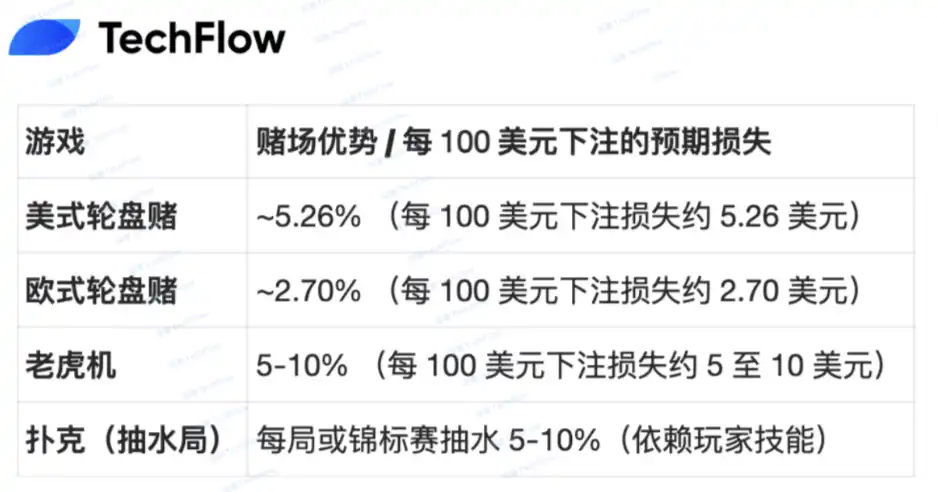
Casino games have a kind of "fair unfairness" mathematically. Over the long run, you can always predict how much you will lose. Let's take a closer look:
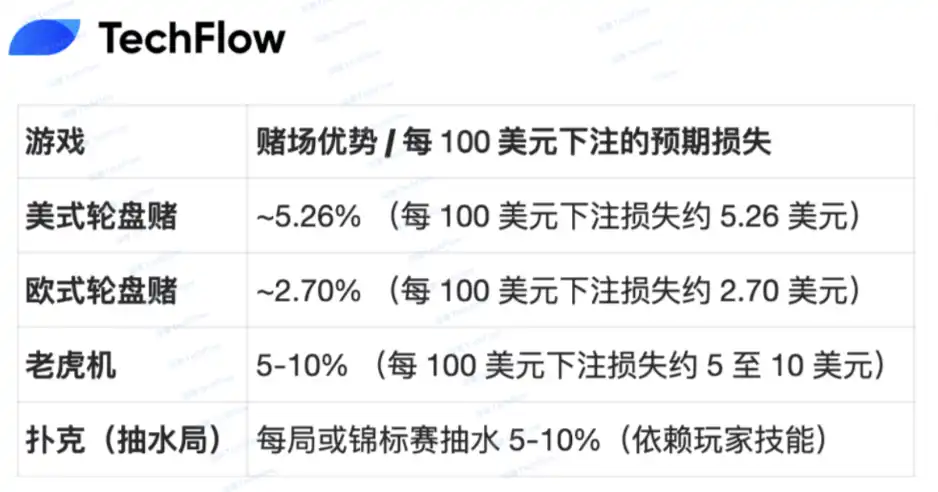
(Original image by Foxi (DeFi / AI), compiled by Deep Tide TechFlow)
In traditional gambling, the casino profits in a slow and predictable manner. Whether it's each spin of the roulette wheel or each pull of the slot machine's lever, it follows a known probability model. For example, in American roulette, if you bet on red, you have a 47.37% chance of winning and a 52.63% chance of losing. Over time, the casino always wins, but it does not cheat—it simply leverages probability to its advantage. However, to protect gamblers, some jurisdictions mandate a minimum return percentage. For instance, in Ontario, the RTP (Return to Player) of a slot machine must be at least 85%, meaning the casino's edge (i.e., house edge) is at most 15%.
Why 99% of People Lose Money in Memecoin Trading
Unlike the casino, Memecoin trading appears to be a "game of opportunity," but the issue is that you don't even know who the real players are. While the Memecoin market doesn't have a clear "House Edge," through transaction fees, slippage, insider trading, and market manipulation, your funds will still be slowly eroded. Moreover, this erosion is often insidious and challenging to quantify.
Here are the three main reasons that lead to widespread losses among Memecoin investors:
· Transaction Fee
· Slippage
· Market Manipulation
1. Transaction Fee: The Hidden "Maker's Fee"
Every transaction incurs a fee. Whether you are on a centralized exchange (CEX, such as @bitgetglobal or @MEXC_Official), a decentralized exchange (DEX, such as @RaydiumProtocol), or using a trading bot (like @gmgnai, which most people are using), these fees will gradually erode your profits.
CEX Fee: Approximately 0.1% per transaction (buying + selling = 0.2% round-trip fee)
DEX Fee: Approximately 0.3% per transaction, plus Gas fees (each transaction could cost $5-$50+)
Trading Bot Fee: Approximately 1% per transaction, plus priority fees (which could be 4 times the regular DEX fee)
Memecoin Tax: Some projects extract 5%-10% from each transaction as part of a redistribution or burn mechanism. For example, @aipool_tee charges a 10% fee on sell transactions.
These trading bots are earning substantial amounts from retail users. Although the number of people trading Memes has decreased as of now (February 17), daily revenue can still exceed $700,000.
On the surface, 0.2%-1% transaction fees may not seem high, but when you trade frequently every day, these fees quickly add up. Making 10 trades in a day could potentially consume 2%-6% of your principal, which is even more severe than losses from playing European roulette.
2. Slippage (MEV Cost)
Slippage refers to the difference between the expected price of a trade and the actual execution price due to market fluctuations. In Memecoin trading, slippage is particularly severe, especially in cases of low liquidity or high market volatility.
· Example: You try to buy a Memecoin with $100, but due to insufficient liquidity, you actually receive tokens worth $95, resulting in a 5% loss.
· When selling, a similar situation occurs. You plan to sell for $200, but slippage causes you to only receive $190.
· Total slippage loss: approximately 10% of the round-trip transaction cost.
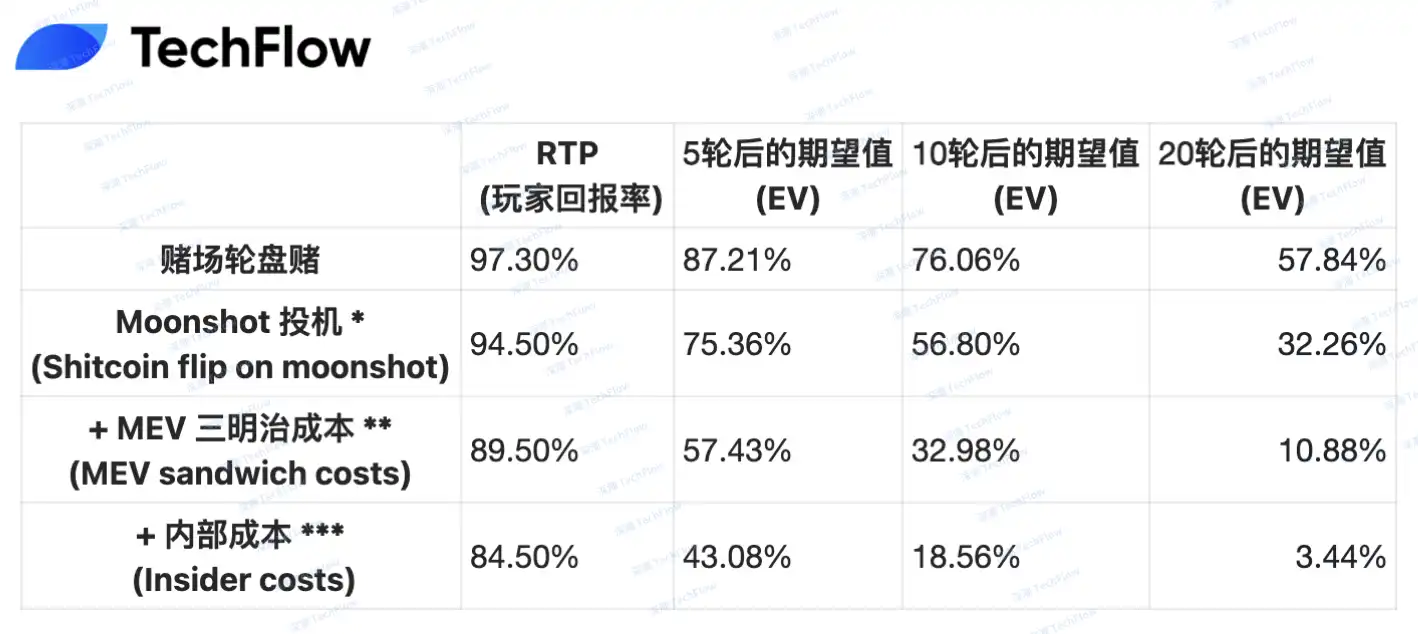
@0xngmi mentioned that about 2.5% of the transaction fee is consumed due to MEV (Sandwich Attack cost), and on the BNB Chain, this cost could be over 5%, attributed to its inferior infrastructure.
A more robust blockchain infrastructure can significantly reduce MEV costs. This is also why many believe Solana is superior to the BNB Chain (I fully agree on this). If @cz_binance wants to promote Meme culture on the BNB Chain, the primary task should be to reduce MEV costs, thereby increasing Memecoin players' expected value (EV).
However, even on Solana, a 2.5%-5% MEV cost is still more severe than losses in a casino game. If you find the house edge on a slot machine to be as high as 10%, you might be furious. But in the Memecoin market, this is not even the worst part.
3. Insider Trading and Market Manipulation
On this point, little needs to be said. Unlike a casino, which has clear rules, the Meme market is entirely skewed towards insiders. No regulation can prevent team wallets, developers, or influencers from conducting "Pump and Dump" schemes to exploit retail traders. For example, the following cases:
· $LIBRA: Took off with tokens worth over $107 million
· $MELANIA: Is it related to Meteroa?
· $CAR: Africa Rugged event
· $CUBA: Another Country's Rugged Event
· $GANG: @mrpunkdoteth Cash Out $10 Million via Fans
· $Broccoli: Manipulated by Scammers and Insiders for Profit
These are just the tip of the iceberg. It can be said that unless you are an insider like @frankdegods, you have virtually no advantage to participate in these Memecoins. In a casino, at least you know what the house edge is, while in the Memecoin market, you don't even know who the house is, but they are definitely taking your money.
Final Comparison: Memecoin Speculation vs. Gambling Expectation Value (EV)
Casino games will slowly drain your funds over time, while Memecoin speculation is much more brutal. One wrong trade could wipe out weeks of gains in an instant. The only motivation to keep participating is the occasional 100x return. However, the actual likelihood of achieving a 100x return is approximately 1/25,000, even lower than the odds of winning the lottery.
People often believe they are "special" or "skilled" (yes, I'm that self-delusional person), but ultimately, they get rekt.
What makes Memecoin not like gambling is that it gives people a sense of illusory control—a misconception that one can make money through research, timing, and skill. Indeed, some traders can profit, but they are the minority, much like professional poker players. The majority of traders, like most gamblers, will ultimately lose.
Advice to On-Chain
If you want to attract users and increase on-chain transaction volume, make sure traders' MEV costs are low enough, and try to reduce transaction fees through cooperation or fund subsidies. Casinos can operate in the long run because gamblers are willing to continue participating.
Advice to Investors
If you are engaging in Memecoin speculation, remember, the house always wins. And you will only realize who the house is when it's too late. If you find yourself unable to disengage, you may already be in a state of gambling addiction.
You may also like

Citibank releases "2030 Asset Tokenization Market Outlook": 6 major trends may create a $8.2 trillion market

The trillion-dollar valuation test: Are the three major super IPOs a celebration for tech stocks or a nightmare for the crypto market?

Morning Report | Digital Asset completes $355 million financing led by a16z Crypto; Meta completes operational separation from Manus

a16z Crypto Partner: Cash flow is the moat

Cryptocurrency market makers collectively seek change as it becomes increasingly difficult to make money

How TradeXYZ, xStocks, and Alpaca break down the SpaceX IPO into three different strategies

$75 billion in risk asset redistribution: How will SpaceX's IPO affect U.S. stocks and Bitcoin?

Why Is BlackRock Investing $5 Billion in the SpaceX IPO?
Morning News | CME Group launches Nasdaq Cryptocurrency Index futures; Asset management giant Janus Henderson strategically invests in Ethena

Bitcoin Layer 2 Network Botanix: Why Did We Choose to Dissolve?

Why did Oracle deliver the strongest financial report in history, yet its stock price fell?
When the P2P illicit funds from ten years ago turned into 60,000 bitcoins
Dialogue with OmenX Founder: Why does the prediction market need an evolution from "spot" to "derivatives"?
Galaxy in-depth report: Is Solana still worth paying attention to?
Young people in South Korea make a "final effort" in the epic bull market
The pricing controversy of Trade.xyz exposes the fatal weakness of Pre-IPO perpetual contracts

How much longer can Ethereum's last big buyer hold on?

World Cup 2026 Coming – WEEX Celebrates with $1M Prize Pool & Michael Owen Live
Citibank releases "2030 Asset Tokenization Market Outlook": 6 major trends may create a $8.2 trillion market
The trillion-dollar valuation test: Are the three major super IPOs a celebration for tech stocks or a nightmare for the crypto market?
Morning Report | Digital Asset completes $355 million financing led by a16z Crypto; Meta completes operational separation from Manus
a16z Crypto Partner: Cash flow is the moat
Cryptocurrency market makers collectively seek change as it becomes increasingly difficult to make money
How TradeXYZ, xStocks, and Alpaca break down the SpaceX IPO into three different strategies


