
A $2 Trillion Denouement: The AI-Driven Global Economic Crisis of 2028

 Prefer us on Google


Original Title: THE 2028 GLOBAL INTELLIGENCE CRISIS
Original Authors: CITRINI and ALAP SHAH, Citrini Research
Translation: Peggy, BlockBeats
Editor's Note: This past Spring Festival holiday, the development of AI has brought about a far greater impact than last year's emergence of DeepSeek during the Spring Festival, only this time the anxiety far outweighed the excitement.
On February 20, the first trading day of the Year of the Horse in the Hong Kong stock market, MiniMax, a four-year-old AI company, saw its market value briefly exceed HK$300 billion; similarly, the almost simultaneous listing of Spectrum AI also showed a strong trend. The combined market value of the two companies has surpassed HK$620 billion, approaching or even surpassing old Internet giants such as Kuaishou, JD.com, and Ctrip.
This anxiety is not unique to China. The emotions surrounding AI in China and the U.S. are almost mirror images of each other. On one side, the 2026 Spring Festival Gala has become a stage for the concentrated display of AI and robots, with the technological narrative entering the public's life in a high-density, high-paced manner; on the other side, the U.S. stock market has been experiencing repeated shocks, with sectors such as software, SaaS, and catering seeing deeper declines, and the market has begun to reexamine the second-order effects of AI, discussing not only which company will win but how it will change employment, consumption, credit, and the macro cycle.
The public's aversion to tech overload and the financial elites' concern about structural risks are merging. In such a emotional background, this article from Citrini Research emerged and quickly became a tangible expression of anxiety. This article sets up a hypothetical scenario: in June 2028, the disruptive impact of artificial intelligence leads to a large number of white-collar workers losing their jobs, consumer spending decreasing, software-supported loans defaulting, and the economy contracting.
So far, this article has garnered over 23 million reads on Twitter, making it the most popular recent public event, and even seen as the catalyst for the sharp volatility in the U.S. tech sector on Monday (February 23), with the Dow Jones Index experiencing its biggest drop of over 800 points. The market breadth was dire, with only 27% of stocks rising. Software, payment, and delivery stocks suffered heavy losses, with DoorDash (DASH), American Express (AXP), KKR (KKR), and Blackstone (BX) all falling by over 8% as mentioned in the article.
This article may not necessarily explain the market's decline, but it certainly amplified the existing unease in the market. In a phase of AI disruption, geopolitical tensions, and macro uncertainty, a narrative dark enough and internally consistent enough is sufficient to provide an outlet for fragile emotions.
The authors of this article are Citrini Research and Alap Shah. Citrini Research was founded by James van Geelen; Alap Shah, an economics graduate from Harvard University, previously worked as an analyst at Citadel LLC and has been the CEO of Littlebird since September 2024.
The following is the original text:
If our long-term bullish view on AI always holds, could that instead be bad news for the overall economy?
The following content is not a prediction but a scenario exploration. It is neither an intentional rendering of a bearish narrative to sow panic nor a doomsday fantasy about AI. The sole purpose of this article is to attempt a systematic modeling of a path that has not been extensively discussed before. This question was initially raised by our friend Alap Shah, and we collectively explored this idea in our discussions. While we authored this piece, he has written two other pieces on this topic, which can be referred to separately.
It is hoped that this article will help readers prepare more fully for potential left-tail risks before AI gradually changes the way the economy operates, possibly making the structure itself increasingly counterintuitive.
Below is a macro memorandum written by Citrini Research in June 2028, attempting to trace back and review the formation process of the global intelligence crisis and its cascading impacts.

Macro Memorandum: Economic Consequences of Intelligence Oversupply
CitriniResearch
(February 22, 2026) June 30, 2028
This morning's announced unemployment rate is 10.2%, 0.3 percentage points higher than the market's expectations. As a result, the market is down 2%, with the S&P 500 index experiencing a cumulative drawdown of 38% from its peak in October 2026.
Traders are almost non-reactive to this; just six months ago, such a level of unemployment would have been enough to trigger circuit breakers.
In just two years, the economy has transitioned from being "risk-manageable, with shocks contained to individual sectors" to a system that no longer aligns with the growth experiences of any of us. This quarter's macro memorandum attempts to reconstruct this evolutionary process and conduct a post-mortem systemic dissection of the economic structure before the crisis truly hit.
Once upon a time, market sentiment was still bullish. In October 2026, the S&P 500 nearly reached 8000 points, and the Nasdaq index crossed 30,000 points. The first round of layoffs around the replacement of human labor began in early 2026, and it did deliver the expected outcomes for the capital markets: increased profit margins, surpassing performance, and stock price appreciation.
Enterprises' record profits were swiftly reinvested in AI computational power expansion.
On the surface, macro data still looked bright, with nominal GDP consistently showing double-digit annualized growth, significant productivity gains, and a new high in actual output per hour since the 1950s. All of this came from AI agents that don't rest, take sick days, or require welfare benefits.
The wealth of computational power owners rapidly ballooned, while actual wage growth notably weakened. Despite officials emphasizing record productivity, an increasing number of white-collar jobs were being replaced by machines, forcing laborers into lower-paying positions.
As signs of consumer slackness began to emerge, the commentary space introduced a new concept: "Phantom GDP" – output that appears in statistical reports but doesn't actually enter the real economic cycle.
In nearly all tech metrics, AI was exceeding expectations; the capital markets' narrative almost entirely revolved around AI. The only deviation was that the economic structure itself was not synchronously benefiting.
In hindsight, this logic wasn't that complex. If a GPU cluster in North Dakota's output was deemed equivalent to the economic contribution of 10,000 white-collar workers in Midtown Manhattan, its impact was more akin to an economic pandemic rather than a cure.
The velocity of money circulation stagnated. The consumer-centric economy, which accounts for about 70% of the GDP, rapidly contracted. Perhaps we could have realized this sooner by posing a simple question: How much money does a machine spend on discretionary goods?
The answer is obvious: none.
Subsequently, negative feedback began to self-reinforce: AI capability increases → reduced workforce needed by companies → expanded white-collar layoffs → replaced individuals cut back on spending → profit pressures force companies to further invest in AI → AI capability keeps increasing...
This is a cycle lacking a self-restraint mechanism, a spiraling process where human intelligence is systematically replaced.
The income-generating capacity of the white-collar cohort and the resulting consumption willingness were structurally eroded, and this income is the foundation on which the $13 trillion mortgage market relies. Underwriters had to reevaluate a long-assumed issue: whether so-called prime mortgages still have an adequate safety margin.
Meanwhile, a continuous 17-year period without experiencing a meaningful default cycle has allowed the private equity market to accumulate a large number of software asset transactions supported by private equity. Almost without exception, these transactions were built on the same assumption: that ARR (Annual Recurring Revenue) would be long-term stable, continue to grow, and possess compounding properties.
However, in the middle of 2027, the first default triggered by AI disruption directly undermined this premise.
If the impact were confined to the software industry, the situation might still be within a manageable range, but the reality is different.
By the end of 2027, almost all business models built on intermediary roles began to come under pressure. Companies that profited from providing frictional intermediary services to humans saw widespread collapses.
Looking deeper, the entire economic system is essentially a highly correlated bet on white-collar productivity continuing to rise. The market crash in November 2027 was not the starting point of the shock but only accelerated various pre-existing negative feedback loops.
The market had been anticipating a turning point where bad news would be seen as good news for almost a year. Discussions at the government level on response plans began, but public confidence in the government's ability to provide effective assistance rapidly waned. Policy responses have always lagged behind economic reality, and at this stage, the lack of a systemic solution itself is pushing the spiral of deflation further.
How It All Started
By the end of 2025, there was a leap in the capability of agent-based programming tools.
An experienced developer, using Claude Code or Codex, could replicate the core functionality of a medium-sized SaaS product in a matter of weeks. Although it was challenging to cover all edge cases, the maturity was already enough to make a CIO reviewing a $500K annual subscription renewal contract seriously consider one question—'Why don't we do this ourselves?'
Since most companies' fiscal years align with the calendar year, the IT spending budget for 2026 was finalized as early as the fourth quarter of 2025. At that time, 'agent-based AI' was still at a conceptual stage.
Therefore, the mid-year review became the first true stress test as the procurement team, for the first time, reevaluated existing spending decisions under the premise of fully understanding the real capabilities of these systems.
That summer, we interviewed a procurement manager from a Fortune 500 company who recalled a crucial budget negotiation: the sales side had originally planned to follow the previous years' negotiation template, which included a 5% annual price increase, along with a set of standard phrases like 'your team is already dependent on us.' However, this procurement manager openly stated that he had been in talks with OpenAI, considering having their frontline deployment engineers leverage AI tools to directly replace the current vendor.
In the end, the contract was renewed with a 30% discount. In his view, this was already a relatively ideal outcome. SaaS long-tail companies like Monday.com, Zapier, and Asana face a much more challenging situation.
Investors had actually anticipated that the SaaS long tail would be the first to be impacted. After all, they account for about one-third of enterprise technology stack spending, making them the most exposed.
The truly overlooked blind spot is that those considered core software of system-level record systems were originally thought to be secure enough.
It wasn't until ServiceNow's third-quarter 2026 earnings report was released that the reflexivity mechanism truly came to light:
ServiceNow's ACV growth rate slowed from 23% to 14%; they announced a 15% workforce reduction and initiated a structural efficiency plan; stock price fell by 18%.
—Bloomberg, October 2026
SaaS has not died, and self-hosted systems still involve trade-offs between maintenance costs and complexity. But the very viability of self-hosting as an option has fundamentally shifted the starting point of pricing negotiations.
More importantly, the competitive landscape has undergone a structural change. AI has significantly lowered the barrier to functional development and product iteration, rapidly eroding differentiation. Incumbent vendors are forced into price wars, having to both compete with each other and face a new wave of challengers unburdened by historical cost structures, directly empowered by agent-based programming capabilities.
It wasn't until this moment that the market truly realized the high interconnectivity between these systems.
ServiceNow bills by seat count, so when its Fortune 500 clients reduce their workforce by 15%, it means that 15% of licenses are synchronously canceled.
Similarly, the AI layoff logic that drives customer profitability improvement is also mechanically eroding its revenue base. This company, which sells workflow automation, is ultimately disrupted by more efficient workflow automation; and its response can only be to lay off employees and reinvest the cost savings into the very technology disrupting it.
What else can they do? Stand still and slowly wait for death?
So, the most direct and ironically poignant result emerged: those most threatened by AI became the most aggressive adopters of AI.
In hindsight, this seems logical, but at the time (at least for me), it was not so. The traditional model of technological disruption is usually that existing giants resist new technology, lose market share to more agile newcomers, and eventually decline slowly. Kodak, Avon, BlackBerry, all followed this path.
But 2026 was different. Unlike before, companies were not choosing to resist; they simply couldn't. When stock prices dropped by 40% to 60%, and the board demanded a clear plan of action from management, these companies at the center of AI disruption really had only one path left: layoffs to redirect cost savings into AI, using AI to sustain output at a lower cost.
From the perspective of an individual company, such a decision was entirely rational; however, at a systemic level, it had catastrophic consequences. Every dollar saved in labor costs was transformed into an investment in strengthening AI capabilities, setting the stage for the next round of layoffs.
And yet, software was just the opening act.
Just as investors were debating whether SaaS valuations had bottomed out, a more critical shift had already occurred, and this self-reinforcing logic had spilled out of the software industry. The same logic that supported ServiceNow's layoffs applied equally to all white-collar cost-core businesses.
When Friction Goes to Zero
By early 2027, the use of large language models had become the default. People were unconsciously using AI agents, yet they might not even be aware of the concept of AI agents, much like most people didn't understand what cloud computing was but had long been accustomed to streaming videos. To the average user, it was more like a basic function such as autocomplete or spell check, a capability that a device was expected to have.
Qwen's open-source proxy shopping assistant became a key catalyst for AI taking over consumer decision-making. In just a few weeks, almost all mainstream AI assistants embedded various forms of proxy shopping functions. The maturity of distilled models enabled these proxies to run directly on end-user devices such as phones and laptops, no longer relying entirely on cloud computing, significantly reducing the marginal cost of inference.
What should have truly alerted investors was that these proxies did not wait for explicit user instructions; they ran continuously in the background based on preset preferences. Consumption was no longer a series of discrete choices made by humans but transformed into a 24/7 automatic optimization process that continued to operate for every connected consumer. By March 2027, the average American individual's daily token consumption had risen to 400,000 tokens, a tenfold increase from the end of 2026.
And the next link in this chain had already begun to loosen.
Intermediation
Over the past fifty years, the U.S. economy had layered a vast set of rent-seeking structures on top of human limitations. Decision-making took time, patience was limited, brand familiarity often replaced detailed comparisons, and most people, in order to skip a few pages, were willing to accept less-than-ideal prices. The enterprise value of trillions of dollars was based on the long-standing presence of these behavioral frictions.
The initial shift, seemingly subtle, was the beginning of frictionless agents. Those subscription services that had not been used for months yet still auto-renewed, those pricing models that quietly increased after a trial period, all were redefined as terms open to renegotiation. The key metric underpinning the entire subscription economy, Customer Lifetime Value (LTV), began to see a significant decline.
Consumer agents gradually rewrote the operational logic of almost every consumer transaction. While a person may not have the energy to price compare across five platforms before buying a protein bar, a machine could.
The travel booking platforms were the first to be hit as their business logic was highly standardized. By the fourth quarter of 2026, AI agents were able to, at a faster pace and lower cost, put together complete travel itineraries covering flights, hotels, ground transportation, points optimization, budget constraints, and refund policies, surpassing traditional platforms in overall efficiency.
Insurance renewals were similarly not spared. The business model that originally relied on policyholder inertia for profit was rapidly eroded by automated annual price comparison agents: the 15%–20% premium space from passive renewals almost disappeared in a short amount of time.
Financial advisors, tax services, routine legal affairs... industries whose value proposition was built on handling complex, tedious matters for clients were impacted. Because to an agent, the concept of tedium does not exist.
Even areas considered to be protected by relational value were not immune.
The real estate industry had long relied on information asymmetry between buyers and sellers, maintaining a 5%–6% commission structure. When AI agents gained access to MLS data and could instantly access decades of transaction records, this knowledge advantage was swiftly replicated.
A seller's report from March 2027 described this phenomenon as an agent-to-agent war. The median buyer's commission in major cities compressed from 2.5%–3% to below 1%, with an increasing number of transactions completing with no human agent on the buyer's side involved.
We overestimated the value of relationships. Many so-called relationships were essentially just friction disguised as friendliness.
And this was only the beginning of the intermediary layer crumbling. Successful companies had invested billions, building moats using consumer behavioral biases and psychological inertia, but in front of machines, these mechanisms quickly failed.
Machines only optimize for price and matching. They don't care about your favorite app, won't be enticed by a sleek checkout page, won't choose the most convenient option out of fatigue, and certainly won't repeatedly order from the same platform out of habit.
Destruction is a special moat, a habit-forming middleman.
DoorDash serves as a prime example. Agent-based programming significantly lowered the barrier to entry for food delivery platforms, allowing a skilled developer to deploy a fully functional competitor in a matter of weeks. A plethora of new platforms emerged, rapidly attracting supply by directly allocating 90%–95% of the delivery fee to drivers. A multi-platform management dashboard enabled gig workers to simultaneously access twenty to thirty platforms, nearly eliminating any previous lock-in effect. The market fragmented in a very short period, driving profit margins close to zero.
The agent also accelerated the deterioration of both ends: fostering competitors and favoring them. DoorDash's moat was fundamentally built on a simple premise: "You're hungry, you're too lazy to comparison shop, this app is on the homepage."
But the agent has no "homepage"; it simultaneously queries DoorDash, Uber Eats, restaurant websites, and dozens of new platforms, each time selecting the lowest-cost, fastest delivery option.
For machines, habitual loyalty does not exist.
Ironic as it may seem, this may be the only time the agent has helped the soon-to-be-replaced white-collar worker in this chain reaction. As they shift to delivery workers, at least their income is no longer halved by the platform. However, this brief moment of goodwill brought about by technology did not last long, as the widespread adoption of autonomous driving quickly reversed the situation.
When agents begin to control the transaction itself, they continue to seek greater optimization opportunities.
A mere comparison and aggregation ultimately have limits. To consistently reduce costs for users, especially as agents begin to transact with each other, the most direct way is to eliminate transaction fees. In machine-to-machine transaction scenarios, the 2%–3% credit card interchange fee naturally becomes the most prominent target.
Agents began seeking settlement pathways faster and cheaper than traditional card networks. Most ultimately chose to use stablecoins on the Solana or Ethereum Layer 2 networks for payment, enabling settlements that are nearly instant, with transaction costs amounting to mere fractions of a cent.
Mastercard Q1 2027 Earnings Report: Net revenue up 6% year-over-year; Purchase volume growth rate slowing from 5.9% in the previous quarter to 3.4%; Management mentioning "Agent-led price optimization" and "Pressure on discretionary spending categories."
——Bloomberg, April 29, 2027
This earnings report marked an irreversible turning point.
Agent-based business shifted from product-level innovation to infrastructure-level disruption in settlements. MA dropped 9% the next day, with Visa also under pressure, but its earlier positioning in the stablecoin infrastructure space helped narrow the decline.
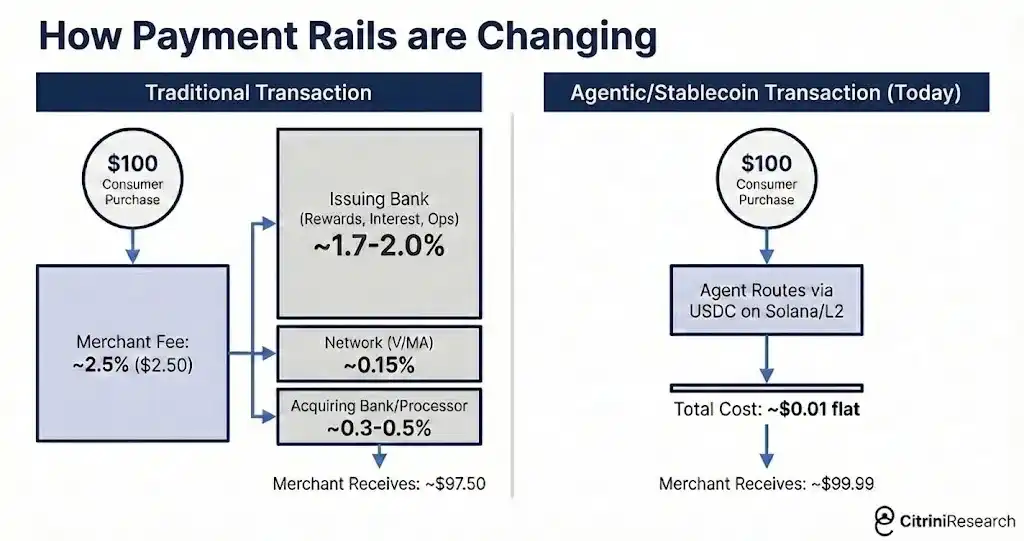
Agent-based business bypasses the interchange fee settlement path, posing a more severe impact on banks with bank card business at their core and single-business issuing institutions. These institutions have long collected most of their revenue from the 2%–3% interchange fee and built a complete business segment around points and rewards programs supported by merchant subsidies.
Among them, American Express has faced the most pressure. On the one hand, the shrinkage of white-collar employment has continuously weakened its high-value customer base; on the other hand, agent-based bypass of interchange fee settlement has directly undermined its core revenue model. In the following weeks, the stock prices of Synchrony (SYF US), Capital One (COF US), and Discover (DFS US) also dropped by more than 10%.
Their moats are essentially built on friction, and friction is rapidly approaching zero.
-- Price
From Industry Risk to Systemic Risk
Throughout 2026, the market has always regarded the negative impact of AI as an industry-level shock. The software and consulting industry was hit hard, payment systems and other fee chokepoints began to waver, but the broader macroeconomy still looked robust. Although the labor market was cooling down, there was no sign of an out-of-control decline. The mainstream consensus believed that creative destruction is a necessary stage of any technological innovation cycle: there will be localized pains, but the overall net benefit brought by AI will eventually outweigh its negative impact.
In our macro memorandum in January 2027, we pointed out that this is a flawed cognitive framework. The United States is fundamentally a white-collar-dominated service-based economy. White-collar workers account for 50% of total employment and contribute about 75% of disposable income. The businesses and jobs being eroded by AI are not on the fringes of the U.S. economy; they are the U.S. economy itself.
"Technological innovation destroys jobs while creating more jobs" was the most popular and convincing counterargument at the time.
It became popular because it had hardly ever failed over the past two centuries. Even though we cannot clearly imagine the specific form of future jobs, they always appear as scheduled. ATMs reduced the operating costs of bank branches, and banks opened more branches in return; teller positions continued to grow over the next twenty years. The internet disrupted travel agencies, yellow pages, and brick-and-mortar retail, but it also gave birth to entirely new industries, creating a large number of new jobs.
However, there is one premise that has never been broken: all these new jobs require humans to perform.
AI is changing this premise. Today, AI has become a general intelligence and is rapidly progressing in tasks that humans would have been redeployed to. The displaced programmers cannot simply transition to AI management, as AI itself now has management capabilities.
Today, AI agents are able to independently take on research and development tasks lasting weeks. While business school professors still attempt yearly to fit these data with a new S-curve, exponential growth has long surpassed our existing cognitive boundaries of possibility.
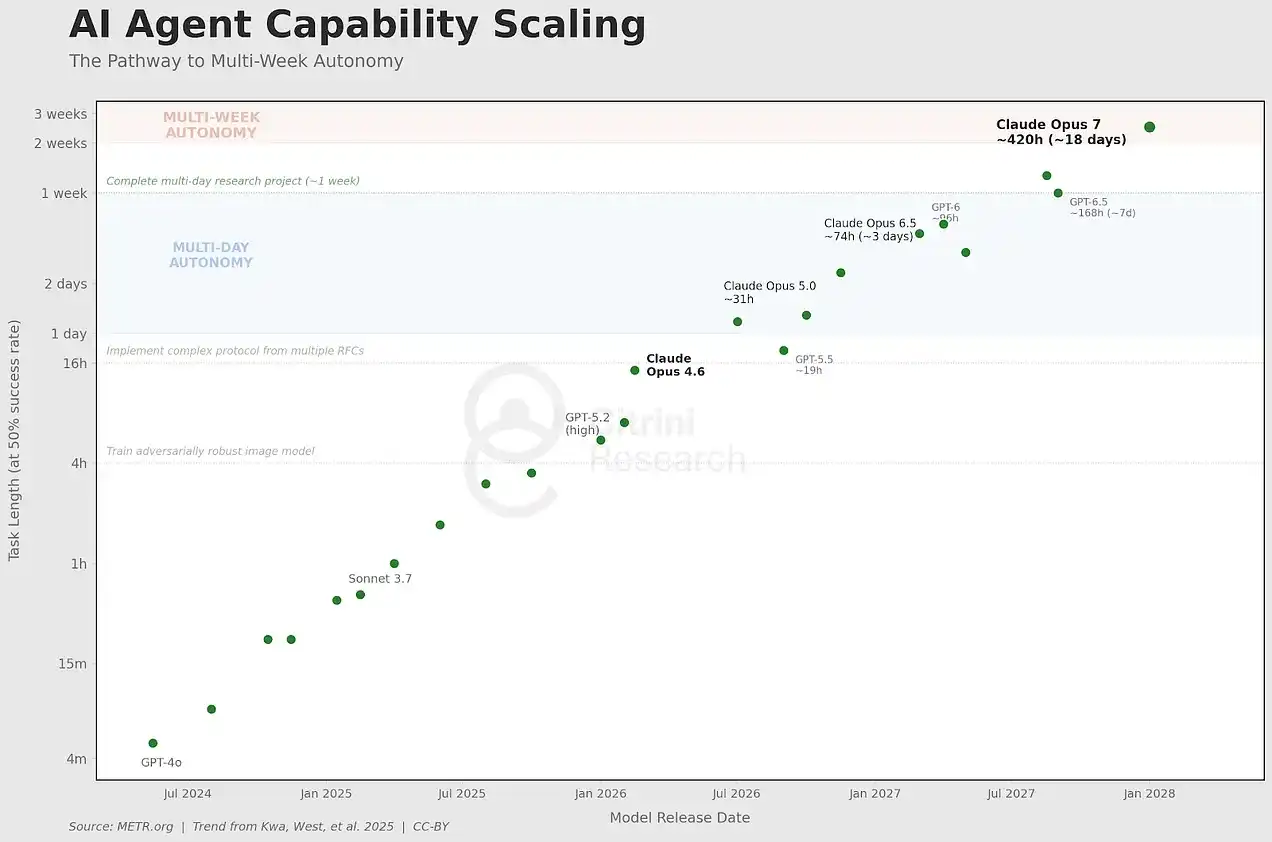
They write nearly all the code, with the best-performing agents being smarter than almost all humans in almost everything. And they are becoming cheaper.
AIs have indeed created new job roles, prompting cues like engineer. AI security researcher. Infrastructure technician. Humans are still in the loop, coordinating at the highest level or controlling taste. But with each new position added, often dozens of old ones are eliminated; and the pay levels for new positions are only a small fraction of the replaced positions.
US JOLTS Data: Job Openings Fall Below 5.5 Million; Unemployment-to-Job-Opening Ratio Rises to Around 1.7, the Highest Since August 2020—Bloomberg, October 2026
The annual hiring rate has been lackluster, but the JOLTS data in October 2026 provided some decisive evidence. Job openings fell below 5.5 million, a 15% year-on-year decrease.
INDEED: Job Postings in Software, Finance, and Consulting Industries See Steep Declines Amid 'Productivity Initiative' Spread—Indeed Hiring Lab, November-December 2026
White-collar job openings are rapidly contracting, while blue-collar openings (construction, healthcare, technical workers) remain relatively stable. Attrition is focused on positions that involve writing memos, approving budgets, and maintaining the mid-level operation of the economy (we are still there). However, the real wage growth for these two groups has been negative for most of the year and continues to decline.
The stock market's reaction to the JOLTS data is far weaker than to another piece of news they care more about: the fact that General Electric's Vernova's entire turbine capacity has been sold out to 2040. The market oscillates between negative macro data and positive AI infrastructure expansion, leading to overall sideways trading.
However, the bond market (always smarter than the stock market, or at least less romantic) began to price in the risk of the consumer side downturn. The 10-year Treasury yield started a decline from 4.3% to 3.2% over the following four months. Nevertheless, the overall unemployment rate did not see a runaway increase, and the subtle differences in the structure were still overlooked by some.
In a typical economic recession, problems often have self-correcting mechanisms. Overbuilding leads to a construction slowdown, which results in lower interest rates, stimulating new construction. Excess inventory leads to destocking, triggering restocking. The cyclical mechanism contains the seeds of its own recovery.
But this time, the root of the cycle is not cyclical.
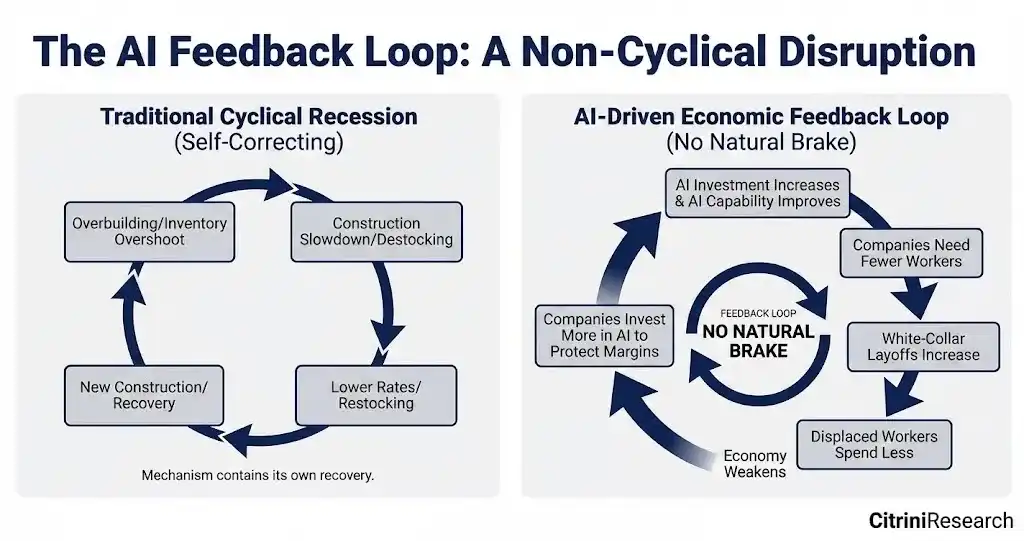
AI is getting better and cheaper. Companies first lay off employees, then reinvest the cost savings into more AI capabilities, leading to further conditions for layoffs; the laid-off workers then reduce their consumption; consumer-facing companies see a decline in sales, profit pressure, and can only continue to increase their investment in AI to maintain profit margins. As a result, AI once again becomes stronger and cheaper.
This is a negative feedback loop without a natural brake.
Intuitively, one might think that the overall demand downturn will eventually slow down the pace of AI development. However, this is not the case because it is not a capital expenditure (CapEx) in the traditional sense relying on super-scale computing centers, but rather an operational expenditure (OpEx structural substitute).
A company that used to spend $100 million annually on workforce and only invested $5 million in AI may now have reduced its workforce spending to $70 million while increasing the AI budget to $20 million. The AI investment has doubled, but this growth is not due to expansion; it occurs in the process of reducing overall operating costs. In other words, every company's AI budget is increasing while total spending is contracting.
Ironically, even as AI is reshaping and weakening the economic system it is embedded in, the AI infrastructure complex itself continues to perform strongly.
NVIDIA (NVDA) continues to deliver record revenue, TSMC's capacity utilization remains above 95%, and hyperscale cloud providers invest $150 billion to $200 billion in data center construction each quarter. Economies most emblematic of this trend, such as Taiwan and South Korea, have also significantly outperformed the broader market in the capital markets.
India, on the other hand, presents a starkly different situation. Its IT services industry has an annual export scale of over $200 billion, serving as a core source of India's current account surplus and a key pillar to offset the long-standing merchandise trade deficit. The entire model is built on a simple comparative advantage: the cost of Indian developers being only a fraction of their American counterparts.
However, the marginal cost of AI programming agents has collapsed to almost just the cost of electricity. By 2027, the cancellations of contracts with Tata Consultancy Services (TCS), Infosys, and Wipro have significantly accelerated. As the rapidly evaporating trade surplus supporting India's external accounts, the Rupee devalued by 18% against the US Dollar within four months. By the first quarter of 2028, the International Monetary Fund (IMF) had initiated preliminary contact with New Delhi.
The engine driving disruption grew stronger every quarter, indicating that the pace of disruption was also accelerating continuously. The labor market does not have a natural bottom.
In the United States, the question is no longer about when the AI infrastructure bubble will burst. What is truly starting to be repeatedly asked is, as consumers themselves are systemically replaced by machine systems, where will an economy built on consumer credit head.
Intelligent Replacement Spiral
2027 was the year when the macroeconomic narrative was no longer subtle. The transmission mechanisms of the past 12 months' disconnected yet distinctly adverse development trends became evident. You don't need to look at the data from the Bureau of Labor Statistics (BLS); you just need to attend a friend's dinner party.
The displaced white-collar workers did not stay idle; they downgraded. Many moved into lower-paying service and gig economy jobs, increasing the workforce supply in those areas and depressing wages there.
One of our friends was a Senior Product Manager at Salesforce in 2025. Holding the title, health insurance, a 401k retirement plan, with an annual salary of $180,000, she lost her job in the third round of layoffs. After six months of searching, she started driving for Uber, earning $45,000.
The focus is not on individual stories but on the second-order math, multiplying this dynamic by hundreds of thousands of workers in each major metropolis. An influx of overqualified labor entered the service and gig economy, depressing the wages of already struggling incumbent workers, exacerbating industry-specific disruptions into an economy-wide wage compression.
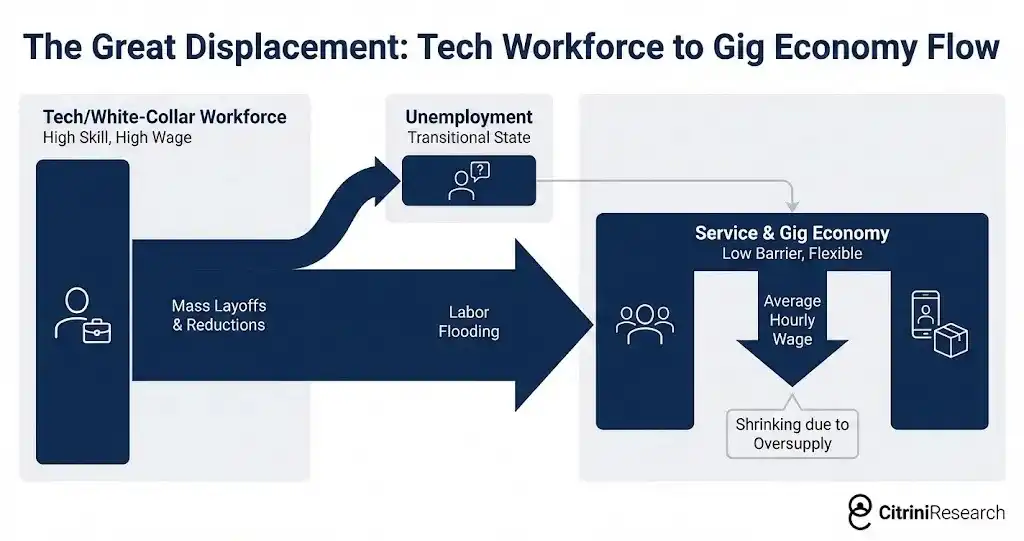
The last remaining human-centric labor pool is due for one more correction, and that correction is happening as we write these words. This is because autonomous delivery and self-driving cars are now engulfing those who absorbed the first wave of displaced workers in the gig economy.
By February 2027, it is apparent that the consumption patterns of even the still-employed professionals are as if they could be the next to be laid off. Their heightened efforts (largely assisted by AI) merely to stay off the chopping block, promoted, or paid more have been dashed. Savings rates have ticked up slightly, spending is muted.
The most dangerous aspect is the lag. High earners maintain the façade of normalcy for two to three quarters with their above-average savings. Hard data doesn't confirm the issue until it's old news in the real economy. Subsequently, data that breaks the illusion is released.
US Initial Jobless Claims Soar to 487,000, Highest Since April 2020 | Labor Department, Q3 2027
Initial jobless claims surged to 487,000, marking the highest level since April 2020. ADP and Equifax confirm that the vast majority of new claimants are white-collar professionals.
The S&P 500 Index slumped 6% in the following week, with negative macro factors starting to dominate.
In a typical economic downturn, unemployment is broad-based. The pain borne by blue-collar and white-collar workers roughly aligns with each group's share of total employment. The consumption hit is also broad-based and will soon manifest in the data as lower-income workers have a higher marginal propensity to consume.
In this cycle, unemployment is concentrated in the highest few deciles of income distribution. They represent a relatively small share of total employment but drive a disproportionate share of consumer spending. The top 10% of earners command over half of all US consumer spending. The top 20% command around 65%. These are the people buying houses, cars, going on vacations, dining out, paying for private school tuition, renovating homes.
They are the demand bedrock of the entire non-essential consumer economy.
When these workers lose their jobs or accept a 50% pay cut to pivot into available positions, the consumption hit is massive relative to the number of lost jobs. A 2% decline in white-collar employment translates to an impact on discretionary consumer spending of about 3-4%. Unlike blue-collar unemployment that typically has an immediate impact (you're laid off from the factory, you stop spending next week), white-collar unemployment has a lag but deeper impact as these workers have savings cushions that allow them to sustain expenditure for several months before the behavioral sea-change occurs.
By the second quarter of 2027, the economy had slipped into a recession. The U.S. National Bureau of Economic Research wouldn't formally declare the start date of the recession for several more months (they never do), but the data was clear—we had seen two consecutive quarters of actual GDP contraction. Yet this was not yet a "financial crisis"...temporarily.
The Domino Effect of Related Bets
The scale of private credit had grown from under $1 trillion in 2015 to over $2.5 trillion by 2026. A significant portion of this capital had been deployed into software and tech transactions, particularly leveraged buyouts of SaaS companies. The valuation basis of these transactions was broadly premised on one key assumption: that revenue would sustain long-term growth in the high double digits.
These assumptions had effectively been shattered between the first showcase of AGI programming capabilities and the Q1 2026 software stock crash. However, the asset's book values seemed oblivious to this fact.
As multiples for a significant number of public SaaS companies had compressed to 5–8x EBITDA, the privately backed software firms on the balance sheets still carried acquisition valuations based on "revenue multiples" that no longer existed. Management teams chose to slowly mark down the book value: from 100 cents to 92, 85; meanwhile, public market comps had long pointed to 50 cents.
Moodys downgraded $18 billion in private equity-backed software debts across 14 issuers, citing "long-term revenue headwinds from AI-driven competitive disruption"; the largest single-industry downgrade since the 2015 energy crisis.—Moodys Investor Services, April 2027
Everyone remembers what happened after the downgrade. For industry veterans who lived through the 2015 energy sector downgrade wave, this playbook was all too familiar.
By the third quarter of 2027, loans backed by software assets started to default en masse; information services and consulting-focused PE portfolio companies promptly followed suit; multiple billion-dollar leveraged buyout transactions involving prominent SaaS companies sequentially entered restructuring.
Zendesk stands as a stark example.
ZENDESK failed to meet debt covenants due to AI-driven customer service automation eroding ARR (Annual Recurring Revenue); a $5 billion direct lending facility was marked at 58 cents on the dollar; setting the record for the largest-ever private credit software default.—Financial Times, September 2027
In 2022, Hellman & Friedman and Permira took Zendesk private for $10.2 billion. The financing structure included a $5 billion term loan, the largest-ever ARR-backed credit facility at the time, led by Blackstone, with participation from Apollo, Blue Owl, and HPS in the lending syndicate.
The core assumption of this loan was crystal clear: assume Zendesk's Annual Recurring Revenue (ARR) remains unchanged. With a leverage ratio of approximately 25 times EBITDA, the entire capital structure made sense only under this condition.
By mid-2027, that condition no longer held.
Over the past half-decade, AI agents had started autonomously handling customer service. The category defined by Zendesk (ticketing, routing, managing human interactions) was being replaced by a class of systems that could resolve issues directly without generating tickets. The "Annual Recurring Revenue" that underpinned the loan underwriting was no longer recurring; it was merely revenue yet to churn out.
Thus, the largest-ever ARR-backed loan transformed into the largest-ever private credit software default. Almost simultaneously, every credit trading desk was repeatedly asking the same question: who else mistook a structural headwind for a navigable cyclical breeze?
Yet, this was also one of the scarce points of consensus in the initial market narrative - one that should have been absorbable, even survivable from the onset.
Private credit is not the banking system of 2008. Its institutional design was meant to avert fire sales through chain reactions. These funds are predominantly closed-ended, with long-term capital lock-ups, typically running for seven to ten years for limited partners. There are no bank runs, no risks of repo financing being pulled. Managers can hold impaired assets, restructure gradually, and await recovery. The process may be painful, but theoretically, it is containable.
Executives at Blackstone, KKR, and Apollo emphasized that software assets represented only 7%–13% of total assets, indicating manageable risk. Seller reports and credit opinion leaders on financial social media repeatedly echoed the same point - private credit has permanent capital to absorb losses that would shatter high-leverage banks.
"Permanent capital."
This term appeared frequently in market-soothing earnings calls and investor letters, almost becoming a mantra. And like most mantras, few ever truly unpacked its significance.
Over the past decade, large alternative asset management firms have been acquiring life insurance companies and transforming them into financing platforms. Apollo acquired Athene, Brookfield acquired American Equity, KKR acquired Global Atlantic.
The logic seems elegant: annuity deposits provide a stable, long-term source of liabilities; the asset managers invest these funds in private credit assets they originate, earning a spread on the insurance side and collecting management fees on the asset management side, creating a "fee stack" revenue structure. As long as one condition holds true, this mechanism operates smoothly.
The condition is that the private credit assets must be principal-protected.
When losses truly materialize, they hit a class of balance sheets that hedge illiquid assets against long-dated liabilities.
The so-called "permanent capital" is not some abstract patient institutional money or a group of sophisticated investors willing to take on complex risks. It is the savings of American families, the funds of Main Street, existing in the form of annuities, invested in the software and tech debt funded by private equity that are now starting to default.
The locked-up capital that cannot exit is, in reality, the money of life insurance policyholders. And in this realm, the rules are different.
Compared to banking regulation, insurance regulators have long seemed more lenient, even somewhat complacent. But this time, it has become a real wake-up call. Regulators who already had doubts about the concentration of private credit in life insurance companies have begun reducing the risk-based capital treatment of these assets. This forces insurance companies to either raise capital or sell assets, and in a market environment that has already become frozen, both options are difficult to execute at reasonable prices.
The regulatory authorities in New York and Iowa announced tighter capital adequacy standards for private rated credit held by life insurance companies; NAIC guidelines are expected to raise RBC factors and trigger additional reviews. — Reuters, November 2027
When Moody's revised Athene's financial strength rating outlook to negative, Apollo's stock price dropped 22% in two trading days. Brookfield, KKR, and other institutions came under pressure as well.
The complexity does not stop there. These institutions have not only created an insurance perpetual motion machine but have also built sophisticated offshore structures to enhance returns through regulatory arbitrage. After U.S. insurance companies underwrite annuities, they reinsure the risk to Bermuda or Cayman-based subsidiaries they control, which are subject to looser regulation jurisdictions and allow lower capital charges on similar assets. The reinsurance entities then bring in external capital through offshore special purpose vehicles, creating a new layer of counterparties that co-invest with the insurance companies in private credit assets originated by the same parent company's asset management arm.
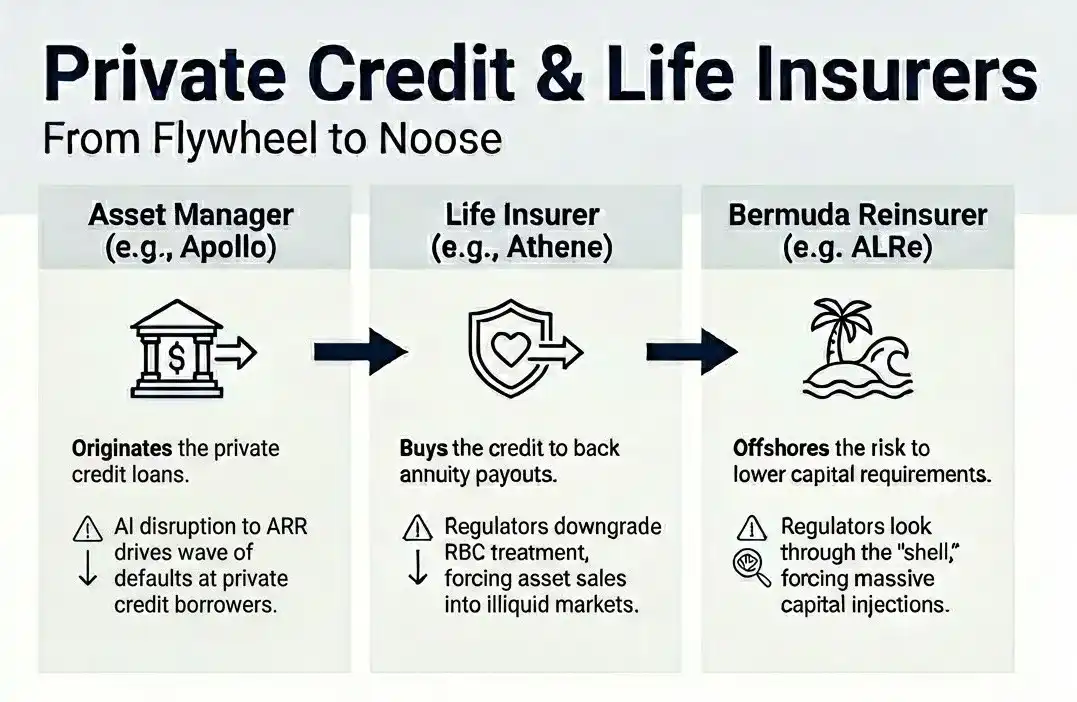
Rating agencies, some of which are owned by private equity firms themselves, have never been known for their transparency, and almost no one was surprised by this. Different companies and different balance sheets are nested and intertwined, forming a complex web of opacity that is truly staggering. Once a default occurs in the underlying loans, it is almost impossible to determine in real time who will ultimately bear the losses.
The market crash of November 2027 marked a turning point in market perception.
What was initially seen as a routine cyclical downturn has now turned into a deeper and more unsettling structural issue. Federal Reserve Chair Kevin Warsh, during an emergency Federal Open Market Committee meeting that month, described it as: "a bet on white-collar productivity growth expectations built on a domino-like interdependent structure."
In fact, what has always triggered a crisis is not the loss itself, but the acknowledgment and recognition of the loss. And within the financial system, there exists an area that is even larger in scale, more crucial in importance, and increasingly worrisome in terms of being truly "recognized."
The Mortgage Question
The Zillow Home Value Index shows a year-over-year decline of 11% in San Francisco, 9% in Seattle, and 8% in Austin; Fannie Mae points out "early delinquency rate increase" in zip codes with over 40% tech/finance employment. — Zillow / Fannie Mae, June 2028
This month, the Zillow Home Price Index indicates an 11% year-over-year decline in San Francisco, a 9% decline in Seattle, and an 8% decline in Austin. This is not the only concerning signal. Last month, Fannie Mae noted that some zip codes with a high concentration of jumbo mortgages were experiencing higher early delinquency rates. Borrowers in these areas typically have credit scores of 780 or above, long seen as the "bulletproof" tier of quality.
The U.S. residential mortgage market is approximately $13 trillion. Mortgage securitization is built on a fundamental assumption that borrowers will generally maintain their current employment status and income levels throughout the loan term. For most mortgages, this assumption spans 30 years.
However, the white-collar employment crisis is shaking this fundamental assumption by continuously revising income expectations downward. A question that sounded almost absurd three years ago is now unavoidable: Are prime mortgages truly as safe as cash?
Looking back at every mortgage crisis in U.S. history, the causes have always boiled down to three main types: first, speculative excess (lending to people who fundamentally couldn't afford a house, like in 2008); second, interest rate shock (rising rates making adjustable-rate mortgages unaffordable, as in the early 1980s); and third, local economic shock (the collapse of a single industry in a single region, like the Texas oil industry in the '80s or the Michigan auto industry in 2009).
But this time, none of the three apply. These borrowers are not subprime, but rather prime with a FICO score of 780; they put down 20%, have clean credit histories, stable employment, and income that was meticulously verified and fully documented at the time of lending. They are the very foundation of credit that all risk models in the financial system default to.
The problem in 2008 was that the loans were bad from the start. The difference in 2028 is that the loans were good from the start. It's just that the world changed after the loans were made.
People borrowed against a future they can no longer believe in and can hardly afford.
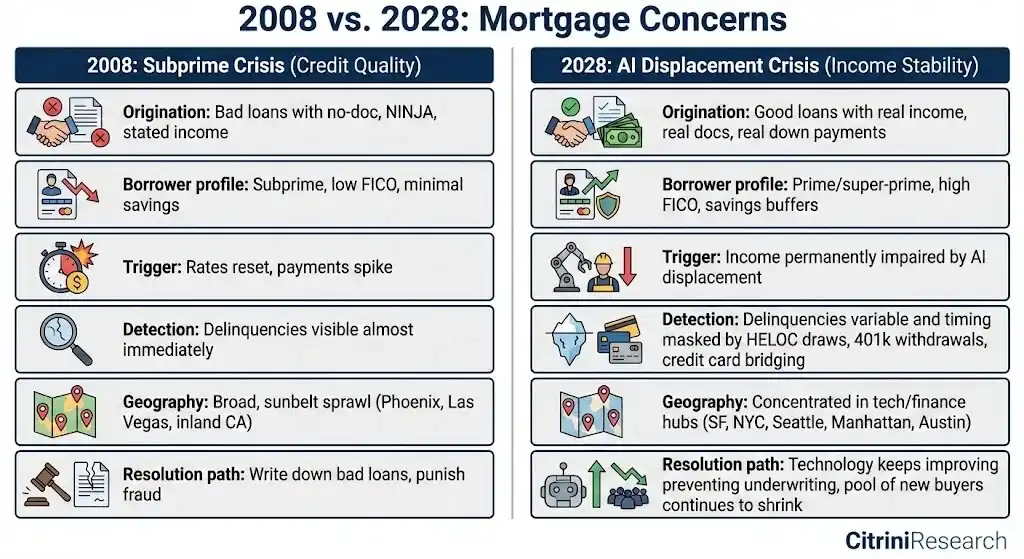
As early as 2027, we started to see some hidden pressures emerge: increases in home equity loan drawdowns, spikes in early withdrawals from 401(k) accounts, rapid accumulation of credit card balances, all while mortgage payments remained current. With layoffs, hiring freezes, and shrinking bonuses, these prime borrowers' households, on the surface, saw their debt-to-income ratios almost double.
They could still make their mortgage payments on time, but at the cost of drastic cuts to discretionary spending, sustained erosion of savings, and deferral of all home maintenance and improvement plans. On paper, their mortgages looked sound, but in reality, they were just one additional shock away from slipping into default territory. And the path of AI's evolving capabilities suggests that this shock isn't far off.
Subsequently, we saw tech- and finance-heavy cities like San Francisco, Seattle, Manhattan, and Austin experience a notable uptick in mortgage delinquency rates, despite the national average staying within historical ranges.
We are now entering the most delicate phase. When the marginal buyer (those potentially buying in) is financially sound, a drop in house prices can be absorbed by the market; however, now, these marginal buyers themselves are facing the same income pressures.
Risks are building up, but a full-blown mortgage crisis has not yet emerged. While delinquency rates are indeed rising, they are still far below the peak seen in 2008. What is truly alarming is not the current level but the trajectory it is indicating.
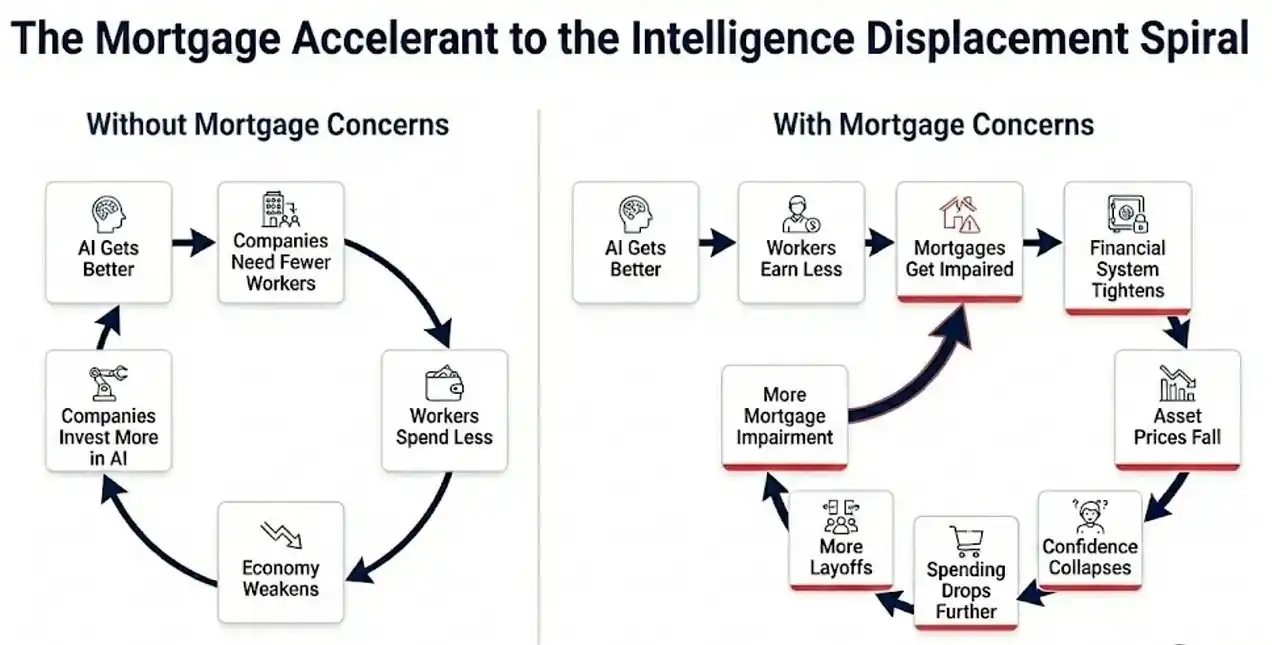
Today, smart automation has added two more financial accelerators directly impacting the real economy downturn.
Labor replacement, mortgage loan concerns, private market turbulence.
All three reinforce each other, magnifying their effects. Traditional policy tools (rate cuts, quantitative easing QE) may help offset pressure on the financial system, but they cannot solve the real economy's engine problem as the issue does not stem from overly tight financial conditions.
The real economy's engine is being driven by another force. AI is making human intelligence no longer scarce or expensive. You can lower interest rates to zero, buy all mortgage-backed securities in the market, or even take over all defaulting software LBO debts...
But this does not change one fact: a Claude agent can perform the job of a product manager earning $180,000 a year at a cost of $200 per month.
If these fears materialize, the mortgage market will collapse in the latter half of this year. In that scenario, we expect the current stock market's retracement to potentially approach the magnitude seen during the global financial crisis (a drop of about 57% from peak to trough), bringing the S&P 500 index back to around 3500 points—the last time we saw this level was in November 2022, before the ChatGPT era.
What is certain is that the income assumption supporting $13 trillion in residential mortgage loans has been structurally undermined. What is uncertain is whether policies can still intervene in a timely manner before the mortgage market fully digests this reality.
We still hold hope, but we cannot deny that pessimistic reasons are accumulating.
Race Against Time
The first negative feedback loop occurred in the real economy: AI capabilities improved, labor force shrank, consumer demand weakened, profit margins squeezed, companies increased AI investment, AI capabilities further improved.
Subsequently, this mechanism spread to the financial system, income losses began to impact mortgage performance, bank asset quality deteriorated, credit tightened, wealth effects diminished, and the feedback loop accelerated. Both of these were further amplified due to government's cluelessness and inadequate response to the crisis.
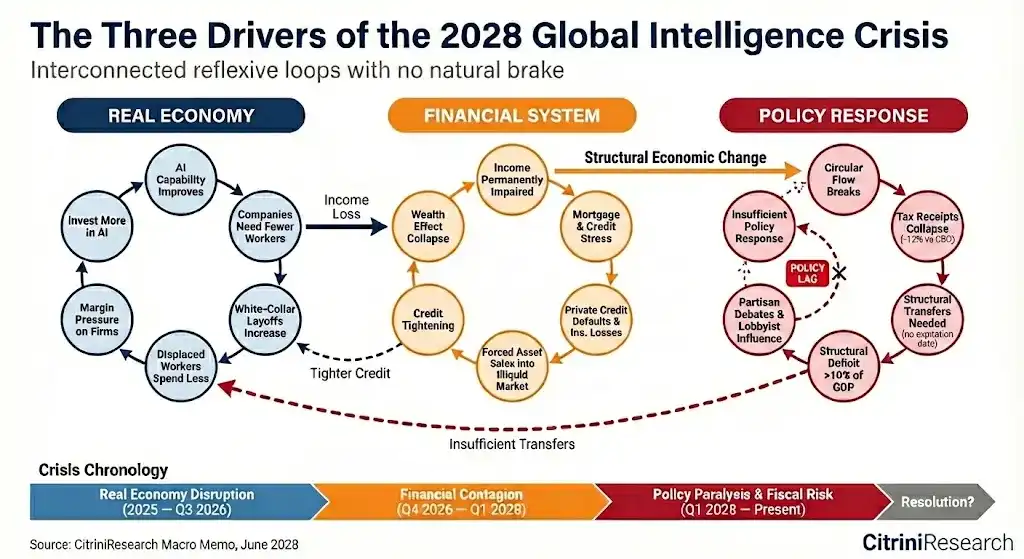
Our system was not designed from the outset to deal with such a crisis. The federal government's fiscal revenue base is essentially a taxation mechanism on human time, where individuals contribute labor, businesses pay wages, and the government collects taxes. In normal years, individual income tax and payroll tax form the backbone of government fiscal revenue.
However, as of the first quarter of this year, federal fiscal revenue is 12% below the Congressional Budget Office's baseline projection. The decline in payroll tax is due to a continuing decrease in the number of people employed at existing wage levels; the weakness in income tax reflects that residents' actual income has been structurally suppressed. While productivity has indeed been rapidly rising, the incremental gains have not flowed to laborers but have been absorbed by capital and computing power.
The share of labor income in GDP has declined from 64% in 1974 to 56% in 2024, driven by globalization, automation, and long-term weakening of labor bargaining power, leading to a slow decline over forty years. Within just four years after AI began an exponential leap, this ratio further plummeted to 46%, marking the largest drop on record.
Output has not disappeared, but it no longer cycles back to enterprises through households, meaning it no longer flows through the IRS either. The closed loop of the economic cycle is breaking, yet both the market and society still expect the government to step in and mend this structural rift.
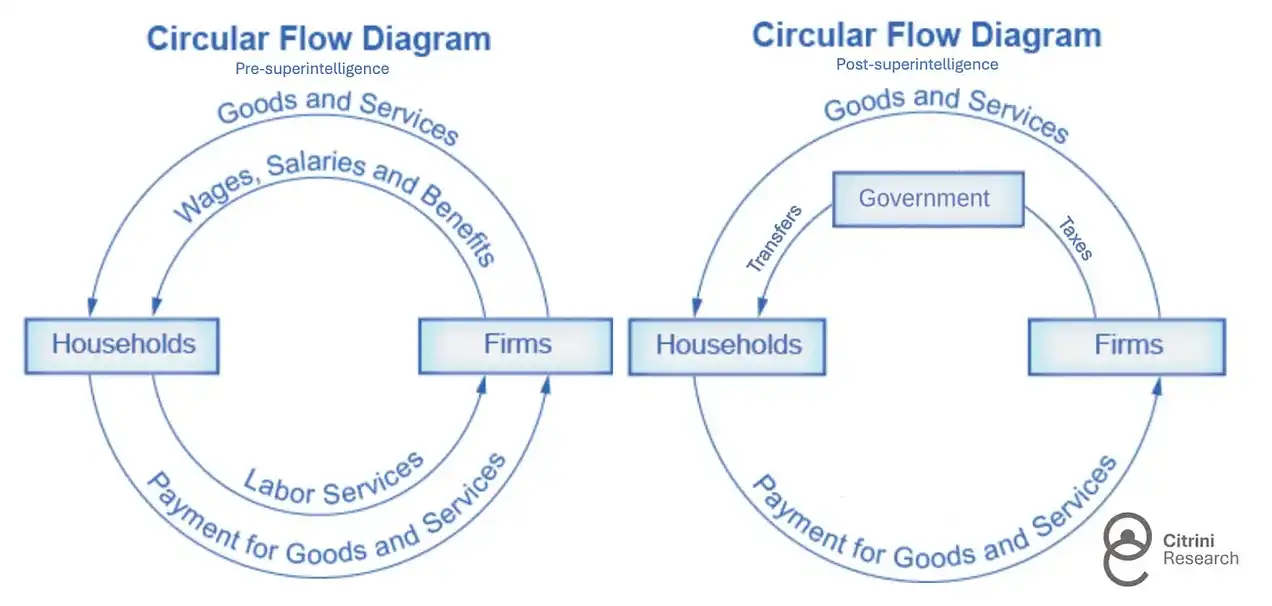
As in every past economic downturn, while fiscal spending rises, fiscal revenue is declining. However, the difference this time is that the expenditure pressure is not cyclical but structural.
The so-called Automatic Stabilizers were originally designed to address short-term unemployment shocks, not long-term, irreversible structural shifts. The premise of this system to pay benefits is that workers will eventually be reabsorbed into the labor market.
But reality is rewriting this assumption, with a significant portion of people not returning to their positions, at least not at levels close to their previous compensation. During the COVID-19 pandemic, the government readily accepted a 15% fiscal deficit because it was widely seen as a temporary shock.
Today, those in need of government support are not facing a public health crisis that will eventually pass but are being replaced by an evolving, irreversible technology.
Therefore, the fiscal system is facing a sharp and unprecedented structural contradiction, where it must transfer more funds to households while the government is collecting less tax revenue from these households.
The United States will not default. It prints the currency it uses for consumption and uses that same currency to repay lenders. However, pressure has begun to show in other areas. This year, the municipal bond market has seen a troubling divergence. States without income tax have overall performed well; but general obligation bonds (GO munis) issued by states highly dependent on income tax revenue (mostly blue states) have begun to be priced in by the market for a certain level of default risk. Politicians quickly picked up on this, and what started as a debate over who should be bailed out rapidly evolved into a partisan battle.
What is worth noting is that the current administration early on recognized the structural nature of this crisis and began advancing a series of bipartisan proposals under the umbrella term "Transition Economy Act." The core idea is to expand the fiscal deficit and introduce a proposed AI inference power tax to provide direct transfer payments to displaced workers.
More radical proposals have pushed the envelope further. The "Shared AI Prosperity Act" advocates for establishing a public claim on the benefits of the AI infrastructure itself, something between a sovereign wealth fund and AI output royalties, with the resulting dividends being used to continuously transfer income to households.
As expected, private-sector lobbying quickly dominated the media landscape, warning of a dangerous slippery slope.
The political games behind the policy discussions are extremely cliché, filled with populism and fringe policies. The right-wing denounces transfer payments and redistribution as Marxism and warns that taxing computational power is akin to handing over technological leadership to China; the left-wing warns that tax laws drafted with the help of vested interests will only be a disguised form of regulatory capture; fiscal hawks emphasize the unsustainability of the deficit; doves repeatedly cite the premature implementation of austerity measures post the Global Financial Crisis (GFC) as a cautionary tale.
With the approaching presidential election this year, these divisions will only be further magnified.
Amidst the endless bickering of politicians, the rate of societal fracture has already significantly outpaced the legislative process itself. The Occupy Silicon Valley movement is a concentrated reflection of this widespread discontent. Last month, protesters blockaded the entrances to the Anthropic and OpenAI offices in San Francisco for three consecutive weeks. The participation numbers are growing, and the media attention received by these protests has even surpassed the unemployment data that sparked the protests.
It is hard to imagine anyone being more universally reviled by the public than bankers were in the aftermath of the Global Financial Crisis, but AI labs are rapidly closing in on that position. From a public perspective, this animosity is understandable.
The founders of these companies and early investors accumulated wealth at a pace that makes the Gilded Age look tame. The benefits of the productivity boom have almost entirely flowed to the owners of computational power and the shareholders of labs dependent on that power, magnifying America's inequality to unprecedented levels.
Each side has its own villains, but the true villain is actually time.
The pace of AI capability evolution far outstrips the pace of institutional adjustment; policy responses continue along ideological, rather than realistic, speed. If the government cannot quickly reach a consensus on what the problem is, the feedback loop described above will write the next chapter for them.
The End of the Intelligence Premium
Throughout modern economic history, human intelligence has always been the scarcest input factor. Capital is abundant (or at least replicable), natural resources, while limited, are often substitutable, technological progress is slow enough for humans to adapt. Only intelligence, the ability to analyze, decide, create, persuade, and coordinate, is something that cannot be massively replicated.
It is precisely because of this scarcity that human intelligence inherently enjoys a premium. From the labor market, to the mortgage system, to tax system design, almost all core economic institutions are built on this premise.
Now, we are experiencing the end of this premium. In more and more tasks, machine intelligence is becoming a competent substitute for human intelligence and is still evolving rapidly. A financial system that has operated under the assumption of scarce human intelligence and has been continuously optimized for decades is now being forced to reprice. This process is bound to be painful, disorderly, and far from over.
But repricing does not equate to collapse.
The economy may still find a new balance. And reaching this balance happens to be one of the few remaining tasks that only humans can do and we must get it right.
For the first time in history, the most productive asset in the economy has not led to more employment but has instead reduced employment. Existing theoretical frameworks are struggling to fully apply because they were never designed to deal with a suddenly abundant element in a world that was originally scarce. So, we can only build new frameworks.
The only truly important question is whether we have enough time.
However, you are not reading this article in June 2028, but in February 2026.
The S&P 500 Index is near its all-time high. The negative feedback loop has not yet started. We are confident that some of the scenarios will not materialize. We are just as confident that machine intelligence will continue to accelerate, and the intelligence premium of humans will continue to narrow.
As investors, we still have time to examine how much of our asset allocation is built on the assumption that we cannot cross this decade. As a society, we also still have time to choose to actively shape the future rather than passively accept outcomes.
The canary in the coal mine is still alive.
This content is provided for general informational purposes only and doesn't constitute financial, investment, legal, or tax advice. Any events, rewards, online promotions, or related information mentioned herein should not be considered a recommendation, solicitation, or invitation to purchase, sell, trade, or otherwise deal in any crypto assets. Crypto assets are highly volatile and may result in loss. The availability of WEEX services, products, and related events may vary by region. You are responsible for ensuring that your participation is in accordance with applicable local laws and regulations.
You may also like

Shao Tianlan Questions the False Revenues of Embodied Intelligence Companies

Three Attacks in Four Days: As the Market Rises, Hackers Get Busier

Full Speech by Wang Xingxing at the 2026 World Robot Conference: Embodied Intelligence of ChatGPT Will Arrive in Two to Three Years at the Fastest

Yushu Is Not Worth Its Current Price

Netflix Releases Trailer for *Moria*, Series About Moria Casán

Donald Trump to Resume White House Correspondents' Dinner After Attack That Forced Its Cancellation

PhotonPay wins three annual partnership awards from Mastercard
Chain games are defeated by reality, Web3 does not believe in dreams

Trump Crypto Ventures Gain from SEC Guidelines Shift
Key Takeaways: The SEC has reclassified many cryptocurrencies as commodities or “digital tools,” easing regulatory pressures. This deregulatory…

Insiders: Zhiqing has rejoined OKX, taking a position in the strategy department of the president's office

GalaChain announces ecosystem expansion, supporting seamless access to Gala Network for Solana, TON, and Ethereum assets

Trump Memecoin Shows Volatility Amid Mar-a-Lago Event
Key Takeaways: TRUMP memecoin holders surpassed 83 wallets with over one million tokens after a luncheon announcement with…
Morning Report | USDC issuance increased by approximately 1.7 billion in one week; Aave will launch the Aave Shield feature; total circulation of Ethereum is approximately 121.53 million

Expert: AI large model poisoning is a new form of unfair competition

The 315 Gala exposed that AI large models have been "poisoned," and "brainwashing" AI has become an industry chain
Huobi Leveraged Double Festivities: Up to 30% Fee Rebate, Limited-Time Zero Interest for USDC Cross-Margin
WEEX Lights Up the Global Stage with a Series of Offline Events in 2025
Inside WEEX's Global Footprint: A Year of Unstoppable Momentum

WEEX at CONF3RENCE Dortmund 2025 Welcome Gala
For WEEX, participating in CONF3RENCE Dortmund marks another important step in its global expansion strategy.
Ripple and SBI Team Up for RLUSD Stablecoin Launch in Japan by Early 2026
Latest Crypto Market Snapshot as of August 22, 2025 BTC Soars to $115,250.00 ETH Hits $4,450.75 XRP Climbs…

Zendaya’s ‘Big Hat Theory’ Meme, Explained
Shao Tianlan Questions the False Revenues of Embodied Intelligence Companies
Three Attacks in Four Days: As the Market Rises, Hackers Get Busier
Full Speech by Wang Xingxing at the 2026 World Robot Conference: Embodied Intelligence of ChatGPT Will Arrive in Two to Three Years at the Fastest
Yushu Is Not Worth Its Current Price
Netflix Releases Trailer for *Moria*, Series About Moria Casán
Donald Trump to Resume White House Correspondents' Dinner After Attack That Forced Its Cancellation
Contents
Latest articles


Latest coin listings on WEEX


