
AERGO Price Rollercoaster: Surging 10x to Plummeting 80% - What Happened Behind the Scenes?


Original Article Title: "A 10x Surge in a Week, an 80% Plunge in a Day – What Happened to AERGO?"
Original Article Author: Oliver, Mars Finance
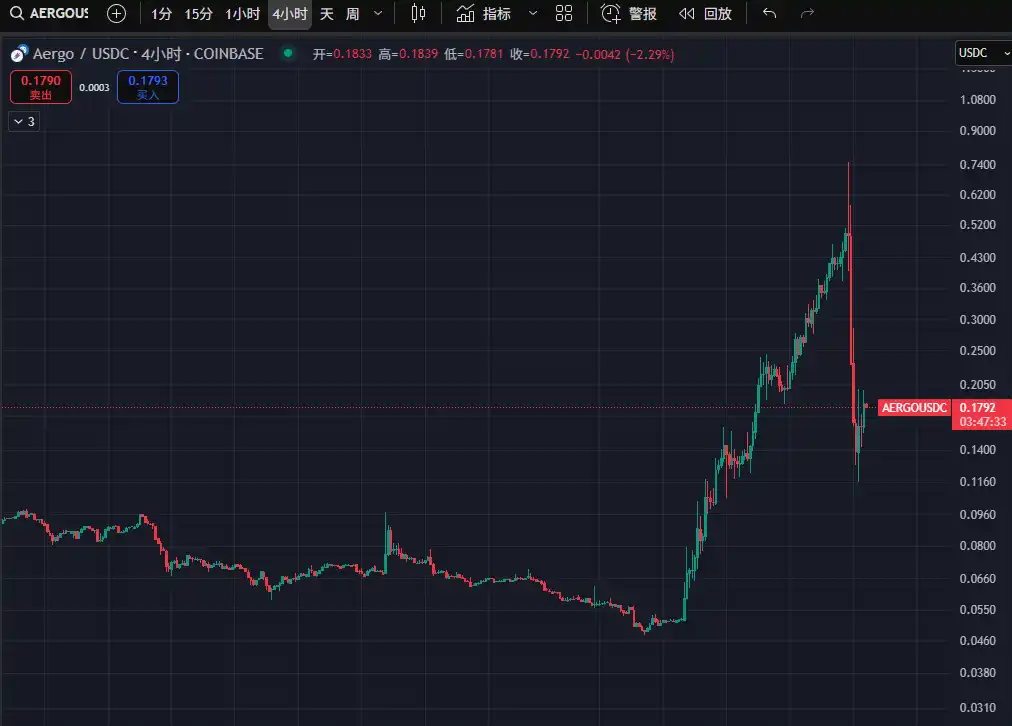
In mid-April 2025, $AERGO caused a stir in the crypto market. Within a week, its price skyrocketed from $0.05 to $0.5, a 10x increase. However, just a day later, the price plummeted by 80% to around $0.1. This rollercoaster ride of a market turned investor sentiment from euphoria to anger, and Binance's data issue escalated the turmoil. What drove the frenzied surge of $AERGO, and what caused the collapse and the community's strong backlash? Let's peel back the layers and uncover the truth behind this storm.
Binance's "Operational Fog": From Delisting to Futures Craze
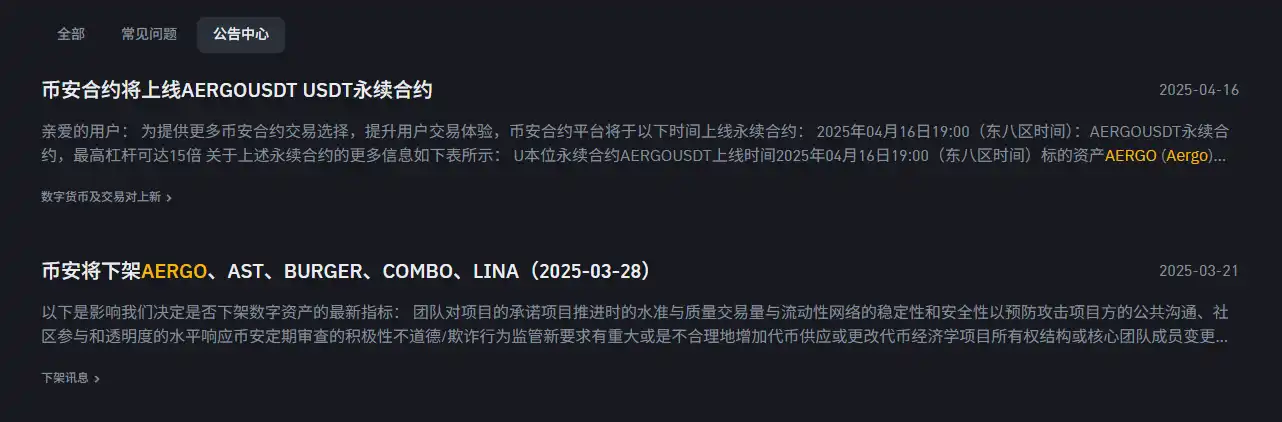
The story of $AERGO began with Binance's dramatic decision. Aergo is a hybrid blockchain project developed by the Korean company Blocko, which has long been under the radar and not widely recognized. On March 28, 2025, Binance announced the delisting of $AERGO's spot trading pair due to "insufficient liquidity." This decision disappointed the community, causing the price to drop to a low of $0.04, and investors were generally bearish on the outlook.
However, the plot took a sudden turn on April 16: Binance announced the listing of the $AERGO/USDT perpetual contract, supporting up to 15x leverage. Upon this news, speculative funds quickly poured in, and the price of $AERGO surged from $0.2 to $0.4995 within hours, reaching a new all-time high.
This surge received support from multiple sources. On April 15, the DigiFinex exchange listed the $AERGO/USDT trading pair, boosting token liquidity. On the same day, the Aergo team announced an AMA on Telegram scheduled for April 16 to discuss decentralized AI and potential new projects, igniting community enthusiasm. Market sentiment was pushed to the peak, with technical indicators showing an RSI (Relative Strength Index) as high as 93, indicating the market was severely overbought, and the speculative craze reached its climax.
The Catalyst for the Collapse: The Leverage Trap and Data Discrepancy
Just as investors cheered for the 10x surge, the Binance futures launch on the afternoon of April 16 became the starting point of a disaster. The price of $AERGO plummeted from $0.5 cliff-like to $0.1 within 12 hours, an 80% drop. Community anger quickly spread, with fingers pointing directly at Binance's data transparency issue. Investors discovered that Binance displayed $AERGO's circulating market cap as $30 million, significantly deviating from the calculated market cap based on a circulation of 477 million. For instance, at a price of $0.4, the market cap for 477 million circulation should be $0.4 × 477 million = $190.8 million; even at a price drop to $0.22419 (data on April 17), the market cap should be approximately $107 million, but Binance still showed $300.869 million. This discrepancy led investors to question whether Binance intentionally underreported the market cap to deceive retail investors into thinking the token was "undervalued," leading them to buy at a high.
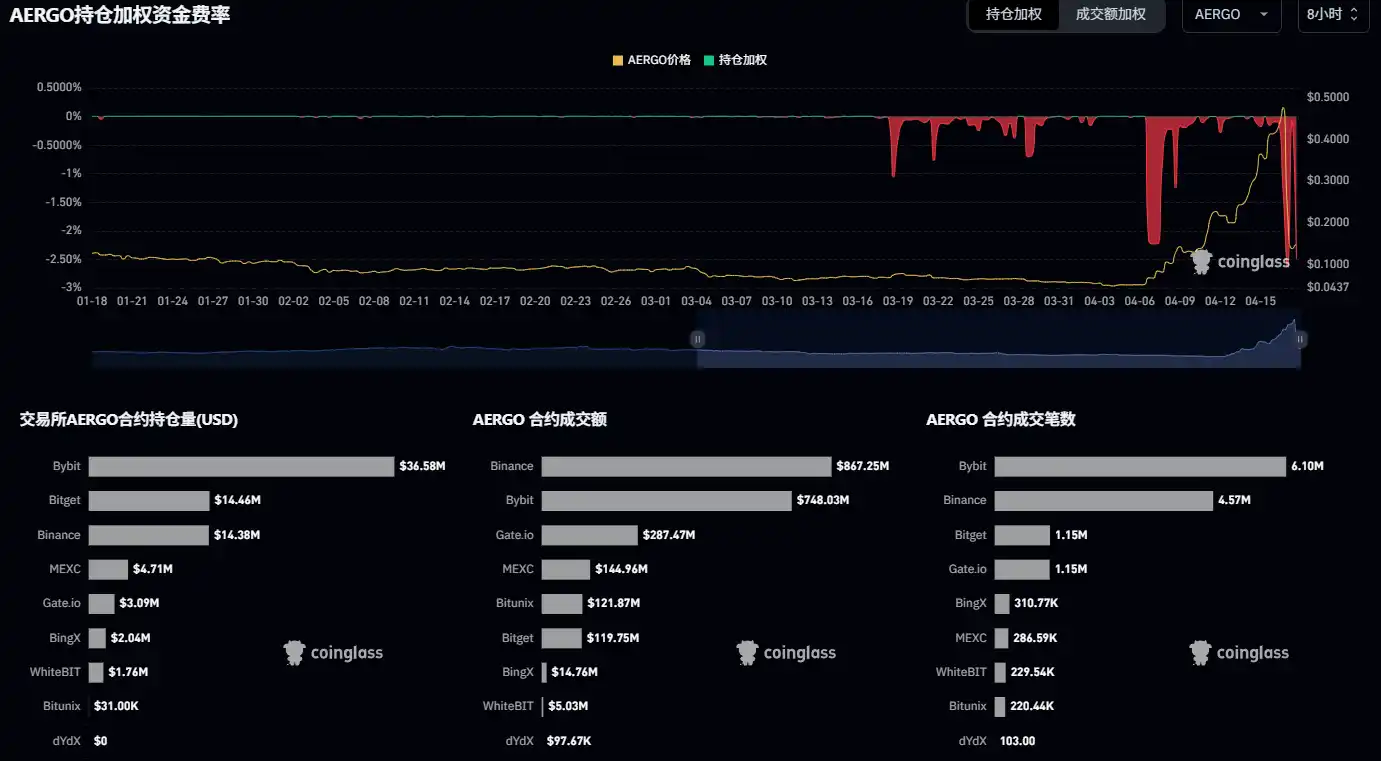
Funding Rate Data Exacerbates Market Turbulence. During the sharp rise, the funding rate for $AERGO was around 0.1%, attracting a significant amount of leverage long positions. However, after the price collapse, Bybit data showed the funding rate dropping to -3.000%, with shorts dominating the market and long positions being liquidated. On-chain data further indicates that the open interest of contracts on Bybit, Gate.io, and MEXC decreased by 53%, 50%, and 71%, respectively, reflecting traders' panic-driven exodus. High concentration has also become a concern: around 50% of the tokens are held by the team and early investors, making them vulnerable to sell-offs by whales.
Community Outrage: Data Manipulation or Amateur Mistake?
Binance's Market Cap deviation issue has become the focal point of community controversy. After investors' calculations, it was discovered that Binance's market cap data was much lower than the actual value. Some mocked, saying, "Doesn't Binance even know primary school math? 477 million circulating supply, $0.4 price, how is the market cap only 30 million?" What's even more puzzling is that the market cap data of exchanges like OKX, Bybit, and BG all align with the actual circulating supply, except for Binance's anomalous data, sparking speculations of "data manipulation." One investor in the community complained, "Thought the market cap was only $30 million, bought some, then it plummeted, upon closer inspection, the market cap was completely wrong!" Another investor expressed that they bought in at a high price due to trusting Binance's data, experiencing consecutive heavy losses.
The consequences of this data deviation are disastrous. Investors generally believe that Binance's underreported market cap may have misled retail traders into thinking $AERGO was "undervalued," prompting them to go long, while whales took the opportunity to sell off for profits. The community has begun calling for rights protection, with some suggesting, "The price has halved twice, can those who lost money going long seek redress from Binance? Clearly, it was their data that misled retail traders!" The Aergo team issued a statement on April 17 acknowledging the unusual price fluctuations but emphasizing they were not informed in advance of Binance's futures listing plans and called for the resumption of spot trading to stabilize the market. However, the official website became temporarily unavailable due to a surge in traffic and DDoS attacks, further undermining community confidence.
The sharp rise and fall of $AERGO reflect the complexity of the crypto market. Community sentiment oscillates between optimism and anger: supporters are looking forward to the community vote on April 26 to steer the project in a new direction, while critics warn that high concentration and opaque operations of exchanges may lead to more volatility. Technical analysis indicates that $AERGO is stabilizing in the $0.1-0.2 range, Bollinger Bands suggest volatility is narrowing, and it may enter a consolidation phase in the short term. However, persistent negative funding rates and a sluggish open interest volume reflect that the market sentiment remains somewhat bearish, and investors need to beware of further downside risks.
Epilogue: Market Lesson in the Data Fog
A 10x surge in a week, an 80% crash in a day—$AERGO's rollercoaster ride is a microcosm of speculation frenzy and market risk. Binance's dramatic moves from delisting spot trading to launching futures not only fueled speculative fever but also triggered a trust crisis due to data inaccuracies. The serious errors in market capitalization not only led retail investors to heavy losses but also exposed transparency issues in trading platforms. For investors, $AERGO's story reminds us that amid the frenzy and pitfalls of the crypto market, the authenticity of data may be the key to determining gains and losses.
You may also like

Will the STRC issuance price discussed with ChatGPT really fall into a death spiral?

TRON revitalizes the image of the bull, creating a more approachable brand character

How to Trade Apple and Nvidia on a Crypto Exchange in 2026 (Without Buying Shares)

Exclusive Interview with Strategy CEO: Putting Aside the Sale of 32 BTC, the 60 Trillion AI Intelligence is the Ultimate Fate of Bitcoin

Morning Report | The South Korean Financial Services Commission plans to expand the regulatory sandbox to include virtual assets; the parent company of the New York Stock Exchange, ICE, has reached a partnership with OKX to jointly establish a cryptocu...

Morning Report | Secret Network loses $4.67 million due to cross-chain vulnerability; Michael Saylor releases Bitcoin Tracker information again, may disclose increased holdings data next week

Kalshi's biggest competitor is not Polymarket

The second half of the computing power battle: Intel CEO Pat Gelsinger reveals how AI is reshaping the global semiconductor supply chain
B.AI partners with MiniMax to launch a limited-time free experience of M3, enabling zero-threshold implementation of Agentic productivity through full-stack infrastructure
A company that was on the verge of bankruptcy has just surpassed Bitcoin in market value

The two giants are racing in "credit": loan balances of 9.9 billion vs 14.6 billion USD, Brazil has become the main battlefield

Rented Belief: How Much of the Bitcoin ETF Fund Flow is Real Money

On-chain finance: On-chain IPOs and on-chain ICOs, a new frontier in the trillion-dollar market

WEEX Live mode: Monitor 20 trading pairs at once and trade like a pro

WEEX Makes Affiliate Access Easier on the Web and in the App
Customize Your Spot Trading Page: Drag Modules and Move the Order Panel Where You Want It

Perp DEX: The Next Generation Exchange "War"

10 Counterintuitive Insights on Latin American Payments
Will the STRC issuance price discussed with ChatGPT really fall into a death spiral?
TRON revitalizes the image of the bull, creating a more approachable brand character
How to Trade Apple and Nvidia on a Crypto Exchange in 2026 (Without Buying Shares)
Exclusive Interview with Strategy CEO: Putting Aside the Sale of 32 BTC, the 60 Trillion AI Intelligence is the Ultimate Fate of Bitcoin
Morning Report | The South Korean Financial Services Commission plans to expand the regulatory sandbox to include virtual assets; the parent company of the New York Stock Exchange, ICE, has reached a partnership with OKX to jointly establish a cryptocu...
Morning Report | Secret Network loses $4.67 million due to cross-chain vulnerability; Michael Saylor releases Bitcoin Tracker information again, may disclose increased holdings data next week


