
 Buy Crypto
- Markets
 Futures
- Spot
- Copy Trade
- Earn
- More
After Iran's Political Risk Rises, Cryptocurrency Sees Massive Outflow


Original Article Title: "After Bombing, Iranians Frantically Move Crypto Assets Out"
Original Article Author: angelilu, Foresight News
On February 28, 2026, the United States and Israel jointly launched the first airstrike on Iran. Within minutes of the news breaking, assets on Iran's largest cryptocurrency exchange platform, Nobitex, began flowing out at an abnormal pace. Meanwhile, on the other end of the Middle East, after days of war, the Tel Aviv Stock Exchange closed at a record high on March 2.
Same war, two drastically different financial signals: one side celebrating capital, the other side witnessing wealth flight. This scene may be the best glimpse into the true role of cryptocurrency assets in geopolitical conflicts.
Nobitex Outflow Surges by 700%
Nobitex is Iran's largest cryptocurrency exchange platform, with over 11 million registered users. In 2025, it processed a total cryptocurrency trading volume of $7.2 billion, serving as a core infrastructure of Iran's crypto ecosystem.
According to blockchain compliance firm Elliptic's on-chain monitoring data, immediately after the US-Israel airstrike, Nobitex saw a 700% surge in cryptocurrency outflows. The flow of funds indicates that these assets are being moved abroad, primarily to overseas cryptocurrency exchanges that have historically received a significant amount of Iranian funds.
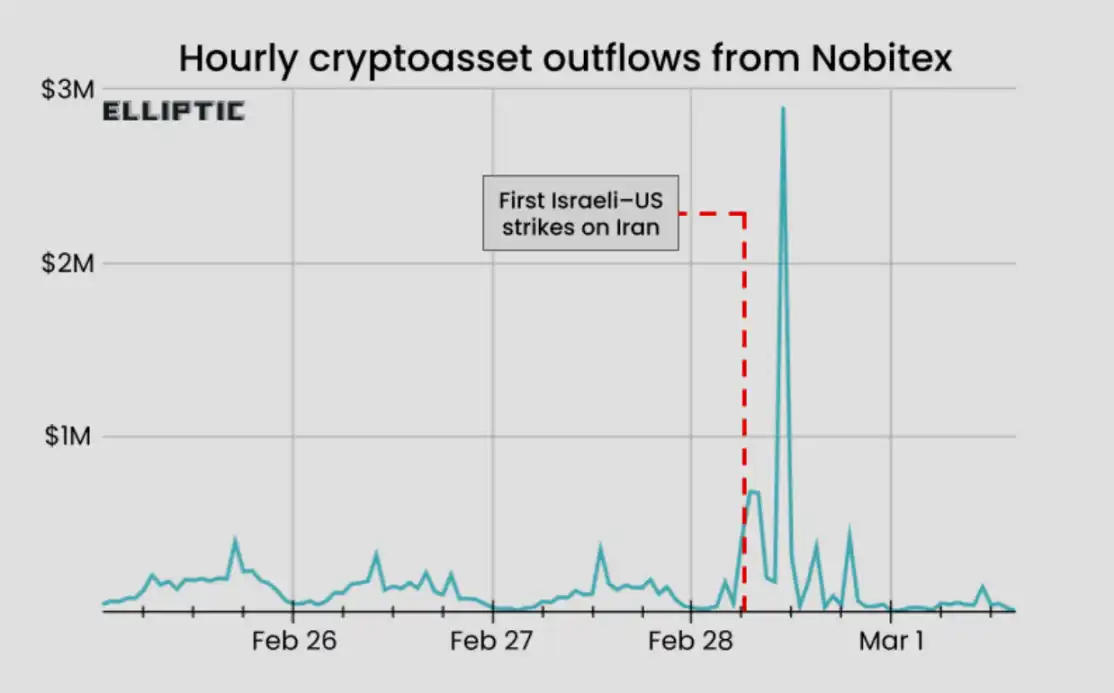
Subsequently, shortly after the US announced sanctions on Iran, cryptocurrency experienced two minor spikes again, indicating that cryptocurrency may be used to try to circumvent these sanctions.
A detailed analysis of the chart data reveals that the baseline of normal outflows from Nobitex before the airstrike was roughly $300-400,000 per hour. The peak outflow of cryptocurrency was about $2.8 million per hour. While the absolute amount is not very large, it reflects a behavioral signal: as soon as the news broke, people's immediate reaction was to move their assets. Furthermore, what Elliptic monitors is only the traceable part on-chain. A large number of Iran's cryptocurrency transactions are conducted off-exchange (OTC) and through P2P channels, which are completely invisible in this data, indicating that the actual outflow volume is even larger.
This is not an isolated incident. Elliptic's tracking shows that since January 2026, Nobitex has experienced multiple outflow peaks: On January 9, mass demonstrations broke out in Iran, prompting the government to impose an internet shutdown. On that day, the outflow hit a yearly high, with assets continuing to flow out even during the network blackout, indicating that some individuals could bypass the blockade to continue operations. Following this, the US Treasury sanctioned two UK-registered exchanges (Zedcex and Zedxion) associated with Iran, causing another brief surge in Nobitex outflows.
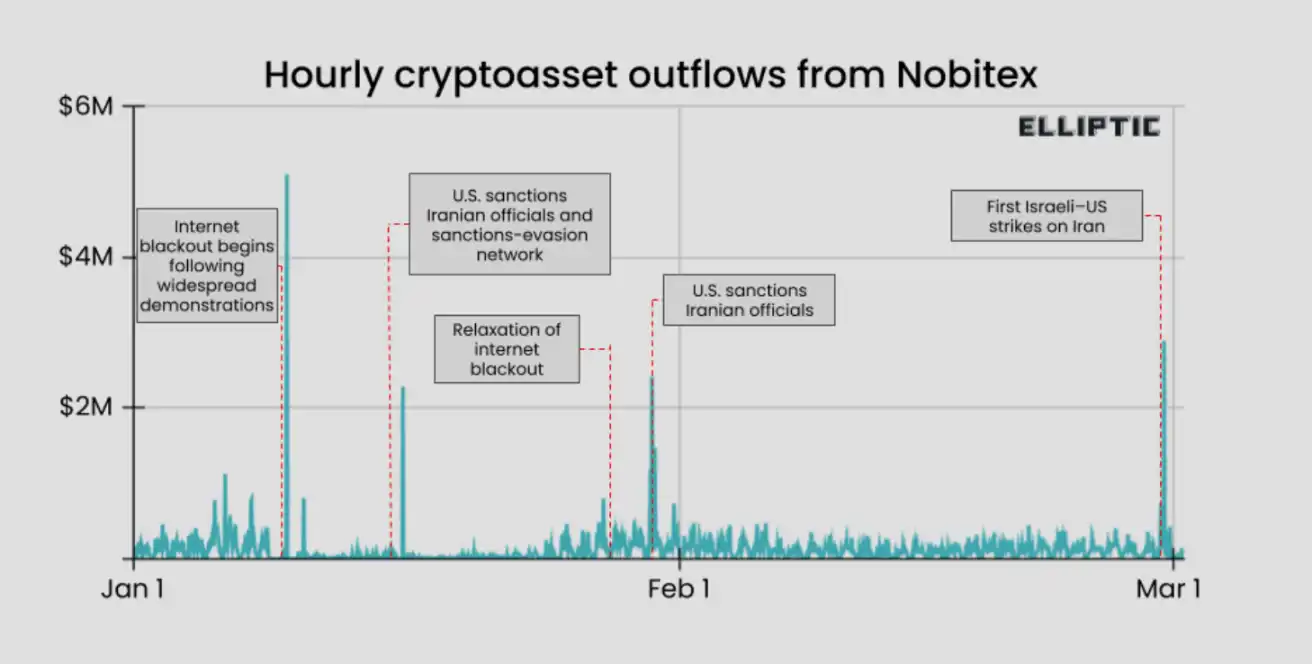
Triple Peak, Three Trigger Points — Sanctions, Internet Shutdown, Airstrike — together outline a pattern: whenever Iran's political or military risk rises, cryptocurrency becomes the first choice for capital flight.
Why Crypto, Not Banks?
The answer to this question lies in Iran's decades-long history of sanctions.
Since the 1979 Islamic Revolution, Iran has been under severe sanctions from the United States and Western countries, cut off from the SWIFT international payment system. Domestic residents can hardly transfer wealth overseas through traditional banking channels. Cryptocurrencies provide a detour: Iranian Rial is exchanged for stablecoins like USDT, then transferred overseas through on-chain transactions to foreign wallets, eventually entering overseas trading platforms. The entire process does not need to go through any traditional banks, and the tentacles of sanctions interception are hard to reach.
The collapse of the Rial also provides the most intuitive escape motive. In early 2025, 1 USD exchanged for about 81.75 million Rials; by January 2026, the exchange rate had dropped to 150 million Rials; after the airstrike, the Rial hit a historic low in a single day, falling to 175 million Rials per 1 USD.
Against the backdrop of long-term international sanctions and geopolitical conflicts, food prices in Iran have risen by over 72% year-on-year, and the national inflation rate has reached 42.5%. At the time of the 1979 Islamic Revolution, 1 USD could only exchange for about 70 Rials. This means that over more than forty years, the purchasing power of the Rial has shrunk by over 25,000 times, and the wealth of the people has been almost ground to powder under the wheel of time.
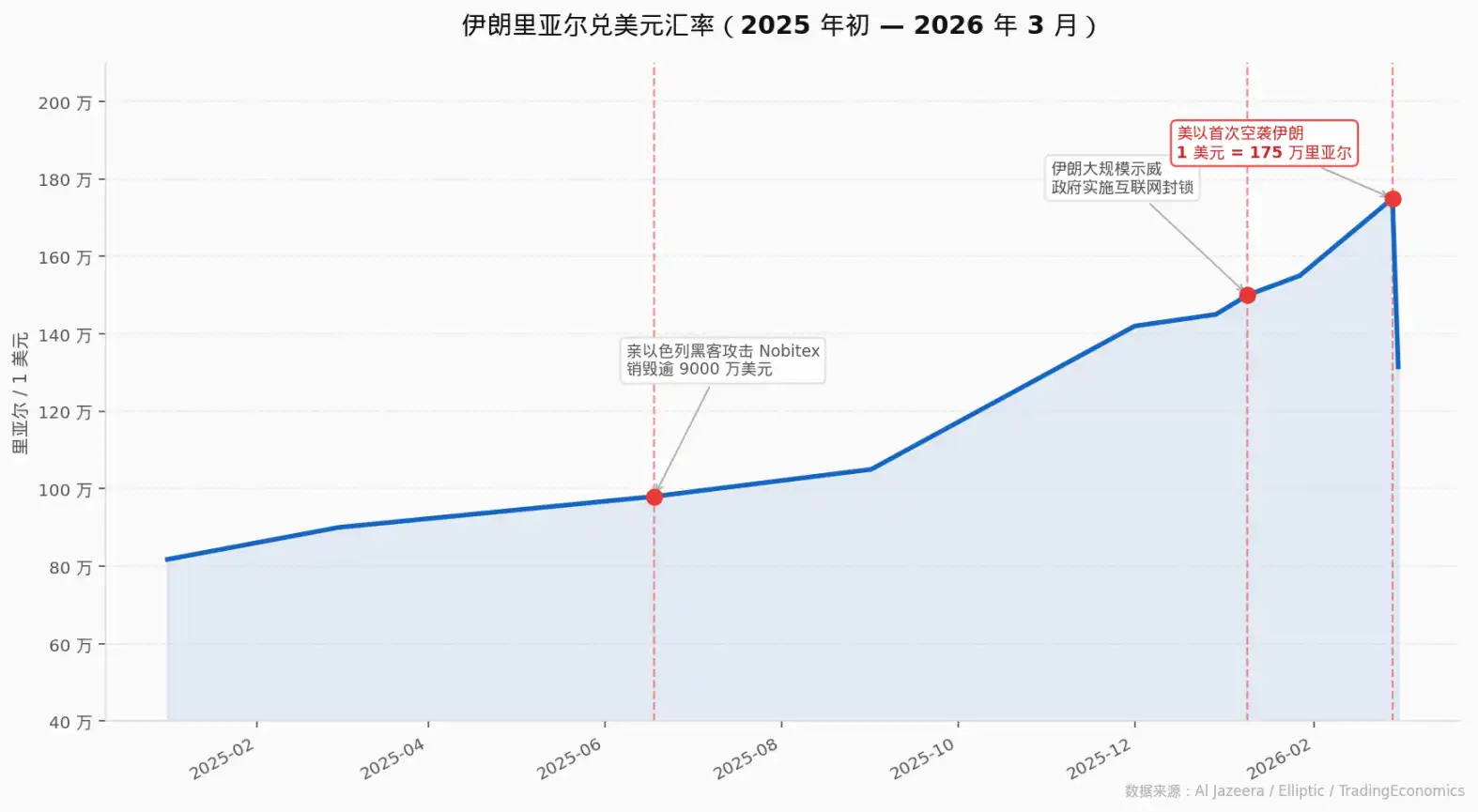
Previously, U.S. Treasury Secretary Benson publicly admitted during a congressional hearing that the United States actively created a shortage of U.S. dollars in Iran, causing the Rial to collapse rapidly, and classified this as part of the U.S.'s strategy against Iran.
What is even more noteworthy is that this route is not only used by ordinary people. Elliptic's research shows that the Central Bank of Iran itself holds at least $500 million in USDT through Nobitex as a reserve means to support the Rial exchange rate and evade sanctions. The government controls crypto on one hand and relies on crypto on the other — this contradiction itself illustrates that cryptocurrency has become irreplaceable in a sanctioned economy.
The Historical Pattern of War and Crypto Outflows
The Iran case is not unique, but a pattern that has been repeated in multiple countries.
In February 2022, Russia invaded Ukraine, prompting the West to impose the harshest-ever financial sanctions on Russia, including excluding its main banks from the SWIFT system. The ruble plummeted, and trading volumes of btc-42">Bitcoin and USDT within Russia quickly surged. However, the situation in Russia differs from that of Iran: constrained by the liquidity of the crypto market, large-scale national sanction evasion is difficult to achieve, and actual outflows are relatively limited.
In August 2021, the Taliban took control of Afghanistan, reaching a peak of about $150 million in cryptocurrency outflows that month, mainly from capital flight by the Kabul elite. The Taliban subsequently announced a ban on cryptocurrency, leading the market to collapse.
Overall, the pattern is clear: War or crisis triggers a surge in cryptocurrency outflows. What sets Iran apart is that the outflows here have formed a systemic rhythm, not just a sporadic response but a normalized channel for capital flight.
You may also like

Consumer-grade Crypto Global Survey: Users, Revenue, and Track Distribution

Prediction Markets Under Bias

Stolen: $290 million, Three Parties Refusing to Acknowledge, Who Should Foot the Bill for the KelpDAO Incident Resolution?

ASTEROID Pumped 10,000x in Three Days, Is Meme Season Back on Ethereum?

ChainCatcher Hong Kong Themed Forum Highlights: Decoding the Growth Engine Under the Integration of Crypto Assets and Smart Economy

Why can this institution still grow by 150% when the scale of leading crypto VCs has shrunk significantly?

Anthropic's $1 trillion, compared to DeepSeek's $100 billion

Geopolitical Risk Persists, Is Bitcoin Becoming a Key Barometer?

Annualized 11.5%, Wall Street Buzzing: Is MicroStrategy's STRC Bitcoin's Savior or Destroyer?

An Obscure Open Source AI Tool Alerted on Kelp DAO's $292 million Bug 12 Days Ago

Mixin has launched USTD-margined perpetual contracts, bringing derivative trading into the chat scene.
The privacy-focused crypto wallet Mixin announced today the launch of its U-based perpetual contract (a derivative priced in USDT). Unlike traditional exchanges, Mixin has taken a new approach by "liberating" derivative trading from isolated matching engines and embedding it into the instant messaging environment.
Users can directly open positions within the app with leverage of up to 200x, while sharing positions, discussing strategies, and copy trading within private communities. Trading, social interaction, and asset management are integrated into the same interface.
Based on its non-custodial architecture, Mixin has eliminated friction from the traditional onboarding process, allowing users to participate in perpetual contract trading without identity verification.
The trading process has been streamlined into five steps:
· Choose the trading asset
· Select long or short
· Input position size and leverage
· Confirm order details
· Confirm and open the position
The interface provides real-time visualization of price, position, and profit and loss (PnL), allowing users to complete trades without switching between multiple modules.
Mixin has directly integrated social features into the derivative trading environment. Users can create private trading communities and interact around real-time positions:
· End-to-end encrypted private groups supporting up to 1024 members
· End-to-end encrypted voice communication
· One-click position sharing
· One-click trade copying
On the execution side, Mixin aggregates liquidity from multiple sources and accesses decentralized protocol and external market liquidity through a unified trading interface.
By combining social interaction with trade execution, Mixin enables users to collaborate, share, and execute trading strategies instantly within the same environment.
Mixin has also introduced a referral incentive system based on trading behavior:
· Users can join with an invite code
· Up to 60% of trading fees as referral rewards
· Incentive mechanism designed for long-term, sustainable earnings
This model aims to drive user-driven network expansion and organic growth.
Mixin's derivative transactions are built on top of its existing self-custody wallet infrastructure, with core features including:
· Separation of transaction account and asset storage
· User full control over assets
· Platform does not custody user funds
· Built-in privacy mechanisms to reduce data exposure
The system aims to strike a balance between transaction efficiency, asset security, and privacy protection.
Against the background of perpetual contracts becoming a mainstream trading tool, Mixin is exploring a different development direction by lowering barriers, enhancing social and privacy attributes.
The platform does not only view transactions as execution actions but positions them as a networked activity: transactions have social attributes, strategies can be shared, and relationships between individuals also become part of the financial system.
Mixin's design is based on a user-initiated, user-controlled model. The platform neither custodies assets nor executes transactions on behalf of users.
This model aligns with a statement issued by the U.S. Securities and Exchange Commission (SEC) on April 13, 2026, titled "Staff Statement on Whether Partial User Interface Used in Preparing Cryptocurrency Securities Transactions May Require Broker-Dealer Registration."
The statement indicates that, under the premise where transactions are entirely initiated and controlled by users, non-custodial service providers that offer neutral interfaces may not need to register as broker-dealers or exchanges.
Mixin is a decentralized, self-custodial privacy wallet designed to provide secure and efficient digital asset management services.
Its core capabilities include:
· Aggregation: integrating multi-chain assets and routing between different transaction paths to simplify user operations
· High liquidity access: connecting to various liquidity sources, including decentralized protocols and external markets
· Decentralization: achieving full user control over assets without relying on custodial intermediaries
· Privacy protection: safeguarding assets and data through MPC, CryptoNote, and end-to-end encrypted communication
Mixin has been in operation for over 8 years, supporting over 40 blockchains and more than 10,000 assets, with a global user base exceeding 10 million and an on-chain self-custodied asset scale of over $1 billion.

$600 million stolen in 20 days, ushering in the era of AI hackers in the crypto world
Vitalik's 2026 Hong Kong Web3 Summit Speech: Ethereum's Ultimate Vision as the "World Computer" and Future Roadmap
On the same day Aave introduced rsETH, why did Spark decide to exit?
Full Post-Mortem of the KelpDAO Incident: Why Did Aave, Which Was Not Compromised, End Up in Crisis Situation?

After a $290 million DeFi liquidation, is the security promise still there?
ZachXBT's post ignites RAVE nearing zero, what is the truth behind the insider control?




 App
App