
After Losing $5.5 Billion in 15 Minutes, Why Did "Meme Coin" OM Experience a 4x Surge?
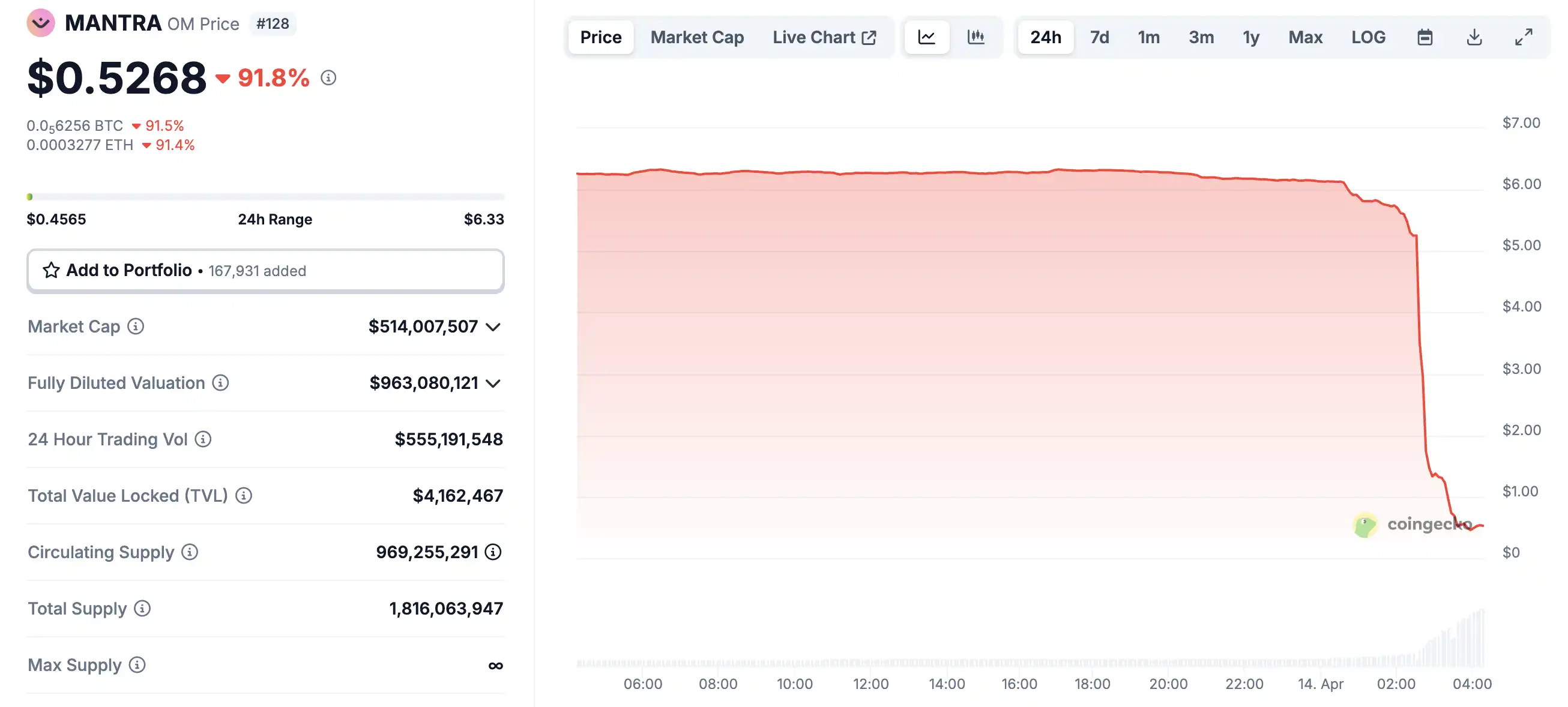
In the early hours, the RWA sector project MANTRA (OM) experienced a rapid 90% drop, plummeting from $6 to $0.5, causing its market capitalization to shrink by over $5.5 billion.
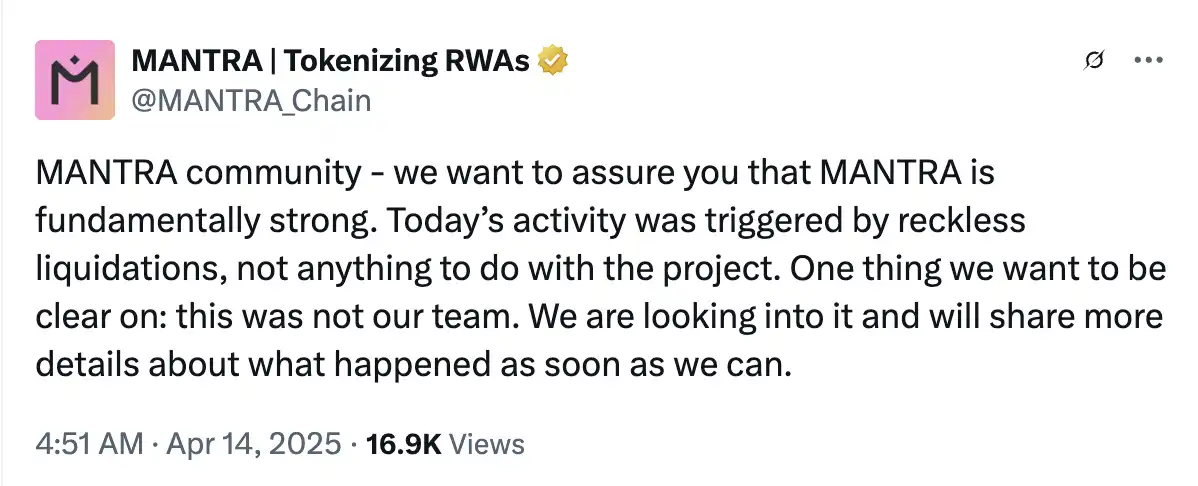
Three hours later, the MANTRA team released a statement attributing the sharp decline to an irrational liquidation event unrelated to the project itself, affirming that it was not initiated by the team.
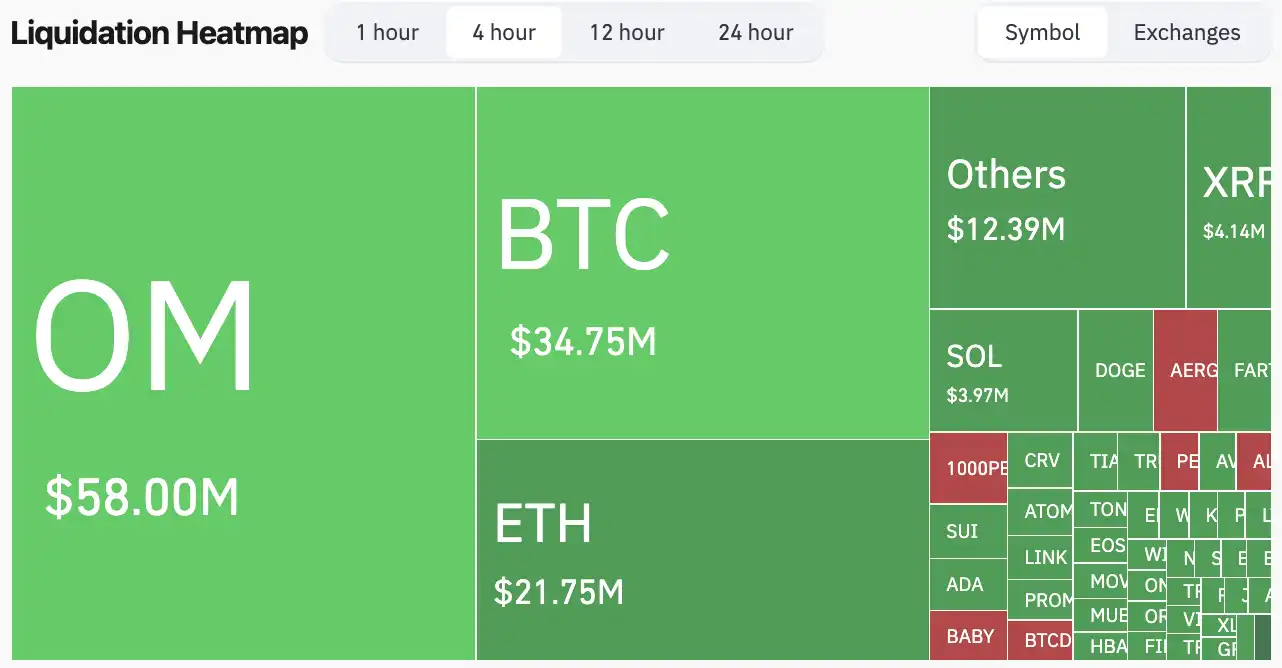
Subsequently, OM surged from around $0.5 to $1.2, experiencing a brief pump. According to Coinglass data, within just four hours, the OM contract saw liquidations totaling $58 million.
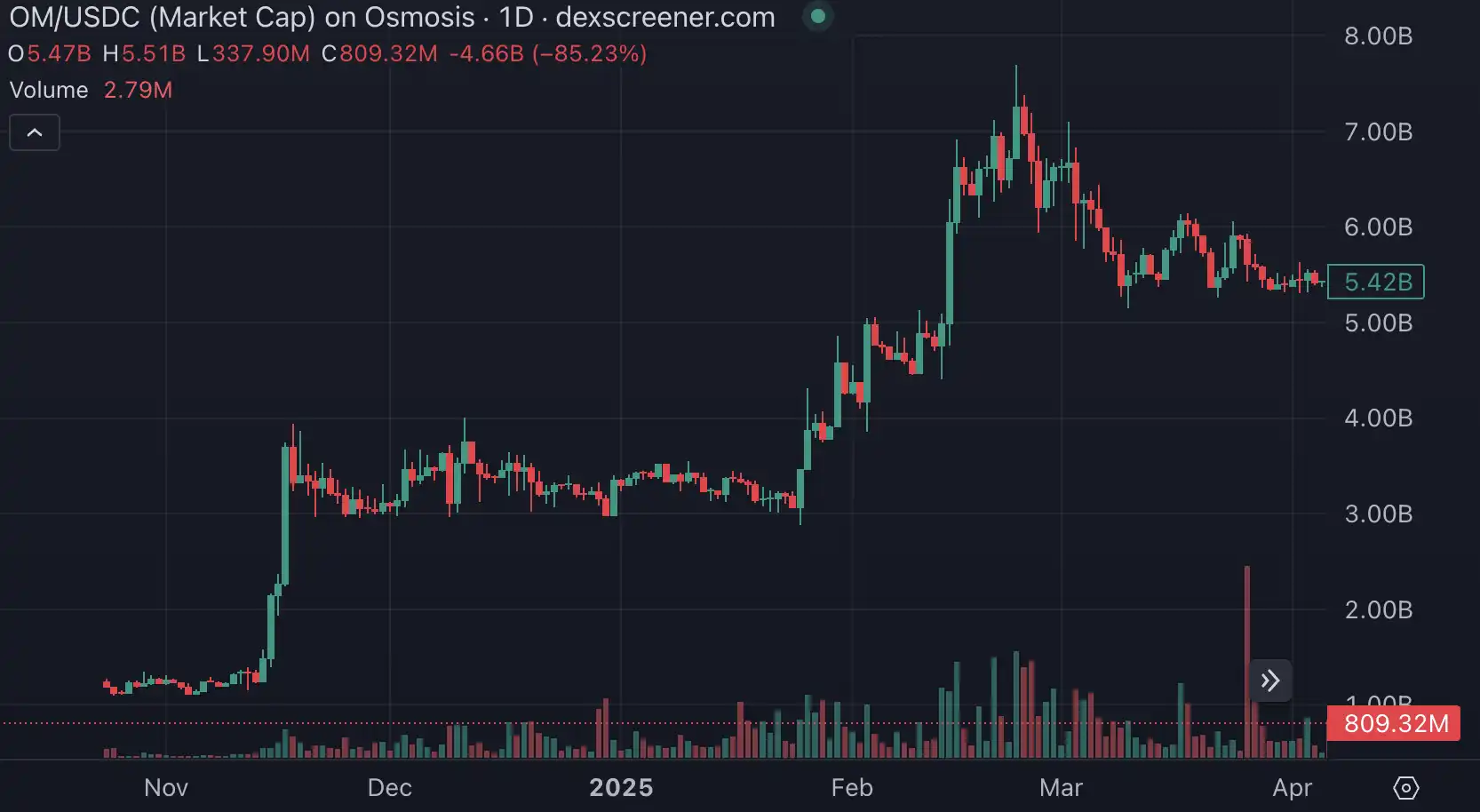
Prior to this crash, OM had gone through multiple violent upswing phases since November last year, earning the nickname "Strong Pump Shitcoin" from the community.
OTC Trading or Team Dump? The Turbulent Life of OM's Whale-Dominated Supply
Recently, the community and various data tracking tools reported that whale addresses of OM had been withdrawing and sending funds to exchanges, with rumors suggesting that several off-exchange trades at a 50% discount or higher had been completed. When large holders start dumping, off-exchange buyers also panic sell.
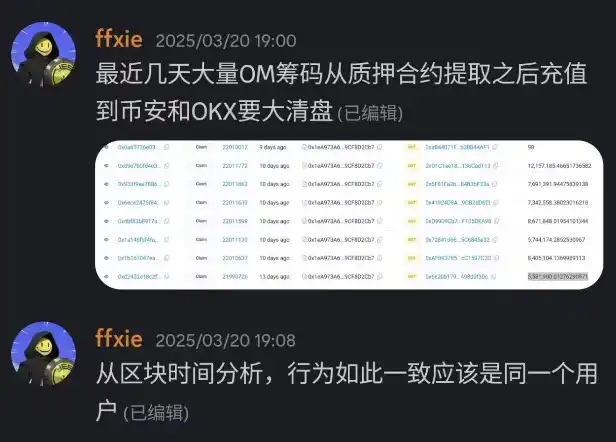
On March 25, according to TheDataNerd's monitoring, the investment firm Laser Digital's address of MANTRA deposited 1.7 million OM to Binance, worth $11.49 million. The wallet had accumulated a total of 27 million OM last year and still holds 6.756 million OM, valued at $45.67 million.
Yesterday, as per Arkham's tracking, the address 0xA8...A84f withdrew 776,000 OM from Polygon's StakedOM contract, approximately worth $5.84 million.
Additionally, as observed by Genç Trader, the wallet address 0x9a…1a28 transferred around $20 million worth of OM to OKX 23 hours ago. Looking at past records, this address had withdrawn about $40 million worth of OM from Binance just a month ago and was one of the whales that had previously pumped the coin's price.
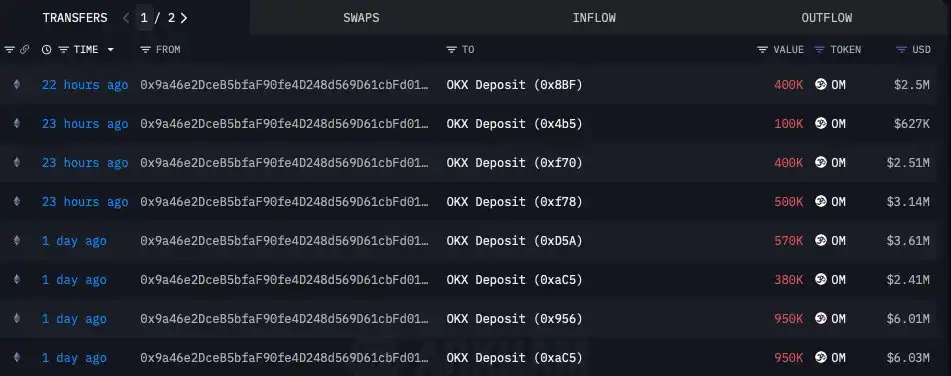
The dumping of OM by several whales is believed to be the direct cause of this recent crash, but some in the community speculate that it may have been premeditated.
PUA Airdrop
Last November, MANTRA announced a change to its airdrop rules, shifting from the previous "3-month cliff period followed by initial liquidity distribution and 9-month linear unlock" to "shortening the cliff period to 1 month, followed by an 11-month linear unlock," triggering strong community dissatisfaction.
Initially, MANTRA used high-profile expectation management to spark user participation, claiming to distribute 50 million OM tokens and promising a 20% immediate unlock on listing, with the airdrop to be completed within a month.
However, in actual implementation, MANTRA successively amended the airdrop rules, first changing the "immediate unlock on listing" to "start of linear release after one month," further delaying it to "10% initial release, with the rest vesting over three years." Simultaneously, with several mechanism changes such as roadmap adjustments and token distribution structures, MANTRA effectively transformed community traffic into a long-term lock-up tool by continually extending the vesting period.
When user sentiment rebounded, the project team introduced a governance voting mechanism to shift responsibility under the guise of "community consensus." However, in practice, the voting rights were concentrated in the hands of the project team or affiliated parties, resulting in high controllability. Finally, some early participants were excluded from the airdrop list, with the project team freezing their stakes citing a "Sybil attack" without disclosing detailed justifications.
High Token Control
The reason OM has been continuously pumped over the past six months is due to its team's significant token control. According to KOL @nihaovand, it usually involves coordinating three waves of community buy-ins at different price ranges to collectively drive up the token price. At the same time, the project team arranges an off-chain exit path for holders. The funds obtained from these exits are then used to boost the coin's price, laying the groundwork for the next wave of off-chain capital influx.
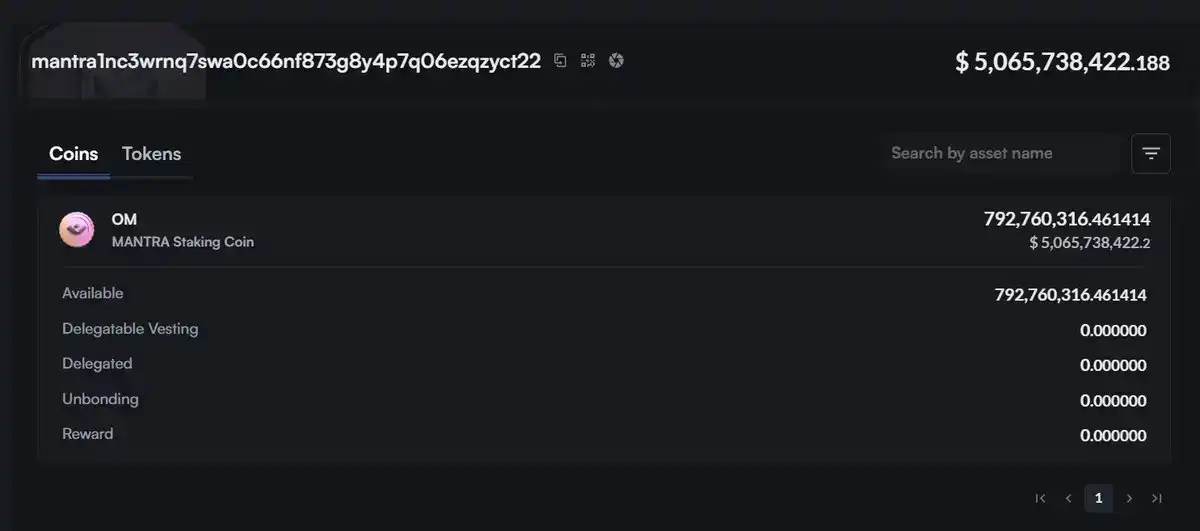
Previously, there were multiple reports alleging that the MANTRA team held 90% of the OM token's supply. Crypto analyst Mosi once wrote an article analyzing how a project with only a $4 million TVL could have over a $10 billion FDV, with the answer being that the team controlled most of the OM circulating supply. The MANTRA team holds 792M OM in a single wallet (90% of the supply), with the team even being too lazy to spread this supply across multiple wallets.
Related reading: "False Circulating Supply, High-profile Pump and Dump: Exposing the Manipulation of High FDV Tokens"
What Is the Actual Circulating Supply of OM?
According to Mosi's analysis, the actual circulating supply of OM = 980 million OM (circulating supply) - 792 million OM (team-controlled portion) = 188 million OM
However, this number may not be accurate either. The team still controls a significant portion of OM, using these tokens to perform a rug pull on their own airdrop, further draining liquidity, and continuing to control the circulating supply. They deployed around 100 million OM for a rug pull on their own airdrop, so this portion of tokens also needs to be deducted from the actual circulating supply.
Ultimately, the actual circulating supply of OM may be only 88 million OM, and the lower actual circulating supply makes it easy to manipulate the price of OM and easily liquidate any short positions. Traders should be wary of shorting OM as the team holds a large portion of the circulating supply, allowing them to easily pump or dump the price.
Mosi believes that Tritaurian Capital may be involved behind OM—this company borrowed $1.5 million from @SOMA_finance (@jp_mullin888 is a co-founder of SOMA, while Tritaurian is owned by Jim Preissler, former CEO of JP Morgan at Trade.io)—as well as some funds and market makers from the Middle East. These operations further compress the actual circulating supply, making its calculation more challenging.
This may also explain why they are unwilling to release the airdrop and have decided to implement a lock-up period. If they did carry out the airdrop, the actual circulating supply would significantly increase, potentially leading to a sharp price drop.
This is not some complex financial engineering, but it seems to be a deliberate plan aimed at reducing the token's actual circulating supply and easily pumping or dumping the price of OM.
You may also like

Anthropic's $1 trillion, compared to DeepSeek's $100 billion

Geopolitical Risk Persists, Is Bitcoin Becoming a Key Barometer?

Annualized 11.5%, Wall Street Buzzing: Is MicroStrategy's STRC Bitcoin's Savior or Destroyer?

An Obscure Open Source AI Tool Alerted on Kelp DAO's $292 million Bug 12 Days Ago

Mixin has launched USTD-margined perpetual contracts, bringing derivative trading into the chat scene.
The privacy-focused crypto wallet Mixin announced today the launch of its U-based perpetual contract (a derivative priced in USDT). Unlike traditional exchanges, Mixin has taken a new approach by "liberating" derivative trading from isolated matching engines and embedding it into the instant messaging environment.
Users can directly open positions within the app with leverage of up to 200x, while sharing positions, discussing strategies, and copy trading within private communities. Trading, social interaction, and asset management are integrated into the same interface.
Based on its non-custodial architecture, Mixin has eliminated friction from the traditional onboarding process, allowing users to participate in perpetual contract trading without identity verification.
The trading process has been streamlined into five steps:
· Choose the trading asset
· Select long or short
· Input position size and leverage
· Confirm order details
· Confirm and open the position
The interface provides real-time visualization of price, position, and profit and loss (PnL), allowing users to complete trades without switching between multiple modules.
Mixin has directly integrated social features into the derivative trading environment. Users can create private trading communities and interact around real-time positions:
· End-to-end encrypted private groups supporting up to 1024 members
· End-to-end encrypted voice communication
· One-click position sharing
· One-click trade copying
On the execution side, Mixin aggregates liquidity from multiple sources and accesses decentralized protocol and external market liquidity through a unified trading interface.
By combining social interaction with trade execution, Mixin enables users to collaborate, share, and execute trading strategies instantly within the same environment.
Mixin has also introduced a referral incentive system based on trading behavior:
· Users can join with an invite code
· Up to 60% of trading fees as referral rewards
· Incentive mechanism designed for long-term, sustainable earnings
This model aims to drive user-driven network expansion and organic growth.
Mixin's derivative transactions are built on top of its existing self-custody wallet infrastructure, with core features including:
· Separation of transaction account and asset storage
· User full control over assets
· Platform does not custody user funds
· Built-in privacy mechanisms to reduce data exposure
The system aims to strike a balance between transaction efficiency, asset security, and privacy protection.
Against the background of perpetual contracts becoming a mainstream trading tool, Mixin is exploring a different development direction by lowering barriers, enhancing social and privacy attributes.
The platform does not only view transactions as execution actions but positions them as a networked activity: transactions have social attributes, strategies can be shared, and relationships between individuals also become part of the financial system.
Mixin's design is based on a user-initiated, user-controlled model. The platform neither custodies assets nor executes transactions on behalf of users.
This model aligns with a statement issued by the U.S. Securities and Exchange Commission (SEC) on April 13, 2026, titled "Staff Statement on Whether Partial User Interface Used in Preparing Cryptocurrency Securities Transactions May Require Broker-Dealer Registration."
The statement indicates that, under the premise where transactions are entirely initiated and controlled by users, non-custodial service providers that offer neutral interfaces may not need to register as broker-dealers or exchanges.
Mixin is a decentralized, self-custodial privacy wallet designed to provide secure and efficient digital asset management services.
Its core capabilities include:
· Aggregation: integrating multi-chain assets and routing between different transaction paths to simplify user operations
· High liquidity access: connecting to various liquidity sources, including decentralized protocols and external markets
· Decentralization: achieving full user control over assets without relying on custodial intermediaries
· Privacy protection: safeguarding assets and data through MPC, CryptoNote, and end-to-end encrypted communication
Mixin has been in operation for over 8 years, supporting over 40 blockchains and more than 10,000 assets, with a global user base exceeding 10 million and an on-chain self-custodied asset scale of over $1 billion.

$600 million stolen in 20 days, ushering in the era of AI hackers in the crypto world

Vitalik's 2026 Hong Kong Web3 Summit Speech: Ethereum's Ultimate Vision as the "World Computer" and Future Roadmap

On the same day Aave introduced rsETH, why did Spark decide to exit?

Full Post-Mortem of the KelpDAO Incident: Why Did Aave, Which Was Not Compromised, End Up in Crisis Situation?

After a $290 million DeFi liquidation, is the security promise still there?

ZachXBT's post ignites RAVE nearing zero, what is the truth behind the insider control?

Vitalik 2026 Hong Kong Web3 Carnival Speech Transcript: We do not compete on speed; security and decentralization are the core

In-depth Analysis of RAVE Events: Short Squeeze, Crash, and Quantitative Financial Models of Liquidity Manipulation

Eve of Ceasefire, US Military Fires on Iranian Vessel | Rewire News Morning Brief

Figma's stock price drops over 7%, will Claude Design be the terminator?

Plunge by 10% Followed by Rebound, Weekend Oil Market Watch

SpaceX Mascot ASTEROID Fast Track $170 million, Stemming from an Unfinished Space Dream

L1 is dead, Appchain should rise
Anthropic's $1 trillion, compared to DeepSeek's $100 billion
Geopolitical Risk Persists, Is Bitcoin Becoming a Key Barometer?
Annualized 11.5%, Wall Street Buzzing: Is MicroStrategy's STRC Bitcoin's Savior or Destroyer?
An Obscure Open Source AI Tool Alerted on Kelp DAO's $292 million Bug 12 Days Ago
Mixin has launched USTD-margined perpetual contracts, bringing derivative trading into the chat scene.
The privacy-focused crypto wallet Mixin announced today the launch of its U-based perpetual contract (a derivative priced in USDT). Unlike traditional exchanges, Mixin has taken a new approach by "liberating" derivative trading from isolated matching engines and embedding it into the instant messaging environment.
Users can directly open positions within the app with leverage of up to 200x, while sharing positions, discussing strategies, and copy trading within private communities. Trading, social interaction, and asset management are integrated into the same interface.
Based on its non-custodial architecture, Mixin has eliminated friction from the traditional onboarding process, allowing users to participate in perpetual contract trading without identity verification.
The trading process has been streamlined into five steps:
· Choose the trading asset
· Select long or short
· Input position size and leverage
· Confirm order details
· Confirm and open the position
The interface provides real-time visualization of price, position, and profit and loss (PnL), allowing users to complete trades without switching between multiple modules.
Mixin has directly integrated social features into the derivative trading environment. Users can create private trading communities and interact around real-time positions:
· End-to-end encrypted private groups supporting up to 1024 members
· End-to-end encrypted voice communication
· One-click position sharing
· One-click trade copying
On the execution side, Mixin aggregates liquidity from multiple sources and accesses decentralized protocol and external market liquidity through a unified trading interface.
By combining social interaction with trade execution, Mixin enables users to collaborate, share, and execute trading strategies instantly within the same environment.
Mixin has also introduced a referral incentive system based on trading behavior:
· Users can join with an invite code
· Up to 60% of trading fees as referral rewards
· Incentive mechanism designed for long-term, sustainable earnings
This model aims to drive user-driven network expansion and organic growth.
Mixin's derivative transactions are built on top of its existing self-custody wallet infrastructure, with core features including:
· Separation of transaction account and asset storage
· User full control over assets
· Platform does not custody user funds
· Built-in privacy mechanisms to reduce data exposure
The system aims to strike a balance between transaction efficiency, asset security, and privacy protection.
Against the background of perpetual contracts becoming a mainstream trading tool, Mixin is exploring a different development direction by lowering barriers, enhancing social and privacy attributes.
The platform does not only view transactions as execution actions but positions them as a networked activity: transactions have social attributes, strategies can be shared, and relationships between individuals also become part of the financial system.
Mixin's design is based on a user-initiated, user-controlled model. The platform neither custodies assets nor executes transactions on behalf of users.
This model aligns with a statement issued by the U.S. Securities and Exchange Commission (SEC) on April 13, 2026, titled "Staff Statement on Whether Partial User Interface Used in Preparing Cryptocurrency Securities Transactions May Require Broker-Dealer Registration."
The statement indicates that, under the premise where transactions are entirely initiated and controlled by users, non-custodial service providers that offer neutral interfaces may not need to register as broker-dealers or exchanges.
Mixin is a decentralized, self-custodial privacy wallet designed to provide secure and efficient digital asset management services.
Its core capabilities include:
· Aggregation: integrating multi-chain assets and routing between different transaction paths to simplify user operations
· High liquidity access: connecting to various liquidity sources, including decentralized protocols and external markets
· Decentralization: achieving full user control over assets without relying on custodial intermediaries
· Privacy protection: safeguarding assets and data through MPC, CryptoNote, and end-to-end encrypted communication
Mixin has been in operation for over 8 years, supporting over 40 blockchains and more than 10,000 assets, with a global user base exceeding 10 million and an on-chain self-custodied asset scale of over $1 billion.