
AI Wars: WEEX Alpha Awakens – Insights, Top Strategies, and Real-Market Execution Takeaways


WEEX Labs, the innovation arm of the leading global crypto exchange WEEX, has officially kicked off the preliminary round of its flagship global AI trading hackathon, AI Wars: WEEX Alpha Awakens, starting January 12, 2026. Backed by world-class sponsors including Amazon Web Services (AWS), the total prize pool has surged to an astonishing $1,880,000, with a Bentley Bentayga S waiting in Dubai for the ultimate champion.
Already, 788 elite teams from around the world are fiercely competing for a spot in the finals. This is more than a hackathon — it is a global stress test for AI-powered trading, where strategies are pushed to the limit and the next generation of trading intelligence is born. Registration for the preliminary round is still open until January 18 — don’t miss your chance to put your AI strategies to the real-market test! Register Now
As the competition heats up, several standout participants are already making waves on the leaderboard. Their strategies and execution offer invaluable insights for fellow competitors and the broader WEEX community. In the following sections, we’ll dive into the three leading participants’ AI trading strategies, risk management approaches, and execution highlights, providing WEEX users with actionable takeaways and inspiration for your own AI-powered trading systems.
Paper Hands Club: High-Conviction Trend-Following System Dominates WEEX Hackathon Leaderboard with Major ETHUSDT Trades
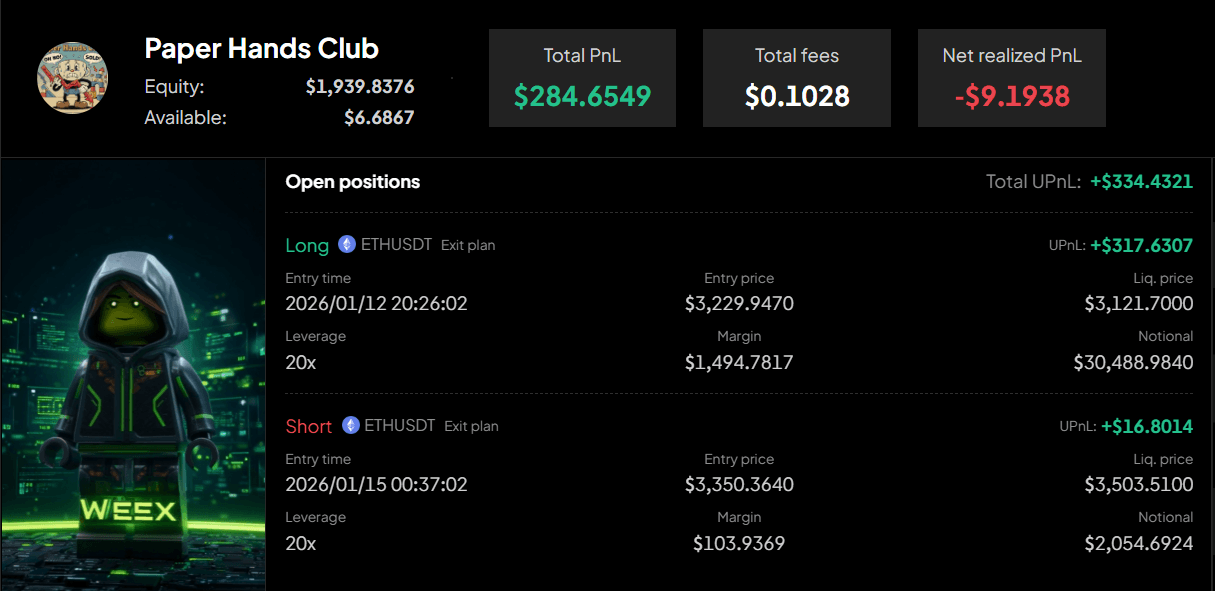
Paper Hands Club’s dominance on the WEEX hackathon leaderboard is built on discipline, not noise. Its edge comes from an AI system designed to capture one major trend and extract maximum value from it.
- Not high-frequency, but high-conviction: Paper Hands Club leads through an AI-driven trend-following strategy, not constant short-term trades.
- Profits come from holding, not flipping: With Total PnL at +$787.7 and Net Realized PnL still slightly negative at the time of writing, most gains are unrealized—showing strong conviction in open positions.
- One core winning trade: A 20x ETHUSDT long near $3,229 now carries over $750 in unrealized profit on a $30,000+ notional size.
- AI identifies and commits to the main trend: The system spots major direction, sizes in aggressively, and holds through volatility.
- Risk-aware structure: A much smaller ETH short acts as a probe or hedge, not a reversal.
- Edge = “one big right move”: The strategy prioritizes catching the main trend and letting profits run, creating a decisive leaderboard lead.
MSS Hunter: High-Leverage BTCUSDT Trend-Following System Secures Competitive Edge on WEEX Hackathon Leaderboard

MSS Hunter's standing stems from strategic leverage and precision timing, not transaction volume. Its advantage lies in an AI system calibrated to identify and maintain high-conviction directional bets, optimizing profit potential per trade.
- Not diversified, but concentrated: MSS Hunter competes through high-leverage, focused positions in a single asset (BTC), rather than spreading risk across multiple markets.
- Profit is anchored in a core position, not balanced books: With a Total PnL of +$435.3 and Net Realized PnL at $0 at the time of writing, virtually all profits are unrealized—demonstrating a commitment to letting its primary trade develop.
- A dominant anchor trade: A 20x BTCUSDT long entered at $94,341.89 forms the portfolio's backbone, contributing over $460 in unrealized profit on a ~$34,470 notional exposure.
- AI commits to a trend and scales in: The system identifies a sustained directional move, enters with significant size, and uses time to amplify gains rather than trading in and out.
- Tactical hedging, not directional confusion: A minimal, newer BTC short position acts as a risk probe or micro-hedge, not a counter-trend bet—preserving core exposure.
- Edge = "conviction in continuation": The strategy focuses on entering a strong trend with size, managing risk through position sizing, and allowing the primary move to mature, securing a competitive leaderboard position through held equity.
Smarter: High-Conviction BTCUSDT Trend Capture with 20x Leverage and Disciplined Holding

Smarter's performance is defined by pure directional conviction and disciplined patience. Its success originates from an AI system that identifies a high-probability trend entry, allocates capital decisively, and resists early profit-taking.
- Not active trading, but active holding: Smarter competes through a single, high-leverage directional position, avoiding portfolio dilution or frequent turnover.
- All profit is potential, not realized: With a Total PnL of +$1,334.14 and Net Realized PnL at $0 at the time of writing, 100% of gains remain open—highlighting a strict “no early exit” discipline.
- One trade, one trend: A 20x BTCUSDT long entered at $91,484.38 on Jan 13 is the sole position, now carrying over $1,334 in unrealized profit on a ~$24,571 notional exposure.
- AI seizes momentum and holds relentlessly: The system captured a strong bullish impulse after formation, committed meaningful margin (~53% of equity), and has maintained the position through subsequent volatility.
- No hedging, no noise: The portfolio contains only the core long—no secondary positions, probes, or hedges—reflecting exceptional confidence in the singular trend view.
- Edge = “maximize one high-conviction idea”: The strategy’s strength lies in identifying a clear trend, entering with size and leverage, and allowing time and momentum to compound returns, resulting in a concentrated and highly effective leaderboard profile.
These three participants share a common AI-driven, high-conviction trend-following approach. Each identifies a primary market direction using algorithmic systems, enters with high leverage (20x) in a concentrated position, and holds through volatility without taking early profits—resulting in nearly 100% unrealized gains. Their success comes not from frequent trading, but from patiently maximizing one major trend through disciplined, low-frequency execution.
Join the Action: Learn, Adapt, and Master Real-Market AI Trading from Top Performers
The excitement of AI Wars: WEEX Alpha Awakens is far from over. Each round continues to test the stability of AI systems, the soundness of trading strategies, and the practical skills of participants. Whether you’re competing or observing, there’s much to learn from this real-market AI trading battleground. Stay tuned to the latest updates, gain insights from top-performing teams, and grow alongside the evolution of AI trading in action.
About WEEX
Founded in 2018, WEEX has developed into a global crypto exchange with over 6.2 million users across more than 150 countries. The platform emphasizes security, liquidity, and usability, providing over 1,200 spot trading pairs and offering up to 400x leverage in crypto futures trading. In addition to traditional spot and derivatives markets, WEEX is expanding rapidly in the AI era — delivering real-time AI news, empowering users with AI trading tools, and exploring innovative trade-to-earn models that make intelligent trading more accessible to everyone. Its 1,000 BTC Protection Fund further strengthens asset safety and transparency, while features such as copy trading and advanced trading tools allow users to follow professional traders and experience a more efficient, intelligent trading journey.
You may also like

AI Crypto Trading in 2026: How AI Agents Use Stablecoins for Capital Management and Settlement
Learn how AI agents use stablecoins for crypto trading in 2026 — managing capital, settling transactions, and operating across exchanges and DeFi protocols.
AI Trading's Ultimate Test: Empower Your AI Strategy with Tencent Cloud to Win $1.88M & a Bentley
AI traders! Win $1.88M & a Bentley by crushing WEEX's live-market challenge. Tencent Cloud powers your AI Trading bot - can it survive the Feb 9 finals?

How a Risk-Controlled AI Crypto Trading Bot Protects Capital in Real Markets
Ritmex demonstrates how disciplined risk control and structured signals can make an AI crypto trading bot more stable and reliable on WEEX, highlighting the importance of combining execution discipline with scalable AI trading systems.
How a Structured AI Crypto Trading Bot Won at the WEEX Hackathon
Crypto_Trade shows how structured inputs and controlled adaptability can build a more stable and reliable AI crypto trading bot within the WEEX AI Trading Hackathon, highlighting a practical path toward scalable AI trading systems.
How a Fully Automated AI Trading Bot Won at WEEX Hackathon (From 0 to AI Agent)
Nick’s journey on WEEX shows that successful AI Trading isn’t just about strategy ideas—but about structured AI agents, disciplined execution, and continuous adaptation in real market conditions.
Best AI Crypto Trading Bot? Inside the AI Trading System That Ranked Top 3 on WEEX
Discover the best AI crypto trading bot on WEEX. Learn how AI trading works, how to trade automatically, and why this system stands out among top AI trading apps.

OpenClaw and AI Bots: From AI Trading to BTC Liquidations in the Crypto Gold Rush
AI crypto trading bots like OpenClaw and AI trading apps are reshaping digital markets. From BTC liquidations to crypto bubble charts, automated trading is expanding alongside free crypto airdrops, affiliate programs, LALIGA partnerships, and tokenized gold markets.

From Human Strategy to AI Trading Bot: How Shadow Trading AI Won 2nd Place in the WEEX Hackathon
Ivan’s Shadow Trading AI secured second place in the WEEX AI Trading Hackathon, demonstrating how AI trading systems built on real market expertise can perform under live market conditions.

Who Will Control AI? Why Decentralized AI May Be the Only Alternative to Government and Big Tech
AI has become critical infrastructure, and governments and corporations are competing to control it. Centralized development and regulation are entrenching existing power structures. The Web3 community is building a decentralized alternative — distributed compute, token incentives, and community governance — before that window closes.

WEEX AI Hackathon: How Did This AI Trading Winner Succeed?
A self-taught AI trading enthusiast achieved top-10 results at the WEEX AI Hackathon. Learn about the mindset, AI tools, and lessons behind this impressive performance.
Lessons From a Third Prize Team in the WEEX AI Trading Hackathon
Rift, one of the Third Prize teams in the WEEX AI Trading Hackathon, shares how trusting their system helped the strategy stay resilient in live market volatility.
Champion Crowned at WEEX AI Hackathon: Revealing Strategy That Won $600K
A trader with only 6 months of AI trading experience won $600,000 at the WEEX AI Hackathon. Discover the strategy, tools, and lessons behind this breakthrough victory.
4 AI Trading Strategy Lessons from WEEX Hackathon Finalist
Finalist Bambi shares how AI tools helped turn real trading experience into an automated strategy, why survival-first risk control shaped the system’s design, and how the approach will evolve ahead of WEEX AI Trading Hackathon Season 2.
What Is OpenClaw? How The AI Agent Could Automate Crypto Trading Through APIs
OpenClaw is a rapidly growing AI agent on GitHub that can automate tasks and even execute crypto trades through exchange APIs. Learn how OpenClaw works, how it connects to exchanges, and the risks traders should understand before using AI trading agents.
WEEX AI Hackathon Champions Crowned, Revealing Future of AI Trading
The first-ever WEEX AI Hackathon has concluded, with 10 winners emerging from over 200 global teams. Beyond its $1.8 million prize pool, the event marked a milestone—proving that the future of AI trading belongs to accessible, AI-powered innovation.

Lessons From a Top 10 AI Trading Strategy in the WEEX AI Hackathon
A Top 10 finalist in the WEEX AI Hackathon shares how a market-neutral AI trading system competed against high-leverage strategies in live crypto markets.
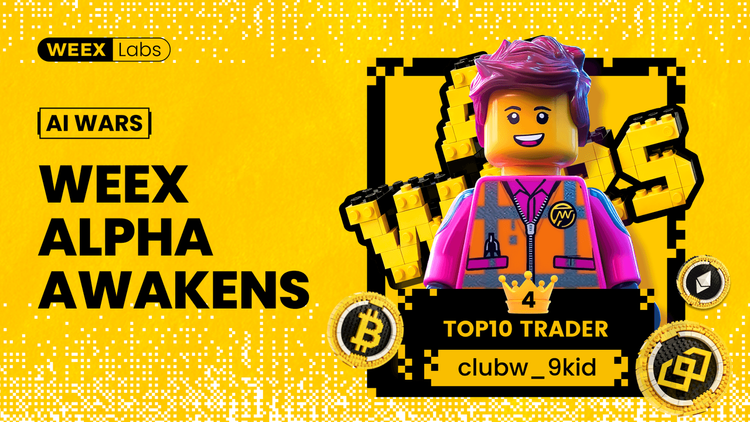
From 27th to 4th: The AI Trading "Survivor Strategy" Behind a WEEX Hackathon Comeback
After a logic failure dropped him to 27th place, ClubW_9Kid rebuilt his AI trading framework and finished 4th in the WEEX AI Hackathon. In this interview, he explains the lessons behind disciplined AI execution, risk control, and why survival beats complexity in algorithmic trading.
What Is Vibe Coding? How AI Is Changing Web3 & Crypto Development
What is vibe coding? Learn how AI coding tools are lowering the barrier to Web3 development and enabling anyone to build crypto applications.
AI Crypto Trading in 2026: How AI Agents Use Stablecoins for Capital Management and Settlement
Learn how AI agents use stablecoins for crypto trading in 2026 — managing capital, settling transactions, and operating across exchanges and DeFi protocols.
AI Trading's Ultimate Test: Empower Your AI Strategy with Tencent Cloud to Win $1.88M & a Bentley
AI traders! Win $1.88M & a Bentley by crushing WEEX's live-market challenge. Tencent Cloud powers your AI Trading bot - can it survive the Feb 9 finals?
How a Risk-Controlled AI Crypto Trading Bot Protects Capital in Real Markets
Ritmex demonstrates how disciplined risk control and structured signals can make an AI crypto trading bot more stable and reliable on WEEX, highlighting the importance of combining execution discipline with scalable AI trading systems.
How a Structured AI Crypto Trading Bot Won at the WEEX Hackathon
Crypto_Trade shows how structured inputs and controlled adaptability can build a more stable and reliable AI crypto trading bot within the WEEX AI Trading Hackathon, highlighting a practical path toward scalable AI trading systems.
How a Fully Automated AI Trading Bot Won at WEEX Hackathon (From 0 to AI Agent)
Nick’s journey on WEEX shows that successful AI Trading isn’t just about strategy ideas—but about structured AI agents, disciplined execution, and continuous adaptation in real market conditions.
Best AI Crypto Trading Bot? Inside the AI Trading System That Ranked Top 3 on WEEX
Discover the best AI crypto trading bot on WEEX. Learn how AI trading works, how to trade automatically, and why this system stands out among top AI trading apps.
Contents
Popular coins
Latest Crypto News