
Bitcoin Surges Back to $90,000: Which Altcoins Are Worth Watching?



Original Article Title: "WOO X Research: Bitcoin Back to $90,000! Which Altcoins Are Worth Looking Forward To?"
Original Source: WOO
Background: Bitcoin Resurges, Altcoins Still at Lows
Bitcoin retested the $90,000 level on April 23, partly due to the gradually clearing situation in the trade war. U.S. Treasury Secretary Benson expressed that the trade deadlock is unsustainable, and it is expected that the situation will ease in the near future.
On the other hand, recently Trump has been publicly pressuring Federal Reserve Chairman Powell, strongly demanding rate cuts, and even making remarks that Powell will be fired if he doesn't cut rates. This has led to global market doubts about the Fed's independence, resulting in a lack of trust in the U.S. dollar. The latest development is that when asked by the media about the matter, Trump stated: "I have no intention of firing him (Powell). I just hope he is more proactive on the rate cut."
During the time when Trump asked for Powell's resignation, Bitcoin seldom played its role as "digital gold" as a safe haven, with its trend highly correlated with physical gold. Now that Powell's career crisis has been averted, the U.S. stock market has rebounded significantly, and Bitcoin continues to rise. At this point, Bitcoin has once again enjoyed the premium of a liquid asset, with a 12% increase in the past seven days.
In our previous article, we mentioned that although Bitcoin has risen this time, altcoins have not kept up. The current Bitcoin dominance rate is as high as 64.2%, reaching a new high in four years. Although it is still uncertain when the altcoin season will come, we can observe which altcoins have performed better than Bitcoin during market turmoil to identify fund preferences and potentially continue a strong trend in the future.
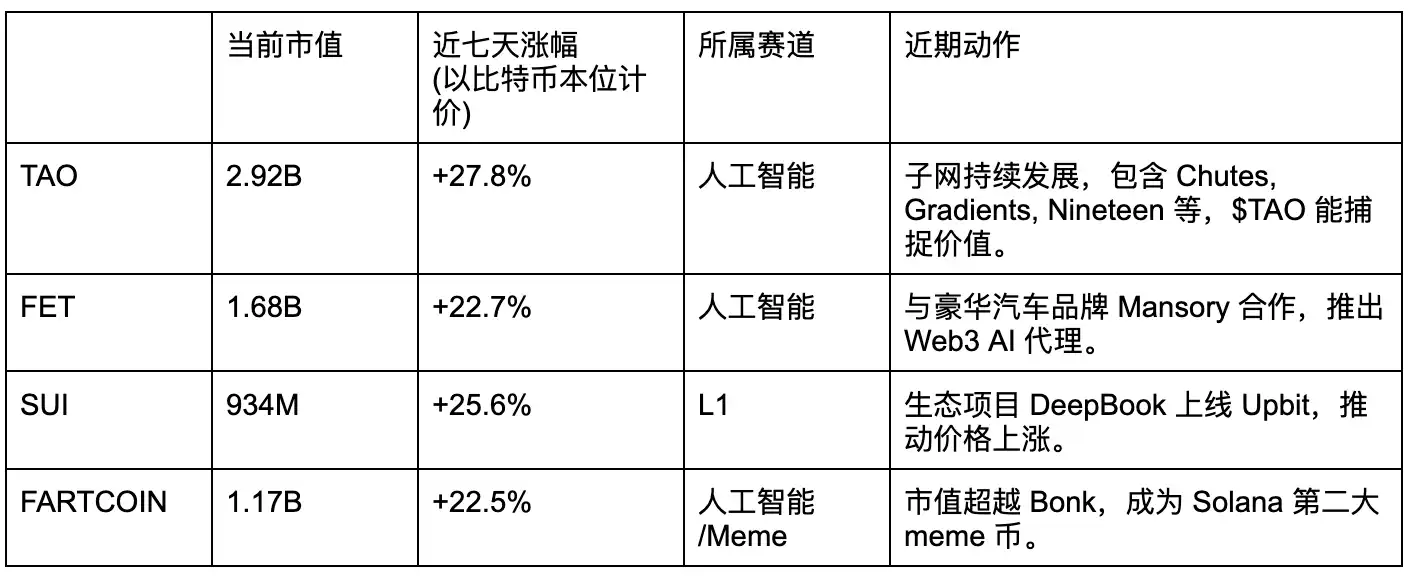
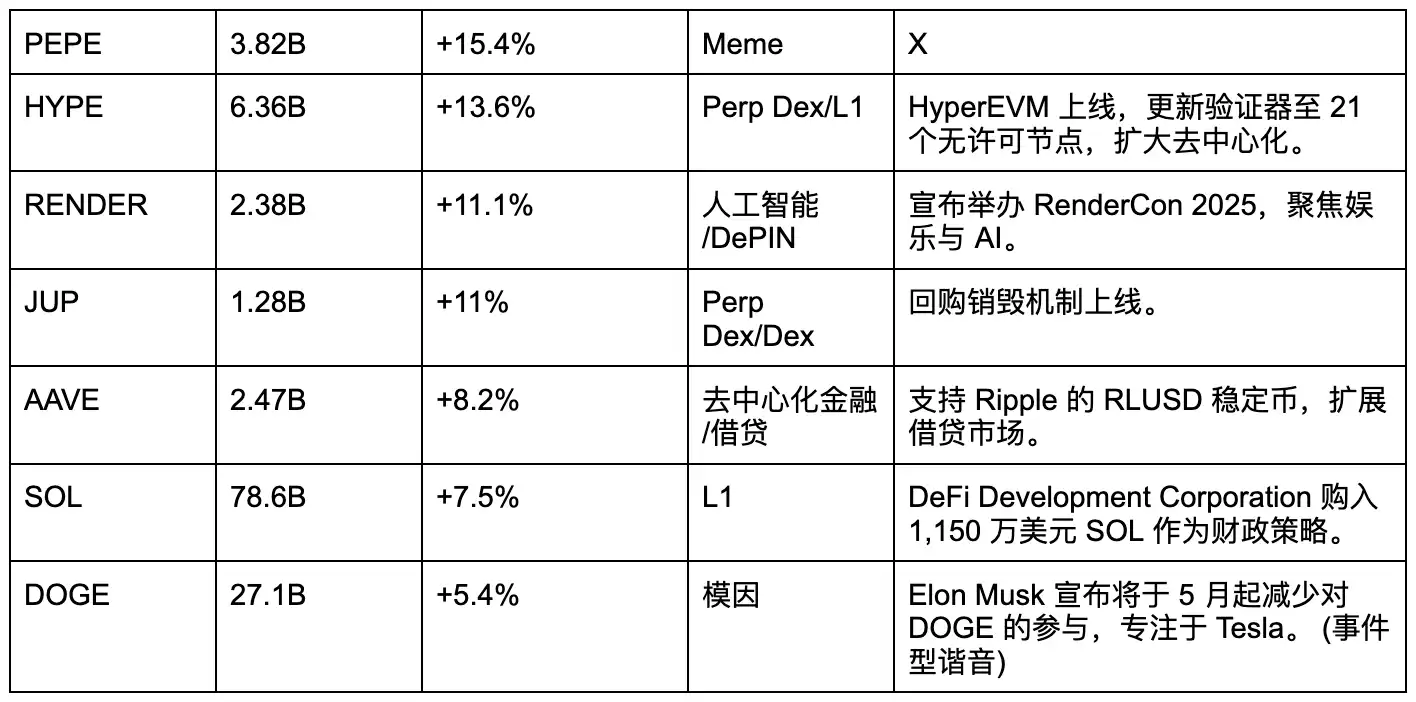
Top 100 Market Cap Trends Outperforming BTC in the Past Seven Days
The table below lists the top 100 tokens by market cap, and the currencies that have outperformed BTC in the past seven days. In fact, it's not just these 11 tokens listed, as when Bitcoin surged on April 23, its market dominance saw a slight decline (0.2%), indicating that some altcoins generally saw gains. Therefore, many coins that had been falling for a long time suddenly surpassed Bitcoin's seven-day gain overnight. However, this kind of surge should be interpreted as liquidity overflow rather than a result of fund selection.
Therefore, in selecting tokens, exclude those that surged overnight and choose altcoins whose gains have steadily exceeded BTC over these seven days.
Which Race Tracks Should You Focus On?
Looking at the intersection of the above-mentioned tokens, the key race tracks to focus on would be: AI, L1, Meme, and DeFi
· AI: The narrative of the previous wave was kicked off by AI, starting from the combination of the Greatest of All Time (GOAT) with memes and then further exploring more possibilities and applications. The AI frenzy led to a bubble, which eventually burst under the successive issuance of coins by the Trump family, causing most AI tokens to drop by over 90% and reshaping their valuations.
The bursting of the bubble does not mean the end of the race track but rather serves as a mechanism to eliminate projects of varying quality from the market. This means that with the continued development of Web 2 AI, Web 3 AI projects have gone through a round of reshuffling. If you believe that Web 2 AI can transition to Web 3, then the current valuation of the AI race track is relatively cheap, and the fundamental aspects of the surviving projects have been tested. If the season of replicas comes in the future, this race track is poised to capture the liquidity overflow from Bitcoin.
Representative tokens outside the table: VIRTUAL, ARC, ALCH, SWARMS, Zerebro
· L1: Public chain coins have always been a more stable choice when the season of replicas arrives. The overall logic is that the development of a public chain determines the ceiling of its ecosystem projects and can also capture the most liquidity.
However, unlike in 2021, funds are no longer solely focused on "EVM copies," but are instead looking for L1s that can truly bring new applications through TPS and developer tools. Once specific catalysts (platform listing, institutional adoption) appear, the price elasticity is significantly higher than that of traditional L1s.
Emerging Public Chains Yet to Issue Tokens: Monad, MegaETH
· Meme: Bitcoin is the biggest meme coin in the entire crypto community, and meme coins have become mainstream in this cycle, with a high probability of continuing to survive in the future. The key factor is that meme coins are a carrier of consensus and culture, and the top meme coins of each public chain can also be seen as leveraged versions of public chain coins. Meme coins mostly exist on-chain, with pricing not monopolized by centralized exchanges, leading to the presence of a wealth effect. In the crypto space, as long as there is a wealth effect, there will be a continuous flow of liquidity and participants.
· DeFi: In the crypto world, DeFi is a rare race track with a real business model, including Perp Dex, Dex earning trading fees; lending, earning the spread in deposited funds; Yield Farming, earning fees for deposits and withdrawals; LaunchPad, earning token issuance fees. The tokens HYPE, JUP, AAVE in the table are all dominant players in the DeFi field. More importantly, they all have token buyback mechanisms, meaning that as the season of replicas arrives and liquidity is restored, increasing trading volume, the network effect of top DeFi protocols will also drive overall projects to higher profitability. Higher profitability implies a stronger buyback effort, as the demand for tokens increases, the probability of price continuously rising also increases.
Epilogue: Keep a Close Eye on Bitcoin Dominance
The start of Altseason signifies the movement of funds from Bitcoin to riskier, lower-cap altcoins. Therefore, there are two key metrics to observe: first, whether Bitcoin can hold above $90,000, providing a stable confidence anchor for the market; second, and more importantly, whether Bitcoin dominance (BTC.D) can start to decline, reflecting a preference for fund diversification.
On April 23, Bitcoin surged to $90,000, but BTC.D only slightly decreased by 0.2%, indicating that we are still in a phase of "funds concentrated in BTC, driving steady growth." However, if BTC.D starts to noticeably decline next, for example, returning to the 57% level seen earlier this year, it would signal funds officially flowing out to the altcoin market, at which point the "rotation market" would have a chance to fully unfold.
In other words, the true starting point of Altseason is not only continuous new highs for Bitcoin but also an increase in risk appetite and fund migration from BTC to other thematic tracks. Only when both of these occur simultaneously will we have the opportunity to see the overall market in full swing. Now is the time to observe, filter, and position oneself; whether the Altseason frenzy is approaching will be revealed by the trend of BTC.D.
This article is a contributed piece and does not represent the views of BlockBeats.
You may also like

Morning Report | Secret Network loses $4.67 million due to cross-chain vulnerability; Michael Saylor releases Bitcoin Tracker information again, may disclose increased holdings data next week

Kalshi's biggest competitor is not Polymarket

The second half of the computing power battle: Intel CEO Pat Gelsinger reveals how AI is reshaping the global semiconductor supply chain
B.AI partners with MiniMax to launch a limited-time free experience of M3, enabling zero-threshold implementation of Agentic productivity through full-stack infrastructure

A company that was on the verge of bankruptcy has just surpassed Bitcoin in market value

The two giants are racing in "credit": loan balances of 9.9 billion vs 14.6 billion USD, Brazil has become the main battlefield

Rented Belief: How Much of the Bitcoin ETF Fund Flow is Real Money

On-chain finance: On-chain IPOs and on-chain ICOs, a new frontier in the trillion-dollar market

WEEX Live mode: Monitor 20 trading pairs at once and trade like a pro

WEEX Makes Affiliate Access Easier on the Web and in the App

Customize Your Spot Trading Page: Drag Modules and Move the Order Panel Where You Want It

Perp DEX: The Next Generation Exchange "War"

10 Counterintuitive Insights on Latin American Payments

The AI gamble of mining companies: Valuations enter a phase of differentiation, and it's hard to turn the tide
A letter from Alliance to entrepreneurs: Written on the occasion of Cursor selling for 60 billion dollars
Stablecoins Finally Find Real Returns: On-Chain Reinsurance Re Explained | Interview with Re Founder Karan Saroya

The impossible triangle is simply a pseudo problem

Will MicroStrategy fall into a death spiral? What will the macro trend be in the second half of the year?
Morning Report | Secret Network loses $4.67 million due to cross-chain vulnerability; Michael Saylor releases Bitcoin Tracker information again, may disclose increased holdings data next week
Kalshi's biggest competitor is not Polymarket
The second half of the computing power battle: Intel CEO Pat Gelsinger reveals how AI is reshaping the global semiconductor supply chain
B.AI partners with MiniMax to launch a limited-time free experience of M3, enabling zero-threshold implementation of Agentic productivity through full-stack infrastructure
A company that was on the verge of bankruptcy has just surpassed Bitcoin in market value
The two giants are racing in "credit": loan balances of 9.9 billion vs 14.6 billion USD, Brazil has become the main battlefield


