
Bitcoin's $2 Trillion Meme: Expanding the Boundaries of Time and Space


Original Title: "Bitcoin's $2 Trillion Sun Plot: Expanding the Boundaries of Time and Space"
Original Authors: @BMANLead, @Wuhuoqiu, @Loki_Zeng, @Kristian_cy, ABCDE
The major event for Crypto in 2024, as the price of Bitcoin approaches the $100,000 mark. With Bitcoin's halving and ETF approval, Trump is about to consider Bitcoin as a strategic reserve. As Bitcoin delves deeper into the traditional financial waters, it prompts us to rethink a question:
What is finance?
At its core, finance is the cross-temporal and spatial allocation of assets.
Typical cross-spatial allocation: borrowing, payments, trading
Typical cross-temporal allocation: collateralization, interest, options
In the past, Bitcoin was only stored in wallets, tending towards stagnation in both time and space. Over 65% of Bitcoin hasn't moved for over a year, "BTC should only be held in a wallet" as if it were an ideological steel engraving.
Therefore, BTCFi has not been well regarded for a long time.
Although Bitcoin's inception was aimed at hedging the traditional financial system, and as early as 2010 Satoshi Nakamoto wrote in a forum pointing out that Bitcoin would support various possible scenario types that he had designed years before, including various DeFi scenarios, the exploration of Bitcoin DeFi or financial scenarios gradually ceased as Bitcoin's positioning shifted towards digital gold.
On another timeline, Rune Christensen announced the vision of MakerDAO in March 2013, followed by the official launch of the first DEX on ETH—OasisDEX in 2016. In 2017, still a student, Stani Kulechov founded AAVE in Switzerland, and in August 2018, the well-known Bancor and Uniswap went live, kicking off the grand DeFi Summer. This also marked the point where the future possibilities of DeFi temporarily handed over to ETH.
However, as Bitcoin's timeline progressed to 2024, Bitcoin once again returned to the center of the crypto world. The price of Bitcoin reached $99,759, coming close to the $100,000 milestone, with a market cap exceeding $2 trillion. BTCFi has become a $2 trillion sun plot, sparking new discussions and innovations around BTCFi...
1. The $2 Trillion Sun Plot of Bitcoin: BTCFi
While Ethereum launched the DeFi Age of Discovery, for Bitcoin, BTCFi may be late to the party, but it will never miss out. Ethereum, as the experimental field of DeFi, has provided valuable lessons for Bitcoin. Today, Bitcoin is like 15th-century Europe, at the dawn of a new continent.
1.1 Bitcoin Transitioning from Passive Asset to Active Asset
The FOMO nature of Bitcoin holders and the increasing motivation for active management will drive Bitcoin's transition from a passive asset to an active asset, laying the foundation for BTCFi's development.
Institutional holdings are continuously increasing. According to Feixiaohao data, a total of 47 companies currently hold $1413.42 billion worth of BTC, accounting for 7.7% of the total BTC circulation. With the approval of a Bitcoin ETF, this trend is accelerating. Since the beginning of the year, BTC spot ETH has seen a net inflow of nearly 17,000 BTC. Compared to early miners and hodlers, institutions are more sensitive to capital efficiency and ROI, not only showing a higher inclination to participate but also likely becoming active drivers of BTCFi.
The emergence of narratives and the BTC ecosystem has made the composition of the BTC community more complex. Traditional BTC holders prioritize security, placing it at a higher level. New members are more interested in new narratives and assets.
ETH DeFi is gradually moving towards its own sustainable development path. Projects such as Uniswap, Curve, Aave, MakerDAO, and Ethena have found ways to achieve economic cycles that do not rely on token incentives but rather on internal or external revenue streams.
With various factors at play, the Bitcoin community's interest in scalability and BTCFi has significantly increased. Forum discussions have become more positive, and the proposal by Bitcoin Core developer Luke Dashjr for the [Disable Merkle Tree proposal] did not receive support and was officially closed in January this year.
1.2 The Improvement of Infrastructure Has Objectively Paved the Way
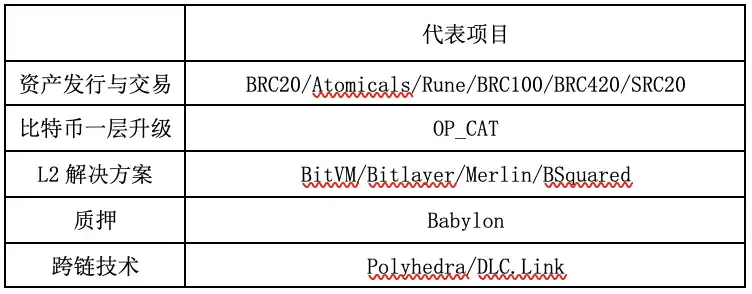
Technological limitations have also been a reason why Bitcoin has long been seen solely as a store of value, but this perception has gradually changed. The scaling debate from 2010 to 2017 culminated in the BTC fork into BTC and BCH, but the enhancement of scalability did not stop there. With two upgrades, SegWit and Taproot, laying the groundwork for asset issuance, inscriptions began to appear in people's endeavors. The widespread creation of assets has brought about objective demands for transactions and financialization. With the emergence of technologies such as Ordinal, Side-chain, L2, OP_CAT, BitVM, the construction of the BTCFi scene has truly become feasible.
1.3 Massive Demand Driving Development
In terms of transaction volume, asset diversification has already driven an increase in transaction frequency. Data from The Block shows that over the past year, BTC's average daily transfers have exceeded 500k/day, with RUNES and BRC-20 dominating. Following this, the demand for transactions, lending, credit derivatives, and interest has smoothly followed suit. BTCFi enables Bitcoin to become a productive asset, allowing BTC to earn yield from the assets it holds.
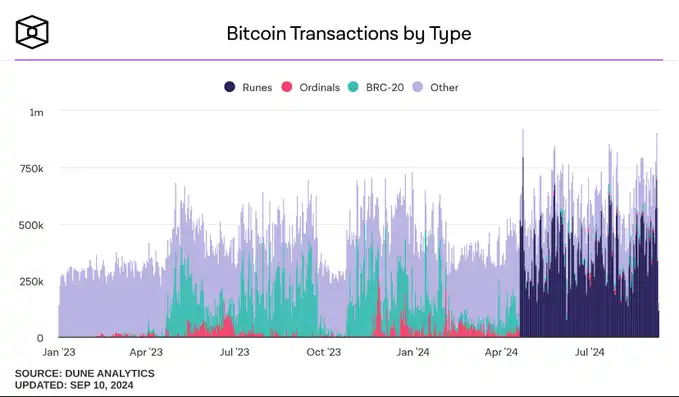
Source: The Block
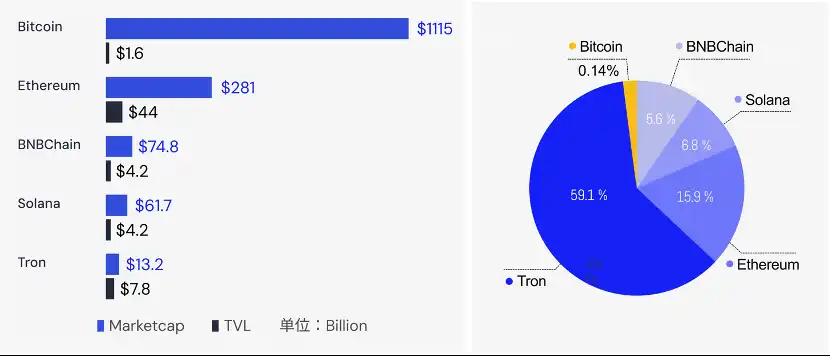
In terms of TVL, BTC, as a cryptocurrency with an absolute advantage in market capitalization, has tremendous potential. Currently, the total value locked (TVL) on the BTC network is approximately $1.6 billion (including L2 and sidechains), accounting for only 0.14% of Bitcoin's total market capitalization. In comparison, the TVL to market cap ratios of other mainstream blockchains are much higher, with ETH at 15.7%, Solana and BNBChain at 5.6% and 6.8% respectively. Calculated based on the average of these three, BTCFi still has 65 times room for growth.
Mainstream blockchains with smart contract capabilities have significantly higher TVL-to-market cap ratios: Ethereum at 14%, Solana at 6%, and Ton at around 3%. Even at a 1% ratio, BTCFi still has tenfold growth potential.
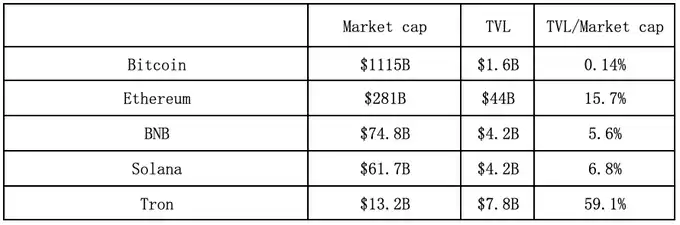
Source: Defillama, Coinmarketcap
2. The First Year of BTCFi
Therefore, by the year 2024, as BTC soared to 2 trillion, it also ushered in the first year of BTCFi.
By combining Bitcoin with "Finance," it instantly unlocked the possibility of 2 trillion, expanding the boundaries of Bitcoin's time and space.
As we have previously stated: the essence of finance is the cross-temporal and cross-spatial allocation of assets.
Thus, Bitcoin Financial (BTCFi) is the cross-temporal and cross-spatial allocation of Bitcoin.
Cross-temporal allocation: enhancing Bitcoin's yield properties, such as staking, timelocks, interest, options, etc., for example:
· Opening up the time dimension for Bitcoin at @babylonlabs_io
· Bitcoin yield gateway at @SolvProtocol
· "Semidecentralization may be the optimal solution" at @Lombard_Finance
· "Comes with Pendle" at @LorenzoProtocol
· Chain designed for BTCFi at @use_corn
Cross-spatial allocation: enhancing Bitcoin's liquidity, such as lending, custody, synthetic assets, etc., for example:
· Custody platforms @AntalphaGlobal, @Cobo_Global, @SinohopeGroup
· Lending newcomer @avalonfinance_
· CeDeFi pioneer @bounce_bit
· Diverse Wrapped BTC options
· Emerging stablecoin @yalaorg
Financial applications have not only returned to the endeavors of BTC ecosystem participants but have also given birth to entirely new possibilities. BTCFi innovative projects have begun to emerge in rapid succession, forming a Bitcoin financial landscape:

Source: ABCDE Capital
Whether it is enabling "digital gold" to possess yield properties or making it more liquid, these two core functions of BTCFi are highly aligned with BTC's current main narrative. Regardless of whether the market is bullish or bearish, as long as BTC remains unchanged, as long as BTC continues to be the most recognized digital gold in the industry, the BTCFi track is unlikely to be, or rather, "unnecessary to be" falsified.
Taking gold as an example, the value of gold usually has three main pillars:
1. Jewelry and industrial use
2. Investment
3. Strategic reserve demand from various central banks
From an investment perspective, gold ETFs, after being introduced 20 years ago, propelled the gold price to soar sevenfold. The reason is that before ETFs, gold investment had only one channel through physical gold, which involved requirements such as insurance, transportation, and storage that were considered too high for many people. Gold ETFs, as a transformative existence, greatly enhanced the liquidity and investment convenience of gold by eliminating the need for storage and allowing trading similar to stocks.
Looking at BTC in comparison, BTC ETFs clearly lack the transformative nature seen in gold ETFs. This is because the barrier to entry for trading this "digital gold" was not high to begin with, and ETFs only further the compliance, regulatory, and ideological aspects. Therefore, the potential impact of BTC ETFs on the price of BTC is likely lower than that of gold ETFs. However, BTCFi, by endowing Bitcoin with a time + space financial allocation attribute, makes BTC more "useful" than before, resembling gold's jewelry and industrial use case. So, compared to Bitcoin ETFs, BTCFi may provide greater long-term assistance in enhancing the value and price of BTC.
2.1. Time: Enhancing Bitcoin's Yielding Property

2.1.1. Opening the Time Dimension for Bitcoin - Babylon
One concept closely tied to BTCFi is Babylon because having Babylon signifies the true concept of "on-chain yield BTC."
It is well known that Bitcoin uses Proof of Work (PoW), which does not have the concept of inflation/yield. Therefore, it cannot generate an annual relatively certain (adjusted based on the staking ratio curve) issuance yield of around 3-4% like Ethereum's Proof of Stake (PoS). However, with Eigenlayer introducing the concept of Restaking to the community, people suddenly realize that if Restaking is a bonus for Ethereum, it is undoubtedly a godsend for Bitcoin.
Of course, you cannot directly send BTC to Eigenlayer; these are fundamentally two different chains. From a technical standpoint, it is also impossible to fully replicate an Eigenlayer on the BTC chain, as BTC does not even have Turing-complete smart contracts. So, is it possible to move Eigenlayer's core concept of Restaking for POS Security to Bitcoin? This is what Babylon aims to achieve.
Simply put, Babylon utilizes existing Bitcoin script and advanced cryptography to simulate Bitcoin-based Staking and Slashing functionalities, without involving bridges or third-party wraps common in the EVM ecosystem that introduce security threats and centralization. Because Bitcoin's script allows for the concept of a "time lock," enabling users to define a lock period during which the Bitcoin (UTXO) cannot be transferred, its functionality is akin to that of a PoS chain's staking. Babylon leverages this feature to ensure that the BTC participating in Staking does not leave the BTC chain but is instead locked in a Bitcoin "Staking address" using time lock technology.
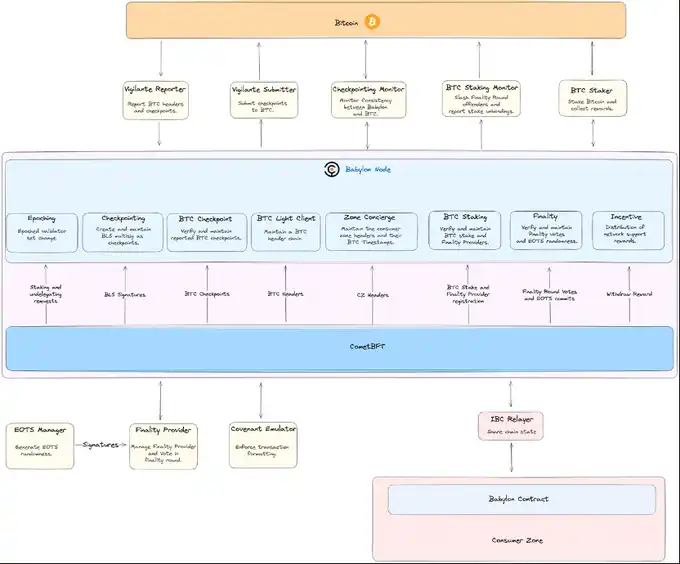
Source: Babylon
When BTC is locked via script, what if a Slashing mechanism is needed? How does Babylon achieve this without smart contracts?
This brings us to Babylon's use of advanced cryptographic technology - EOTS (Extractable One-Time Signatures). When a signer uses the same private key to sign two pieces of information simultaneously, the private key is automatically exposed. This is equivalent to the most common security breach assumption in a PoS chain - "signing two different blocks at the same block height." Through a form of malicious behavior that exposes the private key, Babylon effectively implements a mechanism for "automatic Slashing."
Utilizing the "Restaking" technique, Babylon is primarily used to enhance the security of PoS chains. However, to achieve a complete Eigenlayer technology stack (such as features like EigenDA) or a more complex penalty (Slashing) mechanism, cooperation from other projects within the Babylon ecosystem is still required.
Babylon has adopted an innovative approach: by self-custodying locked Bitcoin, combining on-chain staking and slashing functionalities, it has provided BTC holders with a trustless way to earn rewards for the first time. Previously, BTC holders looking to earn rewards typically had to rely on centralized exchanges (CEX) and other financial platforms or convert BTC to WBTC to participate in the Ethereum DeFi ecosystem, all of which involve a trust assumption in centralized security.
Therefore, while Babylon is designed to target Ethereum's Eigenlayer Restaking ecosystem, due to Bitcoin's inherent lack of a Staking mechanism, we are more inclined to see Babylon as a crucial part of building the BTC Staking ecosystem.
2.1.2 Bitcoin Yield Entry Solv Protocol
When it comes to the Staking ecosystem, we cannot overlook another project—Solv Protocol. Solv is not a direct competitor to Babylon but rather, through the introduction of the staking abstraction layer technology architecture, it can create various LPT (Liquidity Provider Token) products. The sources of revenue for these LPTs can be very diverse, such as:
· Staking rewards from the staking protocol (like Babylon);
· Earnings from POS network nodes (such as CoreDAO, Stacks);
· Or earnings from trading strategies (such as Ethena).
Currently, Solv has launched several successful LPT products, including SolvBTC.BBN (Babylon LPT), SolvBTC.ENA (Ethena LPT), and SolvBTC.CORE (CoreDAO LPT), all of which have performed well. According to DeFiLlama data, the TVL (Total Value Locked) of SolvBTC on the Bitcoin mainnet has already surpassed that of the Lightning Network, ranking first.

Source: Solv
Its yield mechanisms include but are not limited to the following:
SolvBTC - Can be minted on 6 chains, fully circulated on 10 chains, and integrated with over 20 DeFi protocols for earning rewards
· SolvBTC.BBN - BTC can enter Babylon through Solv to earn rewards
· SolvBTC.ENA - BTC can enter Ethena through Solv to earn rewards
· SolvBTC.CORE - BTC can enter Core through Solv to earn rewards
· SolvBTC.JUPITER and other follow-up net-value-growth yield-bearing assets

Source: Solv
Therefore, rather than viewing Solv as a BTC Staking protocol, we prefer to describe it as a "BTC Yield Vault." Solv provides a diverse set of revenue streams, whether it's staking rewards, node rewards, or trading strategy rewards, allowing BTC holders to have a more flexible earnings approach.
Moreover, Solv currently demonstrates the most impressive data performance among all BTCFI protocols:
1. Wide Coverage: Solv is currently circulating on 10 blockchains and has integrated with over 20 DeFi protocols.
2. Innovative Partnerships: For example, Solv's partnership with Pendle provides Bitcoin users with nearly a 10% fixed yield APY, with LP yield of up to 40%.
3. Broad Acceptance: The number of SolvBTC holders has surpassed 200,000, with a total market value exceeding $1 billion.
4. Strong Reserve: SolvBTC's Bitcoin reserve has exceeded 20,000 BTC.
Building on these achievements, the Solv Protocol has taken a phased leadership position in the BTCFI space and continues to iterate on its product. The next focus will be on launching more types of LST products. It is reported that Solv plans to collaborate with Jupiter to launch a new product called SolvBTC.JUP, introducing the LP yield from Perp DEX into the BTC LST product, further expanding the boundaries of BTC Staking.
Meanwhile, Babylon provides a Trustless mechanism that allows BTC holders to earn Staking-like rewards. This also paves the way for projects to compete for an ecosystem position similar to Lido, by creating liquidity assets similar to stETH. While Babylon has achieved secure Bitcoin locking and provides basic earnings, to further unlock BTC liquidity and enhance returns, BTC locked in Babylon can participate in EVM and non-EVM DeFi applications through tokenized warrants. Leveraging the unique composability of blockchain will be a key factor in constructing the LST ecosystem, with SolvBTC.BBN being a successful case study.
In addition to Solv, there are other heavyweight projects in the market also vying for LST ecosystem placement, such as Lombard and Lorenzo. These LST projects are broadly aligned in technical directions such as releasing BTC liquidity and participating in DeFi yield.
Solv's core advantage lies in its ability to offer a more diverse set of income streams for Bitcoin users, including re-staking rewards, staking node rewards, and trading strategy rewards. With this diversified income model, Solv provides Bitcoin users with more flexible and diversified options.
2.1.3 BTCHub of the Move Ecosystem: Echo protocol
Echo is the BTCFi hub of the Move ecosystem, providing a one-stop financial solution for Move's Bitcoin, enabling BTC to seamlessly interact with the Move ecosystem.
Echo was the first to introduce BTC liquidity staking, re-staking, and yield infrastructure to the Move ecosystem, introducing a new asset class of liquidity to the Move ecosystem. Through collaboration with the Bitcoin ecosystem, Echo seamlessly integrates all native BTC Layer 2 solutions, including Babylon, and supports various BTC liquidity staking tokens, making Echo a key gateway for attracting new capital to the Move DeFi ecosystem.
Echo's flagship product, aBTC, is a cross-chain liquidity Bitcoin token backed by BTC in a 1:1 ratio. This innovation promotes Bitcoin DeFi interoperability, allowing users to earn real rewards in ecosystems like Aptos, and aBTC will be fully supported throughout the entire Aptos DeFi network.
Echo first introduced re-staking to the Move ecosystem through its innovative product, eAPT. This will enable re-staking to secure projects that run on the MoveVM chain or any project developing its own blockchain, allowing them to rely on Aptos for security and validation.
Therefore, Echo will serve as the BTChub of the Move ecosystem, providing four Bitcoin-centric products for the Move ecosystem:
· Bridge: bridging BTC L2 assets to Echo, enabling interoperability between the Move ecosystem and BTC L2;
· Liquidity Staking: staking BTC on Echo to earn Echo points;
· Re-Staking: Stake the synthetic LRT token aBTC in the Synthetic Move ecosystem, allowing Bitcoin to interact with the Move ecosystem and earn multi-layered staking rewards;
· Lending: Deposit APT, uBTC, and aBTC to provide collateral lending services, with lending profits shared with users receiving close to a 10% APT yield.
2.1.4 Lombard's "Semi-Decentralization May Be the Optimal Solution"
The core feature of Lombard lies in the balance of its LBTC asset between security and flexibility. Generally, while absolute decentralization can bring higher security, it often makes significant sacrifices in flexibility. For example, the huge gap in market value between RenBTC and TBTC compared to WBTC is a typical case of this trade-off. On the other hand, fully centralized management can provide maximum flexibility; however, due to the need for a trust-based assumption and potential security risks, its growth ceiling is relatively limited. This is also one of the reasons why WBTC's market value share in BTC's total market value has always been relatively low.
Lombard ingeniously found a solution to balance security and flexibility. While maintaining relative security, it maximized the flexibility of its LBTC, thereby opening up new development space for BTC liquidity assets.
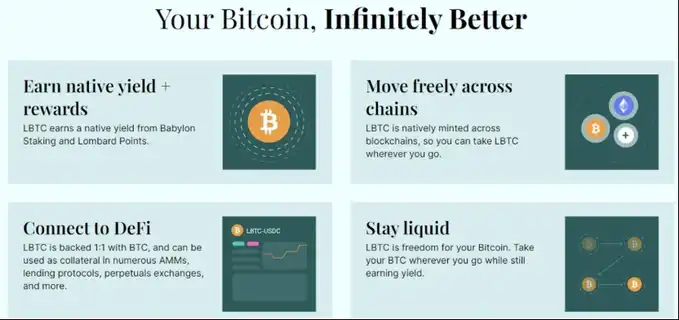
Source: Lombard
Compared to the traditional multi-signature Mint/Burn model, Lombard has introduced a more secure concept called the "Consortium Security Alliance." This concept first appeared in early consortium chains. Unlike many current DeFi projects, especially cross-chain bridge projects where multi-signature nodes are controlled by the project team, Lombard's security alliance consists of highly reputable nodes, including the project team, well-known institutions, market makers, investors, and exchanges, among others. The nodes achieve consensus through the Raft algorithm.
Although this mechanism cannot be fully described as "100% decentralized," its security is far higher than the traditional multi-signature model while retaining features such as full-chain circulation of 2/3 multi-signatures, flexible minting and redemption. In addition, full decentralization does not necessarily equate to absolute security. For example, whether it is POW or POS, the cost of attack and security model can be calculated based on the mechanism design and market value. Except for high-market-value public chains like BTC, ETH, and Solana, the security of most decentralized projects may not be as good as Lombard's "Security Alliance" model. Through this design, Lombard has achieved a balance between security and flexibility, providing users with a trusted and efficient BTC liquidity solution.
In addition to the Security Alliance's design, Lombard also employs CubeSigner, a hardware-backed non-custodial key management platform. With strict policy restrictions in place to prevent key theft, mitigate breaches, prevent key abuse, and more, LBTC's security is further strengthened.
Furthermore, Polychain's $16 million seed round investment undoubtedly signifies Lombard's wealth of resources within the industry, providing significant support for its Consortium node reputation and future integration with DeFi and other public chain projects. LBTC is bound to be one of WBTC's strongest competitors.
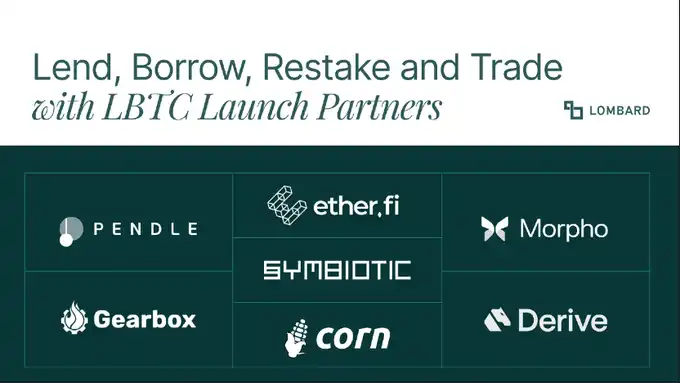
Source: Lombard
2.1.5 Lorenzo with "Built-in Pendle"
Compared to Lombard's unique advantage in asset security, Lorenzo, as the entry point of Binance-backed Babylon LST, also exhibits highly attractive features.
In the current wave of DeFi innovation, traditional DEXes and lending protocols mostly continue the inertia from DeFi Summer or rely on past successes. After the Terra collapse in the stablecoin race, except for Ethena being relatively innovative, other innovations appear lackluster. The only noteworthy race is that of LST (Liquidity Staking Token) and LRT (Liquidity Re-Staking Token), benefiting from Ethereum's shift to POS and the leverage effect triggered by Eigenlayer Restaking.
In this race, the biggest winner is undoubtedly Pendle. It is no exaggeration to say that the vast majority of interest-bearing assets in the Ethereum ecosystem ultimately flow to Pendle. The design of interest separation has brought a whole new dimension to DeFi: risk-averse users can obtain comprehensive hedging mechanisms through Pendle, while more aggressive players seeking higher returns can use implicit leverage to boost their earnings.
Lorenzo clearly aims to excel in this race. After Babylon introduced staking functionality, its LST product now offers similar interest separation operations as assets such as stETH, Renzo, and EtherFI. Lorenzo's LST product can be split into two types of tokens: the Liquidity Principal Token LPT (stBTC) and the Yield Accrual Token YAT. Both tokens are freely transferable and tradable, allowing holders to use them separately to earn income or withdraw BTC from staking. This design not only enhances asset flexibility but also provides users with more investment choices.
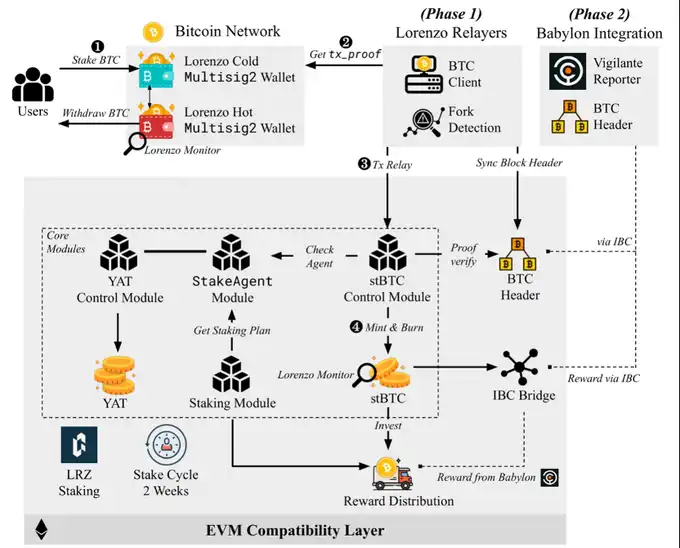
Source: Lorenzo
Through this design, Lorenzo unlocked more possibilities for participating in DeFi using Babylon staked BTC. For example, LPT and YAT can each form trading pairs with ETH, BNB, and USD stablecoins, providing arbitrage and investment opportunities for different types of investors. Additionally, Lorenzo can also support lending protocols around LPT and YAT, as well as structured Bitcoin yield products (such as BTC fixed-income financial products). In other words, Lorenzo can borrow and implement most of the innovative gameplay on Pendle.
As one of the few Bitcoin ecosystem projects personally endorsed by Binance and the only LST project in the current BTCFI track with the inherent "Pendle" attribute, Lorenzo is undoubtedly worthy of the market's focused attention. This project not only expands the boundaries of BTC liquidity but also introduces more flexible yield management and investment methods to the DeFi ecosystem, providing investors with more diversified options.
2.1.6 Chain Corn Born for BTCFi
Corn is the first Ethereum L2 case that uses Bitcoin as Gas, aiming to provide users with various financial services, including lending, liquidity mining, and asset management. The chain was born entirely around Bitcoin's financial needs, and its uniqueness lies in mapping Bitcoin (BTC) to the network's native Gas token BTCN, enabling Bitcoin to be more widely used in the Ethereum ecosystem.
Key Features:
BTCN Token:
Corn has introduced the BTCN token as the Gas fee for transactions on the Corn network. BTCN can be seen as an ERC-20 format Bitcoin mapping, similar to wBTC but with some technical differences. The benefits of using BTCN as Gas include reducing transaction costs, increasing Bitcoin's efficiency, and creating new value capture opportunities for Bitcoin.
Ecosystem "Crop Circle":
Corn has proposed an ecosystem concept called "Crop Circle," aimed at recycling Bitcoin's value in multiple ways to generate additional income. Users can stake BTCN to receive network rewards, participate in liquidity mining, lending, develop a BTCN-based derivatives market, and more.
Tokenomics:
Introducing $CORN and $popCORN. $CORN serves as the base token, which users can acquire through staking BTCN or participating in liquidity provision; $popCORN is the governance token obtained by locking $CORN, granting users governance participation and additional reward rights. This model incentivizes long-term token holding and enhances community engagement through dynamic weighting and locking mechanisms.
By bringing Bitcoin into the Ethereum ecosystem, Corn has provided an innovative L2 solution aimed at creating more earning opportunities for Bitcoin holders.
2.2. Space: Enhancing Bitcoin's Liquidity

2.2.1 Custodial Platforms Antalpha, Cobo, Sinohope
While decentralization is the absolute "politically correct" stance in the crypto space, if we exclude the FTX rug pull as a black swan event, in terms of fund security, the centralized exchanges/custodial/financial service platforms at the top of the industry actually perform much better than the vast majority of decentralized platforms. The annual losses caused by non-custodial wallets/DeFi protocols being hacked far exceed that of centralized custodial platforms by an order of magnitude.
As a result, the top-tier Bitcoin custodial and financial service platforms play an undisputed role in releasing Bitcoin liquidity, endowing Bitcoin with the function of cross-time or cross-space allocation.
Using the following three as examples:
Antalpha - With the largest Bitcoin community in the industry, a strategic partner of Bitmain, Antalpha provides ecosystem products centered around the BTC ecosystem. It offers hardware energy finance services for institutions in the BTC production sector, such as mining machine financing, electricity financing, BTC custody storage MPC solutions, and more.
Cobo - The name of the Whale is well-known in the crypto space, and Cobo's custodial wallet was co-founded by the Whale and Dr. Jiang Changhao. It has seen over 1 billion addresses and $200 billion in transaction volume to date. Cobo now offers various solutions such as MPC, smart contract wallets, and is a trusted one-stop wallet provider for many institutions and users.
Sinohope - A Hong Kong-listed company, provides not only wallet solutions but also a one-stop full-stack blockchain solution, including L1/L2 browsers, Faucets, basic Dex, lending, NFT Market Place, and other comprehensive services.
Several platforms have a large number of real B2B users and have always maintained a high level of security. Therefore, many DeFi protocols have actually collaborated with the above platforms. Here, the concepts of centralization and decentralization are not so clearly defined. Everything starts from the perspective of security and trust, finding a relatively stable balance point between technology and commercialization.
2.2.2 Lending New Star Avalon
Avalon is a decentralized lending platform that focuses on providing liquidity for Bitcoin holders. Users can use Bitcoin as collateral for borrowing, and Avalon automates the lending process using smart contracts. Avalon offers a fixed borrowing interest rate as low as 8%, making it attractive in the competitive DeFi market.
Focus on Bitcoin: Avalon has launched BTC layer2, including Bitlayer, Merlin, Core, and BoB, focusing on providing lending services to Bitcoin holders to meet the liquidity needs of Bitcoin users.
Collateral Management: Avalon uses an over-collateralization mechanism where users need to provide more Bitcoin as collateral than the loan amount to reduce platform risk.
Performance Data: The platform currently has over $300 million in TVL and is actively partnering with various BTCFi projects such as SolvBTC, Lorenzo, SwellBTC, etc., to expand its user base.
2.2.3 CeDeFi Pioneer Bouncebit
BounceBit is an innovative blockchain platform focused on empowering Bitcoin assets, transforming Bitcoin from a passive asset to an active participant in the crypto ecosystem through the fusion of centralized finance (CeFi) and decentralized finance (DeFi), as well as restaking strategies.
Features of BounceBit:
BTC Re-Staking: BounceBit allows users to deposit Bitcoin into the protocol and earn additional rewards through restaking. This increases asset liquidity and income opportunities. Users can deposit various types of on-chain Bitcoin assets into BounceBit, including native BTC, WBTC, renBTC, and more.
Dual-Coin PoS Consensus Mechanism: BounceBit adopts a hybrid PoS mechanism using BTC+BB (BounceBit native token) for validation. Validators accept both BBTC (BounceBit-issued Bitcoin token) and BB tokens as staking, enhancing network resilience and security, while broadening the participant base.
BounceClub: BounceBit offers the BounceClub tool, allowing even non-programmer users to create their own DeFi products.
Liquidity Custody: BounceBit introduces the concept of liquidity custody to keep staked assets liquid and provide more income opportunities.
This differs from the traditional lock-up model, bringing greater flexibility to users.
Through its innovative restaking model and dual-coin PoS consensus, BounceBit provides more income opportunities for Bitcoin holders and drives Bitcoin's application in the DeFi ecosystem. Its liquidity custody and BounceClub tool also make DeFi development more straightforward and user-friendly.
2.2.4 Stablecoin Rising Star Yala
Yala is a stablecoin and liquidity protocol on BTC. Yala enables its stablecoin $YU to flow freely and securely between various ecosystems through its self-built modular infrastructure, unlocking BTC liquidity and bringing significant capital vibrancy to the entire crypto ecosystem.
Key products include:
· Overcollateralized Stablecoin $YU: This stablecoin is generated by overcollateralizing Bitcoin. The infrastructure is not only based on Bitcoin's native protocol but can also be deployed freely and securely in the EVM and other ecosystems.
· MetaMint: A core component of $YU that allows users to easily mint $YU using native Bitcoin in various ecosystems, injecting Bitcoin's liquidity into these ecosystems.
· Insurance Derivatives: Providing comprehensive insurance solutions within the DeFi ecosystem to create arbitrage opportunities for users.
Yala's suite of infrastructure and products serves its vision of bringing Bitcoin liquidity to various crypto ecosystems. Through $YU, Bitcoin holders can earn additional yield in various cross-chain DeFi protocols while maintaining the security and stability of the Bitcoin mainnet; through the governance token $YALA, Yala achieves decentralized governance of its products and ecosystem.
2.2.5 The Flourishing of Wrapped BTC
WBTC
Wrapped Bitcoin (WBTC) is an ERC-20 token that connects Bitcoin (BTC) to the Ethereum (ETH) blockchain. Each WBTC is backed by 1 Bitcoin, ensuring its value is pegged to the price of BTC. The introduction of WBTC allows Bitcoin holders to use their assets in the Ethereum ecosystem, participating in decentralized finance (DeFi) applications. This significantly enhances Bitcoin's liquidity and utility in the DeFi space.
WBTC has always been the flagship of Wrapped BTC, but on August 9, WBTC custodian BitGo announced a joint venture with BiT Global to migrate WBTC's BTC custody address to the joint venture's multisig. What seemed like a routine corporate collaboration caused a stir as BiT Global is controlled by Justin Sun. MakerDAO promptly initiated a "Reduce WBTC Collateral Size" proposal, requesting the reduction of WBTC-related collateral in the core treasury to 0. Market concerns about WBTC gave rise to a new opportunity for a new type of Wrapped BTC.
BTCB
BTCB is a Bitcoin token on the Binance Smart Chain that allows users to trade and transact on the BSC. BTCB is designed to enhance Bitcoin's liquidity while leveraging BSC's low transaction fees and fast confirmation times.
Binance is actively expanding the functionality of BTCB, planning to launch more DeFi products related to BTCB on the BSC. These new products will include lending, derivatives trading, and more, aiming to enhance BTCB's utility and liquidity. BTCB's application on the BSC has received support from various DeFi protocols, including Venus, Radiant, Kinza, Solv, Karak, pStake, and Avalon, among others. These protocols allow users to use BTCB as collateral for activities such as lending, liquidity mining, and stablecoin minting.
Binance aims to enhance the market position of BTCB through these measures and drive wider adoption of Bitcoin in the BSC ecosystem. The introduction of BTCB not only provides a new use case for Bitcoin holders but also injects more liquidity into the BSC DeFi ecosystem.
dlcBTC (now iBTC) @ibtcnetwork
iBTC is a Bitcoin asset based on Discreet Log Contract (DLC) technology, designed to offer users a secure, privacy-preserving way to create and execute complex financial contracts. Its key feature is full decentralization, as users do not rely on third-party custody or multisig mechanisms when using dlcBTC, ensuring complete control over their assets and reducing the risks associated with centralization. Additionally, iBTC's security is enhanced by its unique self-custody mechanism, where the user's Bitcoin is always under their control, and only the original depositor can withdraw funds, effectively preventing the risk of asset theft or government seizure.
iBTC also leverages zero-knowledge proof technology to enhance transaction privacy and security. Users can execute complex financial transactions in contracts without revealing specific details of the transaction, thus protecting their personal information. Through this innovative mechanism, iBTC enables Bitcoin holders to participate in decentralized finance (DeFi) activities while maintaining ownership and control of their assets.
iBTC is the most decentralized solution among all Wrapped BTC solutions, addressing the issue of opaque centralized custody in its commercialization process.
In addition to the above Wrapped BTC solutions, there are various BTC solutions such as FBTC, M-BTC, SolvBTC, and others.
III. Conclusion:
Bitcoin has been around for 15 years and has evolved into not just digital gold but a $2 trillion financial system, with waves of builders continuously expanding Bitcoin's boundaries, turning it into a new track—BTCFi. We have the following observations:
1. The essence of finance is the cross-temporal and cross-spatial allocation of assets, with typical cross-spatial allocation including lending, payments, and trading, and typical cross-temporal allocation including staking, interest, and options. With Bitcoin's market cap reaching $2 trillion, the demand for cross-temporal and cross-spatial asset allocation around Bitcoin has emerged, giving rise to the BTCFi scenario.
2. Bitcoin is poised to become the US national reserve, further becoming an asset allocated by nations and institutions, leading to a significant institutional demand around Bitcoin, such as lending, staking, creating institutional-level BTCFi projects;
3. After the improvement of Bitcoin's asset issuance, layer 2 network, staking, and other underlying infrastructure, it also paved the way for the BTCFi scenario;
4. The TVL of the Bitcoin network is approximately $20 billion (including L2 and sidechains), accounting for only 0.1% of Bitcoin's total market value, while Ethereum accounts for 15.7% and Solana for 5.6%. We believe that BTCFi still has tenfold growth potential.
5. BTCFi is developing in two main directions around Bitcoin: first, enhancing Bitcoin's interest-bearing properties, with projects such as Babylon, Solv, Echo, Lombard, Lorenzo, and Corn; second, enhancing Bitcoin's liquidity, with projects such as Wrapped BTC, Yala, and Avalon;
6. With the development of BTCFi, Bitcoin will transition from a passive asset to an active asset, and from a non-interest-bearing asset to an interest-bearing asset.
7. Comparing it to the history of gold, the launch of the gold ETF 20 years ago pushed the gold price up sevenfold. Its essence is to transform gold from a passive asset into a financial asset, enabling more financial activities based on the gold ETF. Today, BTCFi also endows Bitcoin with financial attributes of time and space, enhancing Bitcoin's financial scenarios and value capture. In the long run, BTCFi will have a huge impact on Bitcoin's value and price appreciation.
You may also like

Latest research from 13 top universities including Cornell University: The current state, challenges, and misconceptions of the fusion of Crypto and AI
Deconstructing Anthropic: The Best AI Company, Possibly Also a Type of Organizational Invention

Humanity Protocol Security Incident Escalates: More Than $31 Million Stolen From Related Addresses as Attacker Continues Selling H for ETH
On June 9, according to monitoring by Onchain Lens, more than $31 million has been stolen from addresses linked to Humanity Protocol, and the attack is still ongoing, with the hacker continuously swapping H tokens for ETH. Project founder Terence Kwok later confirmed the security incident on X, saying the issue involved a private key leak.

Bloomberg: As Bitcoin Weakens, Stablecoins and RWA Continue to Drive Expansion in Crypto Businesses
In June, Bloomberg reported that despite Bitcoin falling below $60,000 last week, wiping out about $235 billion in market value within seven days, and dropping close to 50% from last year’s peak, some core businesses in the crypto industry are still expanding, mainly in stablecoins, real-world asset tokenization (RWA), payments, and infrastructure. The report also noted that overall altcoin activity has contracted significantly: altcoin market capitalization has fallen from a peak of about $431 billion in November 2021 to around $170 billion, and among the tens of millions of tokens issued in recent years, fewer than 1,700 still maintain meaningful trading activity.

Galaxy Deep Research Report: How Hyperliquid's HIP-4 Upgrade Changes the Landscape of Prediction Markets?
Binance Research: RWA Market Expected to Expand Nearly 6x from Early 2025, with Public Equities and Onchain Payments Heating Up Together
In June, Binance Research said in its monthly market report that the real-world asset (RWA) market is expected to grow by about 589% from the beginning of 2025. Bond- and money market fund-related RWA expanded by about $6.5 billion, up 83% year over year, while publicly traded equity RWAs grew by about 422%. The report also noted that monthly crypto debit card transaction volume exceeded $747 million in May, up 48.6% year to date.

Japan to Assess a Framework for Yen Stablecoins and Crypto ETFs as Asia’s Compliant Payments Narrative Heats Up
Recently, according to the original report, Japan is considering the launch of yen stablecoins and cryptocurrency ETFs. Public information remains limited at this stage, and there is still no complete policy text, regulatory draft, or clear implementation timeline, so this is better characterized as a “policy discussion” rather than formal implementation. The original wording also noted that advancing stablecoin regulation in Asia is driving XRP usage and supporting growth in the XRPL ecosystem. However, based on currently available public information, there is not enough evidence to directly establish a clear causal relationship between this round of discussion in Japan and XRP or XRPL.

ZachXBT: Humanity private key leak and abnormal surge in H token should be viewed separately
On June 9, according to related disclosures, on-chain investigator ZachXBT posted an update on Humanity’s roughly $31 million security incident, saying that after further analyzing fund flows, he currently tends to believe the project team was not involved in an “inside job” or a self-staged attack. According to him, the official explanation about the private key leak was broadly accurate, but before the token unlock, the price of H had been artificially pushed higher, and the hacker later took advantage of that market environment; therefore, the private key leak and the earlier abnormal price pumping should be regarded as two separate and independent events. This reframing has shifted the market’s understanding of the nature of the incident. Earlier discussion around Humanity had focused on whether the team directly participated in the attack or used the security incident to cover up internal operations. ZachXBT’s latest remarks shift the focus from “whether it was self-theft” to “whether there were pre-unlock market structure issues.” He also questioned whether the team may have.

Morning Report | OpenAI has submitted an S-1 registration statement draft to the U.S. SEC; Morpho completes $175 million financing

Morning Report | BitMine increased its holdings by 126,971 ETH last week; trader Eugene announced his exit from the crypto market

Wang Chuan: How can one not feel anxious after the neighbor Old Wang made thirty times profit by investing in storage stocks? (Seven) - A quarter-century cycle
Cryptocurrency CEXs are flocking to sell US stocks, and traditional brokerages are facing an "uninvited guest."
$75 billion in foreign capital has fled, and South Korean retail investors have absorbed it all using leverage

Japan’s Three Megabanks Plan Joint Stablecoin Issuance in Fiscal 2026
MUFG, SMBC, and Mizuho reportedly plan to jointly issue fiat-pegged stablecoins in fiscal 2026, signaling Japan’s growing push into bank-led digital payment infrastructure.

Humanity Discloses H Token Dual-Chain Attack Details, With Losses on Ethereum and BSC Exceeding $36 Million
Humanity said the H token attack across Ethereum and BSC caused more than $36 million in losses after leaked ProxyAdmin keys enabled malicious contract upgrades and token minting.
White House Discusses CLARITY Act With Law Enforcement Ahead of Senate Vote
The White House discussed the CLARITY Act with law enforcement ahead of a Senate vote, focusing on illicit finance risks and developer protections.

Bitcoin Trading Guide 2026: Strategies for Experienced Traders

What Is XAUT and PAXG? Why Tokenized Gold Is Booming in 2026
Latest research from 13 top universities including Cornell University: The current state, challenges, and misconceptions of the fusion of Crypto and AI
Deconstructing Anthropic: The Best AI Company, Possibly Also a Type of Organizational Invention
Humanity Protocol Security Incident Escalates: More Than $31 Million Stolen From Related Addresses as Attacker Continues Selling H for ETH
On June 9, according to monitoring by Onchain Lens, more than $31 million has been stolen from addresses linked to Humanity Protocol, and the attack is still ongoing, with the hacker continuously swapping H tokens for ETH. Project founder Terence Kwok later confirmed the security incident on X, saying the issue involved a private key leak.
Bloomberg: As Bitcoin Weakens, Stablecoins and RWA Continue to Drive Expansion in Crypto Businesses
In June, Bloomberg reported that despite Bitcoin falling below $60,000 last week, wiping out about $235 billion in market value within seven days, and dropping close to 50% from last year’s peak, some core businesses in the crypto industry are still expanding, mainly in stablecoins, real-world asset tokenization (RWA), payments, and infrastructure. The report also noted that overall altcoin activity has contracted significantly: altcoin market capitalization has fallen from a peak of about $431 billion in November 2021 to around $170 billion, and among the tens of millions of tokens issued in recent years, fewer than 1,700 still maintain meaningful trading activity.
Galaxy Deep Research Report: How Hyperliquid's HIP-4 Upgrade Changes the Landscape of Prediction Markets?
Binance Research: RWA Market Expected to Expand Nearly 6x from Early 2025, with Public Equities and Onchain Payments Heating Up Together
In June, Binance Research said in its monthly market report that the real-world asset (RWA) market is expected to grow by about 589% from the beginning of 2025. Bond- and money market fund-related RWA expanded by about $6.5 billion, up 83% year over year, while publicly traded equity RWAs grew by about 422%. The report also noted that monthly crypto debit card transaction volume exceeded $747 million in May, up 48.6% year to date.


