
 Buy Crypto
- Markets
 Futures
- Spot
- Copy Trade
- Earn
- More
Bloomberg: Has the US Treasury Market Really Lost Its Safe-Haven Appeal?

Original Article Title: Are US Treasuries Really Losing Their Safe-Haven Appeal?
Original Article Authors: Alice Atkins & Liz Capo McCormick, Bloomberg
Original Article Translation: Felix, PANews
Investors usually flock to US Treasuries to avoid financial market turbulence. During the global financial crisis, the 9/11 attacks, and even when the US credit rating was downgraded, US Treasuries saw a rebound.
However, in early April, during the chaos triggered by President Trump's implementation of "reciprocal" tariffs, something unusual happened. Despite the sharp drops in risk assets such as stocks and cryptocurrencies, US Treasury prices didn't rise as expected but instead fell. The US Treasury yield saw its largest single-week increase in over twenty years.
For a long time, US Treasuries, with a market size of $29 trillion, have been seen as a safe haven during market turmoil, which has been a unique advantage for the world's largest economy. For decades, it has helped the US control borrowing costs. However, recently, the trading performance of US Treasuries has looked more like that of a risk asset. Former Treasury Secretary Lawrence Summers even stated that the performance of US Treasuries resembles that of emerging market debt.
This has profound implications for the global financial system. As the global "risk-free" asset, US Treasuries are used as a benchmark for pricing various assets, from stocks to sovereign bonds, and mortgage rates, while also serving as collateral for trillions of dollars in daily loans.
Below are some viewpoints put forth by investors and market forecasters to explain the abnormal volatility of US Treasuries in April and some potential alternative "safe havens."
Tariff-Driven Inflation
Even though President Trump suspended the implementation of most "reciprocal" tariffs for 90 days, tariffs imposed on China are still much higher than previously anticipated. Furthermore, tariffs on automobiles, steel, aluminum from Canada and Mexico, as well as various goods, remain in place, and Trump has threatened to impose additional import tariffs in the future.
There are concerns that businesses will pass on these tariff costs to consumers in the form of price hikes. An inflation shock would dent the demand for Treasuries as it would erode the future value of fixed income payments provided by Treasuries.
If soaring prices are accompanied by a drop in economic output or zero growth (known as stagflation), monetary policy will enter a new period of uncertainty, forcing the Fed to choose between supporting economic growth and curbing inflation.
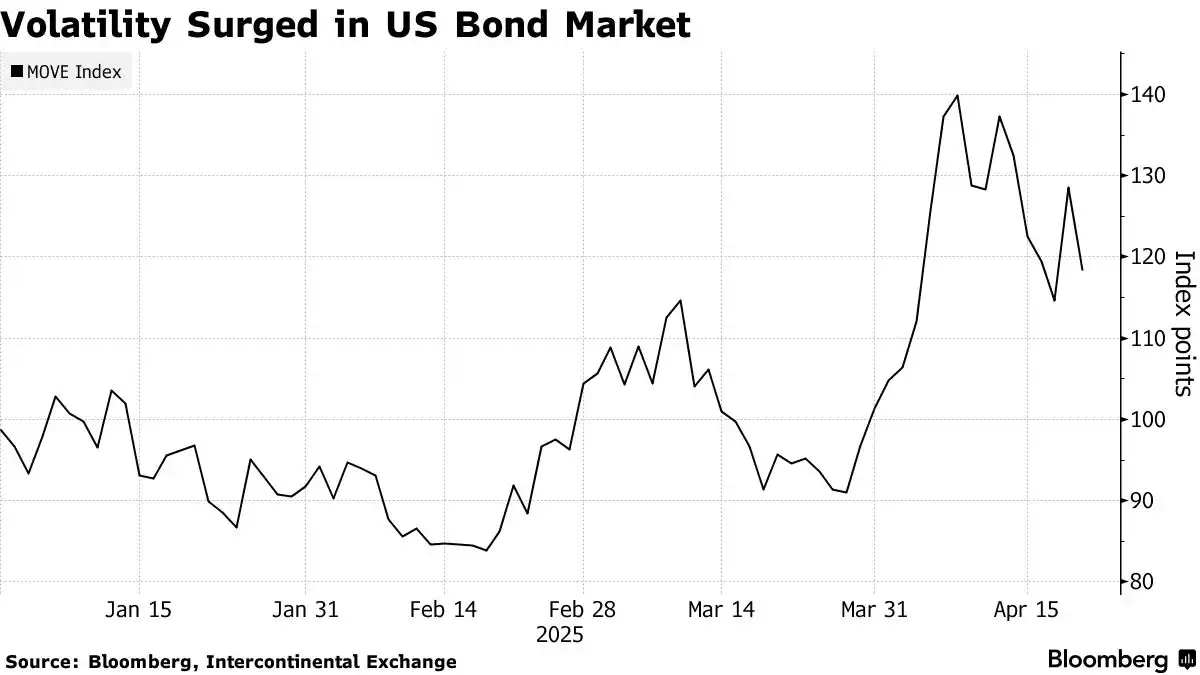
Chasing Cash
Some investors may have already sold off US Treasuries and other US assets, turning to the ultimate safe haven: cash. With the Fed delaying rate cuts, assets in US money market funds have continued to surge, reaching a new all-time high in the week ending April 2. Money market funds are typically seen as akin to cash, with the added benefit of generating returns over time.
Policy Uncertainty
Investors demand higher returns when investing in politically turbulent and economically unstable countries. That's why Argentine government bond yields soared to 13% in mid-April.
Trump's unpredictable political strategies and aggressive tariff policies make it difficult to predict how investment-friendly the US environment will be a year from now.
Another factor driving funds into the US is the belief that the strength of the US judicial system and other institutional powers can constrain the US government and ensure some degree of policy continuity. Trump's willingness to challenge lawyers obstructing his actions and compel the Fed and other independent institutions to comply with his wishes may weaken some people's confidence in the checks and balances that have helped make the US the world's top foreign investment destination.
Fiscal Pressure
In the mid-1970s, the US dollar replaced gold as the world's reserve asset, and central banks around the world began buying US Treasuries to hold dollar reserves. Since the federal government has never reneged on its debt obligations, US Treasuries are seen as a sound investment.
US Treasuries currently make up 121% of GDP. Trump took office betting on reducing the budget deficit through tax cuts to stimulate economic growth, and he recently hinted that tariff revenues also help alleviate the deficit.
However, some worry that his policies will only worsen the national debt. In addition to additional tax cut measures in his plans, Trump is trying to make permanent the tax cuts implemented during his first term. If tariffs lead to an economic downturn, the government may face pressure to increase spending.
In light of this, Mike Riddell, Fixed Income Portfolio Manager at Fidelity International, said that the spiral increase in US Treasury yields could signal "capital flight," as foreign investors become increasingly unwilling to fund the US deficit. "The global ‘bond vigilantes’ clearly remain active."
US debt levels are expected to rise
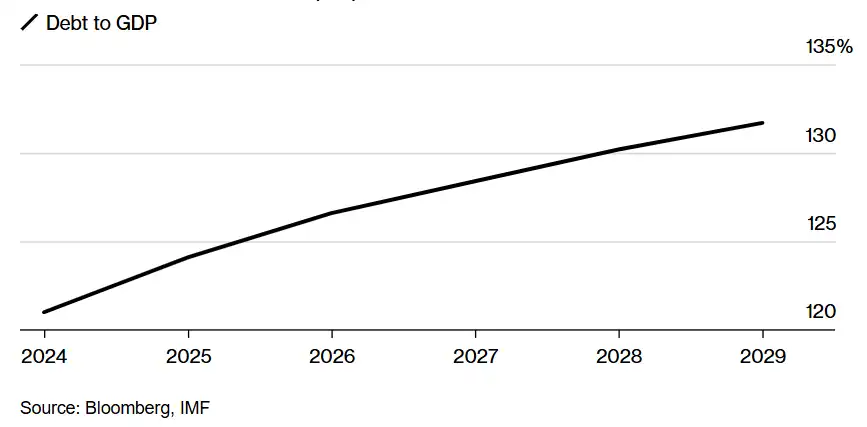
The International Monetary Fund predicts that by 2029, U.S. debt will reach 131.7% of gross domestic product.
Foreign Sell-Off
While difficult to prove in real time, when U.S. treasury bond prices drop, it is often speculated that foreign entities are selling off. This time, some believe it is a response to Trump's tariff policies. China and Japan are the largest holders of U.S. treasuries. Official data shows that both countries have been reducing their holdings for some time.
Given China's secretive trading activities, it is challenging to speculate on the role of the Chinese government. However, strategists often point out that Chinese holdings of U.S. treasuries could be a potential bargaining chip—even though a massive sell-off could devalue China's foreign reserves.
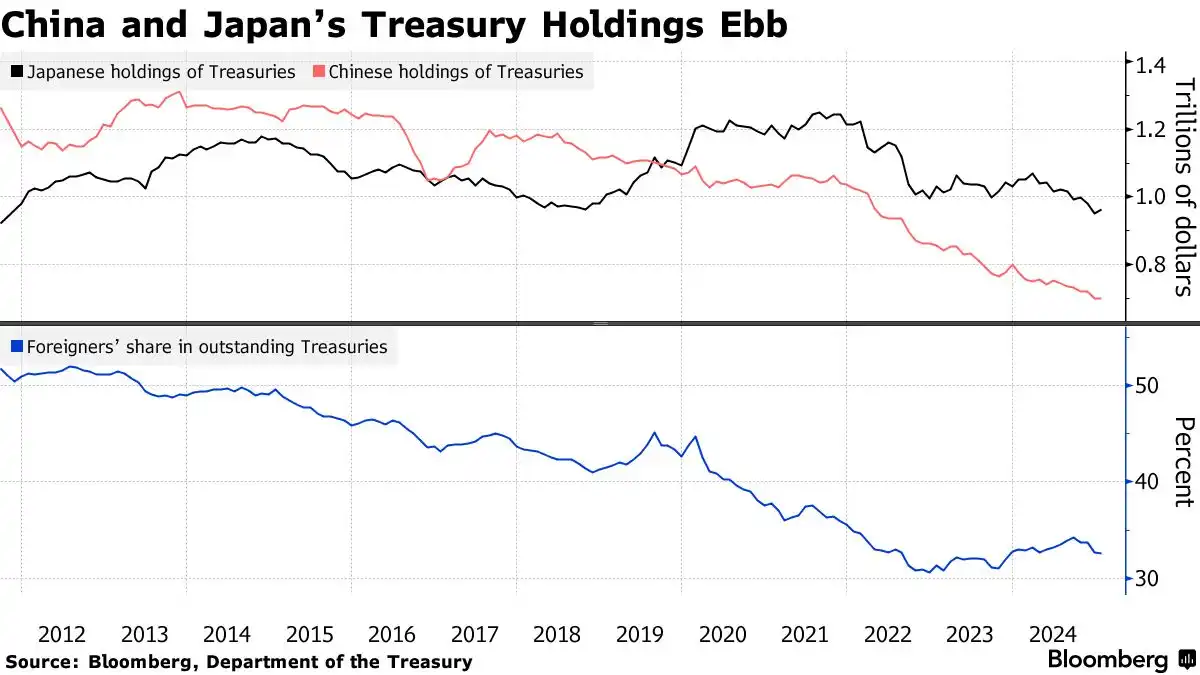
Hedge Fund Trades
Basis trading may have contributed to the sudden surge in U.S. treasury yields in early April. This popular hedge fund strategy profits from the price difference between cash bonds and futures.
Since this spread is typically small, investors often use significant leverage to fund the trade. When market turbulence hits and investors are eager to quickly unwind to repay loans, it can lead to issues. The risk is that this could trigger a chain reaction, driving yields up in a spiral and, worse, causing the treasuries market to seize up, similar to what happened during the 2020 basis trading unwind.
Others point out that the previously prevalent 'U.S. treasuries outperform interest rate swaps' bet suddenly collapsed. In fact, interest rate swaps were performing well as banks settled bonds to meet client liquidity needs and then added swaps contracts to maintain a certain exposure in case the bond market rallied.
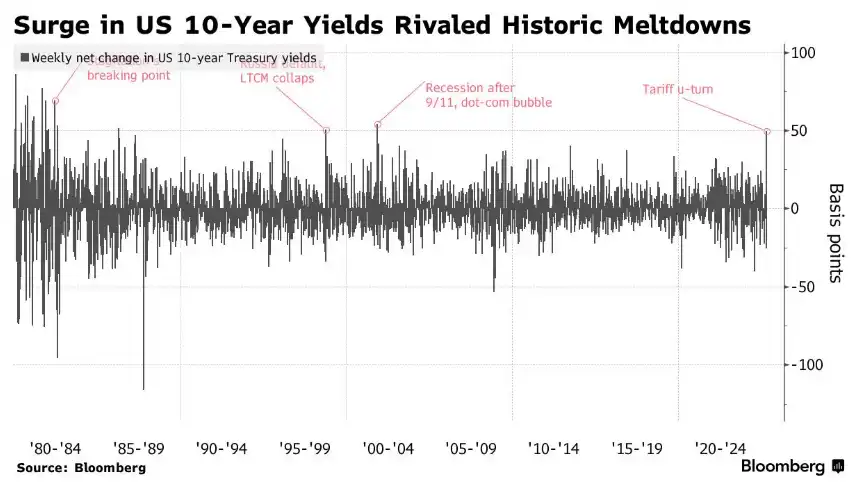
If not U.S. treasuries, then what?
European and Japanese fund managers are finding viable alternatives besides buying U.S. treasuries, which may attract them to shift their asset allocation towards markets with seemingly more stable policy outlooks. Amid broader turmoil, German bonds are one of the main beneficiaries.
Gold, a traditional safe-haven asset, surged to historic highs in April, outperforming almost all other major asset classes. Central banks globally have been hoarding this precious metal for some time, aiming to diversify assets and reduce reliance on U.S. dollar assets. However, unlike bonds, investing in gold does not bring fixed income. Gold investment only yields returns when sold at a higher price.
At the end of the day, no investment can provide the same level of liquidity and depth as the U.S. Treasury market. To truly divest from the U.S. Treasury market would take years, not weeks. However, some market observers believe that April's market trends may signal a shift in the global landscape and a reassessment of assets crucial to the U.S. economic dominance.
You may also like

Consumer-grade Crypto Global Survey: Users, Revenue, and Track Distribution

Prediction Markets Under Bias

Stolen: $290 million, Three Parties Refusing to Acknowledge, Who Should Foot the Bill for the KelpDAO Incident Resolution?

ASTEROID Pumped 10,000x in Three Days, Is Meme Season Back on Ethereum?

ChainCatcher Hong Kong Themed Forum Highlights: Decoding the Growth Engine Under the Integration of Crypto Assets and Smart Economy

Why can this institution still grow by 150% when the scale of leading crypto VCs has shrunk significantly?

Anthropic's $1 trillion, compared to DeepSeek's $100 billion

Geopolitical Risk Persists, Is Bitcoin Becoming a Key Barometer?

Annualized 11.5%, Wall Street Buzzing: Is MicroStrategy's STRC Bitcoin's Savior or Destroyer?

An Obscure Open Source AI Tool Alerted on Kelp DAO's $292 million Bug 12 Days Ago

Mixin has launched USTD-margined perpetual contracts, bringing derivative trading into the chat scene.
The privacy-focused crypto wallet Mixin announced today the launch of its U-based perpetual contract (a derivative priced in USDT). Unlike traditional exchanges, Mixin has taken a new approach by "liberating" derivative trading from isolated matching engines and embedding it into the instant messaging environment.
Users can directly open positions within the app with leverage of up to 200x, while sharing positions, discussing strategies, and copy trading within private communities. Trading, social interaction, and asset management are integrated into the same interface.
Based on its non-custodial architecture, Mixin has eliminated friction from the traditional onboarding process, allowing users to participate in perpetual contract trading without identity verification.
The trading process has been streamlined into five steps:
· Choose the trading asset
· Select long or short
· Input position size and leverage
· Confirm order details
· Confirm and open the position
The interface provides real-time visualization of price, position, and profit and loss (PnL), allowing users to complete trades without switching between multiple modules.
Mixin has directly integrated social features into the derivative trading environment. Users can create private trading communities and interact around real-time positions:
· End-to-end encrypted private groups supporting up to 1024 members
· End-to-end encrypted voice communication
· One-click position sharing
· One-click trade copying
On the execution side, Mixin aggregates liquidity from multiple sources and accesses decentralized protocol and external market liquidity through a unified trading interface.
By combining social interaction with trade execution, Mixin enables users to collaborate, share, and execute trading strategies instantly within the same environment.
Mixin has also introduced a referral incentive system based on trading behavior:
· Users can join with an invite code
· Up to 60% of trading fees as referral rewards
· Incentive mechanism designed for long-term, sustainable earnings
This model aims to drive user-driven network expansion and organic growth.
Mixin's derivative transactions are built on top of its existing self-custody wallet infrastructure, with core features including:
· Separation of transaction account and asset storage
· User full control over assets
· Platform does not custody user funds
· Built-in privacy mechanisms to reduce data exposure
The system aims to strike a balance between transaction efficiency, asset security, and privacy protection.
Against the background of perpetual contracts becoming a mainstream trading tool, Mixin is exploring a different development direction by lowering barriers, enhancing social and privacy attributes.
The platform does not only view transactions as execution actions but positions them as a networked activity: transactions have social attributes, strategies can be shared, and relationships between individuals also become part of the financial system.
Mixin's design is based on a user-initiated, user-controlled model. The platform neither custodies assets nor executes transactions on behalf of users.
This model aligns with a statement issued by the U.S. Securities and Exchange Commission (SEC) on April 13, 2026, titled "Staff Statement on Whether Partial User Interface Used in Preparing Cryptocurrency Securities Transactions May Require Broker-Dealer Registration."
The statement indicates that, under the premise where transactions are entirely initiated and controlled by users, non-custodial service providers that offer neutral interfaces may not need to register as broker-dealers or exchanges.
Mixin is a decentralized, self-custodial privacy wallet designed to provide secure and efficient digital asset management services.
Its core capabilities include:
· Aggregation: integrating multi-chain assets and routing between different transaction paths to simplify user operations
· High liquidity access: connecting to various liquidity sources, including decentralized protocols and external markets
· Decentralization: achieving full user control over assets without relying on custodial intermediaries
· Privacy protection: safeguarding assets and data through MPC, CryptoNote, and end-to-end encrypted communication
Mixin has been in operation for over 8 years, supporting over 40 blockchains and more than 10,000 assets, with a global user base exceeding 10 million and an on-chain self-custodied asset scale of over $1 billion.

$600 million stolen in 20 days, ushering in the era of AI hackers in the crypto world
Vitalik's 2026 Hong Kong Web3 Summit Speech: Ethereum's Ultimate Vision as the "World Computer" and Future Roadmap
On the same day Aave introduced rsETH, why did Spark decide to exit?
Full Post-Mortem of the KelpDAO Incident: Why Did Aave, Which Was Not Compromised, End Up in Crisis Situation?

After a $290 million DeFi liquidation, is the security promise still there?
ZachXBT's post ignites RAVE nearing zero, what is the truth behind the insider control?




 App
App