
BTC Bounces Back to $92,000 Support Amid Institutional Buy-the-Dip


Original Article Title: "Institutional Buying Against the Trend, BTC Pullback Fails to Conceal Long-Term Bull Market Signal"
Original Source: BitpushNews
Due to the rise in U.S. Treasury yields and investors adjusting their expectations for the Federal Reserve's monetary policy, the U.S. Dollar Index (DXY) hit a new high, causing a second consecutive day of correction in the cryptocurrency market.
CMC data shows that in the past 24 hours, BTC briefly dropped to a intraday low of $92,600, rebounding to around $94,400 at the time of writing, still down 2.1% in the past 24 hours, with Ethereum falling to around $3,330.
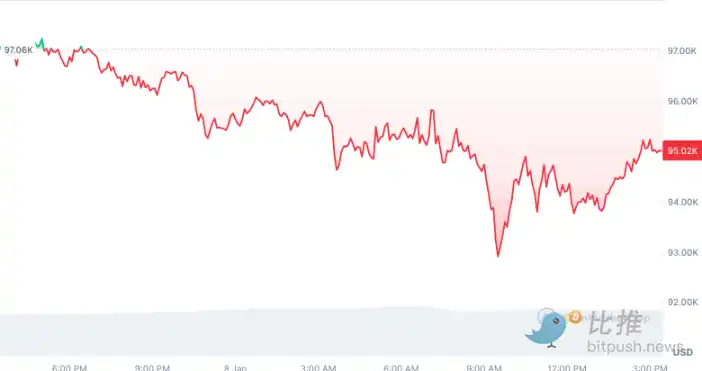
This trend is closely related to strong economic data released by the U.S., including a sharp increase in job vacancies and better-than-expected manufacturing performance. These data further solidify Federal Reserve Chairman Powell's view that there may be no need for aggressive rate cuts this year to effectively control inflation. The "Fed megaphone" Nick Timiraos pointed out that today's released Fed meeting minutes further indicated that officials are generally willing to keep rates unchanged at the meeting scheduled at the end of this month. As a result, the market adjusted its expectations for the Federal Reserve's future monetary policy, causing a drop in risk assets.
CoinGlass data shows that the two-day retreat has led to the liquidation of nearly $1 billion worth of cryptocurrency leverage derivative positions, primarily long positions betting on price increases.
Macroeconomic and Policy Expectations Dominate Market Sentiment
This Bitcoin price correction reflects the market's adjustment of its earlier optimistic expectations for Bitcoin. The previous optimism was mainly based on two assumptions: first, that the Federal Reserve would adopt a looser monetary policy, actively cutting interest rates; and second, that if Trump were re-elected as U.S. President, it would bring a clearer regulatory framework for the cryptocurrency industry. However, current economic data and the Fed's statements have raised doubts in the market about the extent to which these two assumptions will materialize.
Philipp Pieper, co-founder of Swarm Markets, pointed out that in the absence of new market narratives driving the market, the cryptocurrency market is gradually returning to the logic of traditional financial markets. When interest rates are low, investors typically tend to increase their allocation to risk assets (such as cryptocurrencies and tech stocks) in search of higher returns. However, due to the unclear cryptocurrency policies of the Trump administration, the market sentiment is cautious, and this uncertainty is expected to persist for some time.
An analysis report from 10x Research also emphasizes the importance of macroeconomic data on Bitcoin's price. The report believes that the Fed's response to U.S. economic data and global liquidity conditions are the two key macroeconomic factors influencing Bitcoin's price trends. In the short term, Bitcoin's price may therefore enter a volatile "banana zone." The "banana zone" vividly describes the turbulent price movements of assets under the combined influence of macro factors.
BitMEX Co-founder Arthur Hayes also analyzed the impact of USD liquidity on Bitcoin price in his latest blog post, suggesting that Bitcoin and cryptocurrency prices typically rise when USD liquidity increases.
Institutional Accumulation Exceeds 34,000 BTC in the Past 30 Days
Despite short-term market correction pressures, analysts remain optimistic about Bitcoin's long-term prospects. On-chain data from CryptoQuant indicates that the market's "potential demand remains very strong." The institution measures market demand by comparing the amount of idle Bitcoin to the new Bitcoin supply from miners. When the reduction in idle Bitcoin far exceeds the new supply, it indicates strong market demand.
A CryptoQuant analyst wrote that around December 21, 2024, institutional investors sold about 79,000 BTC in a week, leading to a 15% pullback in the market. However, large institutions then took advantage of the market consolidation phase to continue buying below $95,000 using a time-weighted average price (TWAP) strategy. In the past 30 days, institutional investors have accumulated over 34,000 BTC, providing buy-side support for Bitcoin's recent rebound.
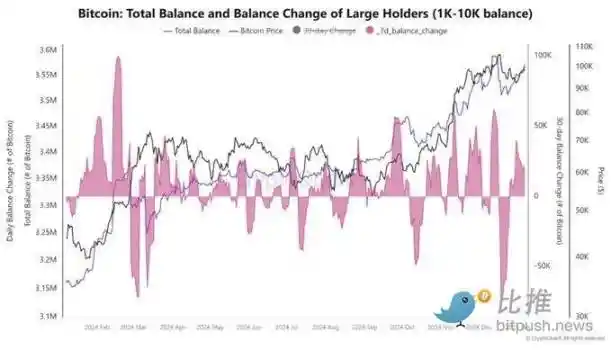
Despite adjustment periods in institutional portfolios, the trend of on-chain Bitcoin accumulation has been evident since June 2023. This indicates that amidst retail demand being at a five-year low, institutional investors' interest in Bitcoin remains high.
CryptoQuant analysis also shows that Bitcoin's pullback has significantly reduced traders' unrealized profits, which is a normal occurrence after a substantial rally. Currently, traders' realized price is around $88,000 (usually forming price support in a bull market).
Historical data shows that after the past two U.S. presidential elections, Bitcoin experienced pullbacks in January, with a 36% decline in January 2017 and January 2021.
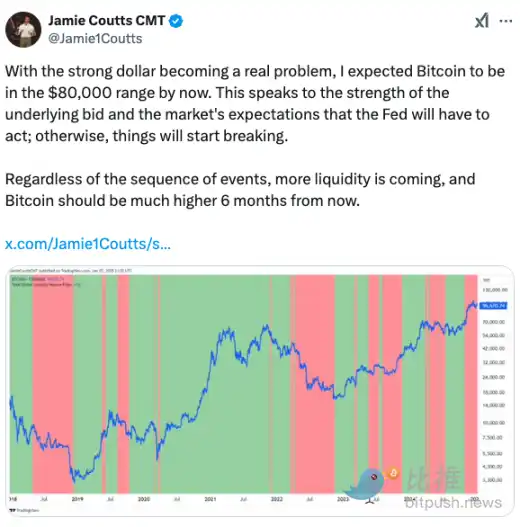
Real Vision's Chief Crypto Analyst Jamie Coutts commented on the X platform, saying, "As the strength of the U.S. dollar becomes a real issue, I originally expected Bitcoin to be around $80,000 now, but it didn't drop to that level, indicating strong potential buying pressure and the market's expectation that the Fed will have to take action; otherwise, the situation will start to deteriorate. However events unfold, more liquidity is on the way, and Bitcoin should be much higher in six months."
Overall, Bitcoin's recent pullback has been mainly influenced by macroeconomic data and changing expectations regarding the Federal Reserve's policy. In the short term, the market may continue to experience a period of volatility. However, institutional investors' ongoing accumulation behavior and the strong demand reflected in on-chain data will provide support for the long-term trend.
You may also like

CFTC Reportedly Plans New Prediction Market Rules Focused on Manipulation Risk and Public Interest Review
The CFTC is reportedly preparing new prediction market rules focused on manipulation risk, public interest review, and retail trader protections.

Meet the new WEEX trial fund—your gateway to greater profits

WEEX Labs Lands at Dutch Blockchain Week: A Disruptive Crypto × AI Conversation Sets Sail in Amsterdam

SK Hynix Reportedly Plans U.S. ADR Listing as Early as August, With SEC Approval Possible in Late June
SK Hynix may pursue a U.S. ADR listing as early as August, with SEC approval reportedly possible in late June amid strong AI chip supply chain demand.

SpaceX vs Tesla vs xAI: Which Elon Musk Trade Has the Biggest Upside in 2026?
OpenAI Reveals It Has Confidentially Submitted an S-1 to the SEC, Keeping the Door Open for a Future IPO
On June 9, according to an OpenAI announcement, the company recently confidentially submitted a draft S-1 registration statement to the U.S. Securities and Exchange Commission (SEC), beginning the preliminary compliance process for a potential initial public offering. OpenAI said it chose to disclose this proactively because it expected the news might leak; however, the company has not yet set a specific listing timeline, and related arrangements may still take some time.

Latest research from 13 top universities including Cornell University: The current state, challenges, and misconceptions of the fusion of Crypto and AI
Deconstructing Anthropic: The Best AI Company, Possibly Also a Type of Organizational Invention
Apollo and Blackstone Reportedly Back $35 Billion Anthropic Chip Financing as Deal Details Remain Unclear
On June 9, according to currently available news alerts, Apollo and Blackstone Group participated in a $35 billion financing for an Anthropic “chip project.” Based on the original wording of the report, the funding has already been raised, but public information remains limited. The financing structure, use of proceeds, project entity, and whether Apollo and Blackstone participated through equity, debt, or project financing have not yet been disclosed.

Humanity Protocol Security Incident Escalates: More Than $31 Million Stolen From Related Addresses as Attacker Continues Selling H for ETH
On June 9, according to monitoring by Onchain Lens, more than $31 million has been stolen from addresses linked to Humanity Protocol, and the attack is still ongoing, with the hacker continuously swapping H tokens for ETH. Project founder Terence Kwok later confirmed the security incident on X, saying the issue involved a private key leak.

Bloomberg: As Bitcoin Weakens, Stablecoins and RWA Continue to Drive Expansion in Crypto Businesses
In June, Bloomberg reported that despite Bitcoin falling below $60,000 last week, wiping out about $235 billion in market value within seven days, and dropping close to 50% from last year’s peak, some core businesses in the crypto industry are still expanding, mainly in stablecoins, real-world asset tokenization (RWA), payments, and infrastructure. The report also noted that overall altcoin activity has contracted significantly: altcoin market capitalization has fallen from a peak of about $431 billion in November 2021 to around $170 billion, and among the tens of millions of tokens issued in recent years, fewer than 1,700 still maintain meaningful trading activity.

Galaxy Deep Research Report: How Hyperliquid's HIP-4 Upgrade Changes the Landscape of Prediction Markets?
Binance Research: RWA Market Expected to Expand Nearly 6x from Early 2025, with Public Equities and Onchain Payments Heating Up Together
In June, Binance Research said in its monthly market report that the real-world asset (RWA) market is expected to grow by about 589% from the beginning of 2025. Bond- and money market fund-related RWA expanded by about $6.5 billion, up 83% year over year, while publicly traded equity RWAs grew by about 422%. The report also noted that monthly crypto debit card transaction volume exceeded $747 million in May, up 48.6% year to date.

Japan to Assess a Framework for Yen Stablecoins and Crypto ETFs as Asia’s Compliant Payments Narrative Heats Up
Recently, according to the original report, Japan is considering the launch of yen stablecoins and cryptocurrency ETFs. Public information remains limited at this stage, and there is still no complete policy text, regulatory draft, or clear implementation timeline, so this is better characterized as a “policy discussion” rather than formal implementation. The original wording also noted that advancing stablecoin regulation in Asia is driving XRP usage and supporting growth in the XRPL ecosystem. However, based on currently available public information, there is not enough evidence to directly establish a clear causal relationship between this round of discussion in Japan and XRP or XRPL.

ZachXBT: Humanity private key leak and abnormal surge in H token should be viewed separately
On June 9, according to related disclosures, on-chain investigator ZachXBT posted an update on Humanity’s roughly $31 million security incident, saying that after further analyzing fund flows, he currently tends to believe the project team was not involved in an “inside job” or a self-staged attack. According to him, the official explanation about the private key leak was broadly accurate, but before the token unlock, the price of H had been artificially pushed higher, and the hacker later took advantage of that market environment; therefore, the private key leak and the earlier abnormal price pumping should be regarded as two separate and independent events. This reframing has shifted the market’s understanding of the nature of the incident. Earlier discussion around Humanity had focused on whether the team directly participated in the attack or used the security incident to cover up internal operations. ZachXBT’s latest remarks shift the focus from “whether it was self-theft” to “whether there were pre-unlock market structure issues.” He also questioned whether the team may have.

Morning Report | OpenAI has submitted an S-1 registration statement draft to the U.S. SEC; Morpho completes $175 million financing

Morning Report | BitMine increased its holdings by 126,971 ETH last week; trader Eugene announced his exit from the crypto market

Wang Chuan: How can one not feel anxious after the neighbor Old Wang made thirty times profit by investing in storage stocks? (Seven) - A quarter-century cycle
CFTC Reportedly Plans New Prediction Market Rules Focused on Manipulation Risk and Public Interest Review
The CFTC is reportedly preparing new prediction market rules focused on manipulation risk, public interest review, and retail trader protections.
Meet the new WEEX trial fund—your gateway to greater profits
WEEX Labs Lands at Dutch Blockchain Week: A Disruptive Crypto × AI Conversation Sets Sail in Amsterdam
SK Hynix Reportedly Plans U.S. ADR Listing as Early as August, With SEC Approval Possible in Late June
SK Hynix may pursue a U.S. ADR listing as early as August, with SEC approval reportedly possible in late June amid strong AI chip supply chain demand.
SpaceX vs Tesla vs xAI: Which Elon Musk Trade Has the Biggest Upside in 2026?
OpenAI Reveals It Has Confidentially Submitted an S-1 to the SEC, Keeping the Door Open for a Future IPO
On June 9, according to an OpenAI announcement, the company recently confidentially submitted a draft S-1 registration statement to the U.S. Securities and Exchange Commission (SEC), beginning the preliminary compliance process for a potential initial public offering. OpenAI said it chose to disclose this proactively because it expected the news might leak; however, the company has not yet set a specific listing timeline, and related arrangements may still take some time.


