
Bull Comeback Speedrun? The Next Investment Opportunity for Crypto AI



Original Article Title: The Next Crypto AI Meta
Original Article Author: @Defi0xJeff, CEO of @steak_studio
Original Article Translation: zhouzhou, BlockBeats
Editor's Note: This article discusses investment opportunities in Crypto AI Agents and DeAI Infrastructure. The liquidity of the AI Agent ecosystem is poor and volatile, while the Bittensor ecosystem has better liquidity and greater stability. DeAI infrastructure is underestimated and has enormous potential. Combining agent and infrastructure market promotion can bring new workflows and investment opportunities.
The following is the original content (slightly reorganized for better readability):
Since Trump took office, crypto investing has become noticeably more challenging. The overall uncertainty has led funds to flow into "safe-haven assets" rather than riskier assets.
The world is closely watching the escalating tariff situation. The crypto market is certainly no exception—although BTC has shown some strength, Fartcoin has performed even more robustly, almost steamrolling everything else.
Everything Else is Struggling
Aside from these two assets, other projects (I mean literally all projects) are all struggling—once-dominant Crypto AI sectors have plummeted significantly, with the overall market cap currently around $60 billion. DeFi hasn't fared much better, with on-chain TVL evaporating over $500 billion, funds are leaving the crypto market, moving to other safer assets.
So What Should We Invest In?
This raises the key question: during market turbulence, how should we invest and in what should we invest?
Most people I know might say to go to Berachain, Sonic, and other on-chain yield farms, which is fine. But for me, there are actually opportunities with a higher risk/reward ratio (R/R) now, especially worth considering during market volatility.
In my opinion, the most asymmetric opportunity right now (meaning enormous potential but not fully priced by the market) lies at the intersection of DeAI Infrastructure and AI Agents (which I will explain in detail later).
Stick to that old saying: "Be fearful when others are greedy, and be greedy when others are fearful." (Wait, I think I said it wrong) Yes, "Be fearful when others are greedy, and be greedy when others are fearful." That's right!
The Crypto AI Subdomains I'm Following
In my view, there are several subdomains within Crypto AI that are particularly worth paying attention to:
· Development Tools: including frameworks, Vibe coding tool, MCP infrastructure
· Decentralized AI Infrastructure: such as decentralized compute, verifiability, deployment methods, privacy preservation, storage, ownership, etc.
· Consumer-Facing AI: including AI agents, Alpha tools, games, DeFAI, GambleFAI, personalized/companion applications
(These are not all subdomains, but you should get the idea of the direction I'm referring to.)
Framework Trends
To illustrate trends in consumer AI / agents and development tools more specifically, I wrote a tweetstorm in March (originally intended to do it monthly, but the market pace didn't require monthly updates).

Frameworks used to have a high valuation, but things are different now. During the rally from October to November last year, the FDV (Fully Diluted Valuation) of various AI frameworks was pumped up. However, as developers realized that these "off-the-shelf frameworks" couldn't handle many complex tasks, and with large models being susceptible to prompt injection attacks in financial scenarios (not very secure), the market's demand for these frameworks started to cool off.
That being said, open-source frameworks and tools like @elizaOS (15.5k GitHub stars), @arcdotfun (3400 likes), @sendaifun (1200 likes) are still seeing steady growth. In just the past month, they have gained 434, 197, and 110 stars, respectively.
Why I Think Agent Distribution Networks Are More Important Than Frameworks
Frankly, I'm not personally that interested in frameworks themselves—because they don't inherently have much value accrual. In contrast, investing in an Agent Distribution Network or an Agent Hub is more intriguing because the value loop here is more transparent—such as the transaction volume generated by speculators or investors trading the AI Agent token can directly translate into transaction fee income.
Currently, @virtuals_io is leading the way in this regard. Although its daily transaction volume has dropped from 8 to 9 figures to 7 figures, it remains one of the most trusted ecosystems for developers, as well as one of the most diverse projects and innovative products in the Agent platform.
@elizaOS is starting to show promise. Especially with its Launchpad @autodotfun recently launched, it means the team now has a distribution channel that can directly bring value to the $ai16z token. @shawmakesmagic has also teased some interesting new features (not yet launched, but looking very promising):
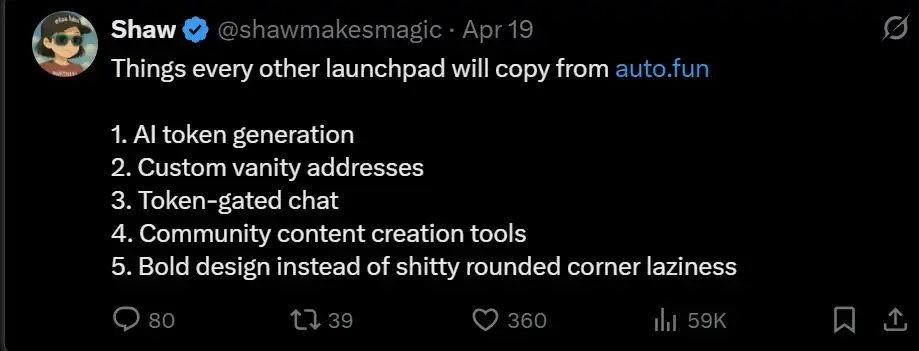
To excel, it is essential to perfect the launch process for high-quality collaborative projects. If @elizaOS wants to truly distinguish itself from Virtuals, it must excel in the quality of its collaborative projects. Otherwise, it is easy to fall into the "low-quality projects + four to five-figure market cap" death spiral.
Stepping back a bit, the direction with the highest cost-effectiveness right now is not Agent or frameworks, but decentralized AI infrastructure (DeAI Infra). Why? If you have been in the AI Agent field for a while, you should be familiar with this evolutionary path: entertainment chat agent ➝ Alpha/tool-based agent ➝ transactional agent ➝ DeFAI abstraction layer ➝ other small narratives ➝ more intelligent context, multi-agent/swarm systems, etc.
Death spiral trap. The reason many teams cannot succeed is that their "agent products" fundamentally lack core AI capabilities—the only "intelligence" is prompting LLM to say something at a scheduled time. Although it is much better now than in the early days, most teams still heavily rely on LLM and off-the-shelf frameworks, and each round of narratives produces immature, out-of-touch products.
Just as many projects in the past forked mainstream DeFi protocols, had six months of hype, and then went back to zero, the result is: rely on token + agent to generate some buzz, attract attention, then no one uses it, attention drops, token drops, and falls into a "death spiral."
Agent teams need infrastructure; Infra teams also need Agent. However, these failed teams do have one strong suit: they know how to GTM (go-to-market), they know how to hype. So the question is—there are a bunch of Agent teams that know how to market, know how to build a community, but they don't have a real AI product; what should they do? The answer is: integrate the capabilities of professional AI models and DeAI infrastructure (inference networks, training platforms, etc.).
In contrast, DeAI Infra teams often lack expertise in GTM, are not crypto native, and don't understand how to engage with the community. So why not bring the two together?
I believe the real opportunity lies in the connection between "Deep AI Infrastructure × Viral-level Agent Distribution."
My Crypto AI Investment Thesis:
Invest in DeAI Infra + Invest in an Agent team that can redefine Crypto's existing workflows
Web2 has long been using AI agents to automate various vertical workflows, with common examples being:
Legal sector: AI assisting law firms in document reading, case database organization, and enhancing courtroom strategies
Accounting sector: AI helping with receipt categorization, generating reports, and preparing tax documents
Construction sector: AI reviewing blueprints, cost estimation, and providing structural optimization recommendations
These projects often reach 7-8 figures in ARR within a few months because they truly leverage AI for automation and augmentation, creating practical value.
However, in Web3, this concept is still very new. To enhance workflows in DeFi, one must not only understand crypto but also grasp the users' real pain points. Some DeFAI projects attempt to create abstraction layers, but they are mostly in the stage of "requiring very specific prompts to function," far from "being user-friendly for everyone."
Therefore, I believe individuals who genuinely comprehend Web3/Crypto workflows are rare. But if you can find and invest in these teams now, you will reap the greatest rewards when they explode in the future.
The issue on the Infra side is—most are not yet available for investment
DeAI Infra teams typically receive VC funding and take a few years to TGE. Some that have already listed have experienced a 50–80% decline. To stabilize token prices, there is only one method: either have actual revenue or secure top-tier liquidity.
For instance, @getgrass_io is a good example: they have a consumer-facing product, leverage user-contributed bandwidth for airdrops, and reportedly have revenue in the 8-9 figures. Such projects are rare, and usually, early participation is only possible through product usage/participation in airdrops. When they truly list, with a high FDV and low circulation, it's easy for the average person to lose out.
Therefore, what is more worth paying attention to is—community-driven, VC-less DeAI ecosystems. Yes, I'm talking about @opentensor (Bittensor).
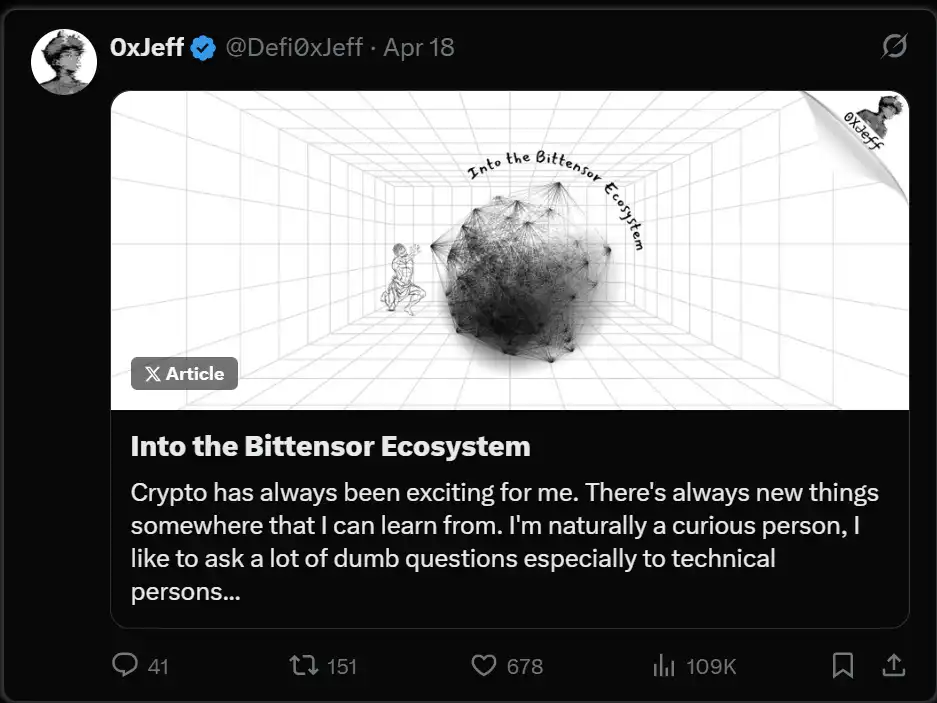
But ever since the Valentine's Day upgrade of dTAO earlier this year, the entire landscape has undergone a huge transformation. Now, it is the market that determines which subnet receives emission. The community — that is, the users themselves — has become the allocator of capital. If the community believes that your subnet has no product, no real value, then you will not receive emission (capital). This forces subnets to build openly, make progress quickly, and create products that people truly need.
This shift has even given rise to some hedge funds specifically investing in Bittensor subnets.

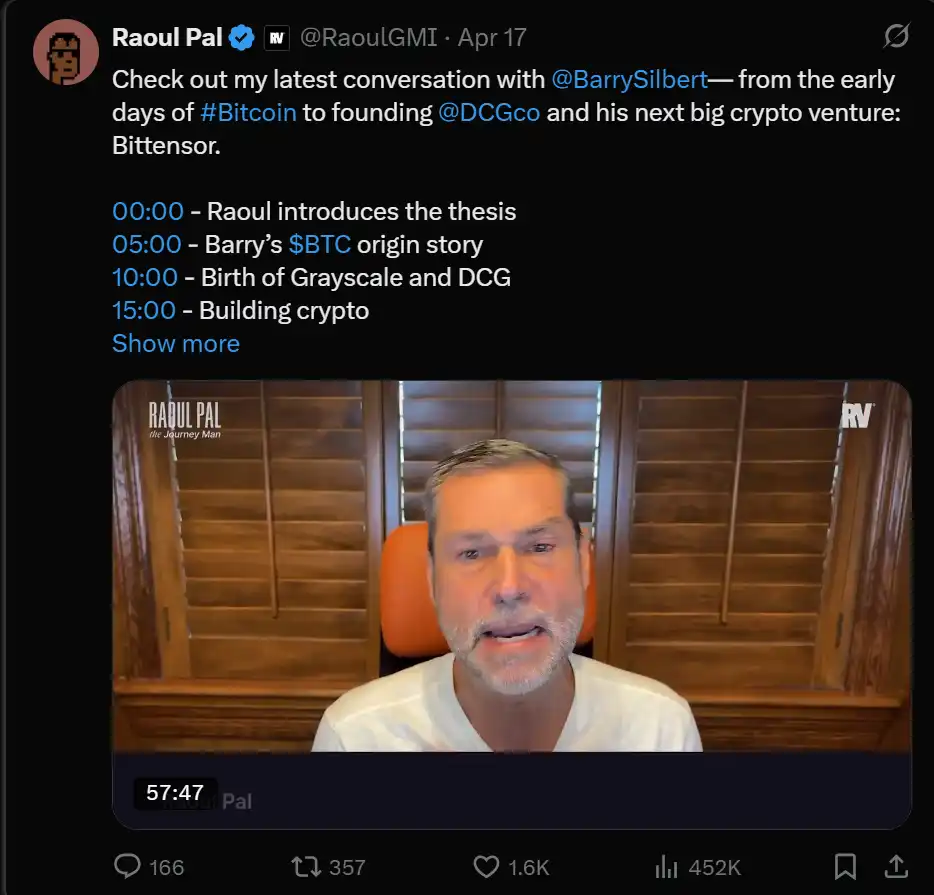
@BarrySilbert is now partnering with @YumaGroup (a subsidiary of DCG) to bet on the Bittensor ecosystem, a company that invests in, builds, and incubates Bittensor subnets. A recent interview between @RaoulGMI and @BarrySilbert has sparked great excitement in the community (as a major crypto institution has now entered the Bittensor ecosystem).
From an investment perspective, the liquidity of the Bittensor ecosystem is significantly superior to that of the AI Agent ecosystem. The core issue with agent ecosystems like Virtuals lies in the liquidity pool (LP) being paired with Virtuals, leading to higher volatility and more impermanent loss (IL) for liquidity providers.
This is why liquidity is usually relatively thin — you typically put in $1k to $5k and might experience a 3% to 7% slippage on these agent tokens. On the other hand, putting a similar amount into subnet tokens would only incur around 0.05% to 0.1% slippage (or even lower).
Brief Summary:
· The hype cycle of crypto AI agents is waning, with true products and users still scarce
· DeAI infrastructure is undervalued, misunderstood, and mispriced
· The best investment opportunities involve combining infrastructure and agent-driven go-to-market (GTM) to unlock new workflows
· $VIRTUAL leads the agent space, Bittensor leads the infrastructure space
· Watch out for teams that combine the two — if discovered early, there is tremendous upside potential
Summary: I believe DeAI will define the next trend of Web3 AI. We will see more teams changing how we interact with each other and protocols, transforming how value is created, and creating new niche markets that attract more users and a larger market share (more mainstream). Now is the best time to understand the DeAI infrastructure and how it is transforming the landscape. Make sure to pay attention to teams that can successfully integrate DeAI and agency.
You may also like

On-chain finance: On-chain IPOs and on-chain ICOs, a new frontier in the trillion-dollar market

Rented Belief: How Much of the Bitcoin ETF Fund Flow is Real Money

The two giants are racing in "credit": loan balances of 9.9 billion vs 14.6 billion USD, Brazil has become the main battlefield

A company that was on the verge of bankruptcy has just surpassed Bitcoin in market value

B.AI partners with MiniMax to launch a limited-time free experience of M3, enabling zero-threshold implementation of Agentic productivity through full-stack infrastructure

The second half of the computing power battle: Intel CEO Pat Gelsinger reveals how AI is reshaping the global semiconductor supply chain

WEEX Live mode: Monitor 20 trading pairs at once and trade like a pro

Morning Report | Secret Network loses $4.67 million due to cross-chain vulnerability; Michael Saylor releases Bitcoin Tracker information again, may disclose increased holdings data next week

Kalshi's biggest competitor is not Polymarket
WEEX Makes Affiliate Access Easier on the Web and in the App
Customize Your Spot Trading Page: Drag Modules and Move the Order Panel Where You Want It

Perp DEX: The Next Generation Exchange "War"

10 Counterintuitive Insights on Latin American Payments

The AI gamble of mining companies: Valuations enter a phase of differentiation, and it's hard to turn the tide
A letter from Alliance to entrepreneurs: Written on the occasion of Cursor selling for 60 billion dollars
Stablecoins Finally Find Real Returns: On-Chain Reinsurance Re Explained | Interview with Re Founder Karan Saroya

The impossible triangle is simply a pseudo problem

Will MicroStrategy fall into a death spiral? What will the macro trend be in the second half of the year?
On-chain finance: On-chain IPOs and on-chain ICOs, a new frontier in the trillion-dollar market
Rented Belief: How Much of the Bitcoin ETF Fund Flow is Real Money
The two giants are racing in "credit": loan balances of 9.9 billion vs 14.6 billion USD, Brazil has become the main battlefield
A company that was on the verge of bankruptcy has just surpassed Bitcoin in market value
B.AI partners with MiniMax to launch a limited-time free experience of M3, enabling zero-threshold implementation of Agentic productivity through full-stack infrastructure
The second half of the computing power battle: Intel CEO Pat Gelsinger reveals how AI is reshaping the global semiconductor supply chain


