
 Buy Crypto
- Markets
 Futures
- Spot
- Copy Trade
- Earn
- More
Consensus Check: What Consensus Was Born at the 2026 First Conference?


Original Article Title: "Consensus HK Observation: What Crypto Consensus Was Born in 2026?"
Original Article Author: Joe Zhou, Foresight News
If 2024 was the "breakthrough year" when ETFs opened the door to Wall Street, and 2025 was the "year of regulatory reshaping" under the new Trump administration, then Consensus HK 2026 just held in Hong Kong has rewritten the script for this year.
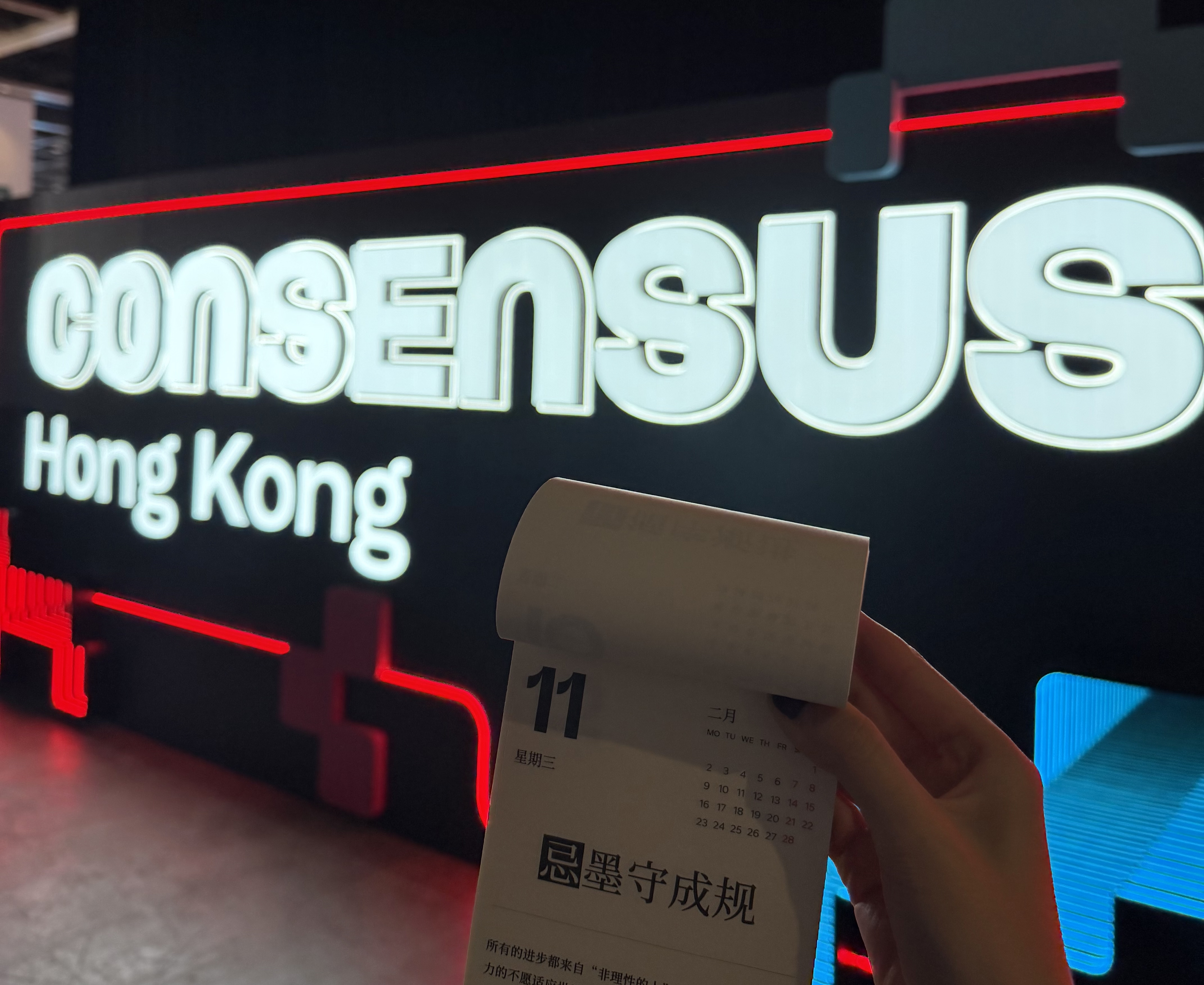
We are about to witness an eruption of "Silicon Finance," a close-quarters battle of "sovereign stablecoins," and Crypto bidding farewell to self-absorption on the chain, instead infiltrating the real world.
Over the three days of the event, as the Solana Foundation, Binance executives, and the Wall Street elites from JPMorgan Chase and BlackRock shared the stage, a profound sense of division and integration swept over. The era of grass-roots movements has ended, replaced by a finely tuned financial machine driven by national powers, decentralized technology, and silicon-based life.
Through a perception of the emotions of over 11,000 attendees and tracking dozens of closed-door meetings, the author has summarized the three major Crypto consensuses at the beginning of 2026:
Consensus One: Without Economic Independent AI, It Can't Be Considered True Silicon-based Life
The definition of AGI is a constant debate in the tech world. But in this arena, a new consensus is emerging: if there is no independent financial sovereignty, not even the right to have its own bank account, the so-called AGI is at best a sophisticated tool of humanity.
The most intense shock at the conference site came from an inversion of the subject-object relationship. The central axis of the narrative is no longer "how humans use AI to trade better," but "how AI uses Crypto to reconstruct production relations" — they are autonomously issuing coins on the chain, managing funds, and even starting to pay wages to hire real humans.

Two robots are boxing at the Consensus venue
Whether it's the early 2026 sensation Rentahuman (AI hiring humans for offline errands) or the newly launched ERC-8004 protocol on Ethereum, the cutting-edge hackers are frantically closing the loop on this "Silicon Finance industry chain." Today, Ethereum, Base, Solana, and even Virtuals designed specifically for AI are all fiercely competing for one throne: to become the preferred underlying settlement network for silicon-based life.
This is not just a geek's frenzy, but has also received official endorsement. In his keynote address at the conference, Hong Kong Financial Secretary Paul Chan vividly and precisely depicted this vision: "As AI agents are able to make and execute decisions independently, we will see the early form of the 'Machine Economy'—where AI can hold digital assets on-chain, pay service fees, and transact with each other."
By 2026, the most active on-chain address will no longer be a human whale, but a tireless AI agent. Crypto is becoming AI's "native bank account," while humans are devolving into AI's "flesh-based API."
Consensus Two: Stablecoin Battle Royale, Hong Kong Fires the First "Onshore Counterattack" Shot
During my on-the-ground visit to Hong Kong, I noticed a dramatic contrast: physical cryptocurrency over-the-counter (OTC) shops were popping up all over the place, but at the most prominent counters, without exception, there was a "banishment order"—a complete halt to the sale of USDT and USDC, and other US dollar stablecoins.
This was far from a spontaneous merchant action but a long-planned "clearing." On the main stage of the Consensus conference, Hong Kong Financial Secretary Paul Chan threw out this puzzle piece: "Hong Kong plans to issue the first batch of a small number of stablecoin issuer licenses in March this year."

Image: Cryptocurrency exchange shops in Hong Kong
This is an extremely acute political-economic signal. Just two weeks ago, offshore kingpin Tether had just bowed to US regulators, launching a compliant version of the US dollar stablecoin, USAT, attempting to seamlessly take over Wall Street. And at this end of the earth, to snipe at the further suction of US dollar stablecoins on Asian liquidity, Hong Kong has given the most assertive response.
This is no longer a simple Crypto compliance issue but a currency sovereignty defense war between major powers. From the EU's MiCA regulation completely banning non-compliant US dollar stablecoins, to Hong Kong's upcoming "big move" in March, to the Euro stablecoin expected to be officially launched in the second half of 2026 led by ten mainstream European banks, a clear battle line has been drawn.
Using both physical and legal means, Hong Kong is cutting off the circulation of offshore US dollar stablecoins to pave the way for its "regular army" (Hong Kong dollar / onshore stablecoin). By 2026, stablecoins will no longer be chips in the crypto casino but will be the "digital nuclear weapons" of the great power financial game.
The intention is clear. While the entire Asia region is frenziedly embracing USDT QR code scans, Hong Kong has preemptively pressed the pause button. This is like "cleaning the house before guests arrive," preparing for the upcoming compliant Hong Kong Dollar stablecoin set to fully launch in March.
USD stablecoins, HKD stablecoins, EUR stablecoins, JPY stablecoins... A stablecoin melee led by various governments is set to officially unfold in 2026.
Consensus Three: Farewell to Self-Indulgence, Embracing Real-World Applications for Mass Adoption as the Only Way Forward
Whether it's Solana's Lily Liu or a BitGo executive, everyone at the roundtable has reached a rare consensus: the L1/L2 TPS (transactions per second) battle has become utterly meaningless, as the infrastructure is severely overbuilt.
The 2026 consensus is: Stop reinventing wheels that only cater to self-indulgence within the Crypto community. The real winners are those who can seamlessly embed Crypto into Web2 scenarios.
A typical paradigm shift is happening:
1. Seamless Integration: PayPal's PYUSD is not an island; its success lies in seamlessly reaching hundreds of millions of users through Venmo, bringing payments back to basics.
2. Global Expansion: Protocols like Aeon Pay have silently permeated the payment networks of eight countries globally through on-chain QR code payments, with users not even needing to be aware of the blockchain's existence.
This trend has also received an endorsement from Vitalik Buterin. He has recently emphasized multiple times: the industry should stop trying to "buy" user attention through token incentives and instead focus on the real-world usability of applications.
Many professionals believe that stablecoins, AI agents, prediction markets, RWAs (Real-World Asset tokenization), and other tracks are undertaking the preliminary mission of leading Crypto toward large-scale application adoption. They are not isolated speculative targets but rather the underlying arteries connecting decentralized finance with the real world.
Epilogue: The Turbulent 2026
The sentiment conveyed at Consensus HK 2026 is calm yet brutal.
Crypto is entering a new phase.
This is no longer an era where you can get rich quick by writing a few lines of Ponzi code. As the heavy cavalry of Old Money enters the scene and AI agents start executing trading strategies around the clock, the window left for retail traders and classic indie developers is closing.
However, at the same time, the age of "Silicon Finance" and "Borderless Compliance Payments" is just beginning.
You may also like

56% Spike in Memecoin Trading Volume, Yet Shiba Inu (SHIB) Remains Static With 0 Netflow
Key Takeaways: Recent memecoin market saw a volume increase of 56%, highlighting a shift in investor interest towards…

American Airlines Praises Ripple, Surprising XRP Community
Key Takeaways: American Airlines reports exceptional results from Ripple Treasury usage. Ripple Treasury aids treasury efficiency without needing…

USDT Supply Surges to $188B as Tether Solidifies Stablecoin Dominance
Key Takeaways: Tether’s USDT supply reaches an all-time high of $188 billion, maintaining its dominance in the stablecoin…

North Korea’s $500M DeFi Heist Unveils New Cyber Warfare Tactics
Key Takeaways: North Korean operatives have obtained over $500 million from DeFi platforms in under three weeks. The…

How Crypto Futures Markets Are Fueling ‘Scam Coin’ Insider Schemes
Key Takeaways: RAVE’s market cap skyrocketed to $6.7 billion before plummeting by 95% due to insider control and…

XRP Price Prediction: Wall Street Giants Eye Ripple – Should You?
Key Takeaways: Wall Street players like Mastercard and BlackRock are adopting bullish XRP positions. XRP Ledger sees a…
WOJAK Crypto Meme Coin Pumps 87% as MAXI Targets $5M: Unveiling the Trading Insights of 2026
Key Takeaways: WOJAK crypto surged 87% in 24 hours, driven by aggressive accumulation, signaling renewed interest in meme…

XRP Price Prediction: Wall Street Giants Back Ripple’s Future – Should You?
Key Takeaways: Leading Wall Street firms are showing bullish interest in XRP’s price potential. At the Digital Assets…

XRP Price Prediction: Wall Street Giants Shift Focus to Ripple
Key Takeaways: XRP Ledger is seeing massive institutional interest from giants like Mastercard and BlackRock, aligning with overall…

Protect Your Crypto: Practical Steps to Avoid Scams
Key Takeaways: Recognize red flags early by knowing scams like phishing and rug pulls. Secure your assets with…

How Much Is Blueface Worth? Latest Net Worth Revealed (2026)
Key Takeaways: Blueface’s net worth in 2026 ranges from $4 million to $7 million, reflecting both his musical…

Google’s Quantum AI Sparks Ripple’s 2-Year Plan for XRP: What’s the Impact on Holders?
Key Takeaways: Ripple’s multi-phase plan targets quantum cryptography readiness for XRP Ledger by 2028 due to Google Quantum…
Eightco Holdings (NASDAQ: ORBS) Reveals $336M in Digital Assets and Equity Investments
Key Takeaways: Eightco’s treasury includes $90M in OpenAI, $25M in Beast Industries, 11,068 ETH, and $283 million WLD…

DeFi Losses Top $600 Million Amid Kelp DAO Exploit and TVL Decline
Key Takeaways: Total DeFi losses have skyrocketed to approximately $1 billion recently, with $600M+ linked directly to the…

SEC’s “Innovation Exemption” Sets New Rails for Tokenized Securities
Key Takeaways: SEC Chair Paul Atkins introduces an “innovation exemption” to regulate tokenized securities. A five-category token framework…

Ripple Sets 2028 Deadline for Quantum-Ready XRPL
Key Takeaways: Ripple commits to a 2028 deadline for XRPL’s quantum-readiness, focusing on quantum-resistant cryptographic systems. Google’s research…

Key NFT Projects to Watch in 2026
Key Takeaways: Successful NFT investing in 2026 revolves around real-world utility, team credibility, and regulatory compliance. Top picks…
How Syncro Sender Optimizes Solana Transactions for High-Stakes Teams
Key Takeaways: Syncro Sender uses multi-path delivery and staked validator connections to enhance Solana transaction efficiency. It significantly…
56% Spike in Memecoin Trading Volume, Yet Shiba Inu (SHIB) Remains Static With 0 Netflow
Key Takeaways: Recent memecoin market saw a volume increase of 56%, highlighting a shift in investor interest towards…
American Airlines Praises Ripple, Surprising XRP Community
Key Takeaways: American Airlines reports exceptional results from Ripple Treasury usage. Ripple Treasury aids treasury efficiency without needing…
USDT Supply Surges to $188B as Tether Solidifies Stablecoin Dominance
Key Takeaways: Tether’s USDT supply reaches an all-time high of $188 billion, maintaining its dominance in the stablecoin…
North Korea’s $500M DeFi Heist Unveils New Cyber Warfare Tactics
Key Takeaways: North Korean operatives have obtained over $500 million from DeFi platforms in under three weeks. The…
How Crypto Futures Markets Are Fueling ‘Scam Coin’ Insider Schemes
Key Takeaways: RAVE’s market cap skyrocketed to $6.7 billion before plummeting by 95% due to insider control and…
XRP Price Prediction: Wall Street Giants Eye Ripple – Should You?
Key Takeaways: Wall Street players like Mastercard and BlackRock are adopting bullish XRP positions. XRP Ledger sees a…


 App
App