
 Buy Crypto
- Markets
 Futures
- Spot
- Copy Trade
- Earn
- More
Deep in Conversation with a16z Co-founder: The Dark Side of US Financial Regulation and the Truth About Debanking

Original Article Title: Marc Andreessen is right about Debanking
Original Article Author: nic carter
Original Article Translation: Deep Tide TechFlow
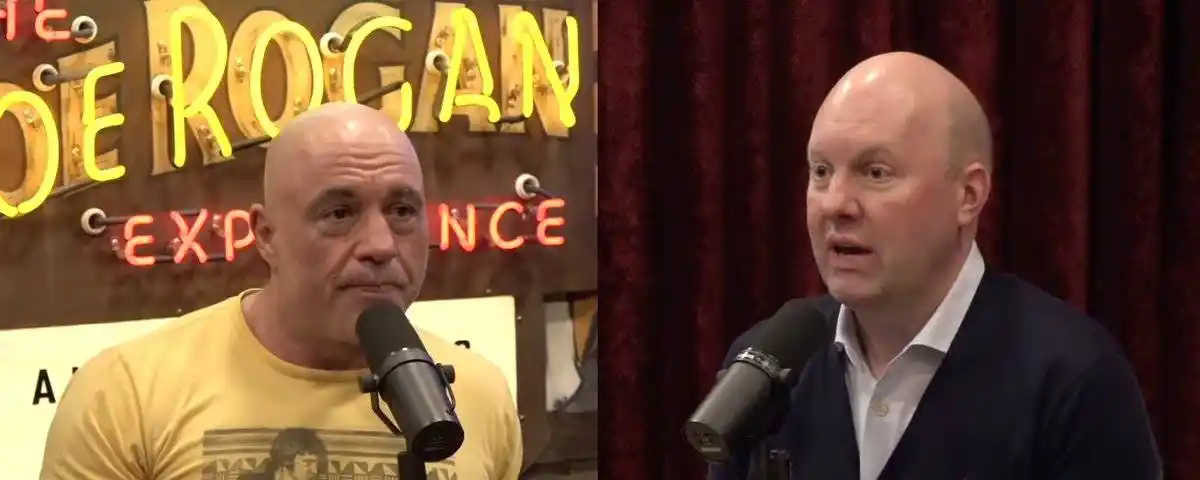
This week, venture capitalist Marc Andreessen appeared on Joe Rogan's podcast to discuss the systemic "debanking" phenomenon, especially in the context of the crypto industry, and made some controversial remarks. At the beginning of the show, he directly called out the Consumer Financial Protection Bureau (CFPB), labeling it as the unseen hand behind the debanking of crypto startups. The CFPB was created under the leadership of Elizabeth Warren. In response, some critics argue that not only is there no such debanking issue, but the CFPB is actually working to end this phenomenon.
Several different issues need to be clarified here. First, what exactly is Marc Andreessen complaining about? Are his concerns valid? Second, what role does the CFPB play in debanking politically unpopular entities — as an enabler or a blocker?
For many left-leaning individuals, they may not understand the crypto industry or the right-wing's concerns about debanking. Therefore, after Marc's comments and Elon's support on platform X, the left camp is generally confused and even disbelieving. I believe it's essential to first read the full conversation between Marc and Joe as many people are just reacting based on snippets, while the dialogue actually contains many independent claims and deep insights. The full transcript is available in the appendix. Let's delve into the details below.
What are Marc Andreessen's key points?
In the show, Marc put forward several interrelated claims. He first criticized the CFPB as an almost unsupervised "independent" federal agency that can "intimidate financial institutions, hinder new competition, especially those trying to challenge big banks through emerging startups."
He then mentioned debanking as a specific harm and defined it as "when an individual or company is completely expelled from the banking system." Marc pointed out that this phenomenon often occurs through banks as intermediaries (similar to government indirect scrutiny through big tech companies), while the government maintains a certain distance to avoid direct responsibility.
Marc believes that "over the past four years, this situation has affected nearly every crypto entrepreneur. This phenomenon has also touched many fintech entrepreneurs and anyone trying to launch new banking services, as governments try to protect existing large banks." Additionally, Marc mentioned some politically unpopular businesses, such as during the Obama administration, the legal marijuana industry, adult services industry, and gun shops and manufacturers. The Department of Justice (DoJ) at the time referred to these actions as 'Operation Choke Point.' Later, the crypto industry referred to a similar phenomenon as 'Choke Point 2.0.' Marc stated that this action primarily targeted the government's political enemies and tech startups they did not support. "Over the past four years, we have seen about 30 founders affected by deplatforming."
Marc further pointed out that the victims include "almost all crypto founders and startups. They have either been deplatformed as individuals, forced out of the industry, had their corporate accounts closed, rendering them unable to operate, or even been sued by the SEC, or threatened with lawsuits."
Furthermore, Marc also mentioned that he knew of people who had been deplatformed for "holding unacceptable political views or making inappropriate statements."
In summary, Marc Andreessen made the following points:
· Debanking refers to individuals or businesses being deprived of banking services. This may be because their industry is politically unpopular, or they hold political views different from the mainstream.
· The Consumer Financial Protection Bureau (CFPB) is at least partially responsible for this, with some federal agencies involved, although not explicitly mentioned.
· The actual way this phenomenon operates is that regulatory agencies delegate the task of financial oppression to banks, allowing the government to avoid direct responsibility.
· During the Obama administration, the primary victims of debanking were some legal but politically unpopular industries, such as marijuana businesses, adult services, and gun shops and manufacturers.
· During the Biden administration, the targets have been the crypto industry's companies and entrepreneurs, as well as fintech companies. Additionally, sometimes conservative individuals also face debanking due to their political views.
· Marc also mentioned that 30 tech startup founders in the a16z portfolio had experienced de-banking.
We will evaluate these points in detail at the end of the article.
How do Critics View Marc Andreessen's Points?
Simply put, left-wing liberals are displeased with Marc's remarks. They believe that Marc borrowed the narrative of "de-banking" to support the crypto and fintech industry, overlooking more deserving victims—such as Palestinians who have been banned by Gofundme for remitting money to Gaza. Mainstream leftists, on the other hand, are more direct in their attitude, generally supporting the de-banking of their political opponents and thus tend to avoid discussing the whole issue.
However, within the left, there is also a faction that has maintained some ideological consistency, questioning the power of corporations and governments in the speech and financial realms. (This group may be expanding, especially as the right has regained control of some tech platforms and reinstated some national powers.) These people have been vocal about the de-banking issue for some time. They realize that although currently the main victims of de-banking are right-wing dissenters (such as Kanye, Alex Jones, Nick Fuentes, etc.), if the situation were to reverse, this phenomenon could equally happen to the left. They have a narrower definition of de-banking: "De-banking, or what some financial institutions term 'de-risking', refers to banks terminating business relationships with customers deemed politically incorrect, extreme, dangerous, or otherwise out of compliance." (Quoted from an article by TFP). In the article, Rupa Subramanya discusses how banks, by considering someone to pose an excessive reputational risk, can completely ruin their financial lives. In fact, people from different political spectrums have been affected—including Melania Trump, Mike Lindell, Trump himself, Christian charities, "January 6th event" participants, and Muslim crowdfunding organizations and charities.
Nevertheless, many left-wing individuals still criticize Marc's views, especially regarding the CFPB part. Here are some specific examples:
· Lee Fang: The CFPB has consistently opposed de-banking, so why does Andreessen say this? What evidence does he have? What he doesn't mention is that the CFPB investigated the startups supported by Andreessen because they were suspected of consumer fraud, not because of political speech. In fact, the root of de-banking lies with the FBI and the Department of Homeland Security (DHS), not the CFPB.
· Lee Fang: Debanking is indeed a serious issue. For example, we've seen truck drivers opposing COVID prevention policies lose their bank accounts for participating in events, and organizations supporting Palestine being banned from using Venmo. However, now some predatory lenders and scammers are conflating consumer protection with "debanking," trying to use this to push for deregulation.
· Jarod Facundo: I truly don't understand @pmarca's point. Just a few months ago, CFPB Director Chopra warned Wall Street at a Federalist Society event not to deplatform conservative voices for no reason.
· Jon Schweppe: I agree with @dorajfacundo's point. I really don't understand what @pmarca is specifically referring to. The CFPB has been at the forefront of opposing discriminatory debanking. What's going on?
· Ryan Grim: CFPB recently released a very good new rule specifically targeting banks deplatforming users based on political views. Yes, a left-wing populist CFPB head is standing up for conservative rights. And now, those risk-averse VCs and Musk who don't like the CFPB are spreading lies, trying to stoke public sentiment to weaken the CFPB's power.
Overall, these critics are not friendly to the cryptocurrency and fintech industry. They believe that companies in these industries are not "real" debanking victims, especially compared to crowdfunding platforms sending money to Gaza. In their view, the crypto industry is "reaping what they sowed." They believe that cryptocurrency founders engage in token dumping, suspected fraud, and deceit, so it is only right for banks to take action against them. "If crypto founders are debanked, it's just a banking regulation issue, not our concern."
Furthermore, these critics argue that Marc's mistake is blaming the CFPB. They state that the CFPB is, in fact, an agency dedicated to combating debanking, and Marc is dissatisfied with CFPB simply because the fintech platforms he invests in are subject to strict CFPB oversight to ensure these platforms do not abuse consumer rights.
Since Marc made remarks on Rogan's show, many founders in the tech and crypto industry have come forward to share their experiences of unilateral deplatforming by banks. Some in the crypto industry believe that the unconstitutional attacks on the regulatory agencies targeting the crypto industry are coming to an end, and they see a glimmer of hope. Calls for an investigation into "Operation Choke Point 2.0" have also reached a climax. So, who is right? Andreessen or his critics? Is the CFPB really the culprit? Is the debanking phenomenon really as serious as Marc claims? Let's start by examining the role of the CFPB.
What is CFPB?
The Consumer Financial Protection Bureau (CFPB) is an “independent” agency established in 2011 following the financial crisis under the Dodd-Frank Act. Its responsibilities are extensive, including overseeing banks, credit card companies, fintech firms, payday lenders, debt collectors, and student loan servicers. As an independent agency, the CFPB's funding is not subject to congressional appropriations (thus insulating it from congressional budgetary oversight). Its director is not easily removable by the President, the agency can promulgate rules autonomously, and can bring enforcement and legal actions in its own name. Essentially, the CFPB wields significant power. The creation of the CFPB was largely driven by Senator Elizabeth Warren.
The CFPB has been a target of attacks by conservatives and libertarians as it is a new federal agency and largely unchecked. It was championed by Elizabeth Warren, who is a frequent target of right-wing criticism. The CFPB aims to effectively “regulate” fintech companies and banks, even though many of these companies are already heavily regulated. For instance, banks are subject to oversight by state or federal authorities (OCC) and also report to the FDIC, the Federal Reserve, and the SEC (if publicly traded). Credit unions, mortgage lenders, and others have their own regulators. Prior to the establishment of the CFPB, there was no obvious regulatory gap in financial regulation in the U.S. In fact, the U.S. has more financial regulators than any other country in the world. Therefore, questioning Elizabeth Warren's motives on financial oversight is not unfounded.
About the CFPB’s Scope of Responsibilities:
The CFPB’s mandate includes specific provisions against discriminatory banking practices. This includes the “Unfair, Deceptive, or Abusive Acts or Practices (UDAAP)” under the Equal Credit Opportunity Act (ECOA) and the Dodd-Frank Act. Under the ECOA, credit transactions must not discriminate based on protected classes which include race, color, religion, national origin, sex, marital status, age, or receipt of public assistance.
However, the issue of “Choke Point” raised by Marc Andreessen falls outside the purview of these regulations. “Crypto entrepreneurs” or “conservative individuals” are not within the legally defined protected classes. Therefore, this part of the CFPB’s mandate, even in theory, cannot address politically motivated attacks against specific industries. Additionally, the ECOA primarily focuses on credit services rather than broader issues in banking services.
The UDAAP section in the Dodd-Frank Act is another provision that could potentially involve decentralization. This provision grants the CFPB broad powers to combat practices deemed unfair, deceptive, or abusive. For example, the massive settlement agreement between the CFPB and Wells Fargo was based on UDAAP. In theory, if the CFPB were to address decentralization, it might do so through UDAAP. However, aside from making some statements, they have not taken concrete action at this time.
CFPB's Official Stance
CFPB Director Rohit Chopra explicitly opposed payment platforms banning users for political reasons in a June speech to the Federalist Society. In his speech, he expressed concerns about large tech payment platforms (such as PayPal and Venmo) irresponsibly banning users, especially when these platforms do not provide any appeal process for users. He specifically mentioned that these platforms might exclude users because they expressed politically unpopular views elsewhere. This phenomenon does exist, so Chopra's ability to openly discuss these issues is encouraging.
However, there are two issues here.
First, Chopra's focus is primarily on the irresponsible behavior of private enterprises, especially when these enterprises exhibit characteristics similar to monopolies. He did not address the risk of government power, namely the possibility of the government using regulatory tools to force banks to engage in industry-wide redlining. This is precisely what Marc Andreessen criticized.
Second, while Chopra's remarks are commendable, the CFPB's actual actions in this regard are still limited. Based on current trends, they may regulate large non-bank payment networks. However, the issue of "Choke Point 2.0" more involves the government's power exerted through financial regulatory agencies to banks. These issues are not within the CFPB's jurisdiction but fall under the responsibility of the Fed, FDIC, OCC, and the relevant executive branch agencies (or Congress in investigative cases) responsible for overseeing these institutions. The CFPB does not have authority over regulating other financial regulatory agencies, so their ability to address "choke point" behavior is limited. (It is worth noting, however, that Chopra is a board member of the FDIC, so he bears some responsibility for or at least has some understanding of some FDIC misconduct.)
It is worth noting that in a court filing in August of this year, the CFPB clearly stated that Christian debanking is a form of discrimination and pointed out that the agency has the statutory authority to address this issue. This statement was seen by Lee Fang as a positive (and surprising) development, as the CFPB has not historically shown particular sympathy toward conservative groups. As mentioned earlier, religious groups are considered a "Protected Class" under the law, so the CFPB's legal intervention against financial exclusion of religious groups is not very controversial. However, we have not yet seen the CFPB take similar action against non-Protected Classes (such as ordinary conservatives or industries like cryptocurrency), which will be discussed in detail in the next section. Nevertheless, this move is undoubtedly a step in the right direction.
CFPB's Action
Recently, the CFPB finalized a new rule that brings digital wallets and payment apps under its regulatory purview, treating them as institutions similar to banks. Under this rule, large digital payment platforms including Cash App, PayPal, Apple Pay, and Google Wallet are required to provide transparent explanations for account closures. In the rule announcement, the CFPB explicitly mentioned the phenomenon of "debanking." However, it is important to note that this rule applies to "large tech companies" or peer-to-peer payment apps, not banks. As of now, there have been no enforcement actions related to this rule, so the actual impact of its implementation remains to be seen.
So, can this rule curb actions similar to "Operation Choke Point 2.0"? The answer is almost certainly no. Firstly, this rule targets the behavior of tech companies, not banks. Secondly, "choke point" style actions are not taken autonomously by banks but are systemic pressures imposed on an entire industry through federal regulatory agencies. If the CFPB were to notice, for example, that cryptocurrency startups were being systematically cut off from banking services, they would have to confront the FDIC, the Fed, the OCC, or even the White House to end such practices. However, considering Elizabeth Warren's strong opposition to cryptocurrency, one cannot help but wonder if the CFPB would take such action. Moreover, the fundamental issue with "choke point" actions lies in bank regulatory agencies exceeding legal boundaries, attempting to debank an entire industry rather than individual banks acting autonomously (banks are just passively carrying out regulatory orders).
In theory, under UDAAP provisions, if an industry (such as cryptocurrency) faces systemic account closures, the CFPB has the authority to investigate. However, the recently enacted payment app rule (cited by some critics of Marc Andreessen to demonstrate the CFPB's anti-debanking stance) does not apply to banks. Furthermore, the CFPB has not taken substantive measures against debanking in its actual enforcement actions so far.
Main Enforcement Actions by CFPB
In the enforcement record of the CFPB, I did not find any settlement cases directly related to derisking. Here are their top 30 settlement cases ranked by amount:
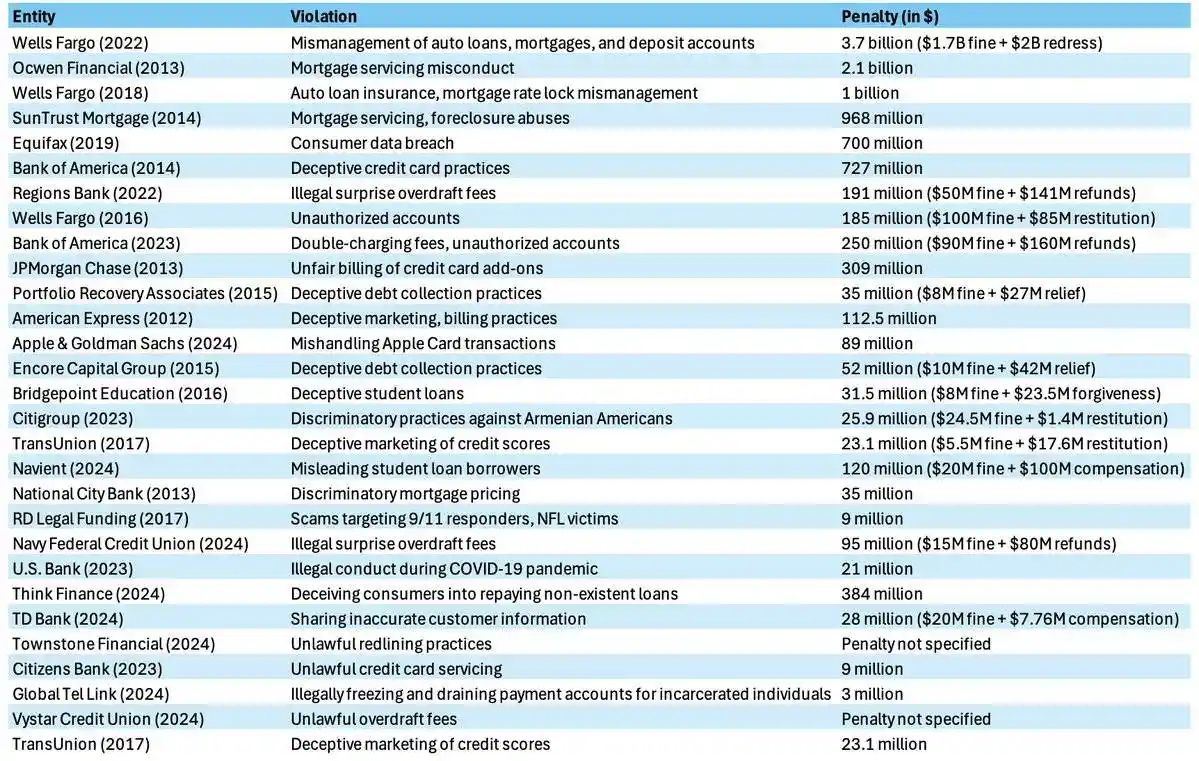
The closest relevant case is the 2023 Citigroup case. At that time, they were found to have engaged in discriminatory practices against Armenian Americans in credit card applications. According to Citigroup, this practice was due to a higher fraud rate within the Armenian community in California (driven by fraud rings). Ultimately, Citigroup paid a fine of $25.9 million.
Another case is the 2020 Townestone Financial case. CFPB found that the company discouraged African Americans from applying for mortgage loans in their marketing and paid a fine of $105,000 as a result.
It is important to note that nationality and race are part of the U.S. legal definition of "Protected Class," so these cases do not involve purely political "Redlining." This is fundamentally different from critics' accusations of derisking in the cryptocurrency industry.
Additionally, I also reviewed the most recent 50 settlement cases by the CFPB since March 2016, but found no cases involving the deprivation of banking services for any reason. In these 50 cases, 15 involved UDAAP violations (such as the well-known Wells Fargo case), 8 involved fair lending violations, 5 involved student loan servicing, 5 involved inaccurate credit reporting issues, 5 involved mortgage servicing, 4 involved auto loan discrimination, and 3 involved illegal overdraft practices. As for derisking: none at all.
Marc's Criticism of Crypto/FinTech Companies and Conservative Figures Being Derisked
On this issue, the situation is very clear. I have thoroughly documented the phenomenon of so-called "Operation Choke Point 2.0." This practice originated in the Obama administration and resurfaced during the Biden administration. In 2013, Obama's Department of Justice (DoJ) launched the "Operation Choke Point" initiative, an official project aimed at using the banking industry to target some legal but politically unpopular industries, such as payday lending, medical marijuana, adult industry, and gun makers. Iain Murray discusses this in detail in his article "Operation Choke Point: What It Is and Why It Matters."
During the Obama administration, the FDIC, under Marty Gruenberg's leadership, convinced banks to "derisk" companies in over a dozen industries through insinuation and veiled threats. This practice sparked strong conservative protests and was exposed by members of the House, led by Congressman Luetkemeyer. Critics argued that this secret regulatory approach through "persuasion" was unconstitutional as it did not go through formal rulemaking or legislative processes.
In 2014, a Department of Justice memo regarding this practice was leaked, leading to a critical report by the House Oversight and Government Reform Committee. Subsequently, the FDIC issued new guidance requiring banks to assess risk on a case-by-case basis rather than implementing industry-wide "redlining." In August 2017, the Department of Justice under the Trump administration formally terminated this practice. In 2020, Trump's Acting Comptroller of the Currency, Brian Brooks, issued the "Fair Access" rule aiming to end derisking based on reputational risk.
However, in May 2021, Biden's Acting Comptroller of the Currency, Michael Hsu, rescinded this rule. In early 2023, following the FTX collapse, cryptocurrency industry members, myself included, noticed similar "choke point" strategies targeting cryptocurrency founders and companies. In March 2023, I published an article titled "Choke Point 2.0 Is Underway, Targeting Cryptocurrency," and followed up with more revelations in May.
Specifically, I uncovered that the FDIC and other financial regulatory agencies secretly imposed a "15% deposit cap" policy on banks regarding cryptocurrency-related companies. This meant that banks could not receive deposits from crypto-related enterprises exceeding 15% of their total deposits. Furthermore, I believe that the closure of Silvergate and Signature, two banks in the crypto industry, was not due to market reasons but rather forced liquidation or closure due to the government's hostile stance toward the crypto industry.
Since then, cryptocurrency companies have continued to face significant challenges in obtaining banking services—despite no public regulations or legislation explicitly requiring banks to restrict services to crypto businesses. The law firm Cooper and Kirk pointed out that the "Choke Point 2.0" approach violated the Constitution.
Recently, I revisited this phenomenon and found new evidence indicating that Silvergate Bank did not collapse naturally but was "intentionally executed."
(See Tweet)
Currently, the "15% Deposit Cap" policy targeting cryptocurrency banks remains in place, severely constraining industry growth. Nearly all US-based crypto entrepreneurs have been affected by this—I can confirm that around 80 crypto companies we've invested in have faced similar issues. Even my company, Castle Island (a venture capital fund investing solely in fiat-native businesses), has had bank accounts abruptly closed.
Following Marc's appearance on the Rogan podcast, many crypto industry executives also shared their experiences. David Marcus revealed that Facebook's Libra project was forced to shut down due to Janet Yellen's intervention. Figures like Kraken CEO Jesse Powell, Joey Krug, Gemini CEO Cameron Winklevoss, Visa's Terry Angelos, and Coinfund's Jake Brukhman all expressed encountering significant obstacles in banking services. Caitlin Long has long been a vocal critic of "Operation Chokepoint 2.0" and even started her own bank, Custodia, which, however, had its Fed account (Master Account) eligibility revoked, preventing it from operating normally.
While critics may lack sympathy for the crypto industry, it must be acknowledged that the crypto industry is entirely legitimate but has been suppressed through secret directives and hints from banking regulatory bodies. This suppression has not occurred through legislation or public rule-making but rather through administrative agencies operating behind the scenes, circumventing democratic processes.
Not only the crypto industry, but fintech companies are also facing similar challenges. According to Klaros Group's research, since early 2023, a quarter of FDIC's enforcement actions have targeted banks partnering with fintech firms, while non-fintech partner banks accounted for only 1.8%. As an investor in the fintech field, I can attest firsthand that fintech companies have faced significant difficulties in finding bank partners, a challenge that is nearly on par with the hurdles faced by crypto companies in obtaining banking services.
The Wall Street Journal has criticized FDIC's actions, noting that the agency "is, in effect, making rules without the notice and comment required by the Administrative Procedure Act." This behavior has not only substantially harmed the industry but also raised widespread questions about its legality.
Andreessen mentioned that there are indeed numerous instances supporting the issue of de-banking among conservative individuals. For example, Melania Trump mentioned in her recent memoir that she had her bank account canceled. The right-wing Gab.ai platform also faced similar issues. In 2021, General Michael Flynn had his account closed by JPMorgan Chase due to perceived "reputational risk." In 2020, Bank of America closed the account of the Christian nonprofit Timothy Two Project International and, in 2023, froze the account of Christian pastor Lance Wallnau. In the UK, Nigel Farage was de-banked by Coutts/NatWest, sparking a minor public outcry. These are just a few examples among many.
According to current laws, US banks have the right to close accounts for any reason without providing an explanation to the customer. Therefore, fundamentally, Andreessen's point is valid: the phenomenon of de-banking does exist and has far-reaching consequences.
Controversy Surrounding the Term "De-banking"
Critics argue that Andreessen is attempting to use the concept of "de-banking" to advance his own economic agenda. Some point out that his motivation in addressing this issue is to alleviate regulatory pressures on the cryptocurrency and fintech industry. Lee Fang mentioned:
"De-banking is indeed an important issue. We see that truck drivers opposing vaccine mandates have lost their bank accounts due to their activities, and organizations supporting Palestine are unable to use payment platforms like Venmo. However, now some predatory lenders and scammers are conflating consumer protection with 'de-banking,' using it to call for regulatory relaxation."
Furthermore, an Axios author also hinted that Andreessen's focus on the Consumer Financial Protection Bureau (CFPB) issue may be related to his company's investment in some controversial neo-banks such as Synapse, which collapsed earlier this year. This criticism suggests that Andreessen's sole focus on "de-banking" is to promote the interests of the cryptocurrency and fintech industry while circumventing CFPB regulations on consumer protection.
Although the critics' points may sound logical, the reality is more nuanced. Historically, the Obama administration did develop strategies to use bank regulations to suppress certain industries (such as gun manufacturing and payday loans), actions that were deemed unconstitutional. The Biden administration has further optimized these strategies and effectively used them to suppress the cryptocurrency industry. For example, by pressuring partner banks, the government indirectly restricts banking services to cryptocurrency companies. These practices are not established through legislation or public rulemaking but rather operate behind the scenes through administrative means, bypassing democratic procedures.
Currently, this strategy is also beginning to target the fintech industry. According to research by Klaros Group, since early 2023, a quarter of FDIC enforcement actions have been against banks partnering with fintech companies, as opposed to only 1.8% against banks that do not partner with fintechs. As an investor in the fintech space, I can personally attest that this approach has made it extremely challenging for fintech companies to find bank partners, almost akin to the difficulty faced by cryptocurrency firms in obtaining banking services.
These phenomena indicate that regulatory agencies have overstepped their bounds and severely impacted multiple legitimate industries. Whether in cryptocurrency or the fintech industry, a more transparent and democratic regulatory approach is needed, rather than relying on secret directives and vague policy enforcement. In the future, as regulatory policies are adjusted, these issues may gradually be exposed and corrected.
Regardless of whether commentators like Fang believe that the Biden administration's debanking of cryptocurrency companies will weaken his moral critique of the more sympathetic debanked groups, this is not the focus. The fact is that this phenomenon is indeed occurring, and it is debanking, and it is unlawful. Similarly, whether Marc Andreessen's criticism of the CFPB is motivated by economics is also not relevant. (Based on my investigation, to date, the CFPB has not taken enforcement action against any companies invested in by Andreessen's venture capital firm, a16z.)
What is important is that banking regulatory agencies (not limited to the CFPB but including multiple agencies) have indeed weaponized the financial system to achieve political ends. This behavior has far exceeded the scope of administrative authority and has harassed legitimate industries. And the fact is that this overreach does exist.
Evaluation of Andreessen's Views on the Rogan Show
Based on a comprehensive analysis, we can evaluate Andreessen's points as follows:
· Debanking refers to individuals or businesses being deprived of banking services due to their industry being politically unwelcome or due to their holding dissenting political views.
This definition is accurate. It is important that the severity of debanking should not change based on whether the victims meet certain people's sympathy standards.
· CFPB does indeed often pursue aggressive policies against fintech companies and banks, and the necessity of its existence is questionable.
However, based on the current information, the CFPB is not the primary culprit of "Operation Chokepoint 2.0." The more direct culprits are the FDIC, OCC, and the Federal Reserve, which have engaged in coordinated actions with the Biden administration. Although the CFPB has recently made statements on debanking issues, it has not taken concrete actions, so it has neither mitigated the problem nor is the primary party at fault.
· At the core of deplatforming is the idea that regulators avoid direct responsibility by having banks enforce financial censorship.
This model is akin to the way large tech companies censor dissenters. By having banks or fintech platforms deny services, it is possible to effectively suppress "regime enemies" while avoiding excessive external scrutiny.
· The "Operation Chokepoint" during the Obama administration focused on some legal but unpopular industries, including cannabis companies, the adult industry, as well as gun stores and manufacturers.
This description is accurate. In fact, this operation originally started with the payday lending industry, but Andreessen did not mention this.
· The Biden administration's deplatforming efforts mainly target cryptocurrency companies and fintech firms, occasionally involving conservative individuals.
Both points are true. We have more evidence indicating that the crackdown on the crypto industry is a coordinated effort, while the actions against the fintech industry, though less evidenced, have indirectly pressured through enforcement actions on partner banks by the FDIC. As for the deplatforming of conservative individuals, we have a lot of anecdotal evidence, but there is no explicit internal bank policy targeting conservatives. These actions are usually justified on the grounds of "reputational risk," based on a case-by-case decision-making process. Ultimately, banks are a complete black box, and they don't have to provide a reason for reducing an individual's or company's risk.
· Founders in a16z's investment portfolio have been deplatformed
Based on existing information, it is entirely possible, even highly likely, that 30 tech founders in a16z's investment portfolio have been deplatformed. As an active cryptocurrency investment firm, many of a16z's investment projects involve cryptocurrency, and almost all domestic cryptocurrency startups have faced banking service issues at some point.
Where Did Marc Go Wrong?
· Marc exaggerated the role of the CFPB when describing its function. The recent crackdown on the cryptocurrency and fintech industry was actually more led by regulators such as the FDIC, OCC, and the Fed, rather than the CFPB. However, Marc did mention some unspecified "agencies" involved in deplatforming on the show, although he did not specifically refer to the FDIC, OCC, or the Fed. Additionally, the influence of CFPB founder Elizabeth Warren on this matter cannot be overlooked. She was one of the key drivers of "Operation Chokepoint 2.0," especially with Bharat Ramamurti, appointed by her, leading related actions in the Biden administration's National Economic Council. Therefore, it is understandable that Marc magnified the CFPB's responsibility.
· Marc's discussion of PEP is somewhat one-sided. Being classified as a politically exposed person does not directly result in a bank account closure, but it does indeed increase the bank's due diligence requirements for these customers. Marc may have been inspired by the Nigel Farage de-banking incident at Coutts. In that case, Nigel was considered a PEP, which was indeed a contributing factor but not the sole reason.
Despite some nuances in the details, Marc's main point is valid, and the critics' rebuttal does not hold water. The CFPB has not yet emerged as an effective anti-debanking force, while the debanking phenomenon does exist, with a particularly noticeable impact on the cryptocurrency and fintech industry. With Republicans in control of Congress and launching related investigations, more evidence is expected to reveal the true scale and mechanisms of debanking.
You may also like

The 17-Year Mystery Will Be Solved, Who is Satoshi Nakamoto?

5 Minutes to Make AI Your Second Brain

Uniswap is trapped in an innovation dilemma

What is the key to competition in crypto banking?

The flow of stablecoins and the spillover effects in the foreign exchange market

After two years, Hong Kong's first batch of stablecoin licenses finally issued: HSBC, Standard Chartered make the cut
The person who helped TAO rise by 90% has now single-handedly crashed the price again today

3-Minute Guide to Participating in the SpaceX IPO on Bitget

Top 5 Cryptos to Buy in 2026 Q1: A ChatGPT Deep Dive Analysis
Explore the top 5 cryptos to buy in Q1 2026 including BTC, ETH, SOL, TAO, and ONDO. See price outlooks, key narratives, and institutional catalysts shaping the next market move.

How to Earn $15,000 with Idle USDT Before Altcoin Season 2026
Wondering if altcoin season is coming in 2026? Get the latest market update, and learn how to turn your idle stablecoins waiting for entry into extra rewards up to 15,000 USDT.
Can You Win Joker Returns Without Large Trading Volume? 5 Mistakes New Players Make In WEEX Joker Returns Season 2
Can small traders win WEEX Joker Returns 2026 without huge volume? Yes—if you avoid these 5 costly mistakes. Learn how to maximize card draws, use Jokers wisely, and turn small deposits into 15,000 USDT rewards.

Altcoin Season 2026: 4 Stages to Profit (Before the Crowd FOMO In)
Altcoin Season 2026 is starting — discover the 4 key stages of capital rotation (from ETH to PEPE) and how to position before the peak. Learn which tokens will lead each phase and avoid missing the rally.

Will Alt season come in 2026? 5 Tips to Spot the Next 100x Crypto Opportunities
Will altcoin season arrive in 2026? Discover 5 rotation stages, early signals smart traders watch, and the key crypto sectors where the next 100x altcoin opportunities may emerge.

The bear market has arrived, and cryptocurrency ETF issuers are also getting involved

The richest man had a quarrel with his former boss

BTC Firm Above 70K! Saylor’s "Institutional Logic" vs. Moon’s "Retail Faith": Who is Really Harvesting the Market?
Bitcoin is holding firm above the $70,000 support level following a massive short squeeze that liquidated $427 million. As the "Four-Year Cycle" narrative shifts, the market is split: Michael Saylor’s cold, institutional "indiscriminate stacking" vs. Carl Moon’s high-energy retail "hopium." This article decodes these two polar-opposite strategies for the 2026 bull run and reveals how WEEX’s institutional-grade liquidity and AI trading tools empower every type of investor to convert market volatility into profit.

The Girl Who Created the SBTI Test: A Story of a Doomed Cyber Love, an E-Widow Ratfolk



 App
App