
Delisting Without Price Drop? Unveiling the Capital 'Short-and-Distort' Play Behind ALPACA


Original Article Title: "From Delisting to Price Surge? Unveiling the Capital 'Raid Drama' Behind ALPACA"
Original Article Author: Fairy, ChainCatcher
From "Delisting Bomb" to "Wealth Rocket"?
On April 24, Binance announced the delisting of the ALPACA token. Normally, delisting news would result in selling pressure, panic, and a price crash. However, ALPACA defied expectations and has surged over 650% since the announcement.
This bizarre rebound begs the question: is it a last gasp of the project or a scripted move by capital players? Behind this sudden and dramatic surge, a storm may be brewing...
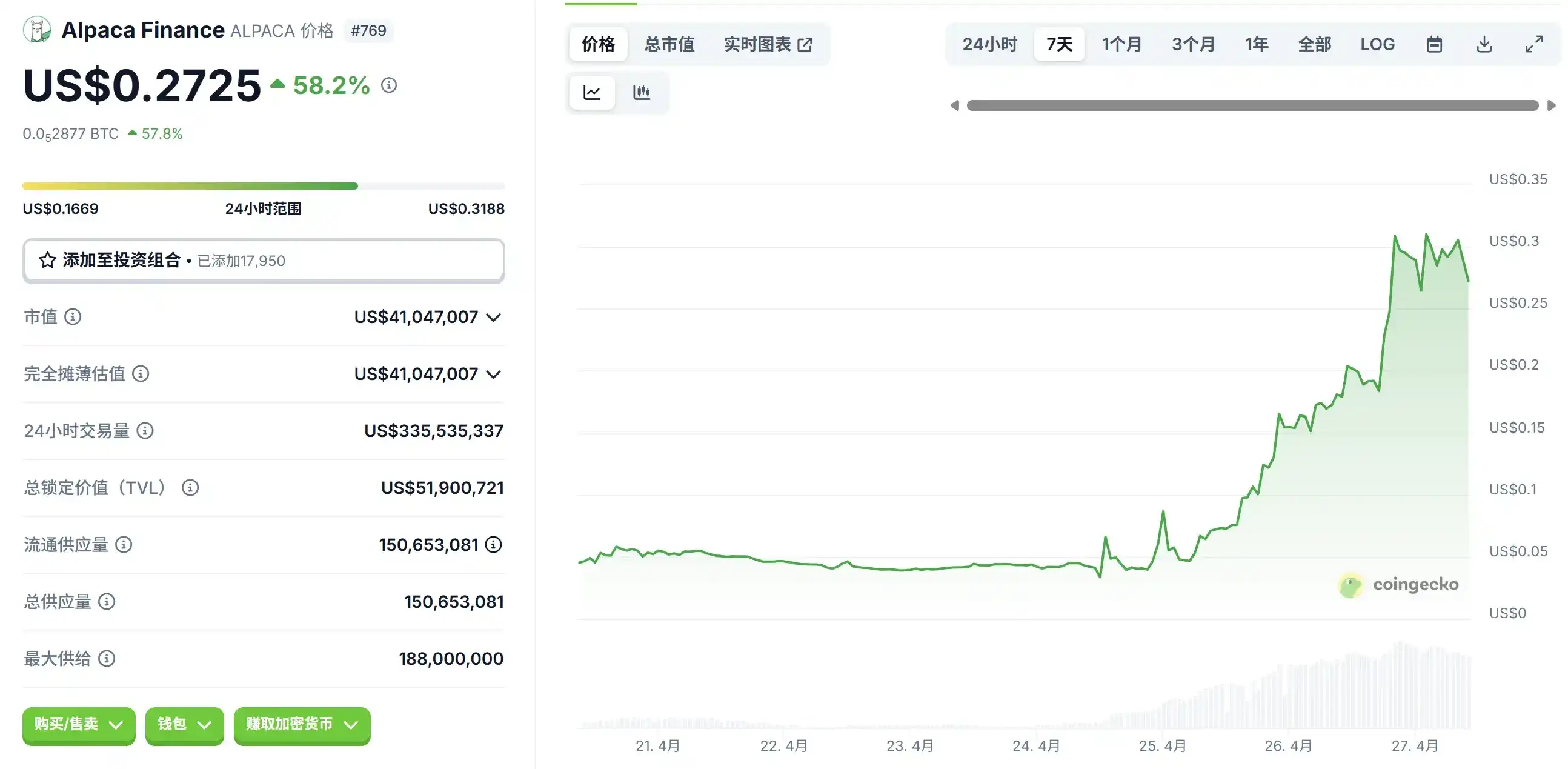
Image Source: Coingecko
From Delisting Countdown to "Sky Clearing" Moment
On April 10, Binance initiated the second phase of its coin delisting vote. A week later, the results were announced, with ALPACA ranking seventh out of 17 candidate projects, signaling the delisting crisis. On April 24, Binance officially announced the delisting of ALPACA on May 2 and the perpetual contract settlement on April 30. Following the news, ALPACA's price plummeted from $0.0329 to $0.029, with its market cap shrinking to $5 million.
Just when the market anticipated ALPACA's demise, a dramatic scene unfolded: within one hour, the price surged from $0.029 to $0.0857, a staggering 195% increase. This sudden and sharp surge caught the shorts off guard and set the stage for even crazier price action to come.
On April 25, Alpaca Finance's official announcement stated that due to a trading volume exceeding 1 billion tokens, a liquidity provider had requested a token minting to maintain liquidity, but this plan was canceled after community opposition. This change undoubtedly dealt another blow to the bears.
Consequently, on April 26, ALPACA's liquidation volume even surpassed that of Bitcoin, with short liquidations dominating. Throughout the entire market activity, it seemed to have turned into a "precision harvesting battle" against the shorts.
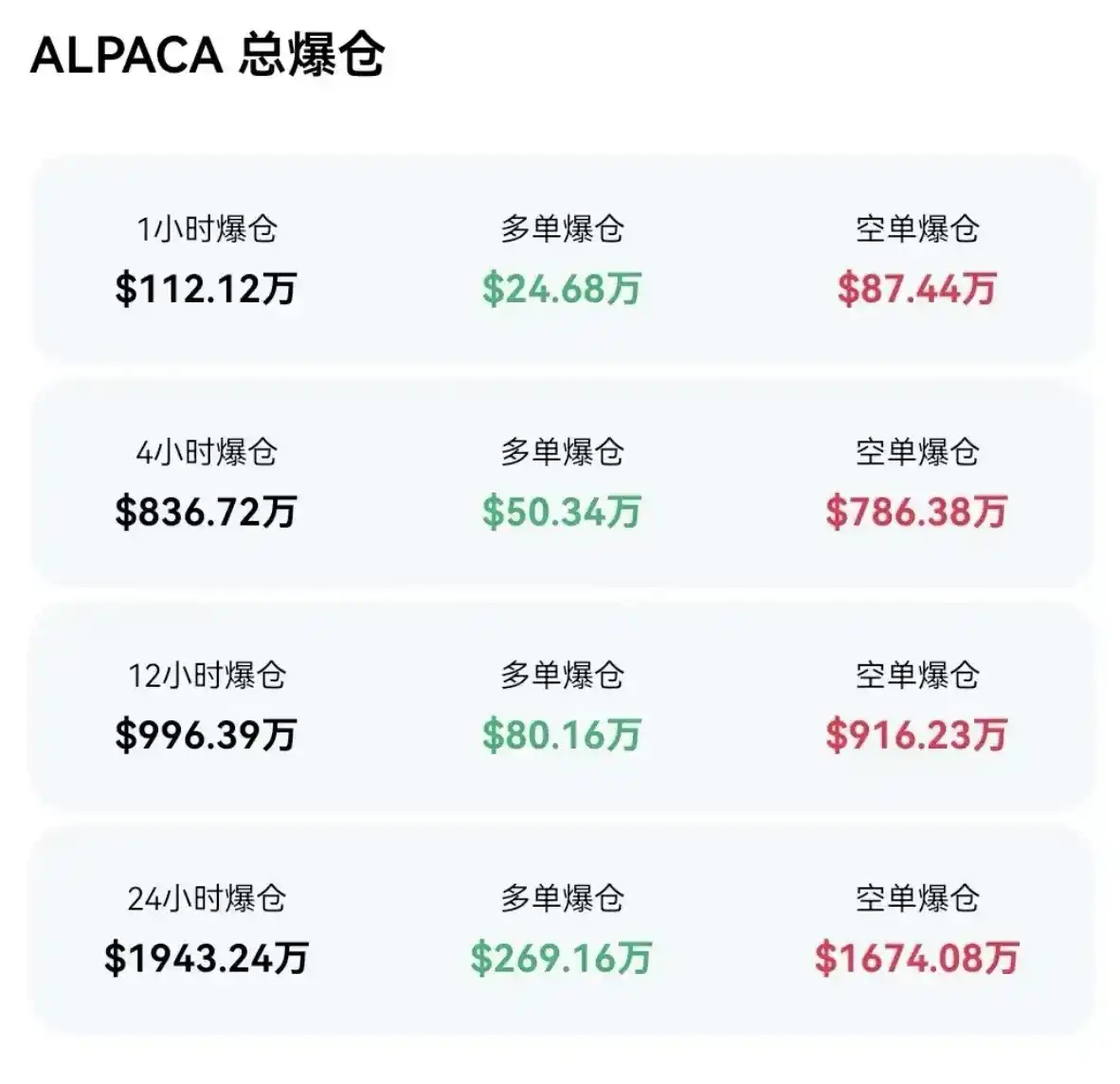
Image Source: Coinglass
「Short Squeeze Playbook」
Regarding the rebound of ALPACA, He Yi expressed that this may be a quick break-even maneuver by shell-buying investors through short-term manipulation. Based on the analysis of community users @LuBtc 888, @0x_ooorange, and @Mumu_yay, we have outlined a complete "Short Squeeze Playbook":
I. Advance Layout before Delisting
Prior to the delisting announcement, the "whales" may have early knowledge or sensed abnormalities. There was suspected capital absorption around April 19. During this period, the trading volume of ALPACA on Binance significantly increased, but the price increase was very limited.
II. Creating Expectation Misalignment, the Emergence of a "Bearish Trap"
The market generally expected "delisting = crash". Retail investors and short-term speculators collectively had a bearish view, leading to an influx of short positions and a surge in the open interest of ALPACA contracts. The "whales" took advantage of this situation to absorb funds at low levels, built long positions massively at the bottom, then raised the spot price sharply, triggering a chain of short liquidations.
III. Rule Changes Accelerate the Short Squeeze Pace
Binance shortened the funding rate collection period from 8 hours to 1 hour, causing the ALPACA funding rate to plummet to -2%. Shorts not only faced the risk of liquidation but also had to pay high "interest" every hour, forcing them to accelerate their liquidation, leading to an accelerated short squeeze, with the speed of the pump also rapidly increasing.
IV. The Main Player's Profit Model
· Spot Market: Absorb chips during the delisting panic, create a "last glory" illusion during the pump, attract retail investors to chase the price higher, then unload at a high.
· Futures Market: Hold a huge amount of long positions, continuously collect interest payments from shorts through the negative fee rate mechanism, achieving profits from both directions.
ALPACA Post-Event Suspense
Regarding the future trend of ALPACA, the market opinions are divided. @Mumu_yay believes that the delisting announcement will trigger the liquidation mechanism, meaning that the positions of both longs and shorts will be automatically cleared. In this case, the "whales" do not need to worry about finding exit liquidity; they just need to wait at a high level and prepare for liquidation to be triggered.
However, crypto KOL Kuang Ren Madman holds a different view. He believes that from a game theory perspective, whales will choose to gradually establish long positions at highs, then switch to short positions, use this to suppress the spot price, and ultimately maximize their interests through liquidation. Therefore, his conclusion is that the trend of ALPACA will lead to a crash.
Furthermore, trader @thankUcrypto pointed out that usually, a pump occurs before delisting, followed by a dump before delisting as well. As Binance is the platform with the strongest market liquidity, if it does not engage in a dump operation before delisting on May 2, market makers will have to wait until after delisting to dump on other trading platforms. However, due to the shallow order books and buy support on other platforms, the profit from dumping would be significantly reduced.

The Storm Is Not Over, the Future Is Uncertain
As the delisting date of May 2 approaches, ALPACA's fate remains uncertain. Its price trajectory has become a typical example of capital gamesmanship in the crypto market. The market is always cyclical, and perhaps in the future, new "ALPACAs" will continue to emerge, staging similar dramas in different forms.
In the midst of the storm, rationality remains the only reliable anchor for investors. Faced with short-term emotions and temptations, only by remaining clear-headed and keeping our eyes wide open can we avoid losing our way in the chaos. Stay away from high-risk coins lacking fundamental support and be vigilant of the hidden currents of manipulation and control. In navigating the seas, only a steady helmsman can steer clear of reefs.
You may also like

Morning News | The draft amendment to the People's Bank of China Law aims to clarify the legal status of digital renminbi; South Korea will transfer about 40 unregistered virtual asset service providers to law enforcement agencies

Interpreting the Ethereum Foundation's new structure: Reaffirming self-sovereignty amid institutional trends

Interview with NDV Founder Jason Huang: Popping the AI Bubble and the Myth of Microstrategy, Seeking the Ultimate Ace in the Crypto Market
Morning Report | Former Ethereum Foundation researcher establishes Ethlabs; EU Parliament Economic Committee passes digital euro regulatory proposal

Dragonfly partner Haseeb: The fastest-growing companies in the future may all be stuck at 149 people

How xBubble Breaks the Deadlock in VC's Heavy Investment in the OPC Economy

The encrypted unicorn Blockstream is deeply embroiled in a serious fraud case

Morning Report | The South Korean Financial Services Commission plans to expand the regulatory sandbox to include virtual assets; the parent company of the New York Stock Exchange, ICE, has reached a partnership with OKX to jointly establish a cryptocu...

Exclusive Interview with Strategy CEO: Putting Aside the Sale of 32 BTC, the 60 Trillion AI Intelligence is the Ultimate Fate of Bitcoin

TRON revitalizes the image of the bull, creating a more approachable brand character

Will the STRC issuance price discussed with ChatGPT really fall into a death spiral?

The foundation retreats, Ethlabs steps forward: Ethereum welcomes its largest restructuring in history

NYSE Parent ICE and OKX Launch Joint Venture: What It Means for Tokenized Stocks
ICE and OKX have announced a joint venture focused on tokenized stocks, but stock futures are already live across crypto markets. Here's what the partnership means, how stock futures work, and why traders are paying attention.

How to Trade Apple and Nvidia on a Crypto Exchange in 2026 (Without Buying Shares)
Morning Report | Secret Network loses $4.67 million due to cross-chain vulnerability; Michael Saylor releases Bitcoin Tracker information again, may disclose increased holdings data next week
Kalshi's biggest competitor is not Polymarket

The second half of the computing power battle: Intel CEO Pat Gelsinger reveals how AI is reshaping the global semiconductor supply chain
B.AI partners with MiniMax to launch a limited-time free experience of M3, enabling zero-threshold implementation of Agentic productivity through full-stack infrastructure
Morning News | The draft amendment to the People's Bank of China Law aims to clarify the legal status of digital renminbi; South Korea will transfer about 40 unregistered virtual asset service providers to law enforcement agencies
Interpreting the Ethereum Foundation's new structure: Reaffirming self-sovereignty amid institutional trends
Interview with NDV Founder Jason Huang: Popping the AI Bubble and the Myth of Microstrategy, Seeking the Ultimate Ace in the Crypto Market
Morning Report | Former Ethereum Foundation researcher establishes Ethlabs; EU Parliament Economic Committee passes digital euro regulatory proposal
Dragonfly partner Haseeb: The fastest-growing companies in the future may all be stuck at 149 people
How xBubble Breaks the Deadlock in VC's Heavy Investment in the OPC Economy


