
 Buy Crypto
- Markets
 Futures
- Spot
- Copy Trade
- Earn
- More
Different Rulings in Similar Cases: Why can Uniswap go free while Tornado Cash cannot?

Original Title: "The Same Judge, Different Outcomes for Uniswap and Tornado"
Original Author: Eric, Foresight News
In the early hours of March 3, Beijing time, a collective lawsuit against Uniswap and Uniswap founder Hayden Adams for fraudulent tokens on Uniswap was dismissed by the Southern District of New York federal court. Uniswap Foundation's General Counsel Brian Nistler referred to it as a "landmark ruling for DeFi."
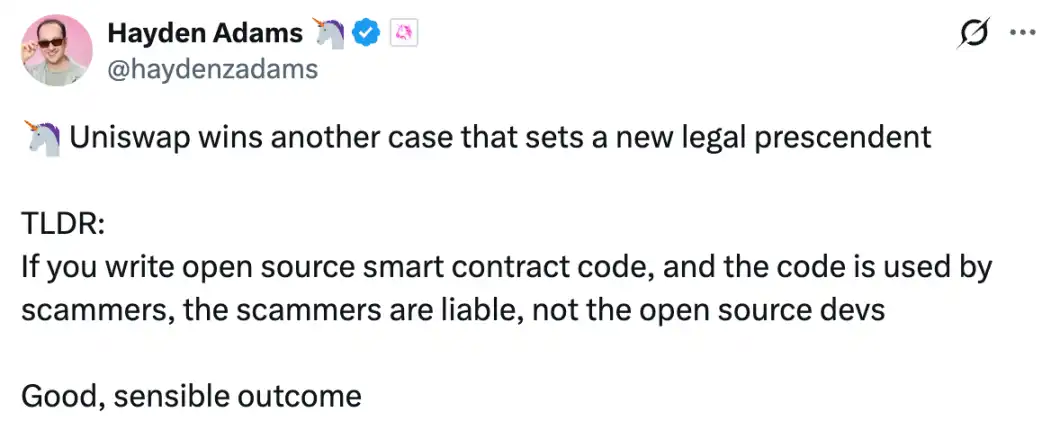
Hayden Adams also tweeted, "If you write open-source smart contract code and that code is used by scammers, then the responsibility lies with the scammer, not the open-source developer. This is a fair and just outcome."
For Web3 developers, this is undoubtedly good news. However, little-known is the fact that the judge who made this "just ruling" is the same person who, during their tenure as the former SEC chairman, found Tornado Cash developers guilty.
The Final Judgment
From the collective lawsuit against Uniswap to today's final judgment, nearly 4 years have passed.
In April 2022, Uniswap users represented by Nessa Risley filed a collective lawsuit in court, accusing defendants including Paradigm, a16z, Uniswap, and its founder Hayden Adams of violating federal securities laws by issuing and selling unregistered securities, including UNI, on Uniswap in token form. The defendants also failed to register Uniswap as an exchange or broker-dealer under applicable securities laws and failed to provide investors with a registration statement for the securities they issued and sold.
This lawsuit was initiated by the law firms Kim&Serritella and Barton, representing users who traded EthereumMax, Bezoge, MatrixSamurai, Alphawolf Finance, RocketBunny, and BoomBaby.io tokens on Uniswap between April 5, 2021, and April 4, 2022.
The five words "Unregistered Securities" had an unusually strong impact on the crypto industry at the time, but this lawsuit unexpectedly quickly turned overwhelmingly in favor of Uniswap.
Despite the presiding judge Katherine Polk Failla acknowledging that the plaintiff's so-called "scam token" did indeed qualify as a security, she believed that Uniswap was not liable for it. Failla argued that Uniswap's decentralized nature meant that the protocol could not control which tokens were listed on the platform or who could interact with it, stating that the "case is more like holding the developer of a self-driving car responsible for a third party using the car to commit a traffic violation or rob a bank."
Based on this, Failla dismissed the federal securities law charges in August 2023. The plaintiffs then appealed, with the Second Circuit Court of Appeals in 2025 affirming the dismissal at the federal level but remanding the state law claims for further review.
Subsequently, the plaintiffs amended their complaint and refiled. This time, the aggrieved investors accused Uniswap and other defendants of aiding and abetting fraud and making false statements, profiting from transactions involving the scam token, and violating multiple states' laws against fraudulent practices.
Following a reevaluation by the same Judge Failla, the amended lawsuit was once again dismissed, with no opportunity for further amendments, bringing the case to a definitive close.
The reasoning provided by the judge this time was essentially the same as before: Uniswap did not have knowledge of the scam token, and even if it did, it did not provide substantial assistance. Additionally, it did not meet the definition of fraudulent conduct in any state law. Regarding unjust enrichment, Uniswap did not receive any direct benefits, and the speculative nature of indirect benefits from such fraudulent projects expanding the user base was deemed too tenuous.
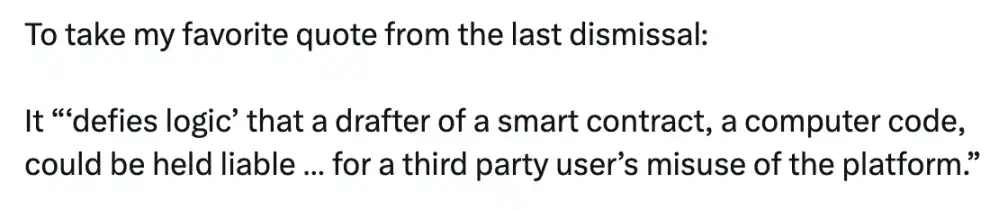
In a tweet, Brian Nistler expressed that, quoting a line from a previous court ruling, the drafter of a smart contract being held responsible for third-party misuse of the platform is simply "illogical."
Another Outcome for Tornado Cash
Facing the same judge, Roman Storm of Tornado Cash experienced a different outcome.
Tornado Cash was first added to the U.S. Treasury Department's Office of Foreign Assets Control (OFAC) sanctions list on August 8, 2022, accusing it of laundering over $7 billion for criminal entities, including North Korean hackers. Two days after being sanctioned, one of Tornado Cash's core developers, Alexey Pertsev, was arrested by Dutch authorities.
On May 14, 2024, a Dutch court sentenced Alexey Pertsev for money laundering to 64 months in prison. The court found that Pertsev was aware that his platform, which he developed and operated, was being used for criminal purposes, did not intervene, and subjectively tolerated Tornado Cash as a money laundering tool. Currently, Alexey Pertsev is still appealing, but there have been no recent developments.
7 months before Alexey Pertsev was convicted, the U.S. Department of Justice filed charges against two other developers, Roman Storm and Roman Semenov, in the Southern District of New York federal court. Roman Storm had previously been arrested in Washington State, while Roman Semenov was still at large.

Roman Storm in Court
Subsequently, despite an appeal, the court determined that OFAC sanctioning Tornado Cash was an overreach and the sanction was invalid. However, Roman Storm still took the defendant's seat in court in July of last year. After a trial presided over by Judge Katherine Polk Failla, the jury found that Roman Storm was "conspiring to operate an unlicensed money transmitting business," but formal sentencing has not yet taken place.
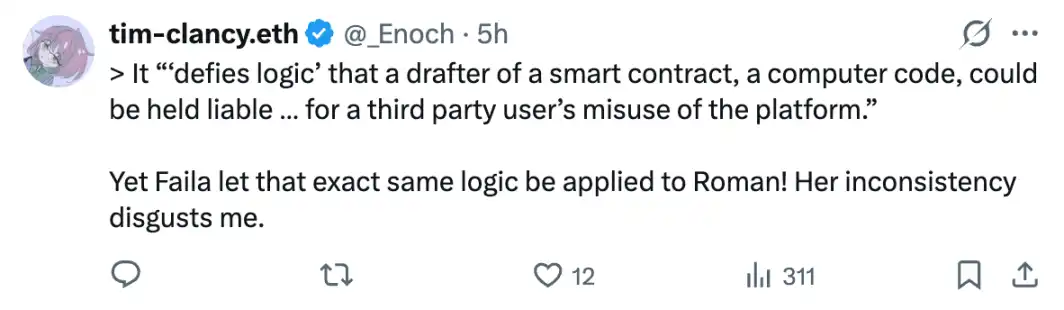
In response to Brian Nistler's tweet celebrating Uniswap's legal victory, Sigil developer tim-clancy.eth's tweet criticizing the inconsistencies before and after Failla's ruling (regarding Roman Storm's judgment actually made by the jury) received the highest number of likes in all comments.
Decentralization is Fine, but Privacy is Not
While I am not a professional lawyer, setting aside political factors, I can also roughly understand why Uniswap and Tornado Cash would have different outcomes from a simple emotional perspective.
The core reason is that the Tornado Cash developers should have been well aware that a mixer would inevitably be used for money laundering. This also clearly demonstrates the regulatory stance: decentralization is acceptable, but it must be traceable. Tether has also faced a similar dilemma in the past, which is why they later began to cooperate with money laundering investigations and added freezing functionality.
Perhaps Roman Storm would feel the today's verdict unjust behind bars, but what he should realize is that even in the United States under the pro-crypto Trump administration, aiding a nation-state hacker from North Korea in laundering money is not tolerable. With the power of Crypto today, it is still not enough to combat the power of a nation.
Web3 practitioners express their grievances for Tornado Cash developers and cheer for Uniswap's legal victory. Because in our eyes, the two protocols are not fundamentally different, and Tornado Cash even excels in privacy protection. Uniswap's decision to add front-end blocking of sanctioned addresses in 2022 has sparked some controversy, and now it seems that permissionlessness within the existing legal framework may be the only way for decentralized protocols to survive.
But then again, does Uniswap really have no responsibility in these fraud incidents?
Strictly speaking, as the metaphor given by the judge, you cannot hold Mercedes-Benz accountable for a bank robbery just because the robber used a Mercedes-Benz for the heist. But from a business perspective, we tend to believe that giants should provide protection within their capabilities. Current security tools can already proactively identify a large number of potential scam projects, and for these established projects that have enjoyed the benefits of Web3 development, simple screening is not a hassle.
It is not a necessary obligation to make every effort to protect investors, but it is a responsibility that ordinary investors hope Uniswap and others can proactively take on.
You may also like

ChainCatcher Hong Kong Themed Forum Highlights: Decoding the Growth Engine Under the Integration of Crypto Assets and Smart Economy

Why can this institution still grow by 150% when the scale of leading crypto VCs has shrunk significantly?

Anthropic's $1 trillion, compared to DeepSeek's $100 billion

Geopolitical Risk Persists, Is Bitcoin Becoming a Key Barometer?

Annualized 11.5%, Wall Street Buzzing: Is MicroStrategy's STRC Bitcoin's Savior or Destroyer?

An Obscure Open Source AI Tool Alerted on Kelp DAO's $292 million Bug 12 Days Ago

Mixin has launched USTD-margined perpetual contracts, bringing derivative trading into the chat scene.
The privacy-focused crypto wallet Mixin announced today the launch of its U-based perpetual contract (a derivative priced in USDT). Unlike traditional exchanges, Mixin has taken a new approach by "liberating" derivative trading from isolated matching engines and embedding it into the instant messaging environment.
Users can directly open positions within the app with leverage of up to 200x, while sharing positions, discussing strategies, and copy trading within private communities. Trading, social interaction, and asset management are integrated into the same interface.
Based on its non-custodial architecture, Mixin has eliminated friction from the traditional onboarding process, allowing users to participate in perpetual contract trading without identity verification.
The trading process has been streamlined into five steps:
· Choose the trading asset
· Select long or short
· Input position size and leverage
· Confirm order details
· Confirm and open the position
The interface provides real-time visualization of price, position, and profit and loss (PnL), allowing users to complete trades without switching between multiple modules.
Mixin has directly integrated social features into the derivative trading environment. Users can create private trading communities and interact around real-time positions:
· End-to-end encrypted private groups supporting up to 1024 members
· End-to-end encrypted voice communication
· One-click position sharing
· One-click trade copying
On the execution side, Mixin aggregates liquidity from multiple sources and accesses decentralized protocol and external market liquidity through a unified trading interface.
By combining social interaction with trade execution, Mixin enables users to collaborate, share, and execute trading strategies instantly within the same environment.
Mixin has also introduced a referral incentive system based on trading behavior:
· Users can join with an invite code
· Up to 60% of trading fees as referral rewards
· Incentive mechanism designed for long-term, sustainable earnings
This model aims to drive user-driven network expansion and organic growth.
Mixin's derivative transactions are built on top of its existing self-custody wallet infrastructure, with core features including:
· Separation of transaction account and asset storage
· User full control over assets
· Platform does not custody user funds
· Built-in privacy mechanisms to reduce data exposure
The system aims to strike a balance between transaction efficiency, asset security, and privacy protection.
Against the background of perpetual contracts becoming a mainstream trading tool, Mixin is exploring a different development direction by lowering barriers, enhancing social and privacy attributes.
The platform does not only view transactions as execution actions but positions them as a networked activity: transactions have social attributes, strategies can be shared, and relationships between individuals also become part of the financial system.
Mixin's design is based on a user-initiated, user-controlled model. The platform neither custodies assets nor executes transactions on behalf of users.
This model aligns with a statement issued by the U.S. Securities and Exchange Commission (SEC) on April 13, 2026, titled "Staff Statement on Whether Partial User Interface Used in Preparing Cryptocurrency Securities Transactions May Require Broker-Dealer Registration."
The statement indicates that, under the premise where transactions are entirely initiated and controlled by users, non-custodial service providers that offer neutral interfaces may not need to register as broker-dealers or exchanges.
Mixin is a decentralized, self-custodial privacy wallet designed to provide secure and efficient digital asset management services.
Its core capabilities include:
· Aggregation: integrating multi-chain assets and routing between different transaction paths to simplify user operations
· High liquidity access: connecting to various liquidity sources, including decentralized protocols and external markets
· Decentralization: achieving full user control over assets without relying on custodial intermediaries
· Privacy protection: safeguarding assets and data through MPC, CryptoNote, and end-to-end encrypted communication
Mixin has been in operation for over 8 years, supporting over 40 blockchains and more than 10,000 assets, with a global user base exceeding 10 million and an on-chain self-custodied asset scale of over $1 billion.

$600 million stolen in 20 days, ushering in the era of AI hackers in the crypto world
Vitalik's 2026 Hong Kong Web3 Summit Speech: Ethereum's Ultimate Vision as the "World Computer" and Future Roadmap
On the same day Aave introduced rsETH, why did Spark decide to exit?
Full Post-Mortem of the KelpDAO Incident: Why Did Aave, Which Was Not Compromised, End Up in Crisis Situation?

After a $290 million DeFi liquidation, is the security promise still there?
ZachXBT's post ignites RAVE nearing zero, what is the truth behind the insider control?

Vitalik 2026 Hong Kong Web3 Carnival Speech Transcript: We do not compete on speed; security and decentralization are the core
In-depth Analysis of RAVE Events: Short Squeeze, Crash, and Quantitative Financial Models of Liquidity Manipulation

Eve of Ceasefire, US Military Fires on Iranian Vessel | Rewire News Morning Brief

Figma's stock price drops over 7%, will Claude Design be the terminator?




 App
App