
During the liquidity crisis of Q1 25YO, where did on-chain transaction volume flow to?




Original Article Title: Where is Onchain Volume Rotating? (Jan 24-Mar 25)
Original Article Author: @stacy_muur, CuratedCrypt0 Member
Original Article Translation: Motion小Deep
Editor's Note: From January 2024 to March 2025, DeFi on-chain transaction volume experienced a surge and downturn. DEX trading volume reached a peak of $380 billion in January 2025, followed by a 35% decline. Solana's native DEX emerged, holding 5 out of the top 10 seats, with Hyperliquid occupying over 60% of the perpetual contract market share. Leading DEXs such as Uniswap and PancakeSwap dominated around 40% of the trading volume. Chain-level market share saw fluctuations, with Solana, Ethereum, and Base showing varying degrees of persistence, while CEX still accounted for nearly 80% of spot trading. The future of DeFi depends on the chain that can solidify user habits, rather than mere speculation.
The following is the original content (restructured for easier reading comprehension):
Over the past 15 months, the DeFi liquidity landscape has been redrawn among different chains, moving away from hype-driven outliers and quietly concentrating on fundamentals rather than noise.
TL;DR
· DEX trading volume hit a historic high of $380 billion in January 2025, followed by a 35% drop in the next two months, signaling a possible short-term top.
· The top 10 DEXs now account for nearly 80% of the activity volume; Uniswap and PancakeSwap alone represent around 40%.
· Solana's native DEX quietly took the top spot, with 5 out of the top 10, and its share expanded due to meme-driven trading volume growth.
· Hyperliquid disrupted the perpetual contract landscape, rising from a newcomer to dominating over 60% of the market share by March 2025.
All insights are based on public data. Special thanks to DefiLlama for consistently providing high-quality statistical data.
A Cycle Defined by Surges and Slowdowns
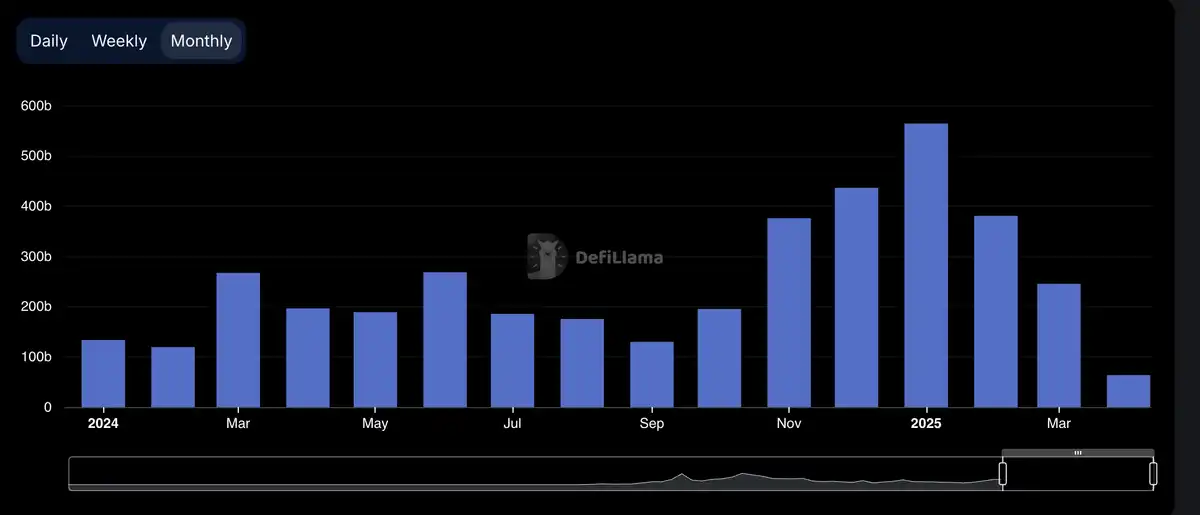
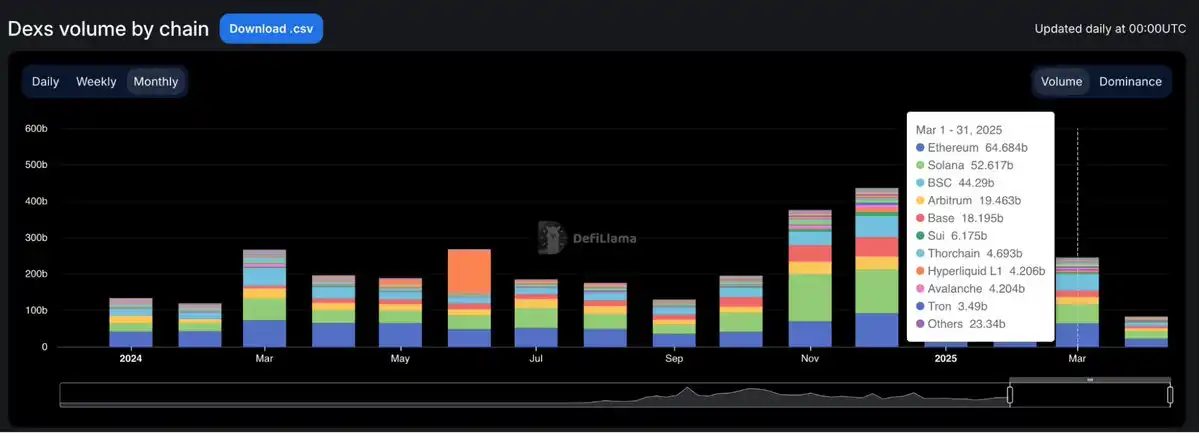
In early 2024, DEX trading volume showed strength in March and May, followed by a slowdown in the middle of the year.
The situation took a sharp turn in the fourth quarter, with transaction volumes surging in November and December, continuing into January 2025 to reach an explosive peak of $380 billion.
However, this wave of growth was short-lived. By February, the transaction volume had dropped to $245 billion, a steep 35% decrease, bringing an end to the three-month vertical climb. This decline set the tone for a more cautious second quarter.
DEX Dominance: Top Heavy Control
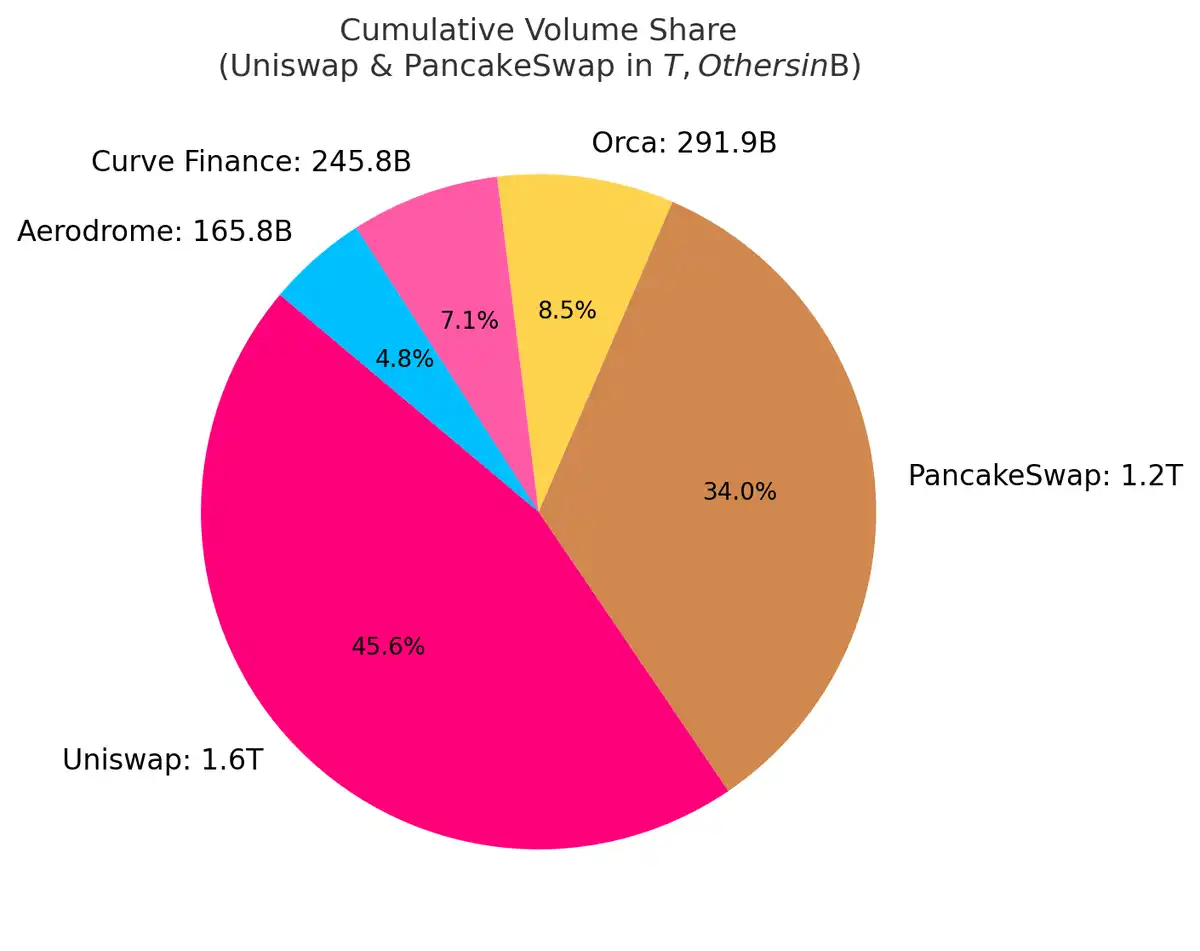
The DEX landscape remains highly concentrated. The top 10 protocols now account for 79.5% of daily trading volume, with just the top 5 controlling 59.1%.
Uniswap and PancakeSwap represent around 40% of all DEX trading volume, being the only two protocols with total trading volume exceeding a trillion dollars. Their dominance is built on first-mover advantage, cross-chain coverage, and deep liquidity.
Uniswap Labs has also launched Unichain, a dedicated Ethereum L2 based on the Optimism Superchain, aiming to provide fast, low-cost transactions with native cross-chain interoperability.
Solana's Quiet Rise
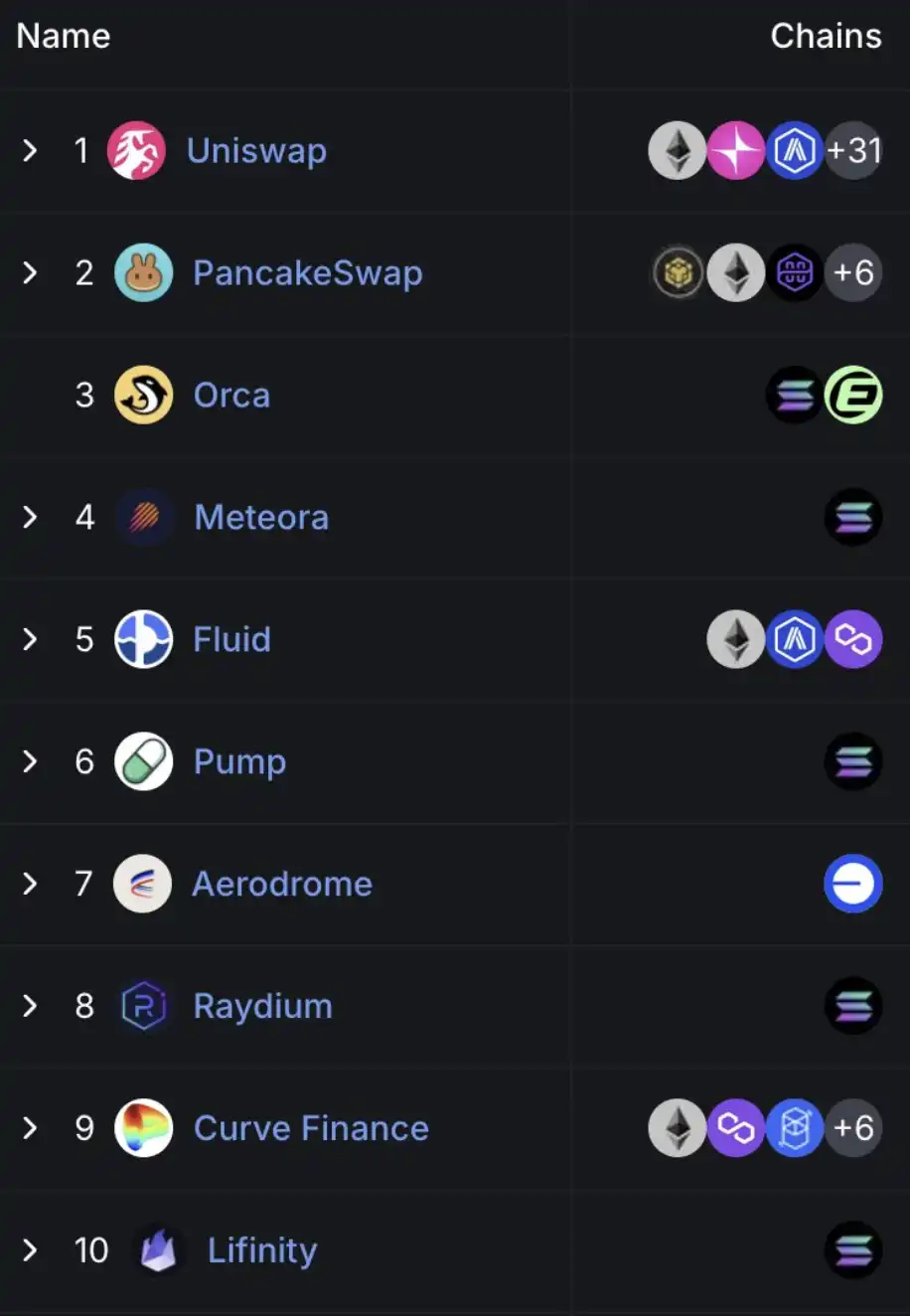
Solana's rise has been noteworthy. Five out of the top 10 DEXs are Solana-native: @orca_so, @MeteoraAG, @RaydiumProtocol, @Lifinity_IO, @pumpdotfun.
Orca (8.02%) and Meteora (6.70%) alone contribute about 15% of global DEX activity.
This rise is driven by low fees, fast block times, and the sticky flow of Solana's meme coin culture. Pump.fun entering the top 10 clearly reflects this energy.
Emerging Protocols: Fluid and Aerodrome
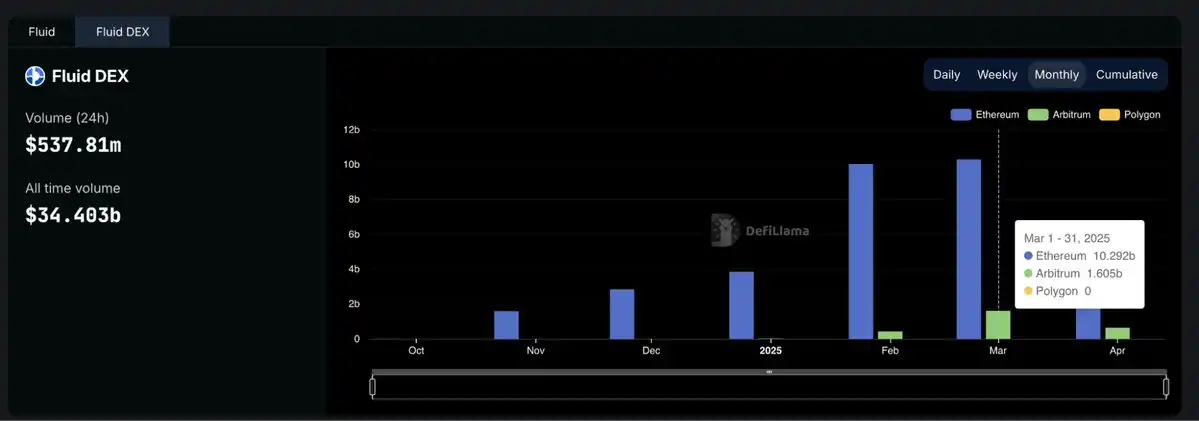
@0xfluid (7.09%) is the most capital-efficient DEX in the top 5. Active on Ethereum, with monthly trading volumes surpassing $100 billion. Its launch on Arbitrum saw volumes grow from $426 million in February to $1.6 billion in March, demonstrating rapid adoption.
@AerodromeFi, based on Base, reflects the growth of liquidity on the Base L2.
While Hyperliquid doesn't rank high in spot trading, it dominates the perpetual contract market with over 60% market share.
Chain-Specific DEX Market Share: Momentum Easy Come, Retention Rare
The past 15 months have shown that while most chains can attract attention, few can retain users. From January 2024 to March 2025, chain-level DEX market share has shifted rapidly, with only a few maintaining significant traction.
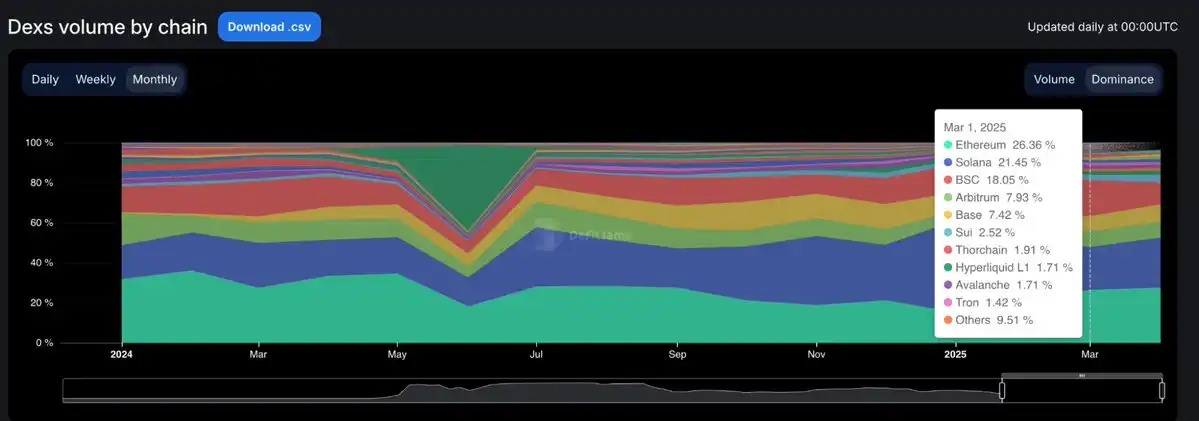
Solana has seen the most prominent performance. It steadily climbed in 2024, reaching a peak of 45.8% in January 2025 during the $TRUMP and $MELANIA meme coin craze. By March, its share halved to 21.5%. Nonetheless, its average share of 25.1% remains the highest across all chains.
Ethereum, on the other hand, exhibited the opposite trend. Starting at about 32% share in 2024, it dropped to 15.3% in January 2025 but rebounded to 26.4% by March, demonstrating its resilience even after losing momentum.
Base has been the most stable climber. Rising from 3% in March 2024 to 12.4% in December and remaining steady at 7.4% in March 2025, averaging 6.6% during this period. No hype, just gradual, sticky growth.
The BNB chain maintained an average share of 14.7%, remaining stable throughout, without any sudden spikes or crashes, sustained only by retail traffic, lacking any breakthrough moments.
Arbitrum started strong at 16% but failed to take off. By January 2025, it slipped to 4.8%, surpassed by Base and Solana.
Blast peaked at 42.3% in June 2024, only to vanish the following month—a typical case of incentive-driven transaction volume with no retention.
Conclusion: Chain-level DEX dominance is highly volatile. Solana surged, Ethereum recovered, Base slowly gained ground, and hype cycles quickly burned out. The enduring chains are not the loudest but the most utilized.
CEX Still Dominates Spot Trading Volume
Despite the DEX explosion at the beginning of 2025, centralized exchanges (CEX) continue to dominate the spot market. Even at the peak of DEX in January, CEX still held nearly 80% of the total trading volume.
While the CEX dominance dropped from 90% at the beginning of 2024 to a low of 79%, the overall pattern is clear: DEX is growing, but CEX remains the default venue for most traders.
Perpetual Contract Protocol Market Share
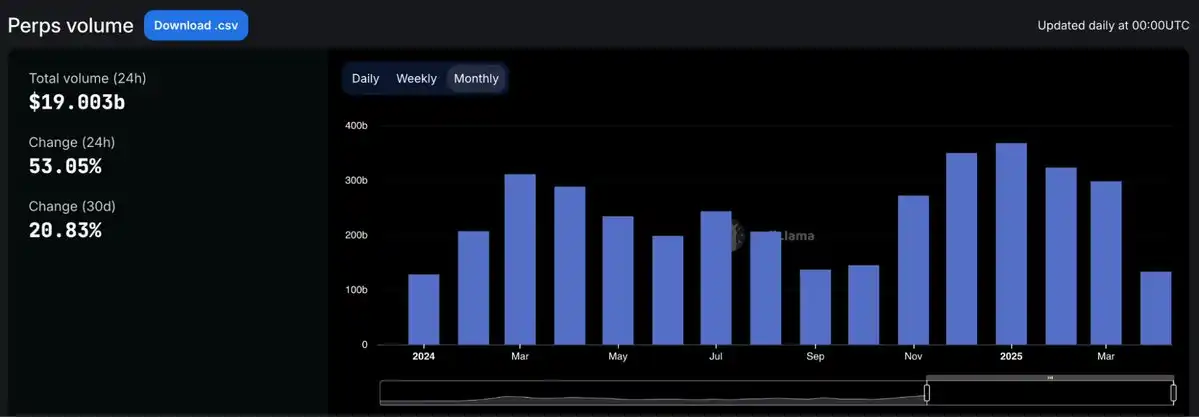
In 2024, the on-chain perpetual contract landscape saw a reversal.
After dYdX's two-plus-year reign at the top, Hyperliquid rose to redefine the dominant position. It first took the lead in February, briefly lost to @SynFuturesDefi mid-year, regained the top spot in August, and has held it since. By March 2025, Hyperliquid held nearly 59% of the perpetual contract trading volume, establishing itself as the preferred venue for professional traders.
This rise to prominence was fueled by a product offering close to a CEX experience, gaining attention. In contrast, dYdX quickly declined. Its market share dropped from 13.2% at the beginning of 2024 to 2.7% in March 2025 as users gravitated towards faster, sleeker, and more modern alternatives.
@JupiterExchange took a different path in perpetual contracts, climbing to second place with an 8.8% share by leveraging Solana-native liquidity and a spot DEX funnel. It expanded rapidly but stabilized behind Hyperliquid. Others such as SynFutures, @Vertex_Protocol, and @ParadexApp briefly showed traction.
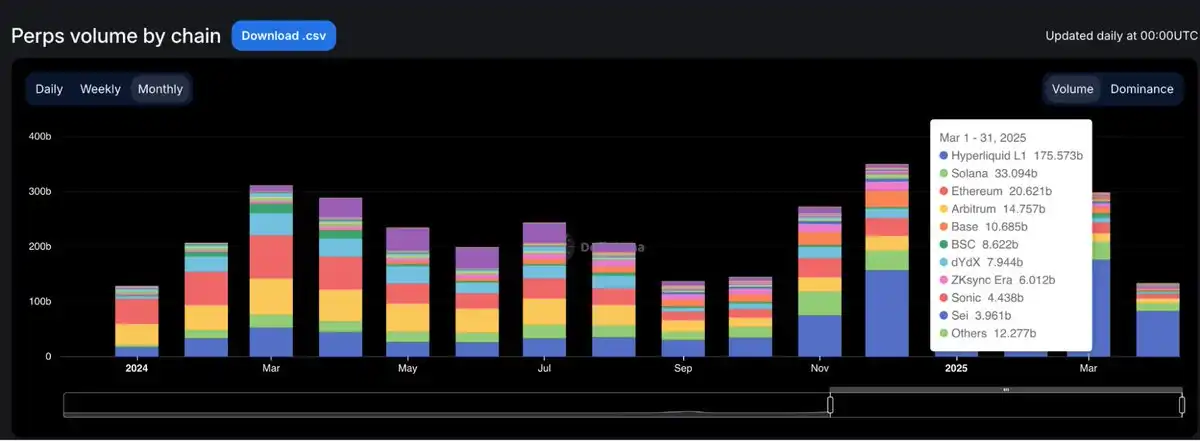
Perpetual Contract Chains: The Execution Layer Rewritten in One Cycle
The most significant shift in perpetual contract infrastructure over the past year has not been in user preferences for a particular protocol but in their trust in which chain executes transactions.
In January 2024, Ethereum and Arbitrum controlled over 65% of the perpetual contract trading volume. However, by March 2025, this had plummeted to just 11.8%, overtaken by updated, faster execution layers.
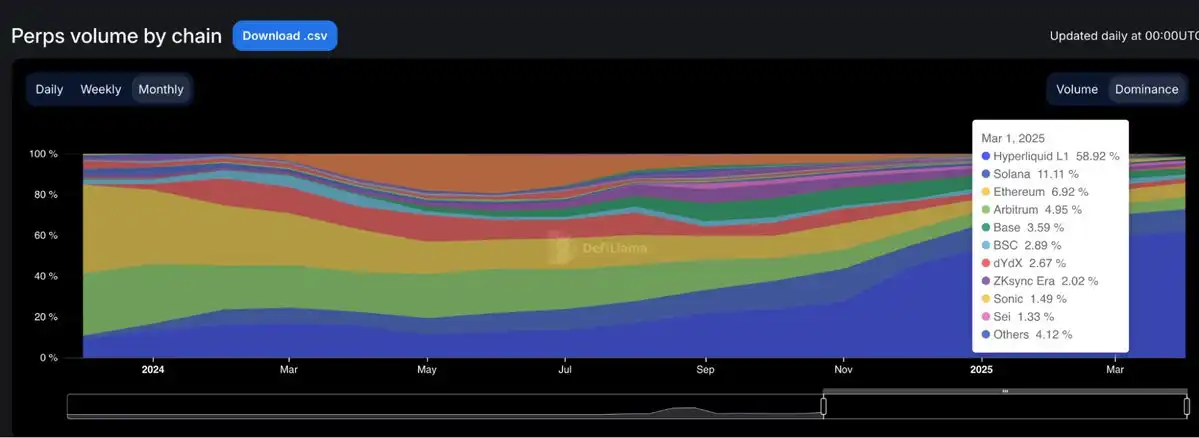
Leading this transition is Hyperliquid's custom chain, which saw its share increase from 13.6% to 58.9% during the same period. In less than a year, it has become the default perpetual contract execution environment, supplanting the L1 and L2 layers that once defined the category. Not only is it faster, but it also provides the high reliability and low latency that professional traders require.
Solana also showed strength, rising to nearly 16% by the end of 2024 with Jupiter and Phoenix, but eventually stabilizing at 10-11%, failing to sustain its breakout momentum. Base and ZKsync showed vitality, peaking at around 6-7%, but have not yet reached the top tier.
Meanwhile, Blast became a cautionary tale: achieving a 18.8% single-month miracle in June 2024, only to quickly vanish. In the realm driven by product quality and user retention, hype failed to endure. The new execution stack is clear—performance-first chains have reset the standard, and traditional infrastructure is no longer the default choice.
The future of DeFi lies not in the number of chains, but in solidifying the narrative into user habits.
You may also like

The second half of the computing power battle: Intel CEO Pat Gelsinger reveals how AI is reshaping the global semiconductor supply chain

WEEX Live mode: Monitor 20 trading pairs at once and trade like a pro

Morning Report | Secret Network loses $4.67 million due to cross-chain vulnerability; Michael Saylor releases Bitcoin Tracker information again, may disclose increased holdings data next week

Kalshi's biggest competitor is not Polymarket
WEEX Makes Affiliate Access Easier on the Web and in the App

Customize Your Spot Trading Page: Drag Modules and Move the Order Panel Where You Want It

Perp DEX: The Next Generation Exchange "War"

10 Counterintuitive Insights on Latin American Payments

The AI gamble of mining companies: Valuations enter a phase of differentiation, and it's hard to turn the tide

A letter from Alliance to entrepreneurs: Written on the occasion of Cursor selling for 60 billion dollars
Stablecoins Finally Find Real Returns: On-Chain Reinsurance Re Explained | Interview with Re Founder Karan Saroya

The impossible triangle is simply a pseudo problem

Will MicroStrategy fall into a death spiral? What will the macro trend be in the second half of the year?

Blockchain Capital Partner: The Core Secret of Arbitrage
STRC unanchored by 11%, can the perpetual motion machine of Strategy still operate?

Bitcoin Market Analysis 2026: Can BTC Reach $150K by Year-End?
Bitcoin ETF Outflows Hit a Record $4.4 Billion: What Are Traders Doing With Their Cash?
WEEX App Just Got Smarter – New Tabs for Faster Trades & Easy Asset Management
The second half of the computing power battle: Intel CEO Pat Gelsinger reveals how AI is reshaping the global semiconductor supply chain
WEEX Live mode: Monitor 20 trading pairs at once and trade like a pro
Morning Report | Secret Network loses $4.67 million due to cross-chain vulnerability; Michael Saylor releases Bitcoin Tracker information again, may disclose increased holdings data next week
Kalshi's biggest competitor is not Polymarket
WEEX Makes Affiliate Access Easier on the Web and in the App
Customize Your Spot Trading Page: Drag Modules and Move the Order Panel Where You Want It


