
Ethereum Narrative Crisis: Why Has Seven Years of Ecosystem Development Struggled to Overcome Market Indifference?
Original Article Title: ETH needs a new narrative
Original Article Author: Richard Chen
Original Article Translation: DeepTech TechFlow
Last week, the price of Ethereum (ETH) fell to the level of its initial coin offering (ICO) in 2017. Back then, Ethereum was just a whitepaper and a token, and compared to today's many real-world applications, the market seems indifferent to the 7.5 years of progress in the Ethereum developer ecosystem.
The bigger issue is that ETH needs a new narrative, a clear reason to attract people to buy the token. Let's analyze the common narratives of ETH and discuss why they are no longer effective.
1. "ETH is Bitcoin's leveraged beta."
In past bull market cycles, this statement held true, as altcoins usually outperformed BTC, with blue-chip altcoins being leveraged beta. Whenever BTC performed well, investors increased their risk exposure to gain better returns in altcoins.
This time it's different. In January 2024, the launch of a Bitcoin ETF brought a new paradigm shift. Nearly $100 billion flowed into Bitcoin ETFs, which now collectively hold 5.7% of the BTC supply. In contrast, Ethereum ETFs only attracted $5 billion in inflows. Unlike past cycles, a significant inflow of funds into the cryptocurrency market, especially from large institutions, is now only flowing into BTC and not diversifying to other parts of the market. While BTC will always have a natural demand for new funds looking to enter the cryptocurrency space, it is unclear if other assets have a similar demand.
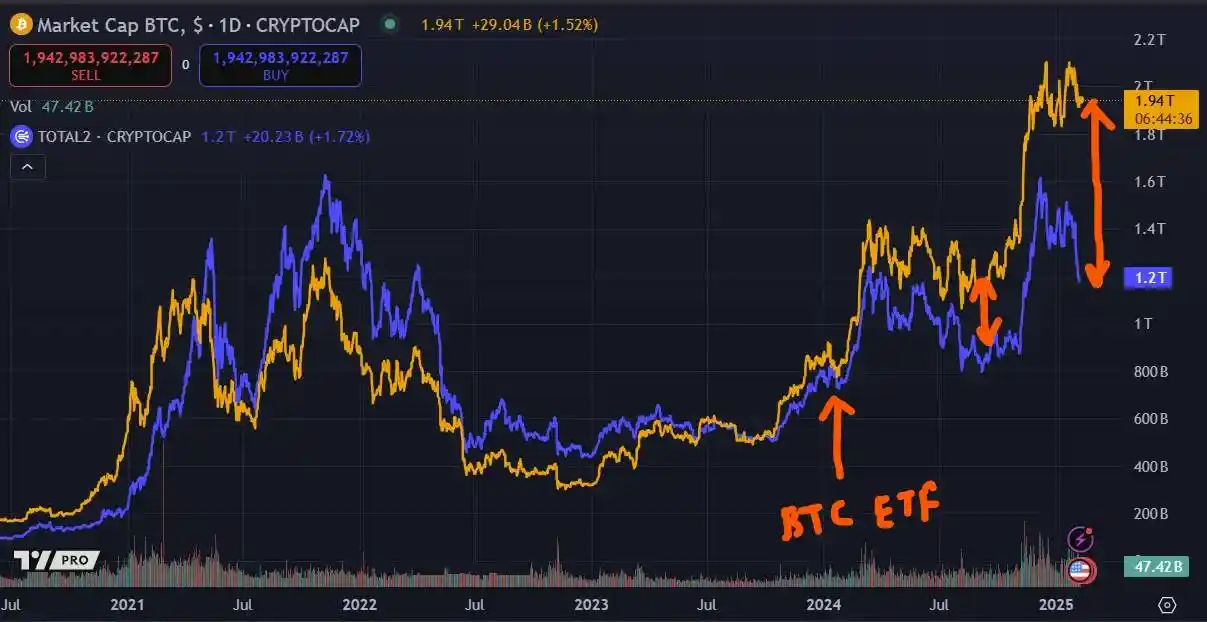
Bitcoin (BTC) is at an independent tier and differentiated from other parts of the market.
The lack of new funds flowing into altcoins leads us to a second-order effect of a zero-sum game speculative fund pool that rotates between different "casinos." This rotation has been evident in price trends over the months post-election, with speculative funds moving from Solana's AI Agent coin to Hyperliquid, then back to $TRUMP and $MELANIA. Without economic growth, the competitive zero-sum attention economy of the crypto tribes accelerates this rotation.
Another second-order effect of funds not flowing into altcoins is that it has harmed the venture capital market. The ideal scenario for a Token Generation Event (TGE) is for the infrastructure project's funding cap to be in the tens of billions of dollars, with the total addressable market (TAM) for other project categories being smaller in comparison. Due to an oversupply of capital relative to founder talent, valuations in private funding rounds have not decreased. As a result, returns in crypto venture capital are being squeezed.
2. "ETH Is Ultrasound Money."
This is no longer the case. In April 2024, the ETH supply started reversing and increasing again. In February 2025, ETH became inflationary since the merge. Therefore, the argument that ETH is a harder money than BTC is no longer valid.
The argument for ultrasound money is also somewhat nuanced. Those newly entering the crypto space would accept the scarcity narrative of "BTC as digital gold" without delving into the technical details of EIP-1559 and which of BTC or ETH is more deflationary.
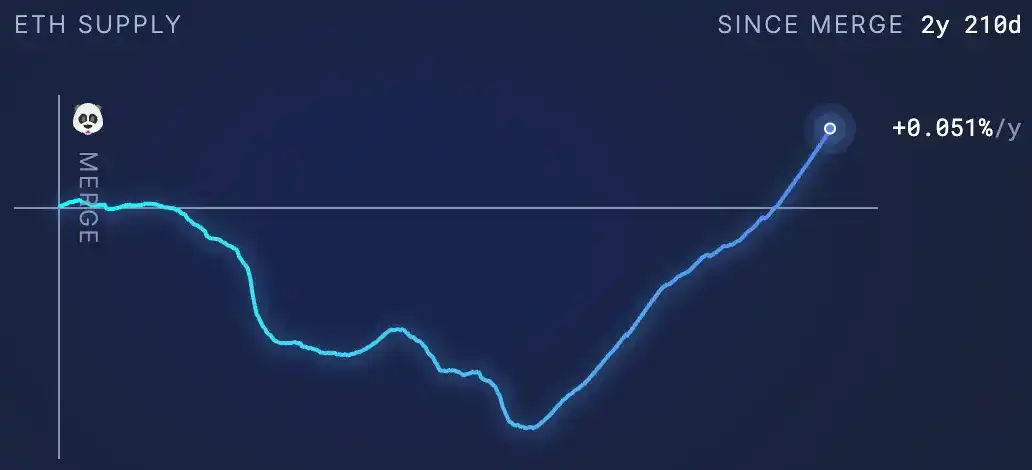
Source: ultrasound.money
3. "ETH Is Digital Oil."
The issue with this framework is that ETH would thus trade like a commodity, exhibiting sideways and range-bound movements. The value of a commodity is based on market supply and demand dynamics, rather than being a growth asset held for the long term. To illustrate this point, there are two charts below comparing the performance of oil and the S&P 500 Index over the past decade.
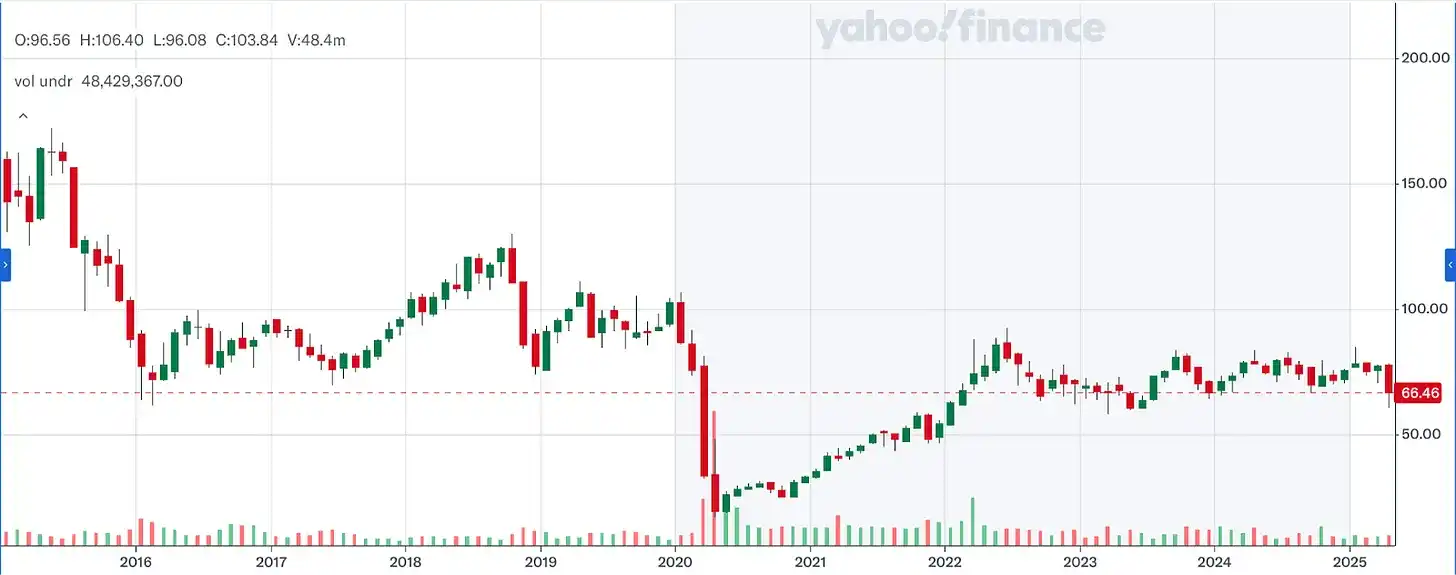
USO
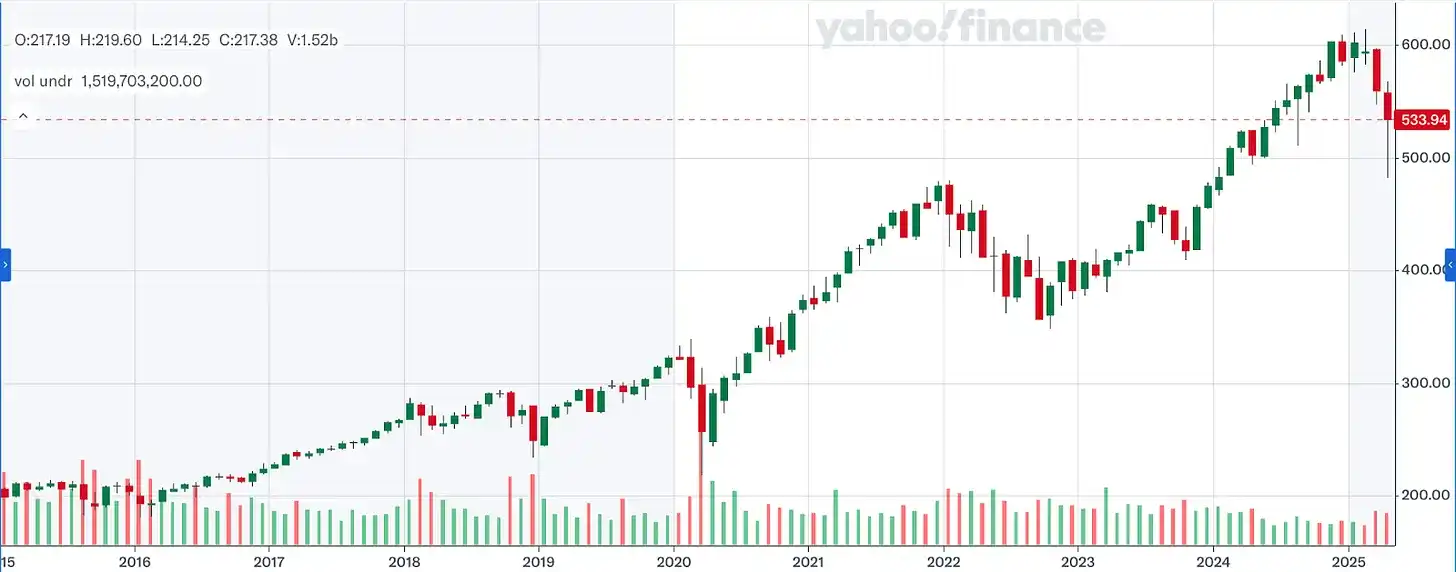
SPY
Over the past decade, oil trading has mostly been range-bound with only two exceptional events: 1) the early 2015 release of U.S. oil supply due to advancements in hydraulic fracturing technology; 2) the COVID crash in early 2020.
Using the "digital oil" framework, if ETH enters the market due to inflation again but without marginal buying demand, the price will decline.
4. "ETH Is a Global Settlement Layer."
Ethereum's long-term scaling roadmap faces an inherent contradiction between two goals: 1) Scaling will be pushed to layer 2 (L2), making Ethereum a settlement layer; 2) L2's economic activity will accrue value to ETH. When EIP-4844 significantly reduces the cost of publishing transaction data to layer 1 (L1), it improves L2 scalability but also reduces Ethereum's revenue.
The bigger issue is that when L2 introduces its own tokens, they become somewhat "parasitic" to ETH. L2 has a strong economic incentive to accumulate value to its own token rather than ETH. Therefore, apart from technical differences in the consensus mechanism, L2 behaves almost like a competing L1.
This has led to the decoupling of the Ethereum Virtual Machine (EVM) from ETH value accrual. Ethereum's greatest historical defense lies in its development tooling ecosystem around the EVM—debuggers, fuzzing tools, template contracts, etc.—all built over years of open-source development. For new developers, building on the EVM is much easier than building on a non-EVM chain without such a robust tooling infrastructure. With the decoupling of EVM and ETH, EVM adoption can continue to grow as new L2s like MegaETH and new L1s like Berachain and Monad leverage the EVM ecosystem, but the value accrues back to their native tokens rather than ETH.
5. "ETH Has the Most On-Chain Economic Activity of Any Chain."
A future scenario may arise where total value locked (TVL) in stablecoins reaches an all-time high, decentralized exchange (DEX) trading volume hits an all-time high, along with other on-chain economic activity metrics on Ethereum reaching new highs, but ETH's price has not reached an all-time high due to a price-to-earnings (P/E) multiple contraction. In this case, ETH's trading is more akin to tech stocks like Tesla (TSLA, 97x forward P/E) or Nvidia (NVDA, 24x forward P/E).
With the current annualized profit, ETH would need a 300x P/E multiple to reach a new all-time high without any price premium. Therefore, there is still significant downside risk from P/E compression.
What will happen next with ETH?
Perhaps ETH will rise due to mean reversion or continue to underperform for the reasons mentioned above.
But before that, ETH needs a new narrative.
You may also like

Anthropic's $1 trillion, compared to DeepSeek's $100 billion

Geopolitical Risk Persists, Is Bitcoin Becoming a Key Barometer?

Annualized 11.5%, Wall Street Buzzing: Is MicroStrategy's STRC Bitcoin's Savior or Destroyer?

An Obscure Open Source AI Tool Alerted on Kelp DAO's $292 million Bug 12 Days Ago

Mixin has launched USTD-margined perpetual contracts, bringing derivative trading into the chat scene.
The privacy-focused crypto wallet Mixin announced today the launch of its U-based perpetual contract (a derivative priced in USDT). Unlike traditional exchanges, Mixin has taken a new approach by "liberating" derivative trading from isolated matching engines and embedding it into the instant messaging environment.
Users can directly open positions within the app with leverage of up to 200x, while sharing positions, discussing strategies, and copy trading within private communities. Trading, social interaction, and asset management are integrated into the same interface.
Based on its non-custodial architecture, Mixin has eliminated friction from the traditional onboarding process, allowing users to participate in perpetual contract trading without identity verification.
The trading process has been streamlined into five steps:
· Choose the trading asset
· Select long or short
· Input position size and leverage
· Confirm order details
· Confirm and open the position
The interface provides real-time visualization of price, position, and profit and loss (PnL), allowing users to complete trades without switching between multiple modules.
Mixin has directly integrated social features into the derivative trading environment. Users can create private trading communities and interact around real-time positions:
· End-to-end encrypted private groups supporting up to 1024 members
· End-to-end encrypted voice communication
· One-click position sharing
· One-click trade copying
On the execution side, Mixin aggregates liquidity from multiple sources and accesses decentralized protocol and external market liquidity through a unified trading interface.
By combining social interaction with trade execution, Mixin enables users to collaborate, share, and execute trading strategies instantly within the same environment.
Mixin has also introduced a referral incentive system based on trading behavior:
· Users can join with an invite code
· Up to 60% of trading fees as referral rewards
· Incentive mechanism designed for long-term, sustainable earnings
This model aims to drive user-driven network expansion and organic growth.
Mixin's derivative transactions are built on top of its existing self-custody wallet infrastructure, with core features including:
· Separation of transaction account and asset storage
· User full control over assets
· Platform does not custody user funds
· Built-in privacy mechanisms to reduce data exposure
The system aims to strike a balance between transaction efficiency, asset security, and privacy protection.
Against the background of perpetual contracts becoming a mainstream trading tool, Mixin is exploring a different development direction by lowering barriers, enhancing social and privacy attributes.
The platform does not only view transactions as execution actions but positions them as a networked activity: transactions have social attributes, strategies can be shared, and relationships between individuals also become part of the financial system.
Mixin's design is based on a user-initiated, user-controlled model. The platform neither custodies assets nor executes transactions on behalf of users.
This model aligns with a statement issued by the U.S. Securities and Exchange Commission (SEC) on April 13, 2026, titled "Staff Statement on Whether Partial User Interface Used in Preparing Cryptocurrency Securities Transactions May Require Broker-Dealer Registration."
The statement indicates that, under the premise where transactions are entirely initiated and controlled by users, non-custodial service providers that offer neutral interfaces may not need to register as broker-dealers or exchanges.
Mixin is a decentralized, self-custodial privacy wallet designed to provide secure and efficient digital asset management services.
Its core capabilities include:
· Aggregation: integrating multi-chain assets and routing between different transaction paths to simplify user operations
· High liquidity access: connecting to various liquidity sources, including decentralized protocols and external markets
· Decentralization: achieving full user control over assets without relying on custodial intermediaries
· Privacy protection: safeguarding assets and data through MPC, CryptoNote, and end-to-end encrypted communication
Mixin has been in operation for over 8 years, supporting over 40 blockchains and more than 10,000 assets, with a global user base exceeding 10 million and an on-chain self-custodied asset scale of over $1 billion.

$600 million stolen in 20 days, ushering in the era of AI hackers in the crypto world

Vitalik's 2026 Hong Kong Web3 Summit Speech: Ethereum's Ultimate Vision as the "World Computer" and Future Roadmap

On the same day Aave introduced rsETH, why did Spark decide to exit?

Full Post-Mortem of the KelpDAO Incident: Why Did Aave, Which Was Not Compromised, End Up in Crisis Situation?

After a $290 million DeFi liquidation, is the security promise still there?

ZachXBT's post ignites RAVE nearing zero, what is the truth behind the insider control?

Vitalik 2026 Hong Kong Web3 Carnival Speech Transcript: We do not compete on speed; security and decentralization are the core

In-depth Analysis of RAVE Events: Short Squeeze, Crash, and Quantitative Financial Models of Liquidity Manipulation

Eve of Ceasefire, US Military Fires on Iranian Vessel | Rewire News Morning Brief

Figma's stock price drops over 7%, will Claude Design be the terminator?

Plunge by 10% Followed by Rebound, Weekend Oil Market Watch

SpaceX Mascot ASTEROID Fast Track $170 million, Stemming from an Unfinished Space Dream

L1 is dead, Appchain should rise
Anthropic's $1 trillion, compared to DeepSeek's $100 billion
Geopolitical Risk Persists, Is Bitcoin Becoming a Key Barometer?
Annualized 11.5%, Wall Street Buzzing: Is MicroStrategy's STRC Bitcoin's Savior or Destroyer?
An Obscure Open Source AI Tool Alerted on Kelp DAO's $292 million Bug 12 Days Ago
Mixin has launched USTD-margined perpetual contracts, bringing derivative trading into the chat scene.
The privacy-focused crypto wallet Mixin announced today the launch of its U-based perpetual contract (a derivative priced in USDT). Unlike traditional exchanges, Mixin has taken a new approach by "liberating" derivative trading from isolated matching engines and embedding it into the instant messaging environment.
Users can directly open positions within the app with leverage of up to 200x, while sharing positions, discussing strategies, and copy trading within private communities. Trading, social interaction, and asset management are integrated into the same interface.
Based on its non-custodial architecture, Mixin has eliminated friction from the traditional onboarding process, allowing users to participate in perpetual contract trading without identity verification.
The trading process has been streamlined into five steps:
· Choose the trading asset
· Select long or short
· Input position size and leverage
· Confirm order details
· Confirm and open the position
The interface provides real-time visualization of price, position, and profit and loss (PnL), allowing users to complete trades without switching between multiple modules.
Mixin has directly integrated social features into the derivative trading environment. Users can create private trading communities and interact around real-time positions:
· End-to-end encrypted private groups supporting up to 1024 members
· End-to-end encrypted voice communication
· One-click position sharing
· One-click trade copying
On the execution side, Mixin aggregates liquidity from multiple sources and accesses decentralized protocol and external market liquidity through a unified trading interface.
By combining social interaction with trade execution, Mixin enables users to collaborate, share, and execute trading strategies instantly within the same environment.
Mixin has also introduced a referral incentive system based on trading behavior:
· Users can join with an invite code
· Up to 60% of trading fees as referral rewards
· Incentive mechanism designed for long-term, sustainable earnings
This model aims to drive user-driven network expansion and organic growth.
Mixin's derivative transactions are built on top of its existing self-custody wallet infrastructure, with core features including:
· Separation of transaction account and asset storage
· User full control over assets
· Platform does not custody user funds
· Built-in privacy mechanisms to reduce data exposure
The system aims to strike a balance between transaction efficiency, asset security, and privacy protection.
Against the background of perpetual contracts becoming a mainstream trading tool, Mixin is exploring a different development direction by lowering barriers, enhancing social and privacy attributes.
The platform does not only view transactions as execution actions but positions them as a networked activity: transactions have social attributes, strategies can be shared, and relationships between individuals also become part of the financial system.
Mixin's design is based on a user-initiated, user-controlled model. The platform neither custodies assets nor executes transactions on behalf of users.
This model aligns with a statement issued by the U.S. Securities and Exchange Commission (SEC) on April 13, 2026, titled "Staff Statement on Whether Partial User Interface Used in Preparing Cryptocurrency Securities Transactions May Require Broker-Dealer Registration."
The statement indicates that, under the premise where transactions are entirely initiated and controlled by users, non-custodial service providers that offer neutral interfaces may not need to register as broker-dealers or exchanges.
Mixin is a decentralized, self-custodial privacy wallet designed to provide secure and efficient digital asset management services.
Its core capabilities include:
· Aggregation: integrating multi-chain assets and routing between different transaction paths to simplify user operations
· High liquidity access: connecting to various liquidity sources, including decentralized protocols and external markets
· Decentralization: achieving full user control over assets without relying on custodial intermediaries
· Privacy protection: safeguarding assets and data through MPC, CryptoNote, and end-to-end encrypted communication
Mixin has been in operation for over 8 years, supporting over 40 blockchains and more than 10,000 assets, with a global user base exceeding 10 million and an on-chain self-custodied asset scale of over $1 billion.

