
 Buy Crypto
- Markets
 Futures
- Spot
- Copy Trade
- Earn
- More
From Wild Fundraising to Unwarranted Hype, What Is Happening to Crypto VCs?

Original Article Title: "Crypto VC in the Midst of Liquidity Anxiety: An Unfolding Imbalance"
Original Source: ChandlerZ, Foresight News
Waterdrop Capital partner Dashan admitted in a recent Space session that all four projects he had recently invested in had launched on Binance, but none had distributed tokens to investors according to the original investment agreement. Despite the token distribution terms being clearly outlined in the contract, after the project goes live, the agreement can be amended at will, and investors are almost unable to take any effective countermeasures.
He mentioned that the amendment to the agreement was not actually the project team's intention, but rather a longstanding unwritten rule of Binance, so he does not blame the project teams because they are also at a disadvantage in front of Binance. The current strategy is very clear: to persuade and help truly high-quality project teams to forgo token distribution and go directly to listing on a relatively clean and regulated market to showcase their value.
In traditional VC investments, rights protection based on contracts does not have the same practical binding force in the encrypted token investment structure. Due to exchanges leading circulation rules after token listing, on-chain asset allocation is not immediately bound by the traditional legal system, and investment agreements often lose their enforceability at critical junctures. In the current market environment, whether a project can gain access to a top exchange directly affects its overall survival, and the importance of agreement terms is marginalized in the face of actual interests. In order to get listed, project teams have to cooperate with exchanges in redesigning aspects such as release schedule, lock-up rules, token distribution ratios, etc. Investors, lacking on-chain governance rights and circulation discourse power, find themselves in a de facto rights disadvantage.
This statement reveals a deep-rooted crisis that the current crypto VC investment system is facing, namely a dilemma where the effectiveness of contracts, liquidity control, and exit mechanisms have completely failed.
Imbalance of Power: The New Relationship Among VCs, Projects, and Exchanges
In the industry's development over the past few years, the model of "project narrative construction - multi-round VC financing - top exchange token generation event (TGE)/listing" has gradually become mainstream. The hallmark of this model is that in the early stages, projects rely on professional VC institutions for funding, resource connection, and reputation endorsement, completing financing with gradually increasing valuations, with the ultimate goal usually being the initial token issuance and circulation on a large centralized exchange for early investors to exit.
In the previous multiple bull markets, crypto VCs, as core resources, held significant power in early-stage financing and token issuance design, playing a key role in driving rapid industry expansion and project incubation. In the last bull market, the position of project teams was enhanced, but VCs still had some dominance due to their large capital and liquidity empowerment such as Launchpad.
However, as the market enters a new adjustment period, liquidity in the altcoin space dries up, and the incentive structure between investors and projects shifts. Exchange power has reached unprecedented levels, becoming the absolute controller of liquidity, with key processes such as listing approval, token allocation, and circulation strategy concentrated in the hands of exchanges. This places projects in an extremely weak position during negotiations, even if they have signed detailed investment agreements. Faced with exchange-proposed changes to circulation conditions, project teams find it difficult to refuse, ultimately having to violate the original agreements with investors.
Exchanges have become the controllers of scarce resources, while VCs are gradually being marginalized, with their actual control capacity significantly reduced.
The "Prisoner's Dilemma" in Liquidity Contraction
The current dilemma faced by "VC coins" is not caused by a single factor.
After multiple rounds of funding, projects often have a high public market valuation at the time of Token Generation Event (TGE). This directly results in a high initial buy-in cost for secondary market investors, while also implying that early investors including VCs, the team, early supporters, etc., hold a large amount of low-cost chips and have a strong potential sell-off motive.
This expectation gap puts tokens under natural selling pressure after listing, with market participants potentially forming a consensus that "selling is the optimal strategy," triggering a negative feedback loop.
Furthermore, the token economy itself exacerbates the dilemma of VC coins.
During a bull market, many projects' token issuance models follow the high growth assumptions of the bull market, such as continuous market cap growth and sufficient liquidity to support gradual unlocking. However, in practice, many projects lack real revenue support, with DeFi relying on Ponzi schemes, GameFi relying on subsidies, NFTs relying on FOMO, and tokens completely losing intrinsic growth momentum.
Most importantly, tokens invested by VCs in the past could eventually be sold to new retail investors on the secondary market, forming a complete exit path. However, there are currently very few new retail investors on-chain and on exchanges, incremental funding is drying up, and VC mutual selling has become the norm.
Essentially, early investors, project teams, liquidity providers, and early users have become part of a zero-sum game within a closed loop, making it increasingly difficult to exit.
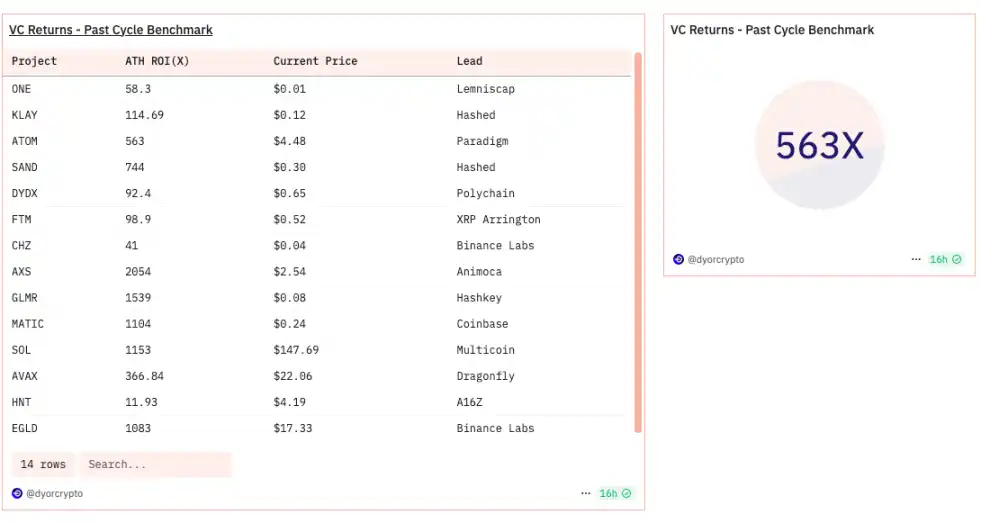
VC Return in the Previous Bull Market Cycle
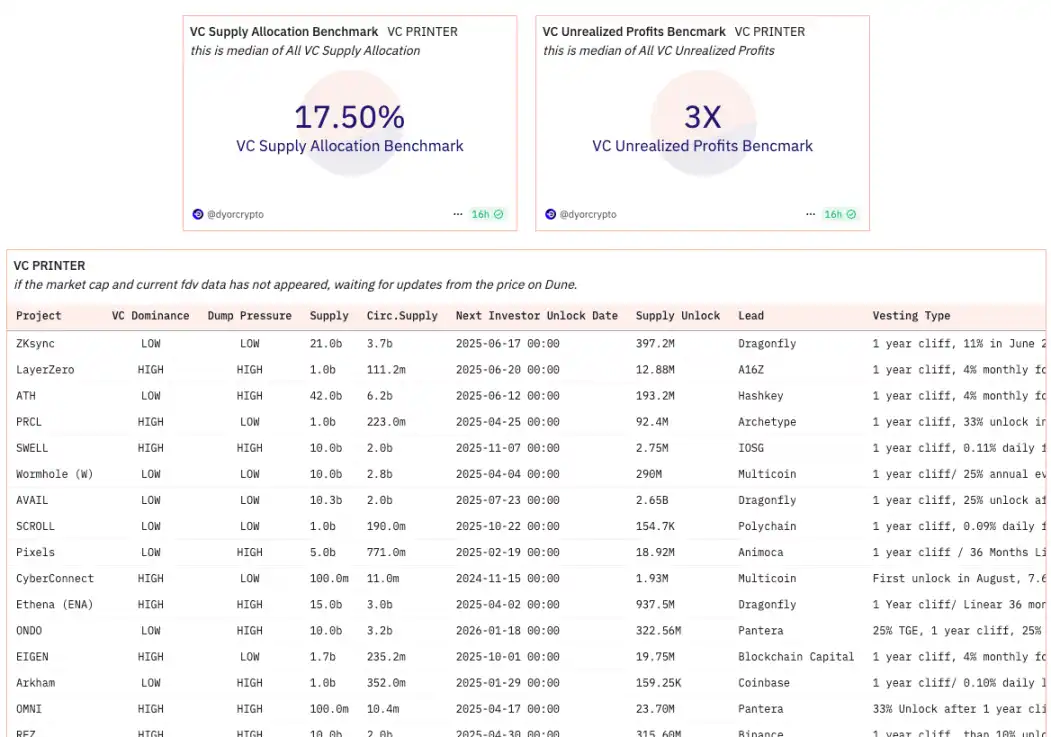
VC Return in the Current Cycle
For VC firms, the traditional strategy of relying on rapid TGEs to achieve high multiple exits is facing challenges, and the realization period of investment returns may lengthen, increasing uncertainty. This may prompt VCs to focus more on a project's long-term fundamentals, sustainable business models, reasonable valuations, and healthier tokenomic models when making investment decisions. Their role may also need to evolve from focusing on early-stage investment and driving listings to more in-depth post-investment management, strategic empowerment, and ecosystem development.
For project teams, there is a need to reassess their token issuance strategy and community relationships. Following the questioning of the "pump and dump" model, exploring a lower valuation starting point, a more equitable distribution mechanism, designing tokenomics that better incentivize long-term holders, as well as increasing operational transparency and strengthening accountability may be more worth exploring.
From a more macro perspective of industry development, the current challenges can be seen as an adjustment in the market's path to maturity. It has exposed issues accumulated during past rapid growth and may drive the formation of a more balanced, sustainable financing, and development ecosystem. This requires all market participants, including VCs, project teams, exchanges, investors, and even regulatory bodies, to collectively adapt to change, seeking to establish a new equilibrium between innovation incentives and risk control, efficiency, and fairness.
Original Article Link
You may also like

What Is an XRP Wallet? The Best Wallets to Store XRP (2026 Updated)
An XRP wallet lets you safely store, send, and receive XRP on the XRP Ledger. Learn what wallets support XRP and discover the best XRP wallets for beginners and long-term holders in 2026.

What are the Top AI Crypto Coins? Render vs. Akash: 5 Gems Solving the 2026 GPU Crisis
What are the best AI crypto coins for the 2026 cycle? Beyond the hype, we analyze top tokens like RNDR, AKT, and FET that provide real-world solutions to the global GPU shortage and the rise of autonomous agents.

What Is a Token in AI? What Is an AI Token + 3 Gems You Can't Miss in 2026
The era of AI hype has transitioned into an era of utility. As we move through Q2 2026, the market is no longer rewarding "narrative-only" projects. At WEEX Research, we are seeing a massive capital rotation into Decentralized Compute (DePIN) and Autonomous Agent coordination layers. This guide analyzes which AI tokens are capturing institutional liquidity and how to spot high-conviction setups in a maturing market.

Consumer-grade Crypto Global Survey: Users, Revenue, and Track Distribution

Prediction Markets Under Bias

Stolen: $290 million, Three Parties Refusing to Acknowledge, Who Should Foot the Bill for the KelpDAO Incident Resolution?

ASTEROID Pumped 10,000x in Three Days, Is Meme Season Back on Ethereum?

ChainCatcher Hong Kong Themed Forum Highlights: Decoding the Growth Engine Under the Integration of Crypto Assets and Smart Economy

Why can this institution still grow by 150% when the scale of leading crypto VCs has shrunk significantly?

Anthropic's $1 trillion, compared to DeepSeek's $100 billion

Geopolitical Risk Persists, Is Bitcoin Becoming a Key Barometer?

Annualized 11.5%, Wall Street Buzzing: Is MicroStrategy's STRC Bitcoin's Savior or Destroyer?
An Obscure Open Source AI Tool Alerted on Kelp DAO's $292 million Bug 12 Days Ago

Mixin has launched USTD-margined perpetual contracts, bringing derivative trading into the chat scene.
The privacy-focused crypto wallet Mixin announced today the launch of its U-based perpetual contract (a derivative priced in USDT). Unlike traditional exchanges, Mixin has taken a new approach by "liberating" derivative trading from isolated matching engines and embedding it into the instant messaging environment.
Users can directly open positions within the app with leverage of up to 200x, while sharing positions, discussing strategies, and copy trading within private communities. Trading, social interaction, and asset management are integrated into the same interface.
Based on its non-custodial architecture, Mixin has eliminated friction from the traditional onboarding process, allowing users to participate in perpetual contract trading without identity verification.
The trading process has been streamlined into five steps:
· Choose the trading asset
· Select long or short
· Input position size and leverage
· Confirm order details
· Confirm and open the position
The interface provides real-time visualization of price, position, and profit and loss (PnL), allowing users to complete trades without switching between multiple modules.
Mixin has directly integrated social features into the derivative trading environment. Users can create private trading communities and interact around real-time positions:
· End-to-end encrypted private groups supporting up to 1024 members
· End-to-end encrypted voice communication
· One-click position sharing
· One-click trade copying
On the execution side, Mixin aggregates liquidity from multiple sources and accesses decentralized protocol and external market liquidity through a unified trading interface.
By combining social interaction with trade execution, Mixin enables users to collaborate, share, and execute trading strategies instantly within the same environment.
Mixin has also introduced a referral incentive system based on trading behavior:
· Users can join with an invite code
· Up to 60% of trading fees as referral rewards
· Incentive mechanism designed for long-term, sustainable earnings
This model aims to drive user-driven network expansion and organic growth.
Mixin's derivative transactions are built on top of its existing self-custody wallet infrastructure, with core features including:
· Separation of transaction account and asset storage
· User full control over assets
· Platform does not custody user funds
· Built-in privacy mechanisms to reduce data exposure
The system aims to strike a balance between transaction efficiency, asset security, and privacy protection.
Against the background of perpetual contracts becoming a mainstream trading tool, Mixin is exploring a different development direction by lowering barriers, enhancing social and privacy attributes.
The platform does not only view transactions as execution actions but positions them as a networked activity: transactions have social attributes, strategies can be shared, and relationships between individuals also become part of the financial system.
Mixin's design is based on a user-initiated, user-controlled model. The platform neither custodies assets nor executes transactions on behalf of users.
This model aligns with a statement issued by the U.S. Securities and Exchange Commission (SEC) on April 13, 2026, titled "Staff Statement on Whether Partial User Interface Used in Preparing Cryptocurrency Securities Transactions May Require Broker-Dealer Registration."
The statement indicates that, under the premise where transactions are entirely initiated and controlled by users, non-custodial service providers that offer neutral interfaces may not need to register as broker-dealers or exchanges.
Mixin is a decentralized, self-custodial privacy wallet designed to provide secure and efficient digital asset management services.
Its core capabilities include:
· Aggregation: integrating multi-chain assets and routing between different transaction paths to simplify user operations
· High liquidity access: connecting to various liquidity sources, including decentralized protocols and external markets
· Decentralization: achieving full user control over assets without relying on custodial intermediaries
· Privacy protection: safeguarding assets and data through MPC, CryptoNote, and end-to-end encrypted communication
Mixin has been in operation for over 8 years, supporting over 40 blockchains and more than 10,000 assets, with a global user base exceeding 10 million and an on-chain self-custodied asset scale of over $1 billion.

$600 million stolen in 20 days, ushering in the era of AI hackers in the crypto world
Vitalik's 2026 Hong Kong Web3 Summit Speech: Ethereum's Ultimate Vision as the "World Computer" and Future Roadmap
On the same day Aave introduced rsETH, why did Spark decide to exit?
Full Post-Mortem of the KelpDAO Incident: Why Did Aave, Which Was Not Compromised, End Up in Crisis Situation?
What Is an XRP Wallet? The Best Wallets to Store XRP (2026 Updated)
An XRP wallet lets you safely store, send, and receive XRP on the XRP Ledger. Learn what wallets support XRP and discover the best XRP wallets for beginners and long-term holders in 2026.
What are the Top AI Crypto Coins? Render vs. Akash: 5 Gems Solving the 2026 GPU Crisis
What are the best AI crypto coins for the 2026 cycle? Beyond the hype, we analyze top tokens like RNDR, AKT, and FET that provide real-world solutions to the global GPU shortage and the rise of autonomous agents.
What Is a Token in AI? What Is an AI Token + 3 Gems You Can't Miss in 2026
The era of AI hype has transitioned into an era of utility. As we move through Q2 2026, the market is no longer rewarding "narrative-only" projects. At WEEX Research, we are seeing a massive capital rotation into Decentralized Compute (DePIN) and Autonomous Agent coordination layers. This guide analyzes which AI tokens are capturing institutional liquidity and how to spot high-conviction setups in a maturing market.



 App
App