
Glassnode: Bitcoin Enters Consolidation Phase, $55k to $79k Key Support Range

Original Title: Structural Weakness
Original Authors: Chris Beamish, CryptoVizArt, Antoine Colpaert, Glassnode
Original Translation: AididiaoJP, Foresight News
Bitcoin is still defending the $60,000-$72,000 range, with selling pressure in the $82,000-$97,000 range limiting any rebound. Outflows, low spot volume, and cooling futures all indicate weak demand, causing the price to react passively rather than break out actively.
Summary
· Bitcoin is trapped between the Realized Market Value (around $79,200) and the Realized Price (around $55,000). After the structural weakness, the market has been on the defensive, with the $60,000-$72,000 range still facing selling pressure.
· Significant chip stacks are present in the $82,000-$97,000 and $100,000-$117,000 ranges, all currently at unrealized losses, posing significant resistance to any rebound.
· Short-term holders are generally at a loss, new entrants lack confidence, making it difficult for an uptrend to gain momentum.
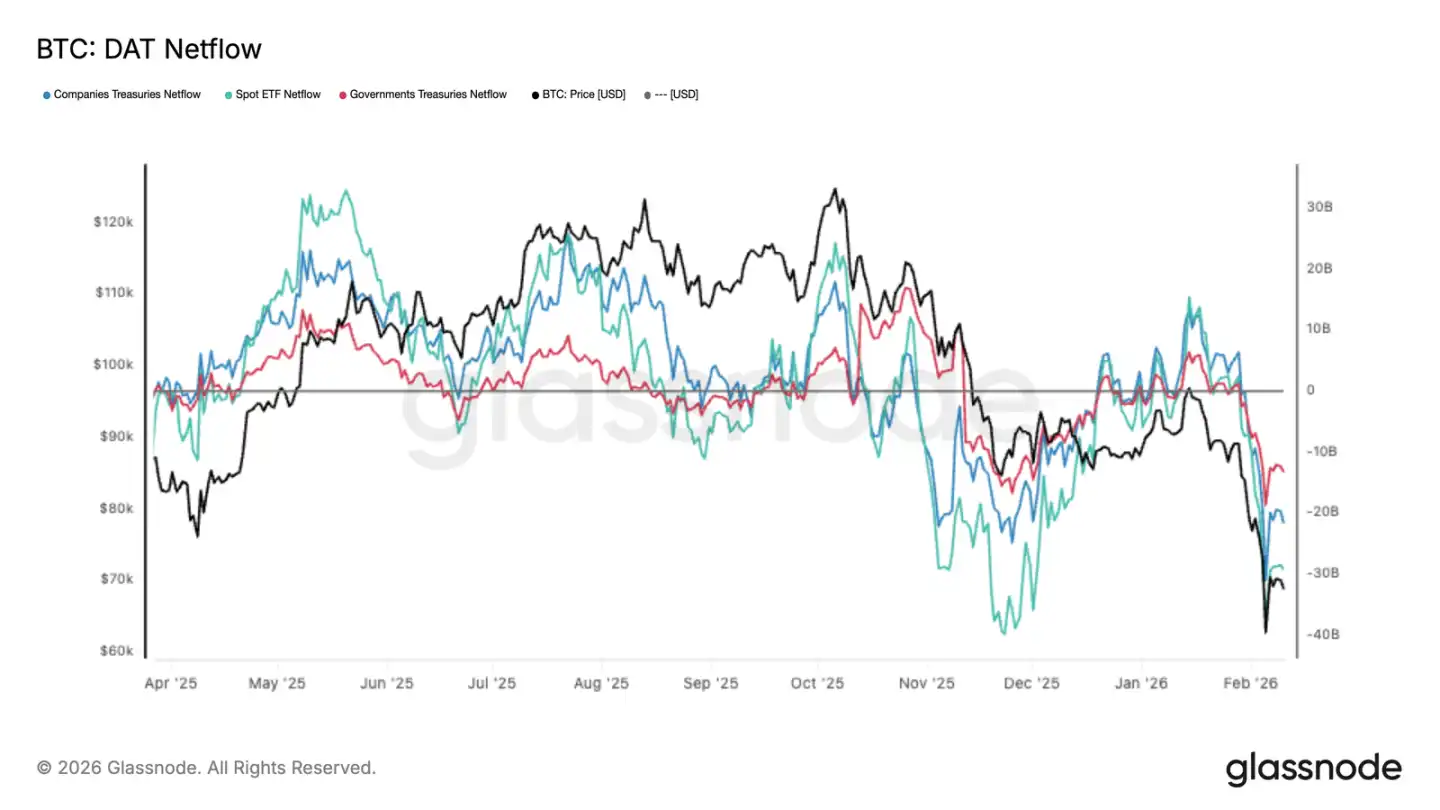
· Net outflows of digital asset holdings by various institutions are synchronized, indicating a broad risk-off behavior, with weak spot accumulation.
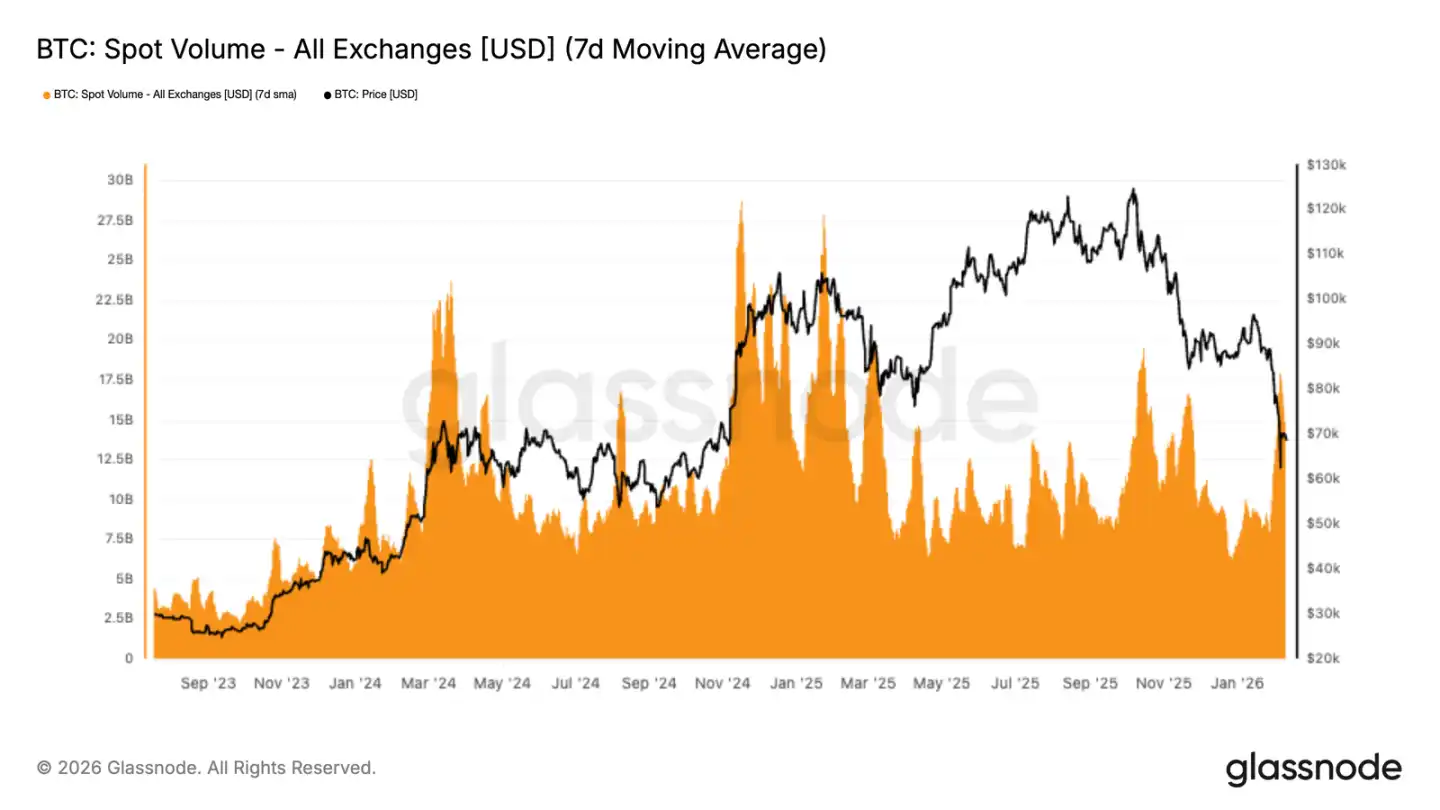
· Spot volume only expands on the downside before quickly tapering off, showing a passive response rather than active bottom-fishing.
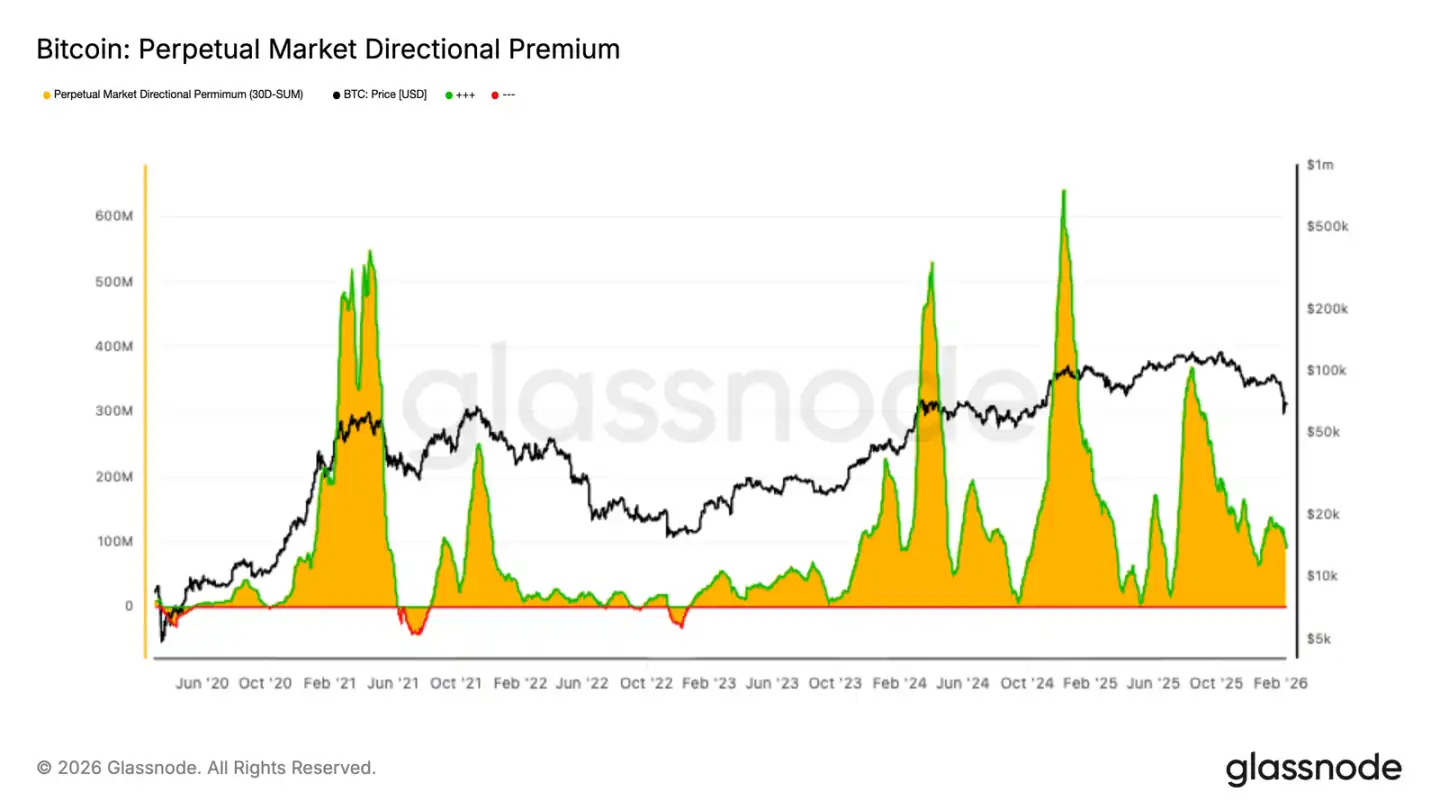
· Perpetual contracts have cooled off, with compressed premiums, leveraged players stepping back, and speculative sentiment receding.
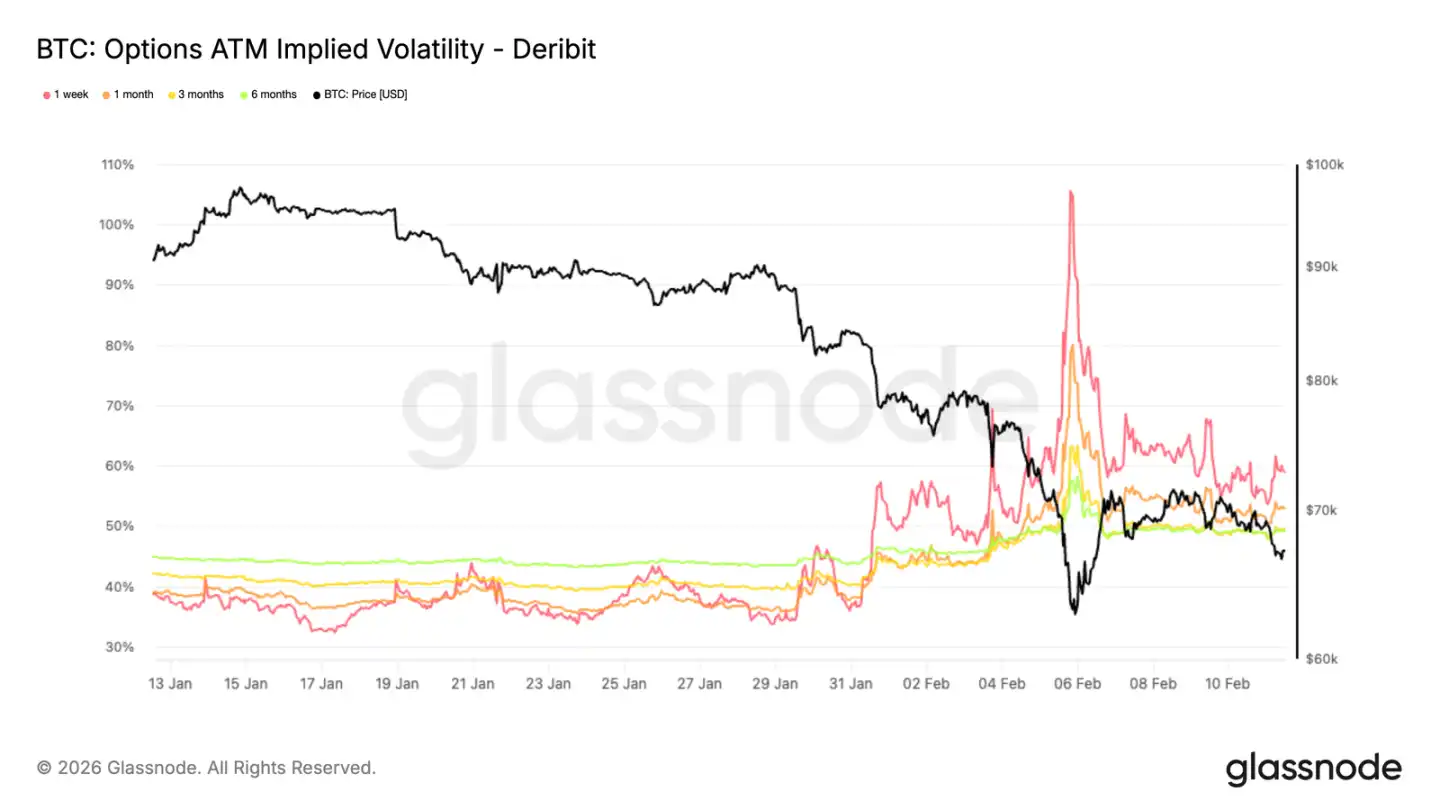
· Implied volatility indicates the market is still continuously seeking protection, maintaining a defensive posture.
· The option market's position structure makes price reversals easy and limits substantial movement, given the already tight liquidity.
On-Chain Insights
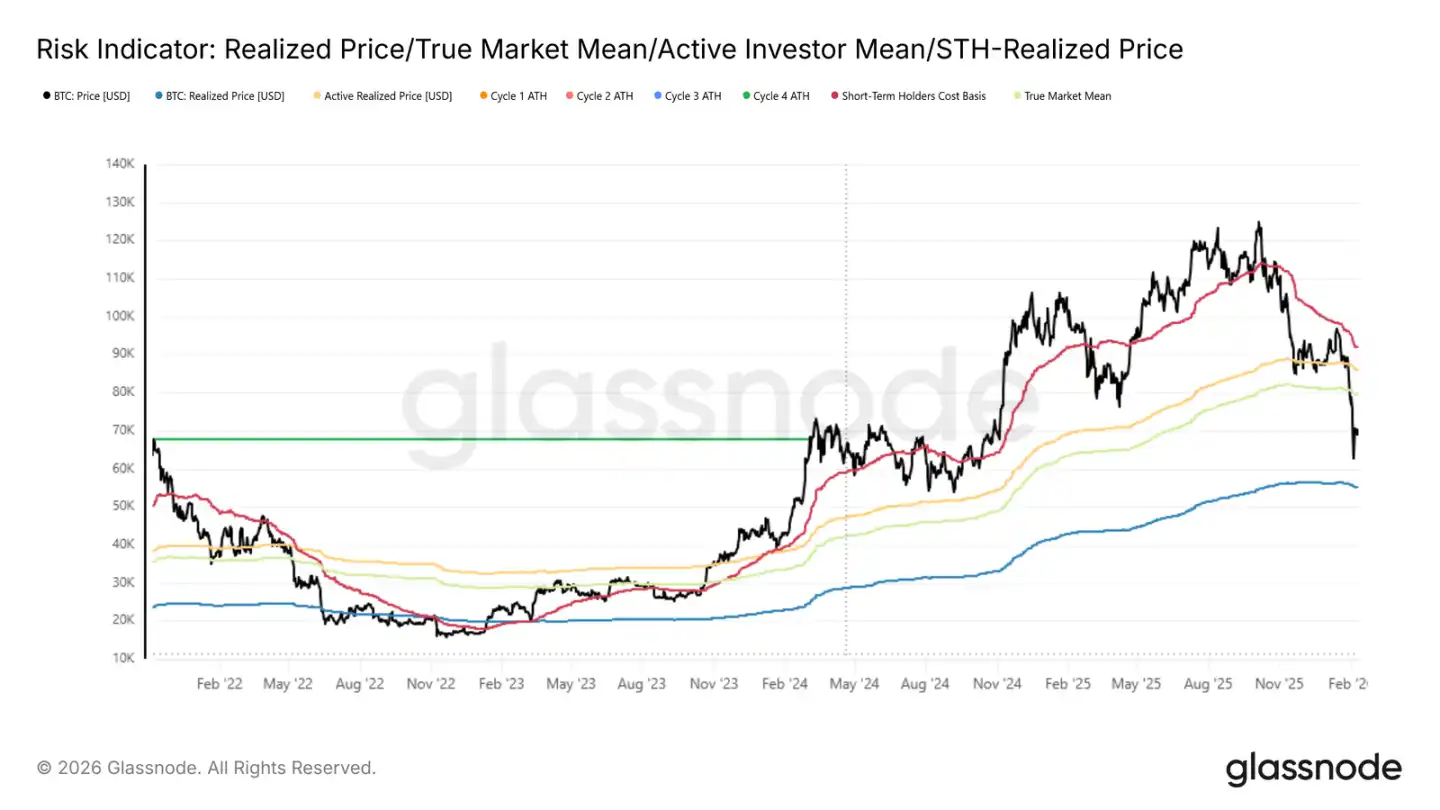
After reaching a new high in October last year, Bitcoin went through three phases: first a sharp drop, repeatedly testing the Realized Market Value; then a period of consolidation until the end of January this year; and most recently, the third phase—breaking below the Realized Market Value, accelerating towards $60,000.
New Trading Range
The upper bound of the third phase's range is the Realized Market Value at $79,200, and the lower bound is the Realized Price at $55,000, resembling the structure of the first half of 2022.
Similar to the second quarter of 2022, the price is likely to oscillate within this range, requiring time to grind, allowing new buyers to enter slowly and absorb supply.
In the short term, to break this situation, it either needs to be extremely strong—directly reclaiming the $79.2k real market value, and regaining strength, or extremely weak—experiencing an event on the level of LUNA or FTX, breaking through the $55k realized price. If neither extreme occurs, the most likely path for the market is to continue grinding within the range.
Range Support
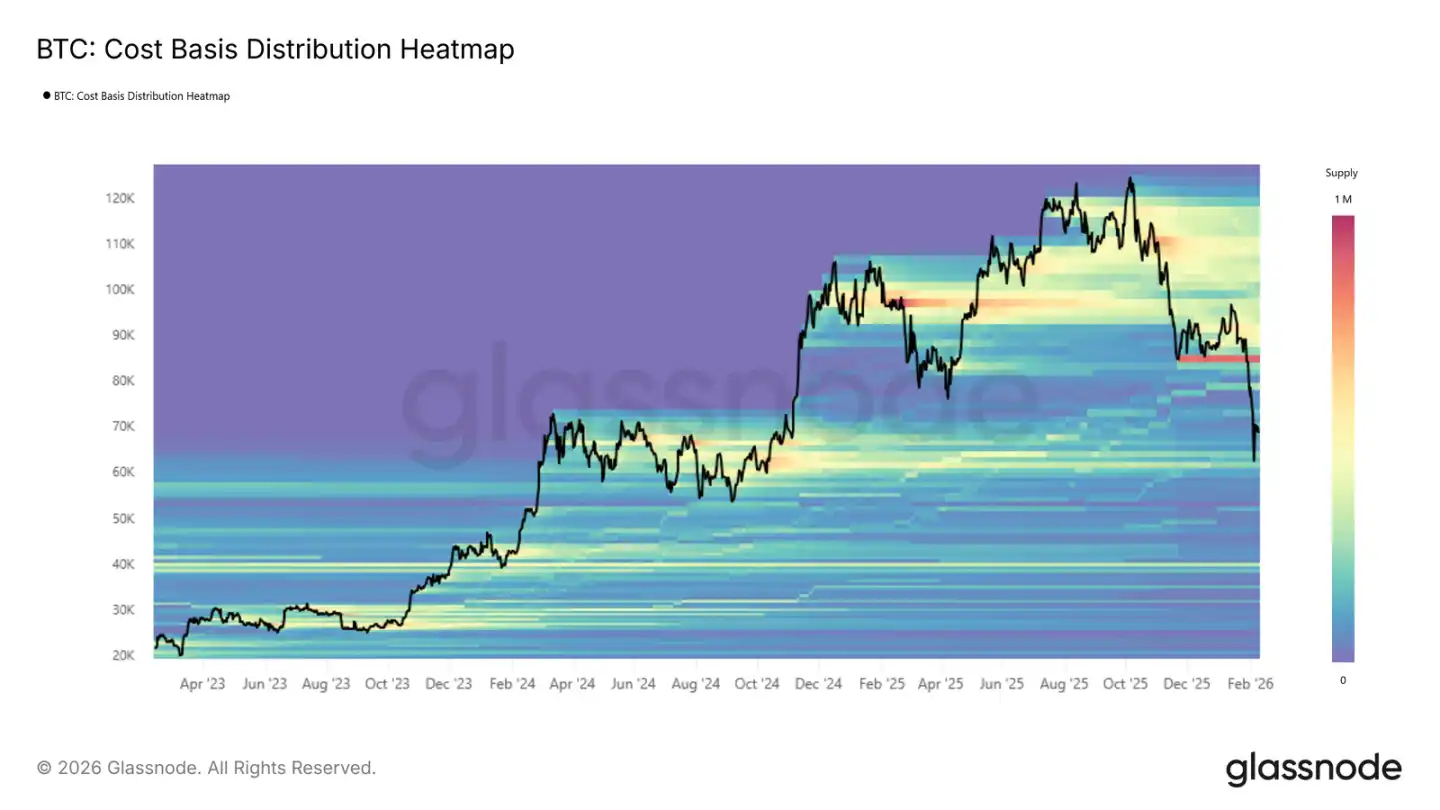
So far, the range between $60k and $72k is still holding off selling pressure. This range was a high-volume trading area in the first half of 2024, and by holding once again, it indicates that there are indeed buyers stepping in at this level.
The ideal scenario is that if this level can continue to attract buyers, similar to the previous strong accumulation phases, it could establish a solid base for the next uptrend.
However, this depends on whether the buying pressure is resolute enough. The $60k to $72k range, how much real money buyers are willing to put on the line will determine whether the market stabilizes or fails to hold and continues to decline.
Selling Pressure
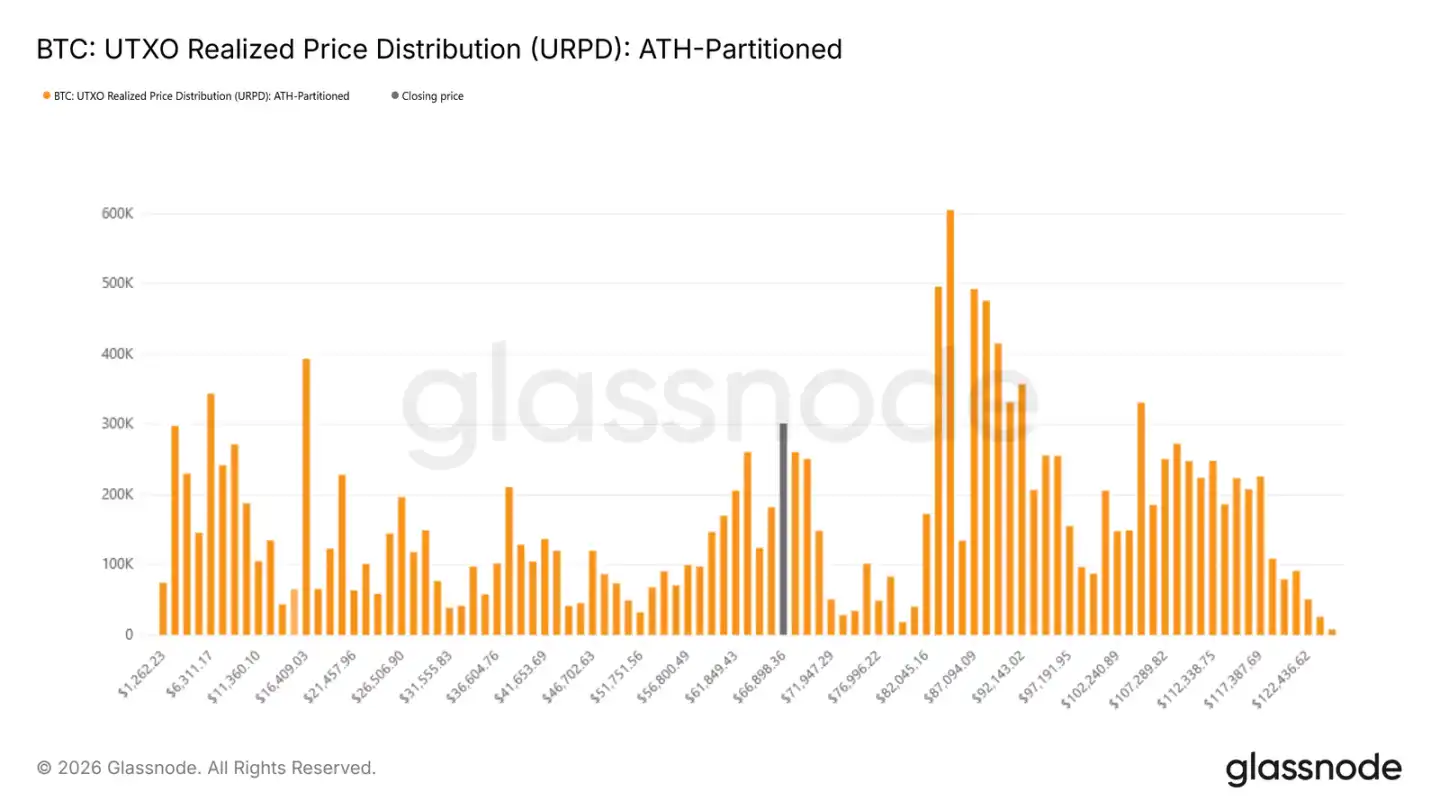
To determine if the $60k to $72k range is indeed strengthening, one can look at the cost distribution. The UTXO realized price distribution shows the concentration of chips at each price level. Currently, the dense area formed in the first half of 2024—the $60k to $72k range—is being supported, indicating that those who bought at that time have not exited at this level and are still holding.
However, there is still significant selling pressure. The $82k to $97k and $100k to $117k ranges have very dense trapped sellers. If the price remains stagnant for a long time or experiences another wave of decline, these individuals may not withstand the pressure and may sell off, creating new selling pressure.
Where Will the Bear Market Rebound Peak
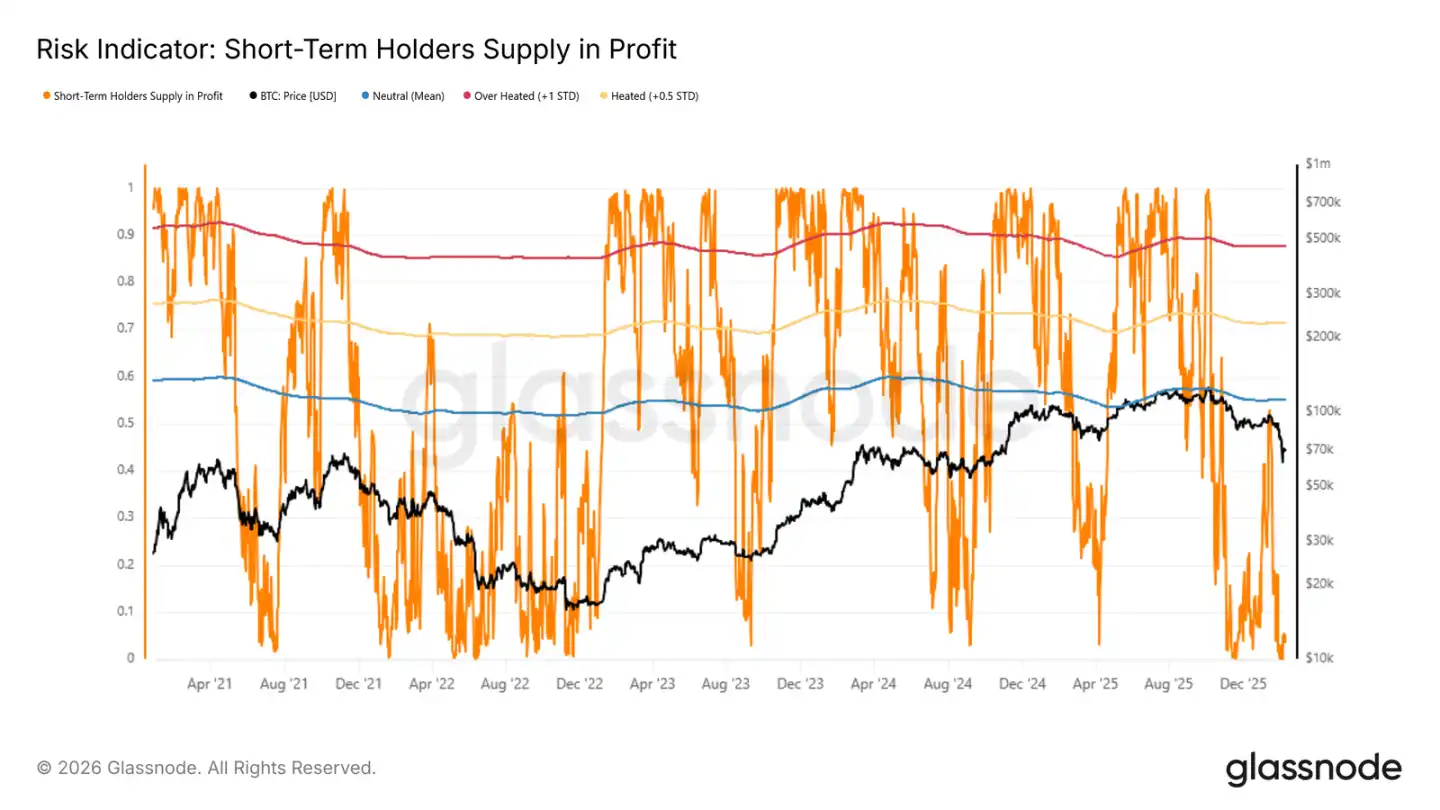
Since the market is likely to grind within the range, finding the interim top and bottom is crucial. In a bear market, rebounds are often seen as exit opportunities by those who recently bought in. Therefore, when these individuals start to realize significant gains, it often marks a local top.
The short-term holder profit ratio is a suitable metric to observe this. Historically, when the bear market rebound reaches the "mean to +0.5 standard deviation" range of this metric, it often struggles to rise further. Currently, this number is only 4.9%, indicating that the vast majority of recent market participants are still at a loss. Few are in profit, making it difficult to create downward pressure, but it also indicates a weak market with no fresh capital inflows, making it challenging for the rebound to extend.
Off-chain Insight
Institutional Funds Exiting
The outflow of digital asset funds has recently turned significantly negative, with ETFs, enterprises, and governments all experiencing net outflows, and Bitcoin hitting a new low. ETFs are the main contributors, with enterprises and governments also reducing their positions. This is not a case of individual fund rebalancing; rather, the institutional players across the entire market are downsizing.
The outflow volume is substantial, overwhelming the spot market. This is not a rotation of funds between different asset classes but a comprehensive derisking. Unless these outflows stabilize, the price will continue to face selling pressure. The extent of the potential decline will depend on when new buyers are willing to enter the market.
Low Spot Trading Volume
When the price dropped to the $70,000 range, there was a brief spike in spot trading volume, lifting the 7-day average. However, this volume came during a downturn, indicating a passive response from market participants rather than proactive bottom fishing. Furthermore, this volume quickly retracted, suggesting that people were watching but not buying.
This indicates that the buying pressure is not keeping pace with the selling pressure. The current trading volume does not represent accumulation but rather turnover and forced liquidations. Without sustained buying interest, the price is susceptible to further downside pressure. The current spot volume reflects a reactive response to panic, not a signal of stabilization.
Decline in Futures Premium
The premium of perpetual contracts has been pushed down, essentially returning to a neutral state. This indicates that leveraged players have backed off; unlike before, they are no longer aggressively pursuing both long and short positions. High premiums often signal a strong directional consensus, but the absence of a premium suggests a lack of market conviction.
The shrinking premium reflects a general lack of activity in the derivatives market, as risk appetite has diminished along with volatility. No one is opening short positions, and no one dares to chase long positions. Directional capital is thin. Derivatives no longer provide momentum, leaving the spot market on its own. The current futures market is sending a single message: caution, the game is over.
Implied Volatility — Changing Risk Pricing
Following this recent downturn, the volatility structure has significantly shifted. Looking at the 1-month at-the-money implied volatility makes this evident; the longer-term volatilities have been repriced: a 5-point increase in 6-month volatility and a 9-point increase in 3-month volatility.
The most notable jump is in the short-term, with 1-week implied volatility surging by over 20 points. Implied volatility represents the market's expectation of future price swings; such a significant surge is unlikely to be temporary. The entire term structure is undergoing a risk repricing.
Although the price has dropped somewhat, interest rates at all maturities remain high, indicating that the market believes uncertainty will persist and that it's not all clear after a drop.
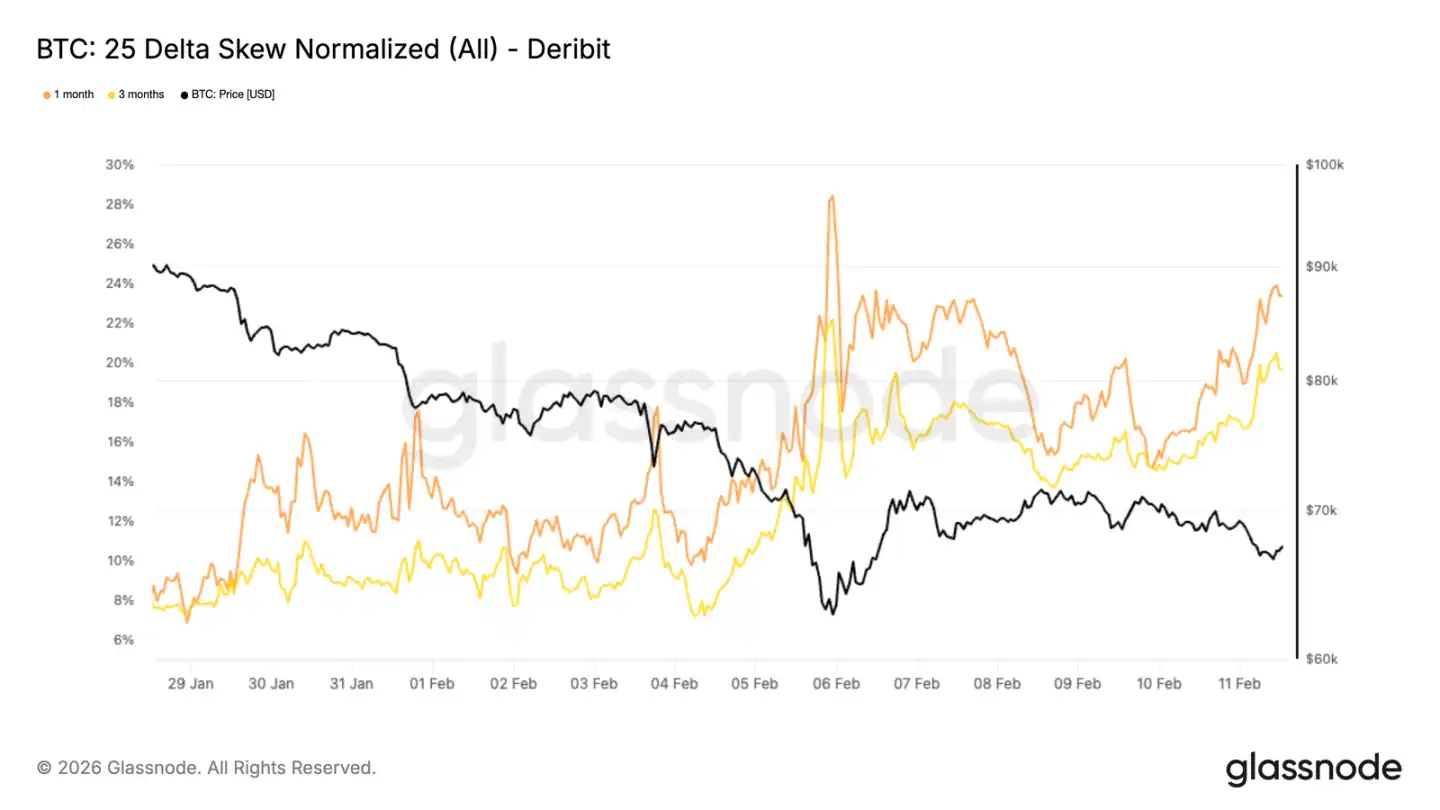
25 Delta Skewness Indicates Ongoing Downside Demand
The overall volatility has increased, but the direction of the money flow depends on the skewness. The 25 delta skewness for 1 month and 3 months plummeted in a straight line during those down days, all buying puts.
There was a rebound on Friday, but the put option premium is still very high, basically returning to the levels of those days when the market fell the most. The 25 delta skewness compares the implied volatility of out-of-the-money puts and calls, with a negative value indicating that puts are more expensive than calls, and everyone is more willing to buy protection. Around January 28, the 1-month and 3-month skewness was approximately an 8% put premium, which has now increased to 23% and 19%.
The entire curve still tilts towards puts, and despite the rebound, the fear has not dissipated.
Market Maker Gamma — Price Rebound
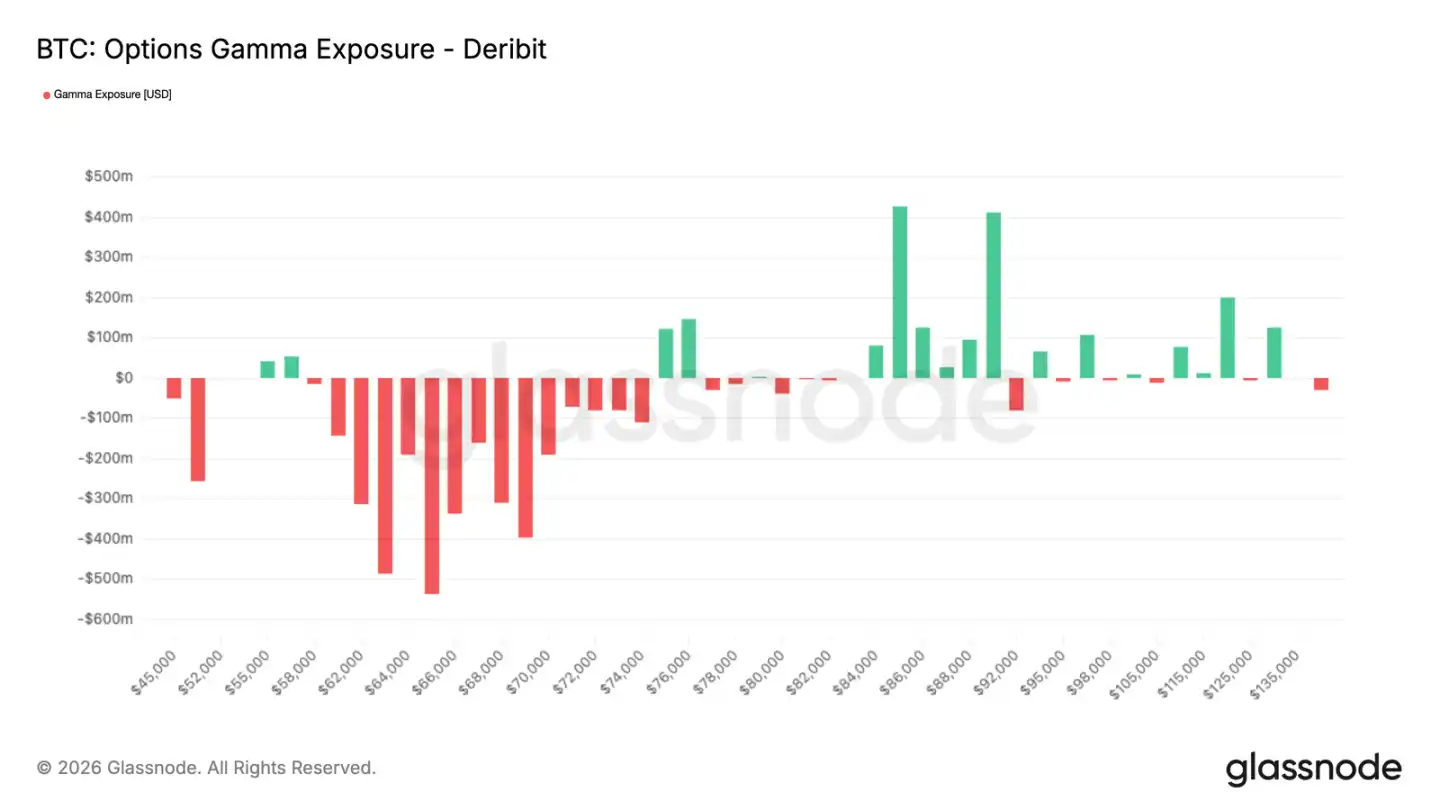
This defensive options flow leaves a mark on the market maker's position. When the market maker is short gamma, they need to buy on the rise and sell on the fall, amplifying volatility with more volatility, rather than dampening it.
The previous wave of heavy put buying has left the market maker's structure unable to recover. Although there have been several days of rebound, this sensitivity has not been eliminated. As a result, the market is very fragile, with hedging orders likely to accelerate in both directions, but the probability of a downward move is higher.
Open Interest Heatmap Shows Extensive Hedging
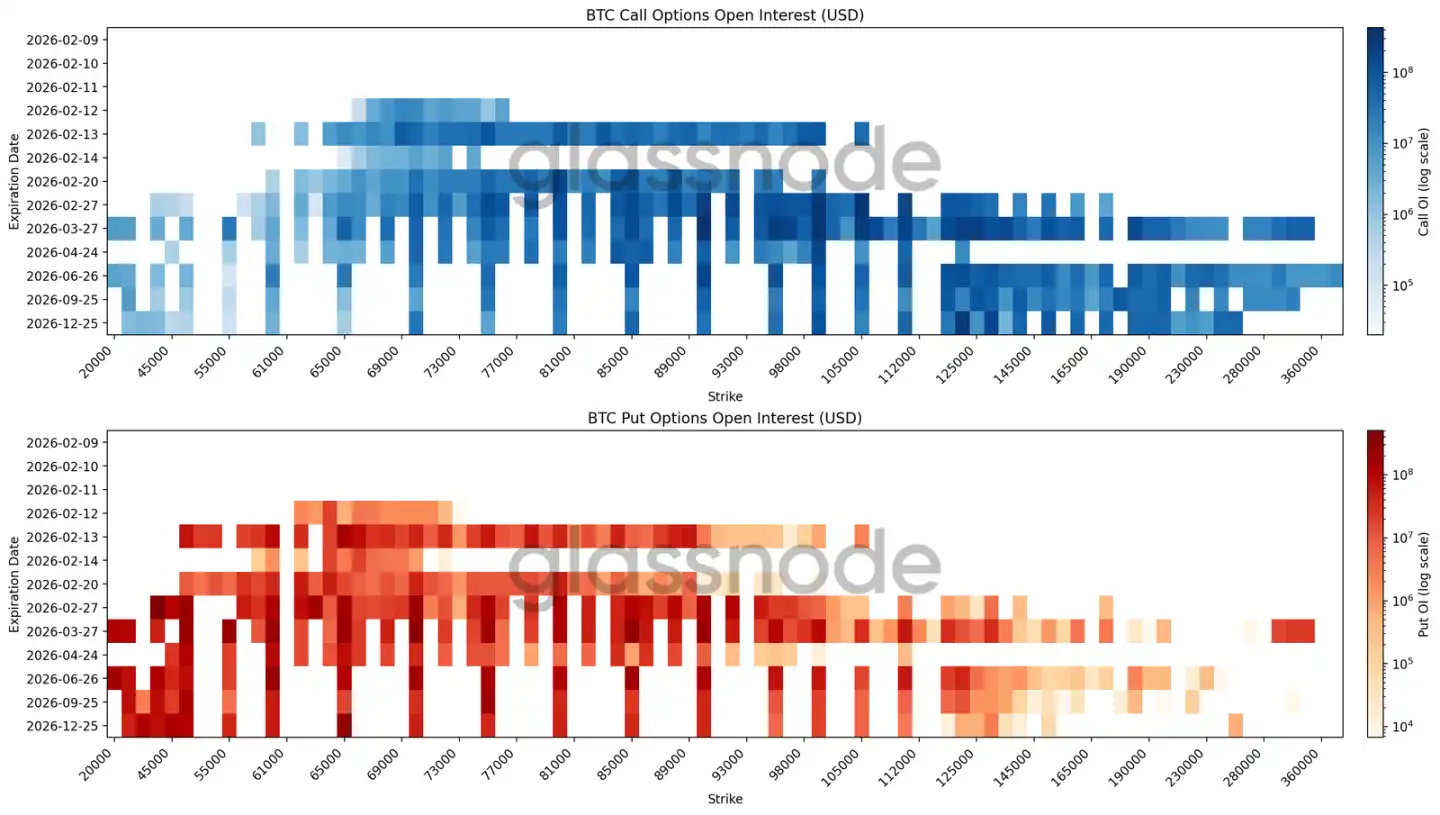
The latest heatmap overlays BTC options open interest for various strike prices and expiry dates, making it easy to see where the money is concentrated and where there may be pricing pressure.
For the February expiry, the largest buy orders are between 60,000 and 70,000. Looking further out, towards the end of the year and longer-dated contracts, there is abundant buying interest between 50,000 and 30,000.
This is not an anticipation of an event at a specific time but a strategy to hedge against multiple periods of decline. It's not a precise bet on a specific price level but rather spreading coverage across a range, a classic range hedge. Call open interest is concentrated above 120,000 for the second half of the year. The money betting on a short-term rise is cashing out, while those anticipating a long-term decline are holding it as tail risk, and this deep negative skewness is how it comes about.
The entire position structure is defensive, not playing for a reversal.
Conclusion
Bitcoin is still within a defensive structure, with the price sandwiched between several key cost levels, and the crucial support area is being repeatedly tested. The range of $60k to $72k is still facing selling pressure, but there is heavy overhead resistance, with short-term holders in loss and weak confidence. In this scenario, any rebound is easily pushed back, and to stabilize, continuous buying pressure is needed.
The on-chain data also confirms this cautious assessment. Institutions are withdrawing, spot transactions are passive, not actively absorbing liquidity. On the derivatives side, speculative sentiment has cooled down, hedging is still occurring, and the structure of market makers is keeping the price highly volatile and making it difficult to establish direction.
Overall, the market is in a balanced period under pressure. Liquidity is thin, participation is scattered, and the position structure is leaning defensive. To see a turnaround, either spot buying pressure needs to increase, or risk appetite needs to return. Until then, the volatility will continue to be driven by short-term position trading, not by a trend.
You may also like

Morning Report | BitMine increased its holdings by 126,971 ETH last week; trader Eugene announced his exit from the crypto market

Wang Chuan: How can one not feel anxious after the neighbor Old Wang made thirty times profit by investing in storage stocks? (Seven) - A quarter-century cycle

Cryptocurrency CEXs are flocking to sell US stocks, and traditional brokerages are facing an "uninvited guest."

$75 billion in foreign capital has fled, and South Korean retail investors have absorbed it all using leverage

Japan’s Three Megabanks Plan Joint Stablecoin Issuance in Fiscal 2026
MUFG, SMBC, and Mizuho reportedly plan to jointly issue fiat-pegged stablecoins in fiscal 2026, signaling Japan’s growing push into bank-led digital payment infrastructure.

Humanity Discloses H Token Dual-Chain Attack Details, With Losses on Ethereum and BSC Exceeding $36 Million
Humanity said the H token attack across Ethereum and BSC caused more than $36 million in losses after leaked ProxyAdmin keys enabled malicious contract upgrades and token minting.
White House Discusses CLARITY Act With Law Enforcement Ahead of Senate Vote
The White House discussed the CLARITY Act with law enforcement ahead of a Senate vote, focusing on illicit finance risks and developer protections.

Bitcoin Trading Guide 2026: Strategies for Experienced Traders

What Is XAUT and PAXG? Why Tokenized Gold Is Booming in 2026

Will the SpaceX IPO Hurt Bitcoin? Here's What Traders Are Watching

Foreign selling in the South Korean stock market accelerates, with cumulative net sales reportedly reaching $75 billion this year
On June 9, The Kobeissi Letter, citing Goldman Sachs data, reported that global investors are selling South Korean stocks at an unusually rapid pace. In the latest trading session, foreign investors sold about $801 million worth of Kospi constituent stocks again; total foreign outflows last week reached about $10 billion, and the market has been in net foreign selling on nearly every trading day over the past month. According to the data cited in the report, foreign investors have sold about $75 billion worth of South Korean stocks so far this year. Meanwhile, South Korean retail and institutional investors together recorded roughly $69 billion in net buying over the same period, suggesting that the market’s main buying support has come from domestic capital rather than returning overseas funds. The information currently disclosed still mainly comes from The Kobeissi Letter’s retelling and Goldman Sachs data summaries, while public details on the statistical period and the specific definition of “selling” remain relatively limited.

Fortune Warns of Strategy’s Financing Structure Risks as Bitcoin Premium Narrows
Fortune warned that Strategy’s Bitcoin treasury model faces growing financing risks as MSTR’s net asset premium narrows and preferred stock dividend pressure increases.

Ferrari Challenge Le Mans: Carl Moon to Dominate in WEEX Livery

Sahara AI Responds to SAHARA’s Sharp Drop: No Contract or Product Security Issues Found, Internal Investigation Underway
Sahara AI responded to SAHARA’s 60% price drop, saying no token contract or product security issues have been found and an internal investigation is underway.

WEEX Deposit/Withdrawal Dynamic Island: Your Asset Status, Always in Sight
Scaling Crypto Derivatives: The Digital Asset Infrastructure Behind High-Volume Trading
In the fast-moving digital asset ecosystem, derivatives platforms face an extreme architectural test. High-leverage futures markets demand more than just standard security—they require absolute operational precision, zero-latency matching engines, and ironclad structural scalability, all while navigating intense market volatility.
As global platforms scale to meet these demands, the industry is shifting away from rigid, monolithic setups toward a more agile, "decoupled" infrastructure philosophy.
The Blueprint for High-Volume Copy TradingFor elite global exchanges like WEEX (founded in 2018), this architectural choice becomes critical when scaling high-volume retail features like social copy trading. When thousands of users automatically mirror the real-time strategies of elite traders simultaneously, it triggers sudden, monumental spikes in concurrent transactional volume.
To prevent execution latency or settlement bottlenecks during these peak volatility events, a platform's primary engine must remain entirely dedicated to risk management, copy-trade synchronization, and order matching.
The Architectural Rule: New-generation platforms must separate front-end user execution engines from heavy backend infrastructural overhead to eliminate operational friction.
By separating these layers, platforms can maintain complete sovereignty over their trading environments and user experiences while strategically aligning with institutional-grade infrastructure ecosystems. This strategic framework allows modern exchanges to leverage advanced Digital Asset Custody infrastructure such as Cobo’s behind the scenes, ensuring that backend wallet management scales elastically alongside trading spikes.
Capitalizing on Market Momentum and 400× LeverageIn a derivatives arena where platforms offer up to 400× leverage on perpetual contracts, capital efficiency and market agility are core business metrics. To capture market momentum, an exchange needs the ability to rapidly expand its asset offerings, supporting everything from legacy crypto assets to sudden, trending altcoins across a massive library of trading pairs.
Adopting a flexible, scalable Wallet-as-a-Service (WaaS) solution such as Cobo’s could completely rewrite the development timeline for high-growth exchanges. Instead of spending months of engineering capital building out custom backend wallet architectures for every new blockchain network, platforms can deploy localized infrastructure in days.
This agility allows platforms to instantly scale their listings to over a thousand trading pairs without compromising security or delaying time-to-market. It mirrors the exact operational advantages seen during high-velocity market events, similar to how advanced wallet infrastructure empowers platforms during sudden asset surges; allowing exchanges to pass that speed and liquidity directly to their global user base.
A Mature Foundation for GrowthThe synergy between trusted infrastructure ecosystems and global trading platforms represents the natural evolution of a maturing crypto market. As WEEX continues to scale its global spot and derivatives offerings for over 6 million users, adopting robust backend paradigms proves that platforms no longer have to compromise between cutting-edge trading velocity and uncompromised structural security.

Get Paid to Onboard? Try WEEX’s New Homepage with Rewards for Registration, Deposit & Trade
WEEX Custom Layout: Build Your Perfect Trading Workspace in Seconds
Morning Report | BitMine increased its holdings by 126,971 ETH last week; trader Eugene announced his exit from the crypto market
Wang Chuan: How can one not feel anxious after the neighbor Old Wang made thirty times profit by investing in storage stocks? (Seven) - A quarter-century cycle
Cryptocurrency CEXs are flocking to sell US stocks, and traditional brokerages are facing an "uninvited guest."
$75 billion in foreign capital has fled, and South Korean retail investors have absorbed it all using leverage
Japan’s Three Megabanks Plan Joint Stablecoin Issuance in Fiscal 2026
MUFG, SMBC, and Mizuho reportedly plan to jointly issue fiat-pegged stablecoins in fiscal 2026, signaling Japan’s growing push into bank-led digital payment infrastructure.
Humanity Discloses H Token Dual-Chain Attack Details, With Losses on Ethereum and BSC Exceeding $36 Million
Humanity said the H token attack across Ethereum and BSC caused more than $36 million in losses after leaked ProxyAdmin keys enabled malicious contract upgrades and token minting.


