
 Buy Crypto
- Markets
 Futures
- Spot
- Copy Trade
- Earn
- More
Global Assets Plunge: Hormuz, Chips, and a South Korean Holiday


On February 28, the US-Israel coalition launched the "Epic Wrath" operation against Iran, conducting airstrikes on over 2000 targets, resulting in the death of Supreme Leader Khamenei.
This was the largest geopolitical event in the Middle East in decades.
The global capital waited for an entire weekend to validate one question: Is the two-year narrative accurate? Is gold a safe haven asset in times of turmoil? Is Bitcoin digital gold? Is the debasement trade a valid concept or a narrative bubble?
The results are in.
Gold first surged to $5400, then plummeted over 4% along with stocks. Silver experienced an 8% single-day crash. Bitcoin initially dipped, then fluctuated, eventually returning to its initial position. The US Dollar Index rose by 1.1%.

Narrative Stress Test
Over the past two years, the crypto and macro circles have embraced an almost flawless narrative: US debt spiral, long-term depreciation of the US dollar, gold and BTC as hard assets hedging against currency dilution, collectively known as the "debasement trade." By 2025, the empirical support for this narrative seemed incredibly robust—gold surged over 50% for the year, BTC reached a peak of $126,000, the US Dollar Index plummeted by nearly 11%, marking its worst first-half performance in 50 years. Citadel's Ken Griffin repeatedly mentioned this concept in public, and BlackRock's BTC ETF's AUM approached a billion dollars.
The most fundamental underlying assumption of this narrative is: when a real crisis hits, people will abandon the US dollar and flock to hard assets.
Last weekend, this assumption faced its first real stress test.
At Monday's opening, gold indeed initially rose—touching a high of $5418 in London Gold Fix, nearly matching the late-January all-time high. However, as oil prices continued to soar, inflation expectations reignited, and the market began to reprice the Fed's rate cut path, everything reversed. Gold closed lower that day, further plummeting over 4% on Tuesday, returning to the lows seen since February 20.
Silver fared even worse. Breaking through $96 on Monday, it suffered a single-day drop of nearly 8% on Tuesday.
The reasons are not complex. Soaring oil prices imply rising inflation expectations, which in turn signal a narrowing room for Fed rate cuts. The shrinking rate cut expectations indicate dollar strength, posing a direct challenge to gold and silver. Additionally, the synchronized risk asset selloff triggered forced liquidation, turning gold and silver into the most liquid and easily sellable positions at the time they were "supposed to rise the most."
This is not the first time. In 2022, the Russia-Ukraine war broke out, and BTC did not serve as a safe haven, following the Nasdaq in a downward spiral; gold initially rose, only to be slammed down by profit-taking—same script, higher intensity.
BTC found itself in a more awkward position. As the war started over that weekend, the crypto market was the only market still trading. BTC first dropped below $66,000, then quickly rebounded, almost filling the gap before the traditional markets opened on Monday. On the surface, this showed "resilience." But the truth is: institutional funds had not entered yet; it relied on retail investors and arbitrageurs searching for direction amid the volatility. As the whole market continued to decline on Tuesday, BTC came under pressure again, hovering around $68,000, failing to show the expected rise of the "digital gold" or the significant drop typical of a "risk asset"—it was just... there, wavering.
Hormuz, Chips, and a Korean Holiday
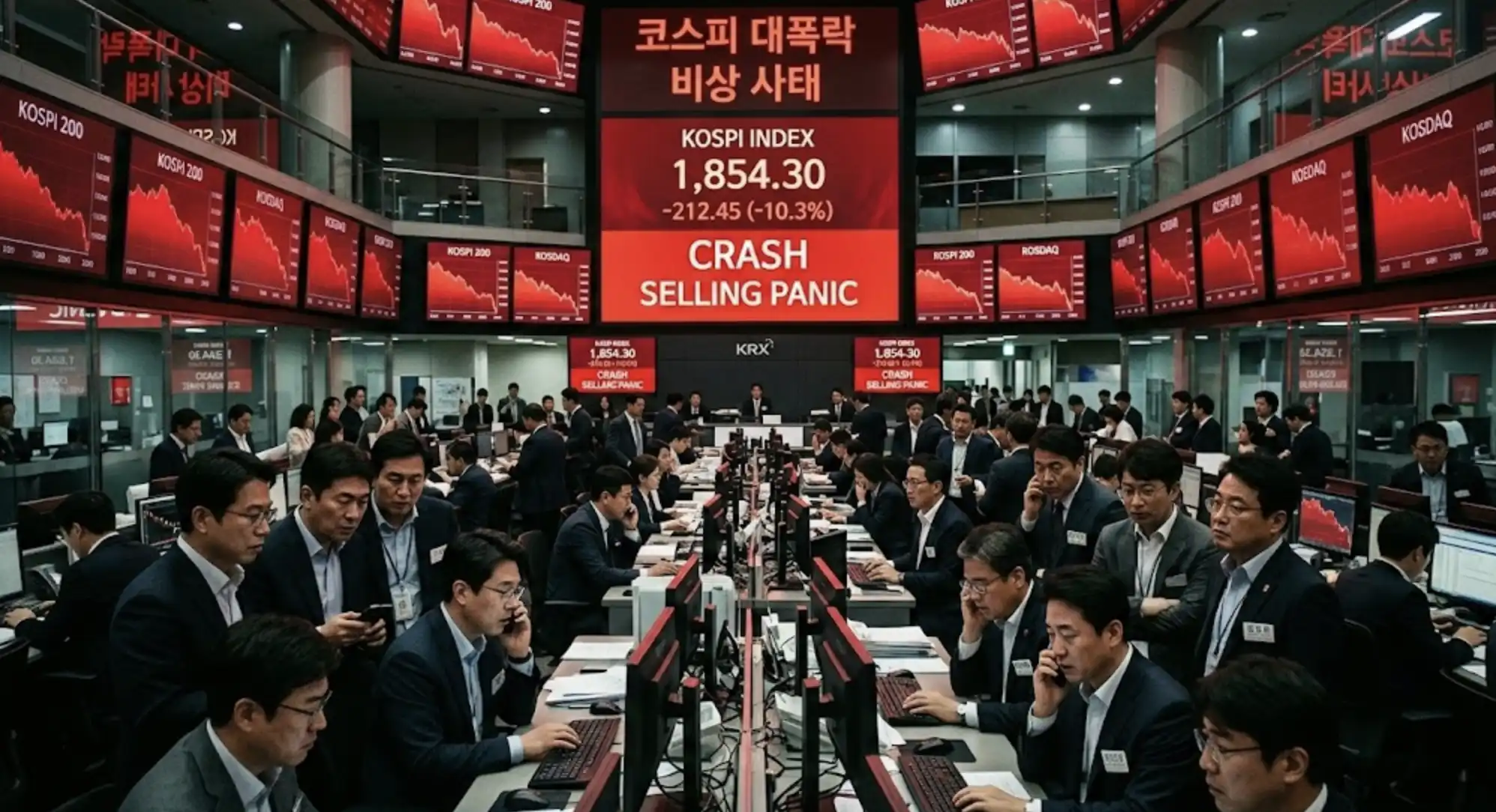
The stampede in Seoul was particularly fierce for a structural reason: Monday was a public holiday in South Korea, with exchanges closed.
Panic had been building over the weekend with no way out. By 9 a.m. on Tuesday, all the unsold positions from the three-day holiday were liquidated in the same second. The KOSPI opened triggering a circuit breaker, ultimately closing down 7.24%, wiping out approximately 377 trillion KRW in market value, equivalent to around $257 billion USD.
This was the largest single-day drop since the August 2024 yen carry trade crisis. Back then, the KOSPI plummeted by 8.77% in a single day, triggered by a collapse in U.S. nonfarm data combined with a surprise rate hike by the Bank of Japan, constituting a financial leverage-level systemic unwind. This time, the direct catalyst was geopolitical—but there was still a taut string behind it, just made of a different material.
Over the past year and a half, Korean retail investors had experienced an epic FOMO phase. From the end of 2024 when the KOSPI was at 2400 points, it surged to over 6000 points by the end of February this year, representing a nearly 150% increase over 14 months. Some brokerages set their target prices at 7000, even 8000. The number of new accounts opened exceeded 100 million in January this year—in a country with a population of 50 million, there were 100 million stock accounts. The Korean government even included "KOSPI 5000" in its policy agenda as a national policy goal.
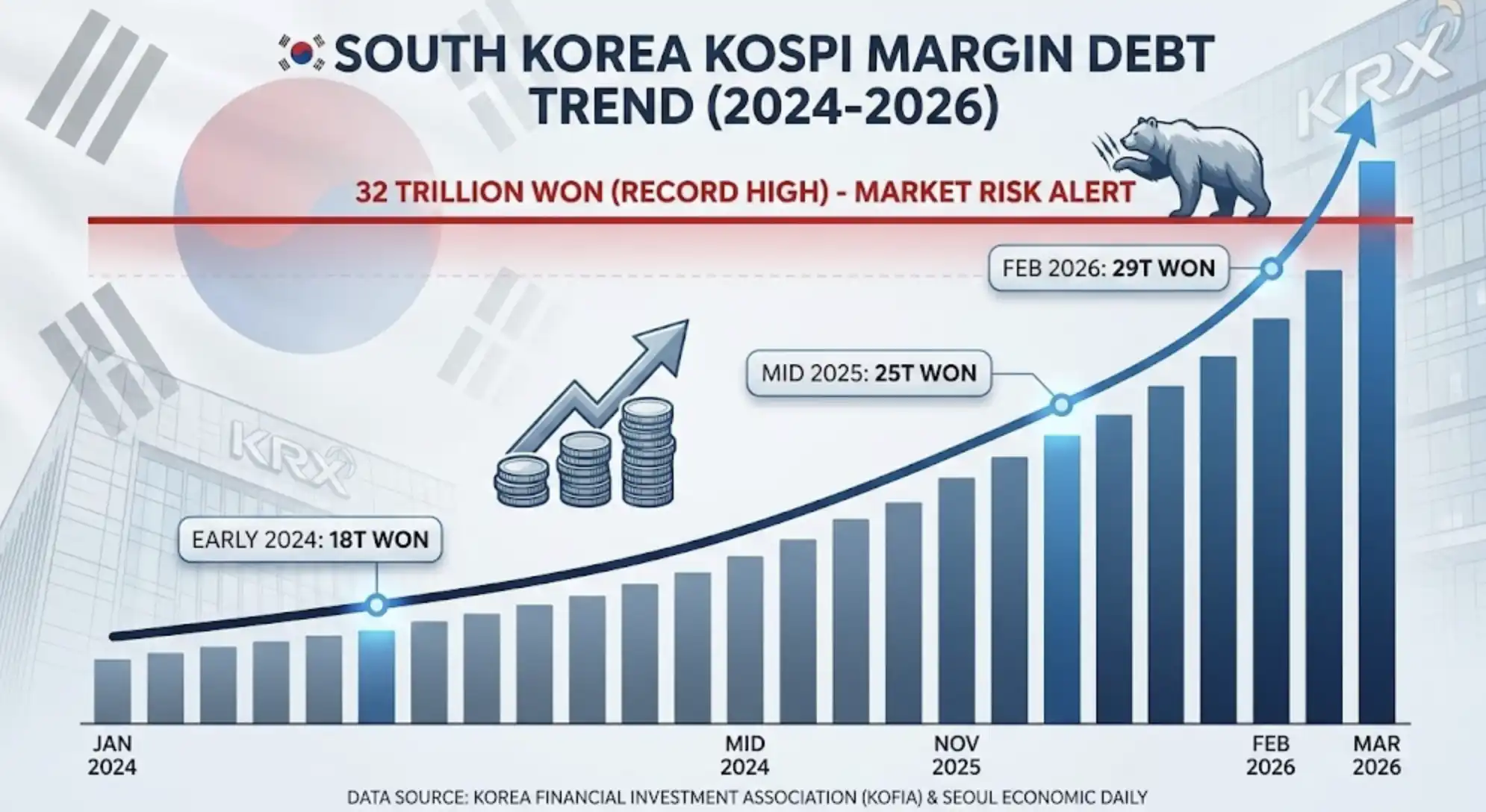
Simultaneously, the outstanding balance of margin loans had also been expanding. As of before the incident, the on-exchange margin loan balance in Korea exceeded 32 trillion KRW, about $224 billion USD, reaching its highest level since 2021. Stock pledge loan balance stood at another 26 trillion KRW, totaling nearly $37 billion USD. The market's fear index, VKOSPI, had skyrocketed to 54 by the end of February, more than twice the "normal" level—while the entire market was hitting new highs, the fear gauge had already entered the extreme fear zone.
This structure, when faced with acute shock, experiences a textbook-style liquidity squeeze.
A stock price decline triggers a margin call, leading brokerage firms to initiate forced liquidation. The liquidation further depresses the stock price, triggering more margin calls—a self-reinforcing feedback loop. Foreign investors net sold over 51.7 trillion Korean won, approximately 5 billion U.S. dollars, on that day, marking the largest single-day net sale this year. On the contrary, individual investors did the opposite: they bottom-fished amidst the turmoil, continued to leverage up on ETFs, wagering on a rebound.
Other Asian markets were simultaneously under pressure. The Nikkei 225 fell by 3% that day, with Toyota down 5.5% and Sony down 4.3%. The Hang Seng in Hong Kong dropped by 2.1%, leading the declines in the Asia-Pacific region. The Stock Exchange of Thailand announced a temporary short-selling halt for most securities. The entire Asia-Pacific MSCI index fell by around 2%.
But the most crucial structural vulnerability lies in Seoul.
What plummeted in this decline wasn't just stocks. It was the KOSPI, a market that has been repeatedly narrated as the "best proxy target for the AI supercycle." Samsung Electronics fell by nearly 10%, breaching a key psychological support level of 200,000 Korean won. SK Hynix fell by 11.5%. These two companies collectively account for about 40% of the KOSPI's market value and are the two most critical nodes in the global AI chip supply chain—Samsung is the world's largest DRAM and NAND flash memory manufacturer, while SK Hynix is a core supplier of HBM high-bandwidth memory, from which the memory used in NVIDIA AI GPUs largely originates.
All these factories are in South Korea. South Korea imports 2.76 million barrels of oil per day, mostly from the Persian Gulf, through the Strait of Hormuz.
Iran announced the closure of the Strait of Hormuz, only to retract that statement. However, insurance companies have unilaterally voted: war risk insurance is suspended, and shipping companies have halted dispatch. An unofficially declared blockade is effectively underway.
Just as the market was in turmoil, another piece of news quietly surfaced: Samsung's U.S. chip factory in Taylor, Texas, has once again postponed its mass production timeline, extending it from 2026 to 2027. This facility, considered a core asset of the U.S. "chip reshoring" strategy, is located in the Texas desert—but the oil it needs still comes from the Persian Gulf.
The Dollar Won, Everyone Lost
Now, here comes the most uncomfortable conclusion.
Throughout the entire cycle, "de-dollarization" has been one of the most mainstream macro narratives. The global reserve currency share of the US dollar has fallen below 47%, central banks around the world have been increasing their gold reserves at a record pace, BRICS has built the mBridge cross-border settlement platform, and the scale of on-chain stablecoins has expanded from over $2.05 trillion to over $3 trillion. Almost everyone in the industry is betting in some way: the golden age of the US dollar is over, and the next era belongs to multipolarity, hard assets, and decentralization.
Then war breaks out, and the US Dollar Index rises by 1.1%, marking the largest single-day gain since May of last year.
On this day, it's a synchronized sell-off across the board: stocks fall, bonds fall, gold falls, silver falls, commodities fall. The flow is only moving in one direction: towards the US dollar.
This is the essence of a liquidity squeeze. It's not because the US dollar has become better, but because the US dollar is the most liquid asset in the global financial system. In times of acute crisis, when everyone needs to head for the exit at the same time, the US dollar is the widest door. Leveraged unwinds need dollars, margin calls need dollars, and the first step of cross-border asset flight is also the US dollar. No other option has this kind of scale.
Iran provided the clearest underline to this logic.
The Iranian rial has depreciated by over 30% since the beginning of the year. Nobitex, Iran's largest cryptocurrency exchange, processes over 87% of Iran's on-chain crypto activity. Within minutes of the airstrikes starting, Nobitex's withdrawal volume surged by 700% (Elliptic data). Chainalysis tracked the fund outflows: a large amount of money flowed out, eventually landing at overseas exchanges historically known to accept inflows from Iran, continuing to convert into USDT and USDC.
At the scene of a real currency crisis, what people do on the crypto networks is flee into the US dollar.
This is not to say the debasement trade is a false proposition. The US's debt issues, inflation problems, and the long-term erosion of the US dollar's purchasing power are real structural pressures. The logic of gold outperforming in the long run has not been overturned by this stress test.
But this time tells us one thing: the debasement trade is a slow variable narrative that requires the scale of time to materialize. While geopolitical shocks are sudden variables that only have one scale — today.
Two sets of time frames placed in the same moment, the slow variable gives way.
The US dollar has won. In the next crisis, the US dollar will most likely win again. Until one day, it doesn't — but that day is unlikely to be as theatrically staged as today.

You may also like

Why can this institution still grow by 150% when the scale of leading crypto VCs has shrunk significantly?

Anthropic's $1 trillion, compared to DeepSeek's $100 billion

Geopolitical Risk Persists, Is Bitcoin Becoming a Key Barometer?

Annualized 11.5%, Wall Street Buzzing: Is MicroStrategy's STRC Bitcoin's Savior or Destroyer?

An Obscure Open Source AI Tool Alerted on Kelp DAO's $292 million Bug 12 Days Ago

Mixin has launched USTD-margined perpetual contracts, bringing derivative trading into the chat scene.
The privacy-focused crypto wallet Mixin announced today the launch of its U-based perpetual contract (a derivative priced in USDT). Unlike traditional exchanges, Mixin has taken a new approach by "liberating" derivative trading from isolated matching engines and embedding it into the instant messaging environment.
Users can directly open positions within the app with leverage of up to 200x, while sharing positions, discussing strategies, and copy trading within private communities. Trading, social interaction, and asset management are integrated into the same interface.
Based on its non-custodial architecture, Mixin has eliminated friction from the traditional onboarding process, allowing users to participate in perpetual contract trading without identity verification.
The trading process has been streamlined into five steps:
· Choose the trading asset
· Select long or short
· Input position size and leverage
· Confirm order details
· Confirm and open the position
The interface provides real-time visualization of price, position, and profit and loss (PnL), allowing users to complete trades without switching between multiple modules.
Mixin has directly integrated social features into the derivative trading environment. Users can create private trading communities and interact around real-time positions:
· End-to-end encrypted private groups supporting up to 1024 members
· End-to-end encrypted voice communication
· One-click position sharing
· One-click trade copying
On the execution side, Mixin aggregates liquidity from multiple sources and accesses decentralized protocol and external market liquidity through a unified trading interface.
By combining social interaction with trade execution, Mixin enables users to collaborate, share, and execute trading strategies instantly within the same environment.
Mixin has also introduced a referral incentive system based on trading behavior:
· Users can join with an invite code
· Up to 60% of trading fees as referral rewards
· Incentive mechanism designed for long-term, sustainable earnings
This model aims to drive user-driven network expansion and organic growth.
Mixin's derivative transactions are built on top of its existing self-custody wallet infrastructure, with core features including:
· Separation of transaction account and asset storage
· User full control over assets
· Platform does not custody user funds
· Built-in privacy mechanisms to reduce data exposure
The system aims to strike a balance between transaction efficiency, asset security, and privacy protection.
Against the background of perpetual contracts becoming a mainstream trading tool, Mixin is exploring a different development direction by lowering barriers, enhancing social and privacy attributes.
The platform does not only view transactions as execution actions but positions them as a networked activity: transactions have social attributes, strategies can be shared, and relationships between individuals also become part of the financial system.
Mixin's design is based on a user-initiated, user-controlled model. The platform neither custodies assets nor executes transactions on behalf of users.
This model aligns with a statement issued by the U.S. Securities and Exchange Commission (SEC) on April 13, 2026, titled "Staff Statement on Whether Partial User Interface Used in Preparing Cryptocurrency Securities Transactions May Require Broker-Dealer Registration."
The statement indicates that, under the premise where transactions are entirely initiated and controlled by users, non-custodial service providers that offer neutral interfaces may not need to register as broker-dealers or exchanges.
Mixin is a decentralized, self-custodial privacy wallet designed to provide secure and efficient digital asset management services.
Its core capabilities include:
· Aggregation: integrating multi-chain assets and routing between different transaction paths to simplify user operations
· High liquidity access: connecting to various liquidity sources, including decentralized protocols and external markets
· Decentralization: achieving full user control over assets without relying on custodial intermediaries
· Privacy protection: safeguarding assets and data through MPC, CryptoNote, and end-to-end encrypted communication
Mixin has been in operation for over 8 years, supporting over 40 blockchains and more than 10,000 assets, with a global user base exceeding 10 million and an on-chain self-custodied asset scale of over $1 billion.

$600 million stolen in 20 days, ushering in the era of AI hackers in the crypto world
Vitalik's 2026 Hong Kong Web3 Summit Speech: Ethereum's Ultimate Vision as the "World Computer" and Future Roadmap
On the same day Aave introduced rsETH, why did Spark decide to exit?
Full Post-Mortem of the KelpDAO Incident: Why Did Aave, Which Was Not Compromised, End Up in Crisis Situation?

After a $290 million DeFi liquidation, is the security promise still there?
ZachXBT's post ignites RAVE nearing zero, what is the truth behind the insider control?

Vitalik 2026 Hong Kong Web3 Carnival Speech Transcript: We do not compete on speed; security and decentralization are the core
In-depth Analysis of RAVE Events: Short Squeeze, Crash, and Quantitative Financial Models of Liquidity Manipulation

Eve of Ceasefire, US Military Fires on Iranian Vessel | Rewire News Morning Brief

Figma's stock price drops over 7%, will Claude Design be the terminator?

Plunge by 10% Followed by Rebound, Weekend Oil Market Watch

SpaceX Mascot ASTEROID Fast Track $170 million, Stemming from an Unfinished Space Dream
Why can this institution still grow by 150% when the scale of leading crypto VCs has shrunk significantly?
Anthropic's $1 trillion, compared to DeepSeek's $100 billion
Geopolitical Risk Persists, Is Bitcoin Becoming a Key Barometer?
Annualized 11.5%, Wall Street Buzzing: Is MicroStrategy's STRC Bitcoin's Savior or Destroyer?
An Obscure Open Source AI Tool Alerted on Kelp DAO's $292 million Bug 12 Days Ago
Mixin has launched USTD-margined perpetual contracts, bringing derivative trading into the chat scene.
The privacy-focused crypto wallet Mixin announced today the launch of its U-based perpetual contract (a derivative priced in USDT). Unlike traditional exchanges, Mixin has taken a new approach by "liberating" derivative trading from isolated matching engines and embedding it into the instant messaging environment.
Users can directly open positions within the app with leverage of up to 200x, while sharing positions, discussing strategies, and copy trading within private communities. Trading, social interaction, and asset management are integrated into the same interface.
Based on its non-custodial architecture, Mixin has eliminated friction from the traditional onboarding process, allowing users to participate in perpetual contract trading without identity verification.
The trading process has been streamlined into five steps:
· Choose the trading asset
· Select long or short
· Input position size and leverage
· Confirm order details
· Confirm and open the position
The interface provides real-time visualization of price, position, and profit and loss (PnL), allowing users to complete trades without switching between multiple modules.
Mixin has directly integrated social features into the derivative trading environment. Users can create private trading communities and interact around real-time positions:
· End-to-end encrypted private groups supporting up to 1024 members
· End-to-end encrypted voice communication
· One-click position sharing
· One-click trade copying
On the execution side, Mixin aggregates liquidity from multiple sources and accesses decentralized protocol and external market liquidity through a unified trading interface.
By combining social interaction with trade execution, Mixin enables users to collaborate, share, and execute trading strategies instantly within the same environment.
Mixin has also introduced a referral incentive system based on trading behavior:
· Users can join with an invite code
· Up to 60% of trading fees as referral rewards
· Incentive mechanism designed for long-term, sustainable earnings
This model aims to drive user-driven network expansion and organic growth.
Mixin's derivative transactions are built on top of its existing self-custody wallet infrastructure, with core features including:
· Separation of transaction account and asset storage
· User full control over assets
· Platform does not custody user funds
· Built-in privacy mechanisms to reduce data exposure
The system aims to strike a balance between transaction efficiency, asset security, and privacy protection.
Against the background of perpetual contracts becoming a mainstream trading tool, Mixin is exploring a different development direction by lowering barriers, enhancing social and privacy attributes.
The platform does not only view transactions as execution actions but positions them as a networked activity: transactions have social attributes, strategies can be shared, and relationships between individuals also become part of the financial system.
Mixin's design is based on a user-initiated, user-controlled model. The platform neither custodies assets nor executes transactions on behalf of users.
This model aligns with a statement issued by the U.S. Securities and Exchange Commission (SEC) on April 13, 2026, titled "Staff Statement on Whether Partial User Interface Used in Preparing Cryptocurrency Securities Transactions May Require Broker-Dealer Registration."
The statement indicates that, under the premise where transactions are entirely initiated and controlled by users, non-custodial service providers that offer neutral interfaces may not need to register as broker-dealers or exchanges.
Mixin is a decentralized, self-custodial privacy wallet designed to provide secure and efficient digital asset management services.
Its core capabilities include:
· Aggregation: integrating multi-chain assets and routing between different transaction paths to simplify user operations
· High liquidity access: connecting to various liquidity sources, including decentralized protocols and external markets
· Decentralization: achieving full user control over assets without relying on custodial intermediaries
· Privacy protection: safeguarding assets and data through MPC, CryptoNote, and end-to-end encrypted communication
Mixin has been in operation for over 8 years, supporting over 40 blockchains and more than 10,000 assets, with a global user base exceeding 10 million and an on-chain self-custodied asset scale of over $1 billion.






 App
App