
Global Liquidity Reconfiguration: How Does RWA Eats Up Traditional Finance's "Latency Arbitrage" Cake?


Original Article Title: "RWA: The Elephant in the Room"
Author: Zeke, YBB Capital
Foreword
"The tokenization of Real World Assets (RWA) aims to enhance liquidity, transparency, and accessibility, allowing a wider range of individuals to access high-value assets," this is Coinbase's explanation of the term RWA, and also a common explanation of RWA in educational articles. However, in my opinion, this sentence is neither clear nor entirely correct. This article will attempt to interpret RWA in the context of this era from my personal perspective.
1. A Fragmented Prism
The combination of crypto and real-world assets can be traced back to over a decade ago with Colored Coins on Bitcoin, which added metadata to Bitcoin UTXOs to achieve "coloring," giving specific Satoshis the attributes representing external assets, thus marking and managing real-world assets (such as stocks, bonds, real estate) on the Bitcoin chain. This protocol, similar to ERC-20, was humanity's first systematic attempt to achieve non-monetary functionality on a blockchain, and also marked the beginning of blockchain's move towards smart contracts. However, limited by Bitcoin script's restricted opcodes, Colored Coins' asset rules needed to be interpreted by third-party wallets, requiring users to trust these tools' definition logic of UTXO "coloring." Centralized trust mixed with factors like liquidity constraints led to the initial conceptual validation of RWA ending in failure.
In the following years, with Ethereum as a turning point, blockchain ushered in the era of Turing completeness. There have been crazy moments for various narratives, but RWA, apart from fiat-backed stablecoins, has always been thunderous yet drizzly over the past decade. Why is this?
I still remember writing in an article about stablecoins that there has never been a real dollar on the blockchain. The essence of USDT or USDC is just a "digital bond" issued by a private company to you, and USDT is much more fragile theoretically compared to the dollar. The reason Tether can succeed is actually due to the urgent need in the blockchain world for a stable value medium that cannot be created.
In the world of RWA, there is no such thing as decentralization; the trust assumption must be built on a centralized entity, and the risk control of this entity can only rely on regulation. The inherent anarchism in the DNA of crypto is fundamentally contradictory to this idea; the underlying architecture of any public chain is designed to resist regulation. The difficulty of regulation above the public chain is the primary reason why RWA has never succeeded.

The second point is asset complexity. Although RWA encompasses the Tokenization of all real-world assets, we can still roughly divide it into two categories: financial assets and non-financial assets. For financial assets, they inherently possess homogenized attributes, and the link between the underlying asset and the Token can be established through regulated custody institutions. For non-financial assets, the issue is much more complex, and the solution basically relies on IoT systems, but still cannot address sudden factors such as human malicious actions and natural disasters. Therefore, in my understanding, RWA as a prism of real-world assets can only reflect limited light. In the future, non-financial assets that want to persist on the chain must inevitably meet the two prerequisites of homogenization and easy valuation.
Thirdly, compared to highly volatile digital assets, it is basically difficult to find real-world assets with a comparable level of volatility. Moreover, it is even more challenging to find assets in the real world that can achieve APY in the tens or even hundreds as seen in DeFi ─ making TradFi pale in comparison. Low returns and a lack of motivation to participate are another pain point for RWA.
If that's the case, why is the crypto community once again focusing on this narrative?
II. Policy Up Top
As mentioned earlier, regulatory advancement is a key factor for RWA to exist in TradFi, and the concept can only move forward when the trust assumption is established. Currently, regions that are friendly to the development of Web3, such as Hong Kong, Dubai, Singapore, etc., have recently successively implemented RWA regulatory frameworks. Therefore, when this starting point emerges, the journey of RWA is just beginning. However, the current situation shows that regulatory fragmentation and TradFi's high alertness to risks have shrouded this track in a layer of fog.
Here are the details of the regulatory frameworks for RWA in major jurisdictions globally as of April 2025:
United States:
Regulatory Agencies: SEC (Securities and Exchange Commission), CFTC (Commodity Futures Trading Commission)
Key Regulations:
· Security Tokens: Need to undergo the Howey Test to determine if they are securities, subject to registration or exemption clauses under the Securities Act of 1933 (such as Reg D, Reg A+).
· Commodity Tokens: Regulated by CFTC, Bitcoin, Ethereum, etc., are explicitly classified as commodities.
Key Measures:
1. KYC/AML: BlackRock's BUIDL Fund is only open to accredited investors (net worth ≥ $1 million), with mandatory on-chain identity verification (such as Circle Verite).
2. Security Tokenization Expansion: Any RWA involving dividends may be classified as a security. For example: SEC's penalty against tokenization real estate platform Securitize (2024 for unregistered security issuance).
Hong Kong:
Regulatory Bodies: Hong Kong Monetary Authority (HKMA), Securities and Futures Commission (SFC)
Core Framework:
· The Securities and Futures Ordinance regulates security token offerings, requiring compliance with investor suitability, disclosure, and anti-money laundering requirements.
· Non-security tokens (such as commodity tokens) are governed by the Anti-Money Laundering Ordinance.
Key Measures:
1. Ensemble Sandbox Program: Testing dual-currency settlement for tokenized bonds (Hong Kong Dollar/Offshore Renminbi), cross-border real estate collateralization (in collaboration with the Bank of Thailand), participating institutions include HSBC, Standard Chartered, AntChain, etc.;
2. Stablecoin Gateway Policy: Only approved HKMA stablecoins (such as HKDg, CNHT) are allowed, while unregistered coins like USDT are prohibited.
European Union:
Regulatory Body: ESMA (European Securities and Markets Authority)
Core Regulations:
· MiCA (Markets in Crypto-Assets Regulation): Effective 2025, requires RWA issuers to establish an EU entity, submit a whitepaper, and undergo an audit.
· Token Categories: Asset-Referenced Tokens (ARTs), Electronic Money Tokens (EMTs), and other crypto assets.
Key Measures:
1. Liquidity Restrictions: Secondary market trading needs licensing, and DeFi platforms may be classified as Virtual Asset Service Providers (VASPs).
2. Compliance Shortcut: Luxembourg Fund Structure (such as Tokeny Gold Token) becomes a low-cost issuance channel, with small RWA platforms expecting a 200% increase in compliance costs.
Dubai:
Regulatory Authority: DFSA (Dubai Financial Services Authority)
Core Framework:
· Tokenization Sandbox (launching in March 2025): Two phases (Intent Application, ITL Test Group), allowing the testing of security tokens (stocks, bonds) and derivative tokens.
· Compliance Pathway: Exemption from some capital and risk control requirements, formal license application possible after 6-12 months of testing.
Advantages: Equivalent to EU regulation, supports Distributed Ledger Technology (DLT) applications, reduces financing costs.
Singapore:
· Security Tokens included in the Securities and Futures Act, subject to exemptions (small issuance ≤ S$5 million, private placement ≤ 50 persons).
· Utility Tokens must comply with anti-money laundering regulations, MAS (Monetary Authority of Singapore) drives pilots through sandboxes.
Australia:
ASIC (Australian Securities and Investments Commission) classifies revenue-bearing RWA tokens as financial products, requiring a Financial Services License (AFSL) and risk disclosure.
In conclusion, while European and American countries focus on compliance thresholds, regions such as Asia and the Middle East attract projects through experimental policies, but compliance thresholds remain high. Therefore, the current status of RWAs is that they can exist on public chains but must be supplemented with various compliance modules to fit within the regulatory framework. These compliance protocols cannot directly interact with traditional DeFi protocols. Furthermore, based on different legal jurisdictions, a protocol that complies with the Hong Kong regulatory framework cannot interact with compliance protocols in other regions. From the current perspective, RWA protocols do not have sufficient accessibility and severely lack interoperability, resembling a "island" and deviating from the ideal form.
So, is there really no way to find a path back to decentralization within these frameworks? Actually, there is. Taking the Ondo protocol as an example within the RWA space, the team has built a lending protocol called Flux Finance, allowing users to use open tokens such as USDC and restricted tokens such as OUSG as collateral for borrowing. Lend out a tokenized anonymous promissory note called USDY (a compounding stablecoin). Designed with a 40-50 day lock-up period, this token avoids being classified as a security.
According to the Howey Test standard by the U.S. SEC, a security must meet conditions such as "investment of money in a common enterprise with an expectation of profits primarily from the efforts of others." USDY's earnings come from the automatic compounding of underlying assets (such as government bond interest), allowing users to passively hold it without relying on active management by the Ondo team, thus not meeting the "efforts of others" element. Ondo further simplifies the circulation of USDY on public blockchains through a cross-chain bridge, ultimately establishing a pathway for interaction with the DeFi world.
However, such a complex and unidirectional approach may not be the desired Real World Asset (RWA) we seek. Another key success factor of fiat-backed stablecoins today is excellent accessibility, achieving widespread financial inclusion at a low real-world threshold. Regarding the islanding issue of RWA, TardFi and project teams still need to explore how to first achieve interconnection within different legal jurisdictions and interact with the on-chain world to some extent. Only then can it truly align with the broad interpretation of the term RWA as stated earlier.
Three, Assets and Earnings
According to rwa.xyz (a professional RWA analysis website), the total value of on-chain RWA assets today is $206.9 billion (excluding stablecoins), primarily composed of private loans, U.S. bonds, commodities, real estate, and equity securities.
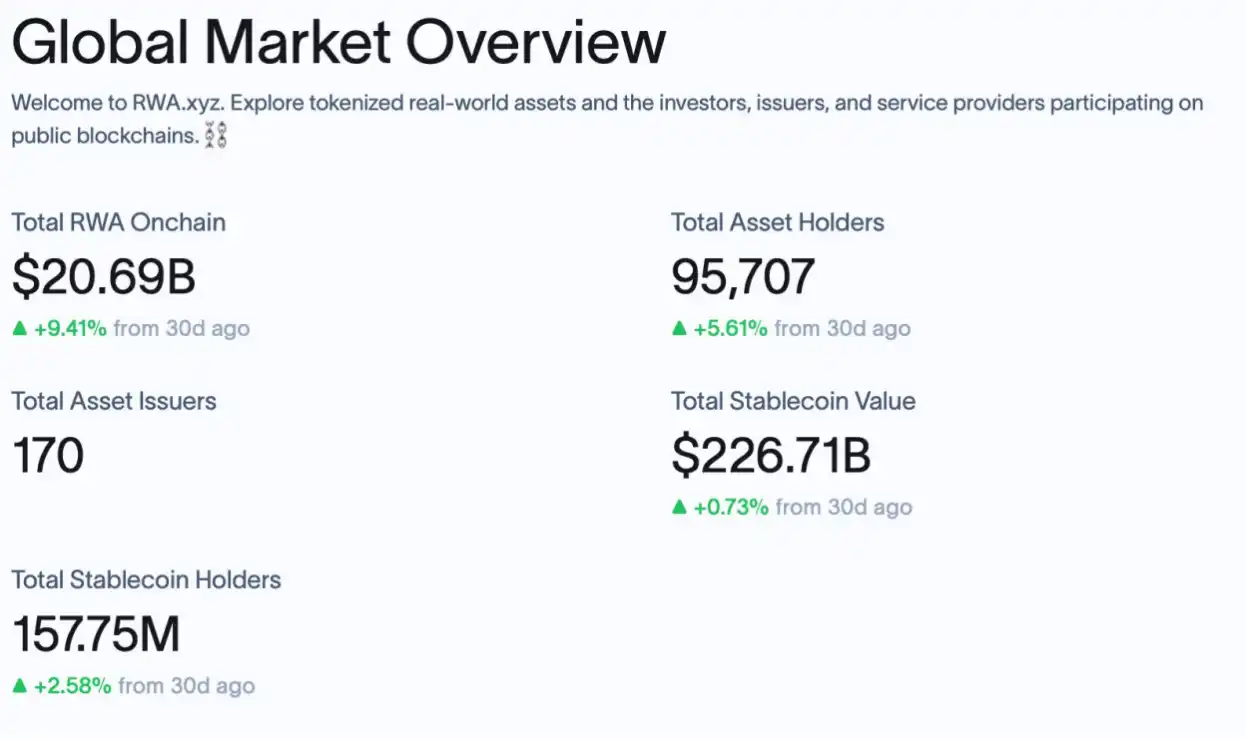
In terms of asset categories, it is not difficult to see that the main target group of RWA protocols is actually not native DeFi users but traditional financial users. Top RWA protocols such as Goldfinch, Maple Finance, Centrifuge, predominantly cater to small and medium-sized enterprises and institutional users. So why move this to the blockchain? (The following four points are just examples based on these protocols' advantages)
1. 24/7 instant settlement: This is one of the pain points of traditional finance relying on centralized systems, which blockchain addresses by providing a round-the-clock transaction system. It also enables instant redemption, T+0 lending, and other operations;
2. Geographical liquidity fragmentation: The blockchain forms a global financial network, allowing small and medium enterprises in third-world countries to attract external investor funds at minimal costs by bypassing local institutions through this network;
3. Reduced marginal service costs: Through smart contract management, the cost of servicing a pool of assets for 100 companies is nearly the same as servicing 10,000 companies;
4. Serving mining companies and small to medium exchanges: Such enterprises typically lack traditional credit records and struggle to obtain loans from banking institutions. By following traditional supply chain finance logic, they can leverage assets like equipment and accounts receivable for financing;
5. Lowering the Barrier to Entry: While early successful RWA protocols were generally designed for enterprises, institutions, or high-net-worth individuals, today, with the introduction of regulatory frameworks, many RWA protocols are also attempting to securitize financial assets to lower the investment threshold for investors.
For Crypto, if RWA can succeed, it indeed holds a Trillion-level imagination space. Moreover, I believe RWAFi will eventually emerge. For DeFi protocols, the underlying assets, after the addition of Tokens with real yields, will become more robust. For DeFi native users, this will introduce new options in asset selection and allocation. Especially in today's geopolitically turbulent and economically uncertain world, some real-world assets may be a lower-risk option than simply holding onto U for wealth management.
Here, I provide some existing RWA product choices and potential future choices: for example, gold has seen an increase of 80% from the beginning of 23 to this month of 25; the Ruble's fixed deposit rates in Russia are 20.94% for a 3-month period, 21.19% for a 6-month period, and 20.27% for a 1-year period; energy assets in sanctioned countries typically trade at over a 40% discount; short-term US Treasury bond yields are at 4%-5%; various stocks on the Nasdaq that have undergone significant corrections may have a stronger fundamental value proposition than your altcoin; further narrowing down to options such as charging stations or even blind boxes from Pop Mart may also be good choices.
IV. Swordholder
In the Three-Body world, Luo Ji, using his life as a trigger mechanism, deployed a nuclear bomb in the solar orbit, building a deterrence system against the Trisolaran civilization based on the Dark Forest theory. In the world of humanity, he is the Swordholder of Earth.
The "Dark Forest" is also the alias for blockchain used by most people in the industry. This is also the "original sin" inherent in decentralization. For some specific areas, RWA may serve as the Swordholder of this parallel world. Although the era of PFP avatars and GameFi stories has now faded away, looking back to the crazy times three or four years ago, we once gave birth to projects like Bored Ape Yacht Club, Azuki, and Pudgy that rivaled traditional IPs. But did we really acquire the IP intellectual property? The fact is, we never did. NFTs, to some extent, are more like consumer goods, and the definition of a 10K PFP on the blockchain is very vague. It indeed created some brilliant and short-lived IPs by lowering the investment threshold, but when it comes to returns and project development, the "Three-Body People" hold all the power.
Let's take Bored Ape Yacht Club as an example. The original intellectual property of the Bored Ape Yacht Club clearly belongs to its issuer, Yuga Labs LLC. According to the user agreement and official information, Yuga Labs, as the project's operating entity, holds the core intellectual property rights such as the copyright and trademark rights of the Bored Ape works. Holders purchasing NFTs only acquire ownership and usage rights to a specific numbered avatar, not the copyright itself.
When it comes to decision-making, Yuga Labs' direction for the Bored Ape Yacht Club design is the Metaverse, leveraging infinite issuance of sub-IPs in exchange for funding, detaching from the original luxury narrative. In this regard, NFT holders have neither the right to be informed, nor decision-making power, nor revenue rights. In the traditional world, when investing in an IP, investors usually have direct usage rights to the entire IP, direct revenue sharing, participation in decision-making, and even development leadership.
Yuga Labs is at least among the top PFP projects, while many other NFT projects have had more chaotic rights distribution. When faced with a looming threat, will they choose to show more respect for their community?
Part V: Above the Medium
In summary, RWAs have the potential to reshape finance and can also bring real-world opportunities to the blockchain, perhaps providing a new way to address the chaos in the blockchain space. However, constrained by the current regulatory framework in TradFi, its form still resembles a private protocol on a public chain, unable to unleash its full imaginative potential. Over time, I hope there will be a guide or alliance in the future to break through this barrier.
Assets on different mediums can unleash unimaginable brilliance. From the bronze inscriptions of the Western Zhou Dynasty to the fish scale pattern books of the Ming Dynasty, asset ownership has ensured the stability and development of society. What would it look like if RWAs could reach their ultimate form? I could buy Nasdaq stocks in Hong Kong during the day, deposit money into the Russian Federation Savings Bank in the early hours, and the next day, I could invest in real estate in Dubai with hundreds of shareholders from around the world who do not know each other's names.
Yes, the world operating on a vast public ledger is the RWA.
This article is contributed content and does not represent the views of BlockBeats.
You may also like

WEEX Live mode: Monitor 20 trading pairs at once and trade like a pro

Morning Report | Secret Network loses $4.67 million due to cross-chain vulnerability; Michael Saylor releases Bitcoin Tracker information again, may disclose increased holdings data next week

Kalshi's biggest competitor is not Polymarket
WEEX Makes Affiliate Access Easier on the Web and in the App

Customize Your Spot Trading Page: Drag Modules and Move the Order Panel Where You Want It

Perp DEX: The Next Generation Exchange "War"

10 Counterintuitive Insights on Latin American Payments

The AI gamble of mining companies: Valuations enter a phase of differentiation, and it's hard to turn the tide

A letter from Alliance to entrepreneurs: Written on the occasion of Cursor selling for 60 billion dollars
Stablecoins Finally Find Real Returns: On-Chain Reinsurance Re Explained | Interview with Re Founder Karan Saroya

The impossible triangle is simply a pseudo problem

Will MicroStrategy fall into a death spiral? What will the macro trend be in the second half of the year?

Blockchain Capital Partner: The Core Secret of Arbitrage
STRC unanchored by 11%, can the perpetual motion machine of Strategy still operate?

Bitcoin Market Analysis 2026: Can BTC Reach $150K by Year-End?
Bitcoin ETF Outflows Hit a Record $4.4 Billion: What Are Traders Doing With Their Cash?
WEEX App Just Got Smarter – New Tabs for Faster Trades & Easy Asset Management

WEEX All-New Search Features: Find, Trade & Earn Faster Than Ever
WEEX Live mode: Monitor 20 trading pairs at once and trade like a pro
Morning Report | Secret Network loses $4.67 million due to cross-chain vulnerability; Michael Saylor releases Bitcoin Tracker information again, may disclose increased holdings data next week
Kalshi's biggest competitor is not Polymarket
WEEX Makes Affiliate Access Easier on the Web and in the App
Customize Your Spot Trading Page: Drag Modules and Move the Order Panel Where You Want It
Perp DEX: The Next Generation Exchange "War"


