
 Buy Crypto
- Markets
 Futures
- Spot
- Copy Trade
- Earn
- More
Historical Perspective: The 12 Months Post-Election Are Typically the Golden Period of a Crypto Bull Market

Original Article Title: Republican Victory Ushers in a New Era for Crypto
Original Article Author: Kelvin Koh, Spartan Group
Original Article Translation: Fu Ruhe, Odaily Planet Daily
The 2024 U.S. presidential election has become one of the most watched elections in recent years. Despite widespread expectations of a fiercely contested election, the election results still took many by surprise. Not only did Trump convincingly win the presidential election, but the Republican Party also secured a majority in both the Senate and the House. Such a sweeping victory will give the Republican Party enough political leverage to drive multiple reforms in the coming years. The cryptocurrency field is expected to undergo significant changes, and we believe the next 12 months will be a bullish period for crypto assets.
One key difference in the 2024 election compared to the past is the emergence of a "crypto agenda," with the winning president and his core advisory team holding a crypto-friendly stance. Crypto companies strongly supported Trump and key Republican candidates through donations. Therefore, it is not surprising that the crypto industry has become one of the major beneficiaries of the Republican Party's resounding victory.
There has been much discussion about the significance of this election for the crypto industry, but here are some of the key impacts:
· Changes in SEC Policy. Under Gary Gensler's leadership, the SEC and other appointed officials of the Biden administration have implemented aggressive regulation on the crypto industry. Despite industry calls for regulatory guidance, the SEC has continued to pursue enforcement actions. During Gensler's tenure, over 2,700 enforcement actions were initiated, resulting in total fines of up to $210 billion. This has made it difficult for many projects to operate in the U.S. Trump clearly stated during his campaign that if elected, he would replace Gensler. As expected, last week Gensler announced that he would step down as SEC chairman on January 20, 2025. Several nominees have already been named to succeed him, and they are generally seen as more supportive of the crypto industry. This means that existing enforcement actions may be reversed, and the SEC will adopt a more cooperative regulatory approach.
· Improvement in Congressional Environment. In the past, a major challenge facing the crypto industry was the difficulty of passing any favorable bills in the U.S. Congress, as most lawmakers lacked an understanding of cryptocurrency. However, after this election, about two-thirds of Congress members are considered crypto-friendly. This could lead to a regulatory framework that supports innovation, making it easier for projects to raise funds and clearing obstacles for institutional capital to enter the crypto space.
· Proposal for a Strategic Bitcoin Reserve. During his campaign, Trump mentioned to his crypto supporters that if elected, he would push for the establishment of a Strategic Bitcoin Reserve instead of having the U.S. government continue to dispose of previously seized bitcoins. This proposal quickly gained attention after the election. If this proposal were to be implemented, the market would start speculating whether this means the U.S. government would become a net buyer rather than a seller of Bitcoin. If MicroStrategy alone can influence the price of Bitcoin, imagine the impact of the U.S. government establishing a Strategic Bitcoin Reserve. More importantly, how would other countries react to this? Would they also come up with similar plans?
· Support for DeFi. Even before the election, a team supported by Trump had launched World Liberty Financial in September 2024, aiming to provide decentralized lending services and governance through the native token WLF. The project has raised over $50 million to date, with the latest investment coming from crypto entrepreneur Justin Sun, who invested $30 million this week. WLF plans to raise a total of $300 million. Whether it reaches $300 million or $50 million, the significance of this project goes far beyond the amount raised—it has provided a huge boost to DeFi developers and innovators. Importantly, a DeFi project supported by the incoming U.S. president will have a profound impact on the entire industry.
Each of the above events alone is enough to have a significant driving force on the crypto market, and the combined impact of these events on the crypto industry is profound. The market has not yet fully reflected the potential impact of these changes, which is why the U.S. media refers to this period as the "golden age of crypto."
In addition to all of the above, Trump has also expressed his desire for the U.S. to become the "global capital of crypto." To some extent, the U.S. is already the de facto leading crypto nation. Many major infrastructure projects, some of the largest blockchain infrastructure companies, and decentralized applications originated in the U.S. The U.S. also has the world's largest licensed cryptocurrency exchanges, the largest crypto investment banks, and the largest Web3 venture capital pool. Furthermore, the U.S. controls around 40% of the global Bitcoin mining hash rate (compared to 17% in 2021), making it the largest center for Bitcoin mining, partly due to policy changes in China. Most of the world's crypto trading is also denominated in dollars, and major stablecoins are pegged to the dollar. Therefore, the U.S. is already a global crypto hub in many ways. However, if the U.S. government plans to consolidate or further expand its dominance, what does this mean for other governments, especially major financial centers like London, Tokyo, Dubai, and Hong Kong? More importantly, can Europe afford to miss out on the Web3 innovation era and once again lag behind after the Web2 era?
Some people may question whether Trump will actually fulfill these promises, but I believe the likelihood of fulfillment is high. Trump does not follow traditional rules, and the political leverage brought by this election victory is very strong. Additionally, Trump has two native cryptocurrency advisors—Elon Musk and JD Vance. The new Secretary of Commerce, Howard Lutnick, also serves as the Chairman and CEO of Cantor Fitzgerald, which has just acquired a 5% stake in Tether (the issuer of the world's largest stablecoin USDT). With a more crypto-friendly Congress, pushing forward these measures should not be difficult.
Historical Data: Strong Cryptocurrency Price Performance in the 12 Months Following the U.S. Election, Altcoins Outperform Bitcoin
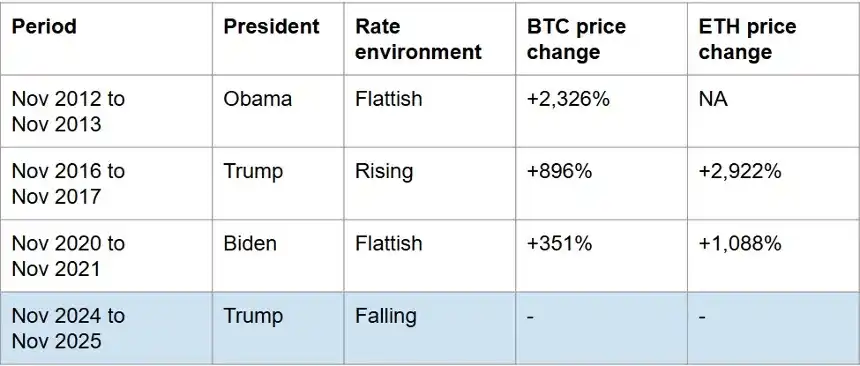
Against this background, discussing the impact of all this on cryptocurrency asset prices becomes particularly important. As seen in the table below, historically, the 12 months following a U.S. election have typically been a period of strong cryptocurrency price performance.
There are two main observations here:
· Regardless of who wins the presidential election and the interest rate environment, cryptocurrency assets have performed very well in the 12 months following the U.S. election. We attribute this to two factors:
a) Clarity brought by the election results and optimism about the new government;
b) The continued momentum of the Bitcoin halving cycle/cryptocurrency cycle.
· In the 12 months following the last two elections, altcoins (represented by ETH) have returned about three times as much as Bitcoin.
30 days after the 2024 election, Bitcoin rose by 46%, and Ethereum rose by 58%. We believe there is still significant upside potential in the next 11 months.
To better understand the opportunity with altcoins, let's look at the chart below, which shows the performance of altcoins relative to Bitcoin. It can be seen that there are stages within the cycle where altcoins significantly outperform Bitcoin. We refer to these stages as "altcoin cycles" or "altcoin seasons." The most recent major altcoin cycle occurred in January 2021 and peaked in November 2021. The previous cycle started in February 2017 and peaked in January 2018.

It is worth noting that these altcoin cycles roughly overlap with the 12-month period following the election. We believe the main reason is the strong price performance in the initial weeks after the election and the shift in investor sentiment towards risk appetite. Additionally, this trend has also attracted retail funds into the cryptocurrency asset class, with retail funds often preferring smaller and mid-sized tokens with higher risk due to the lack of liquidity constraints from institutional investors. Furthermore, at this point in the cycle, altcoins tend to underperform, making their risk-return profile more attractive compared to large-cap tokens. This is also the case in this cycle.
If this historical relationship holds, then we should expect the altcoin season to be imminent.
You may also like

2026 Crypto Taxes: Don't Miss These Staking & DeFi Reporting Rules
Stay compliant in 2026. Learn how to report crypto staking rewards, DeFi incentives, and airdrops. Follow our easy WEEX + KoinX workflow to generate accurate tax reports in minutes.

Crypto Tax Deadline 2026: How to Generate 2026 Crypto Tax Reports (WEEX & KoinX Fast Tutorial)
Still filing crypto taxes close to the 2026 deadline? Follow this step-by-step WEEX Tax API + KoinX workflow to export data and generate an accurate crypto tax report quickly.

Hyperliquid Ten Thousand Character Feature: Jeffrey's Billion Dollar Gold Mining Story

SaaS Churn | Rewire Daily News
There may not be a rate cut this year

CoinGecko Spot Report: Overview of 12 Major CEX Spot Markets, Only 32% of New Tokens Outperforming IEO Price

Even with Gunfire Behind Bars, Why Do American Small Towns Oppose AI Data Centers?

The Sky is the Limit: Wearing Only One Outfit, Cutting My Own Hair, and Giving Billions to Strangers — The Story Behind Hyperliquid

Atlético Madrid vs FC Barcelona: 90 Minutes to Destroy a Dream or Write History
Atlético Madrid vs FC Barcelona Champions League second leg is do-or-die. Full Atlético Madrid vs FC Barcelona lineups, stats, timeline — plus who chokes and who conquers.

Chinese-funded institutions retreat from Hong Kong stablecoins

Morning Report | Strategy invested $1 billion to increase its Bitcoin holdings last week; Aave passed a $25 million grant proposal; Coinone was shut down and fined for violating anti-money laundering obligations

Found a "meme coin" that skyrocketed in just a few days. Any tips?

TAO is Elon Musk, who invested in OpenAI, and Subnet is Sam Altman

The era of "mass coin distribution" on public chains comes to an end

Soaring 50 times, with an FDV exceeding 10 billion USD, why RaveDAO?

1 billion DOTs were minted out of thin air, but the hacker only made 230,000 dollars

After the blockade of the Strait of Hormuz, when will the war end?

Before using Musk's "Western WeChat" X Chat, you need to understand these three questions
The X Chat will be available for download on the App Store this Friday. The media has already covered the feature list, including self-destructing messages, screenshot prevention, 481-person group chats, Grok integration, and registration without a phone number, positioning it as the "Western WeChat." However, there are three questions that have hardly been addressed in any reports.
There is a sentence on X's official help page that is still hanging there: "If malicious insiders or X itself cause encrypted conversations to be exposed through legal processes, both the sender and receiver will be completely unaware."
No. The difference lies in where the keys are stored.
In Signal's end-to-end encryption, the keys never leave your device. X, the court, or any external party does not hold your keys. Signal's servers have nothing to decrypt your messages; even if they were subpoenaed, they could only provide registration timestamps and last connection times, as evidenced by past subpoena records.
X Chat uses the Juicebox protocol. This solution divides the key into three parts, each stored on three servers operated by X. When recovering the key with a PIN code, the system retrieves these three shards from X's servers and recombines them. No matter how complex the PIN code is, X is the actual custodian of the key, not the user.
This is the technical background of the "help page sentence": because the key is on X's servers, X has the ability to respond to legal processes without the user's knowledge. Signal does not have this capability, not because of policy, but because it simply does not have the key.
The following illustration compares the security mechanisms of Signal, WhatsApp, Telegram, and X Chat along six dimensions. X Chat is the only one of the four where the platform holds the key and the only one without Forward Secrecy.
The significance of Forward Secrecy is that even if a key is compromised at a certain point in time, historical messages cannot be decrypted because each message has a unique key. Signal's Double Ratchet protocol automatically updates the key after each message, a mechanism lacking in X Chat.
After analyzing the X Chat architecture in June 2025, Johns Hopkins University cryptology professor Matthew Green commented, "If we judge XChat as an end-to-end encryption scheme, this seems like a pretty game-over type of vulnerability." He later added, "I would not trust this any more than I trust current unencrypted DMs."
From a September 2025 TechCrunch report to being live in April 2026, this architecture saw no changes.
In a February 9, 2026 tweet, Musk pledged to undergo rigorous security tests of X Chat before its launch on X Chat and to open source all the code.
As of the April 17 launch date, no independent third-party audit has been completed, there is no official code repository on GitHub, the App Store's privacy label reveals X Chat collects five or more categories of data including location, contact info, and search history, directly contradicting the marketing claim of "No Ads, No Trackers."
Not continuous monitoring, but a clear access point.
For every message on X Chat, users can long-press and select "Ask Grok." When this button is clicked, the message is delivered to Grok in plaintext, transitioning from encrypted to unencrypted at this stage.
This design is not a vulnerability but a feature. However, X Chat's privacy policy does not state whether this plaintext data will be used for Grok's model training or if Grok will store this conversation content. By actively clicking "Ask Grok," users are voluntarily removing the encryption protection of that message.
There is also a structural issue: How quickly will this button shift from an "optional feature" to a "default habit"? The higher the quality of Grok's replies, the more frequently users will rely on it, leading to an increase in the proportion of messages flowing out of encryption protection. The actual encryption strength of X Chat, in the long run, depends not only on the design of the Juicebox protocol but also on the frequency of user clicks on "Ask Grok."
X Chat's initial release only supports iOS, with the Android version simply stating "coming soon" without a timeline.
In the global smartphone market, Android holds about 73%, while iOS holds about 27% (IDC/Statista, 2025). Of WhatsApp's 3.14 billion monthly active users, 73% are on Android (according to Demand Sage). In India, WhatsApp covers 854 million users, with over 95% Android penetration. In Brazil, there are 148 million users, with 81% on Android, and in Indonesia, there are 112 million users, with 87% on Android.
WhatsApp's dominance in the global communication market is built on Android. Signal, with a monthly active user base of around 85 million, also relies mainly on privacy-conscious users in Android-dominant countries.
X Chat circumvented this battlefield, with two possible interpretations. One is technical debt; X Chat is built with Rust, and achieving cross-platform support is not easy, so prioritizing iOS may be an engineering constraint. The other is a strategic choice; with iOS holding a market share of nearly 55% in the U.S., X's core user base being in the U.S., prioritizing iOS means focusing on their core user base rather than engaging in direct competition with Android-dominated emerging markets and WhatsApp.
These two interpretations are not mutually exclusive, leading to the same result: X Chat's debut saw it willingly forfeit 73% of the global smartphone user base.
This matter has been described by some: X Chat, along with X Money and Grok, forms a trifecta creating a closed-loop data system parallel to the existing infrastructure, similar in concept to the WeChat ecosystem. This assessment is not new, but with X Chat's launch, it's worth revisiting the schematic.
X Chat generates communication metadata, including information on who is talking to whom, for how long, and how frequently. This data flows into X's identity system. Part of the message content goes through the Ask Grok feature and enters Grok's processing chain. Financial transactions are handled by X Money: external public testing was completed in March, opening to the public in April, enabling fiat peer-to-peer transfers via Visa Direct. A senior Fireblocks executive confirmed plans for cryptocurrency payments to go live by the end of the year, holding money transmitter licenses in over 40 U.S. states currently.
Every WeChat feature operates within China's regulatory framework. Musk's system operates within Western regulatory frameworks, but he also serves as the head of the Department of Government Efficiency (DOGE). This is not a WeChat replica; it is a reenactment of the same logic under different political conditions.
The difference is that WeChat has never explicitly claimed to be "end-to-end encrypted" on its main interface, whereas X Chat does. "End-to-end encryption" in user perception means that no one, not even the platform, can see your messages. X Chat's architectural design does not meet this user expectation, but it uses this term.
X Chat consolidates the three data lines of "who this person is, who they are talking to, and where their money comes from and goes to" in one company's hands.
The help page sentence has never been just technical instructions.
2026 Crypto Taxes: Don't Miss These Staking & DeFi Reporting Rules
Stay compliant in 2026. Learn how to report crypto staking rewards, DeFi incentives, and airdrops. Follow our easy WEEX + KoinX workflow to generate accurate tax reports in minutes.
Crypto Tax Deadline 2026: How to Generate 2026 Crypto Tax Reports (WEEX & KoinX Fast Tutorial)
Still filing crypto taxes close to the 2026 deadline? Follow this step-by-step WEEX Tax API + KoinX workflow to export data and generate an accurate crypto tax report quickly.


 App
App