
How did Gate.io manage to break through besides Binance and OKX?

Source: Cointelegraph Chinese
The global cryptocurrency exchange industry has evolved into a multi-layered, differentiated competitive landscape. Based on market share, growth rate, and strategic positioning, major exchanges can now be classified into three categories: Giant Players, Challenger Types, and Stealthy Vanguard.
Giant Players
Binance
Binance currently stands as the world's most influential cryptocurrency exchange, maintaining the top spot in spot, derivatives, and user volume. By 2024, its spot market share reaches as high as 48.2%, indicating its platform token Binance Coin (BNB) enjoys a strong user base and ecosystem foundation. However, Binance's annual total market share has dropped from 42.2% to 32.7%, showing signs of marginal slowdown in user growth and share stability.
Challenger Types
OKEx (OKX)
OKEx has performed well in both the spot and derivatives markets. Last year, its spot trading volume reached $606 billion, ranking top three. However, in February this year, its operating company Aux Cayes FinTech Co was fined $505 million for violating U.S. anti-money laundering laws and is required to hire external compliance advisors by 2027.
Bybit
Bybit has risen rapidly in recent years, ranking second in spot trading share at 11.5% in 2024. Its growth is attributed to new token listings, low fee strategies, and market opportunities following FTX's collapse. In addition, Bybit has established strategic partnerships with blockchain projects such as Solana, TON, and Sui, driving the development of the Web3 ecosystem.
Stealthy Vanguard
Gate.io
Gate.io has earned users' trust through its continued investment in security and transparency. Since 2020, Gate.io has been one of the first exchanges to implement 100% reserve proof.
Furthermore, Gate.io has introduced zero-knowledge proof (zk-SNARK) technology, further enhancing the privacy and security of the reserve proof. The platform's reserves cover 209 digital assets, including mainstream coins such as Bitcoin (BTC), Ethereum (ETH), USDT, all achieving reserve rates of over 100%.
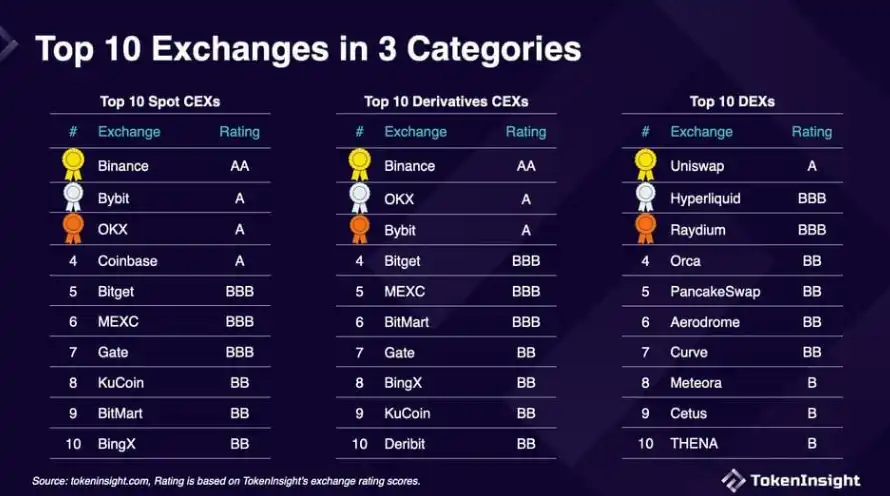
Cryptocurrency Exchange Market Landscape. Source: TokenInsight
Against the Odds: The Self-Revolution of Mid-tier Exchanges
Under the intense market frenzy and tightening regulations, mid-tier exchanges were once seen as the "forgotten part of the era." However, it is in this seemingly unsolvable game that many mid-tier platforms have proactively broken out, shattering the fate of "either the top or elimination." Instead of blindly imitating giants, they have sought their own space for survival and growth through differentiation, refined operations, expanding vertical user tracks, strengthening compliance, and parallel technological advancement.
Taking Gate.io as an example, its key breakthrough strategies and outcomes include:
Full Compensation Mechanism and Transparent Reserve
On April 23, during a system upgrade, Gate.io experienced fluctuations and activated a full compensation mechanism to ensure user rights were not affected. Chief Business Officer Kevin clearly stated in an AMA live broadcast that the platform would provide 100% compensation for any impacts caused by the upgrade, demonstrating the platform's firm commitment to user asset security.
As of January 17, Gate.io's total reserve value reached $10.328 billion, with a reserve ratio of 128.58%. The excess reserve scale reached $2.296 billion, with an excess reserve ratio of 28.58%, showing an increase of $450 million since December last year, a growth rate of 24.38%. The platform's reserve data has also been audited by the authoritative blockchain security company Hacken.
Product Innovation and Ecosystem Expansion
● New Coin Listings: Last year, Gate.io listed 873 new tokens, with 437 being exclusive premieres, providing users with a wide range of investment choices;
● Memecoin Market Layout: By launching dedicated Pilot and MemeBox, the platform attracted a large number of users to participate in this emerging market. Additionally, Gate.io has established a $50 million dedicated fund to support the thriving Memecoin market;
● TON Ecosystem Cooperation: Through a partnership with Telegram, Gate.io introduced the Gate Wallet Mini App and Mini App, attracting numerous TON ecosystem users. These applications have monthly active users exceeding 2.55 million and 1.4 million, respectively, further enhancing the platform's influence in the Web3 and blockchain ecosystem.
Diversified Brand Collaboration
In February this year, Gate.io announced a multi-year partnership with the F1 Red Bull Racing Team. Starting from the 2025 season, Gate.io's branding will appear on key areas of the Red Bull race car such as the rear wing, nose, headrest, wheel hubs, undertray, as well as on the team's uniform and four-time world champion Max Verstappen's helmet.
Compliance Expansion and Globalization Strategy
Gate.io has completed Virtual Asset Service Provider (VASP) registration in Argentina and is advancing compliance efforts in jurisdictions such as Gibraltar, the Bahamas, Hong Kong, Singapore, and the Middle East, laying the foundation for global expansion. Through the acquisitions of Asia-based Coin Master and Cyprus-based Sheer Markets, it has expanded its compliant operations in Asia and Europe.
The Future of Cryptocurrency Exchanges
Looking ahead, the outlook for cryptocurrency exchanges will greatly depend on their ability to adapt to a constantly evolving regulatory environment. As more countries establish their regulatory frameworks, exchanges prioritizing compliance may emerge as industry leaders. The interplay between regulation and innovation will drive the evolution of trading platforms, prompting them to enhance security, transparency, and user experience. Furthermore, with institutional interest in cryptocurrency rising, regulatory clarity will be key to attracting traditional investors. In this dynamically changing landscape, adaptability will be crucial for the success of cryptocurrency exchanges.
● Continual learning to keep up with regulatory dynamics;
● Innovative services to meet regulatory requirements and user needs;
● Establishing partnerships with regulatory bodies to ensure better compliance;
● Focusing on user experience to retain and attract more customers;
● Monitoring global trends to anticipate regulatory changes.
Original Article Link
You may also like

Morning Report | Secret Network loses $4.67 million due to cross-chain vulnerability; Michael Saylor releases Bitcoin Tracker information again, may disclose increased holdings data next week

Kalshi's biggest competitor is not Polymarket

The second half of the computing power battle: Intel CEO Pat Gelsinger reveals how AI is reshaping the global semiconductor supply chain
B.AI partners with MiniMax to launch a limited-time free experience of M3, enabling zero-threshold implementation of Agentic productivity through full-stack infrastructure

A company that was on the verge of bankruptcy has just surpassed Bitcoin in market value

The two giants are racing in "credit": loan balances of 9.9 billion vs 14.6 billion USD, Brazil has become the main battlefield

Rented Belief: How Much of the Bitcoin ETF Fund Flow is Real Money

On-chain finance: On-chain IPOs and on-chain ICOs, a new frontier in the trillion-dollar market

WEEX Live mode: Monitor 20 trading pairs at once and trade like a pro

WEEX Makes Affiliate Access Easier on the Web and in the App

Customize Your Spot Trading Page: Drag Modules and Move the Order Panel Where You Want It

Perp DEX: The Next Generation Exchange "War"

10 Counterintuitive Insights on Latin American Payments

The AI gamble of mining companies: Valuations enter a phase of differentiation, and it's hard to turn the tide
A letter from Alliance to entrepreneurs: Written on the occasion of Cursor selling for 60 billion dollars
Stablecoins Finally Find Real Returns: On-Chain Reinsurance Re Explained | Interview with Re Founder Karan Saroya

The impossible triangle is simply a pseudo problem

Will MicroStrategy fall into a death spiral? What will the macro trend be in the second half of the year?
Morning Report | Secret Network loses $4.67 million due to cross-chain vulnerability; Michael Saylor releases Bitcoin Tracker information again, may disclose increased holdings data next week
Kalshi's biggest competitor is not Polymarket
The second half of the computing power battle: Intel CEO Pat Gelsinger reveals how AI is reshaping the global semiconductor supply chain
B.AI partners with MiniMax to launch a limited-time free experience of M3, enabling zero-threshold implementation of Agentic productivity through full-stack infrastructure
A company that was on the verge of bankruptcy has just surpassed Bitcoin in market value
The two giants are racing in "credit": loan balances of 9.9 billion vs 14.6 billion USD, Brazil has become the main battlefield


