
 Buy Crypto
- Markets
 Futures
- Spot
- Copy Trade
- Earn
- More
How Did the “Zombie Coin” Suddenly Come Back to Life?

Wasn't it supposed to be a bull market where "new projects are hot, old projects are not"? What is XLM? And what about HBAR? I've never even heard of these coins, yet they are mysteriously surging in price?
What Are Korean Moms Buying?
Who is actually buying these "zombie coins"? In short: "institutional buying pressure" led by the United States and "retail buying pressure" led by Japan and South Korea. The institutional buying pressure from the U.S. is well known, but let's take a look at the data from neighboring South Korea.
According to a report by a South Korean media outlet naver.news, on the active crypto exchanges in Korea, Upbit and Bithumb, the number of users over the age of 60 has increased by 30.4% compared to the previous bull market, reaching 770,000 accounts. Moreover, considering the wealth distribution in Korea, the elderly collectively hold 6.76 trillion Korean Won in cryptocurrency assets, with an average investment of about 8.72 million Korean Won per person. At the same time, the amount of money held in Korean banks has hit a new low, decreasing by 26.95 trillion Korean Won since the end of June. It seems like Koreans are withdrawing money from banks to "hoard" and buy coins.
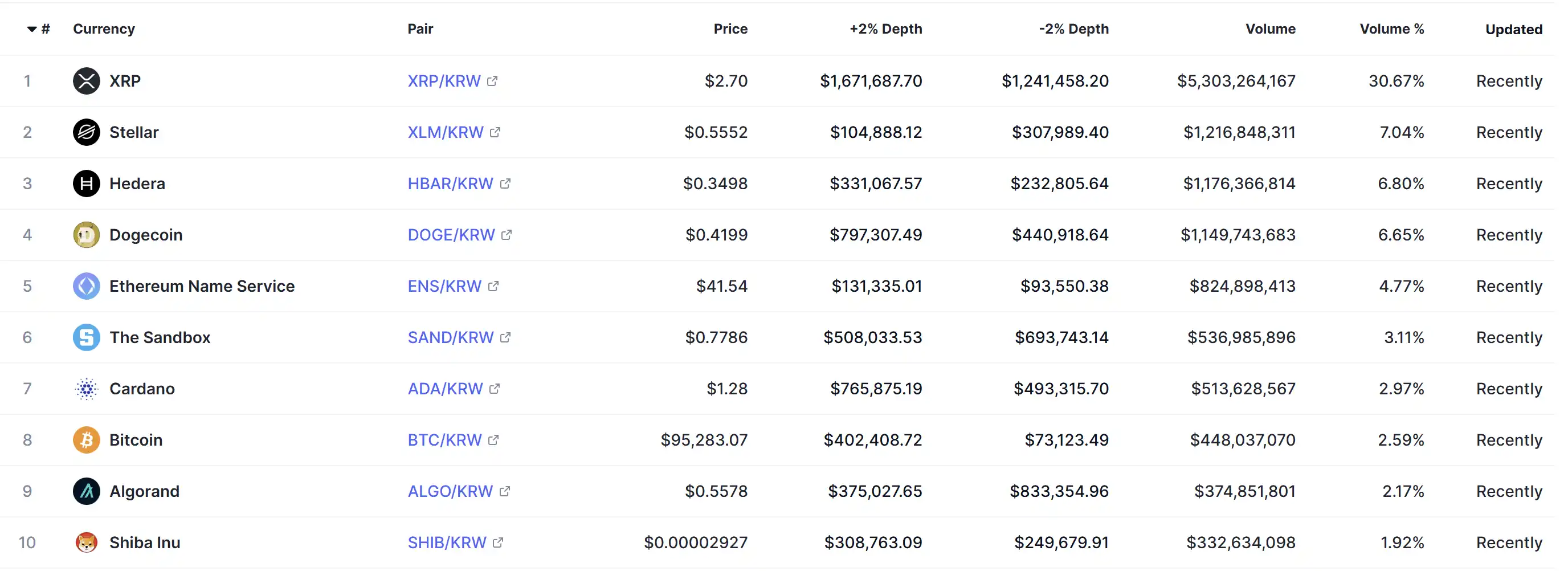
Below is the trading volume list from Upbit in Korea, where you'll find BTC being just a "little brother" in this ranking. XRP's trading volume is over 10 times that of BTC, and projects like XLM (Stellar) and HBAR (Hedera), which are rarely seen in the Chinese-speaking community, are also "famous" on the list.
XRP
One of Ripple's flagship products is RippleNet, which is a global payment network connecting banks and payment providers to facilitate secure and near-instant cross-border transactions. Ripple's technology includes its Interledger Protocol (ILP), designed to reduce settlement times and significantly lower transaction costs, enhancing financial institutions' transparency and liquidity management. Furthermore, Ripple plans to issue stablecoins in the future, which could be a huge potential catalyst for its growth.
Upbit 24h Trading Volume: $55.57 billion
Binance 24h Trading Volume: $56.27 billion
HBAR (Hedera Hashgraph)
Hedera Hashgraph utilizes a novel algorithm called Hashgraph consensus to achieve high levels of scalability, security, and fairness. The platform aims to create and deploy decentralized applications (dApps) and services across various industries ranging from finance and supply chain management to gaming and social networks. Unlike traditional blockchains, Hedera Hashgraph adopts a Directed Acyclic Graph (DAG) structure to enable rapid and efficient consensus among network participants, resulting in fast transaction speeds and minimal energy consumption.
Upbit 24-hour Trading Volume: $12.24 Billion
Binance 24-hour Trading Volume: $12.97 Billion
XLM (Stellar)
The core of the Stellar network is the Lumens (XLM) cryptocurrency, which acts as a bridge asset facilitating seamless value exchange between different currencies, promoting cross-border transactions. Lumens also play a crucial role in preventing spam attacks, ensuring the security and reliability of the Stellar network. In addition to its payment functionality, Stellartron strongly supports micropayments and facilitates the issuance of digital assets through its decentralized exchange feature.
Upbit 24-hour Trading Volume: $12.64 Billion
Binance 24-hour Trading Volume: $7.36 Billion
ENS
ENS stands for Ethereum Name Service, providing a domain name service for Ethereum akin to how we access internet information through domain names today. Built on Ethereum, ENS enables users to purchase secure, private, censorship-resistant .eth domain names that can be used to link to cryptocurrency wallet addresses or other information stored on Web3 infrastructure. The ENS token has previously experienced price pumps due to endorsements by Vitalik Buterin, and in line with Vitalik's "aesthetic," retail investors in South Korea also have a fondness for ENS.
Upbit 24-hour Trading Volume: $8.41 Billion
Binance 24-hour Trading Volume: $1.66 Billion
SAND
Sandbox is a metaverse gaming platform on Ethereum, where users can create, share, and play with crypto assets. Sandbox has been relatively overlooked by the market recently, but Sand has become a favorite among Korean retail investors, with daily price surges exceeding 60% multiple times and a 24-hour trading volume double that of Binance.
Upbit 24-hour Trading Volume: $5.82 Billion
Binance 24-hour Trading Volume: $2.67 Billion
The Retail Investors' Battle Behind Wall Street: Unpacking the Launch Logic of Bull Market 2.0
However, it's not just about the old coins; there are also many compliant coins (including the ones mentioned above: XRP, HBAR, XLM). These coins share several commonalities: retail investors hardly pay attention to them, they were in a downtrend or consolidation phase before November 5, and they experience direct significant price surges without providing an opportunity to get on board beforehand. So why are these coins specifically chosen?
To understand these, we first need to clarify the underlying logic of this bull market.
This bull market mainly follows the United States. The Chinese information on Web3 actually exists in an "information silo." Many people do not know what happened in the United States, Japan, and Korea (which follows the U.S. market).
The start of this bull market and the logic of the first half of this year are fundamentally different. The first half of the year was a bull market driven by ETF positives, where the market followed meme and AI hype. Therefore, it was "hot coins" > others; the second half of the year is the compliance bull with the rise of knowledgeable insiders. Hence, the hype is around compliant assets, "compliant coins" > "hot coins" > others. The tokens that surged this time mainly comply with the ISO 20022 compliance standard.
ISO 20022 is the standard for electronic data interchange between financial institutions, covering financial information exchanged between financial institutions. ISO 20022 is more advanced than the traditional formats used by banks because it supports a larger amount of data and faster processing speed, making it very suitable for fast payments.
If a token complies with ISO 20022, it will be prioritized for international payments.
IOTA
The IOTA token is the native digital currency of the IOTA network, used to facilitate transactions and data transfer within the Tangle. Its feeless nature eliminates barriers to microtransactions, making it ideal for microtransactions in IoT scenarios. IOTA's focus on scalability, security, and seamless transactions aligns with its vision to become the foundational technology of the rapidly growing IoT industry.
Upbit 24h Trading Volume: $321 million
Binance 24h Trading Volume: $181 million
ALGO
Algorand focuses on scalability, low transaction fees, and fast confirmation times, making it suitable for a variety of applications, including financial services, decentralized finance (DeFi), and asset tokenization. One of Algorand's key innovations is its proprietary consensus mechanism, namely Pure Proof-of-Stake (PPoS), which enables fast transaction confirmation times while maintaining a high level of decentralization.
Upbit 24h Trading Volume: $388 million
Binance 24h Trading Volume: $317 million
ADA
Cardano (ADA) is a blockchain platform designed to provide a secure and scalable infrastructure for developing decentralized applications (dApps) and smart contracts. Cardano is developed using a research-driven approach, focusing on scalability, sustainability, and interoperability to address the limitations of existing blockchain technology.
Upbit 24-hour Trading Volume: $5.34 Billion
Binance 24-hour Trading Volume: $11.22 Billion
When Will the Bull Market End
However, when these coins skyrocket by 5 times, when will it all come to an end? Perhaps the answer lies behind the Korean Mom. Based on Upbit Altcoin's daily trading volume data, it can be seen that the recent volume has reached the peak of the March mini bull run. The daily trading volume of Upbit Altcoin can be seen as a signal indicator of bull market FOMO.
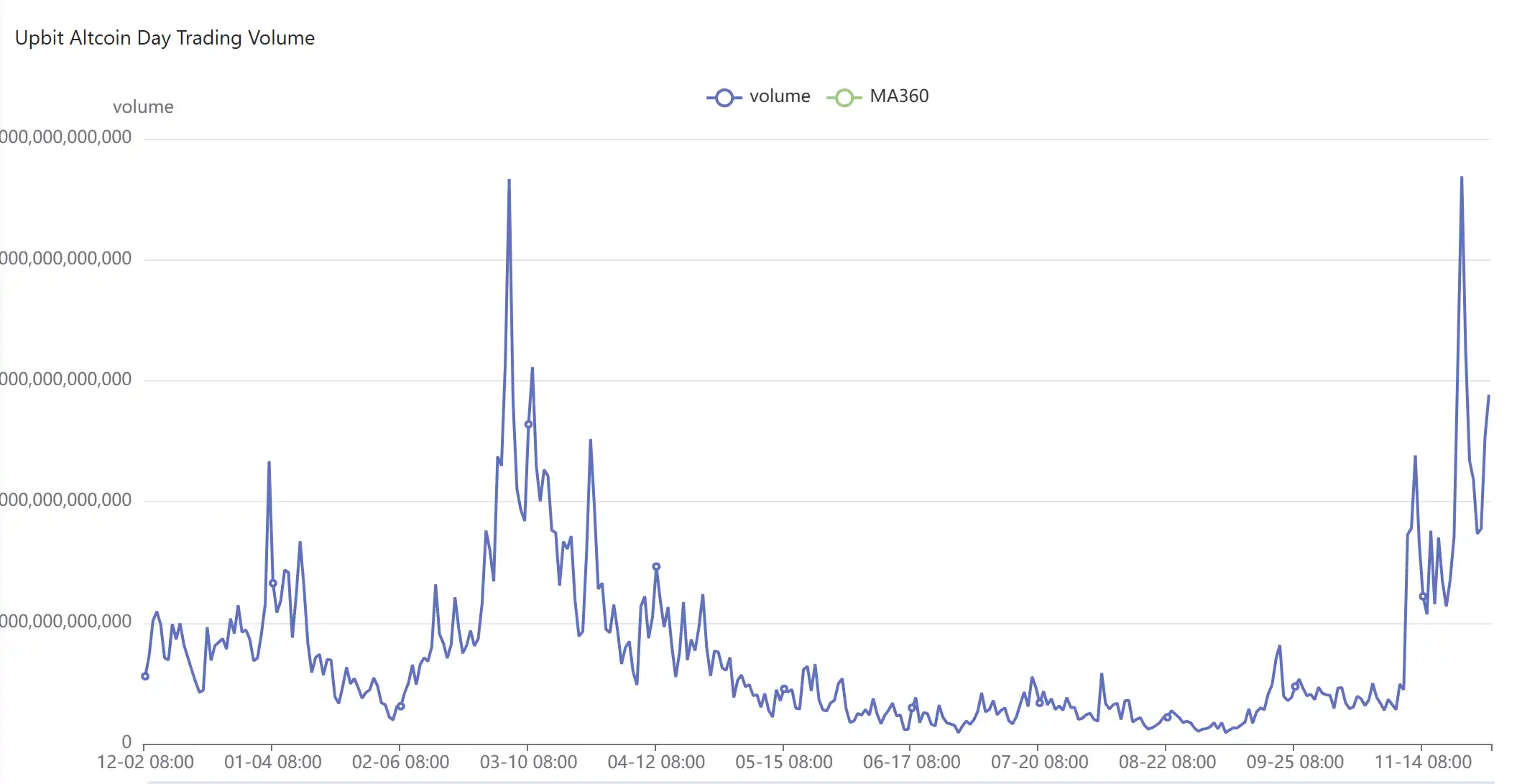
The bull market is a grand retreat, and when even the Korean Mom is caught up in FOMO, it often signifies a temporary peak.
You may also like

The 17-Year Mystery Will Be Solved, Who is Satoshi Nakamoto?

5 Minutes to Make AI Your Second Brain

Uniswap is trapped in an innovation dilemma

What is the key to competition in crypto banking?

The flow of stablecoins and the spillover effects in the foreign exchange market

After two years, Hong Kong's first batch of stablecoin licenses finally issued: HSBC, Standard Chartered make the cut
The person who helped TAO rise by 90% has now single-handedly crashed the price again today

3-Minute Guide to Participating in the SpaceX IPO on Bitget

Top 5 Cryptos to Buy in 2026 Q1: A ChatGPT Deep Dive Analysis
Explore the top 5 cryptos to buy in Q1 2026 including BTC, ETH, SOL, TAO, and ONDO. See price outlooks, key narratives, and institutional catalysts shaping the next market move.
How to Earn $15,000 with Idle USDT Before Altcoin Season 2026
Wondering if altcoin season is coming in 2026? Get the latest market update, and learn how to turn your idle stablecoins waiting for entry into extra rewards up to 15,000 USDT.
Can You Win Joker Returns Without Large Trading Volume? 5 Mistakes New Players Make In WEEX Joker Returns Season 2
Can small traders win WEEX Joker Returns 2026 without huge volume? Yes—if you avoid these 5 costly mistakes. Learn how to maximize card draws, use Jokers wisely, and turn small deposits into 15,000 USDT rewards.

Altcoin Season 2026: 4 Stages to Profit (Before the Crowd FOMO In)
Altcoin Season 2026 is starting — discover the 4 key stages of capital rotation (from ETH to PEPE) and how to position before the peak. Learn which tokens will lead each phase and avoid missing the rally.

Will Alt season come in 2026? 5 Tips to Spot the Next 100x Crypto Opportunities
Will altcoin season arrive in 2026? Discover 5 rotation stages, early signals smart traders watch, and the key crypto sectors where the next 100x altcoin opportunities may emerge.

The bear market has arrived, and cryptocurrency ETF issuers are also getting involved

The richest man had a quarrel with his former boss
BTC Firm Above 70K! Saylor’s "Institutional Logic" vs. Moon’s "Retail Faith": Who is Really Harvesting the Market?
Bitcoin is holding firm above the $70,000 support level following a massive short squeeze that liquidated $427 million. As the "Four-Year Cycle" narrative shifts, the market is split: Michael Saylor’s cold, institutional "indiscriminate stacking" vs. Carl Moon’s high-energy retail "hopium." This article decodes these two polar-opposite strategies for the 2026 bull run and reveals how WEEX’s institutional-grade liquidity and AI trading tools empower every type of investor to convert market volatility into profit.

The Girl Who Created the SBTI Test: A Story of a Doomed Cyber Love, an E-Widow Ratfolk



 App
App