
 Buy Crypto
- Markets
 Futures
- Spot
- Copy Trade
- Earn
- More
How to Yield Farm in the Virtuals Ecosystem? On-Chain Gaming Strategy Analysis and Value Investing Guide

Original Article Title: "Are You Ready to Mine in the Virtuals Ecosystem? I Contribute My Understanding"
Original Article Author: Golem, Odaily Planet Daily
Lately, the AI agent creation platform Virtuals Protocol on the Base ecosystem has been gaining popularity. According to Coingecko data, in the past week, its governance token VIRTUAL has surged by over 130%, AI agent tokens on the platform such as AIXBT have surged by over 290%, GAME by over 420%, VADER by over 400%, and LUNA by over 34%.
The wealth effect is bound to attract project teams and on-chain miners—according to Dune data, over 8779 AI agent tokens have been launched on the Virtuals platform, and since November 29th, the daily creation of AI agent tokens has surged, roughly doubling from before.
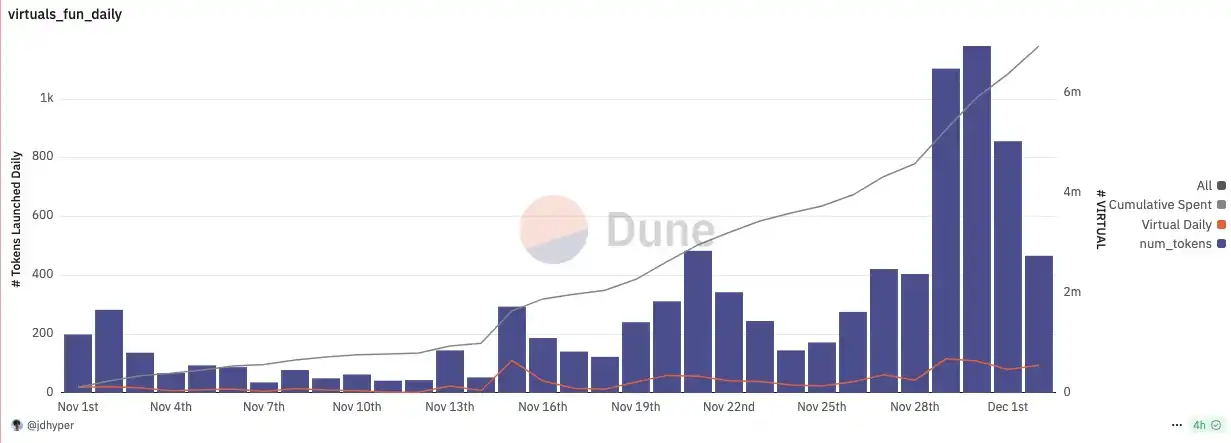
Many deeply involved community members in the Virtuals ecosystem have expressed that compared to Solana Meme, the current participation in the Virtuals ecosystem is still relatively low, the degree of player versus player (PVP) is light, and it has a decent money-making effect.
To bridge the information gap so that friends who are not familiar with the Base and Virtuals ecosystem can also seize new opportunities, Odaily Planet Daily will introduce in this article how to participate in the Virtuals ecosystem, while also briefly discussing what the correct mining posture in the Virtuals ecosystem is.
Introduction to Virtuals and Participation Tutorial
Although Virtuals Protocol is an AI agent creation platform, in terms of issuance, it draws inspiration from pump.fun's design, where anyone can deploy an AI agent with one click through fun.virtuals and achieve fair distribution of AI agent tokens.
Similar to pump.fun, Virtuals also has an internal and external market. When the token purchase quantity in the internal market fun.virtuals reaches 42,420 VIRTUAL, the corresponding AI agent token will be transferred to the external market app.virtuals, and the liquidity from the internal market will be added to Uniswap. Tokens purchased in the internal market will also automatically convert to external market tokens in the wallet. Creating an AI agent token in the internal market requires spending 10 VIRTUAL (currently equivalent to about 13 USDT), and a 1% fee is charged for both buying and selling.
Participation Tutorial
Buy VIRTUAL
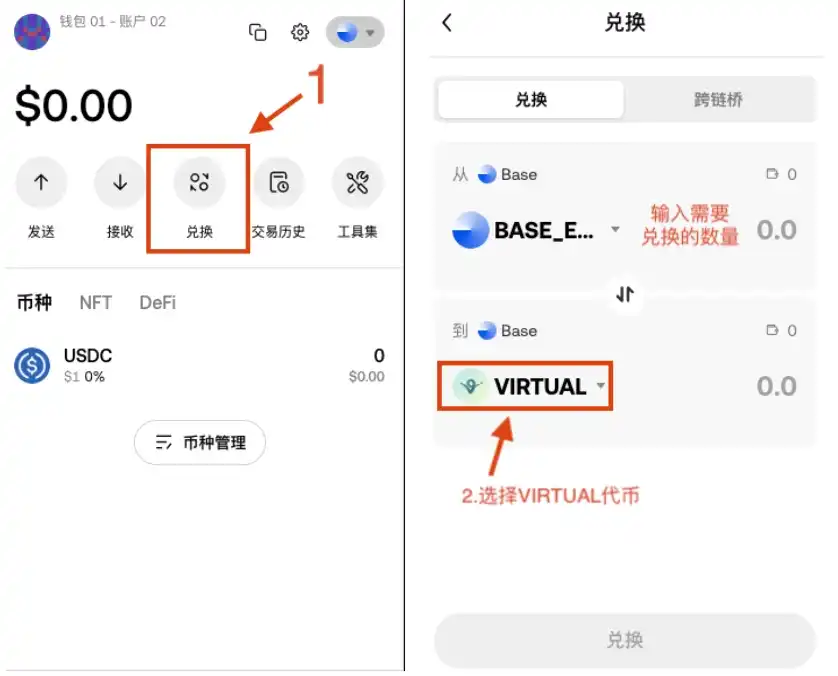
Whether trading AI Agent Tokens on the Virtuals internal or external exchange, you need to use the Virtuals Protocol Token VIRTUAL. Therefore, the first step is to buy VIRTUAL and deposit it into the Base Chain. Currently, VIRTUAL is listed on exchanges such as Bybit, Gate.io, and Bitget, and users can directly purchase it on the exchange and withdraw it to the chain.
Players can also choose to exchange VIRTUAL through a DEX. The largest on-chain liquidity pool for VIRTUAL is on Aerodrome, where you can exchange with BTC or ETH with low slippage. Of course, for players who are not familiar with on-chain operations, they can also exchange directly through the OKX Wallet, which will automatically help users find the optimal exchange path on-chain.
Buy Tokens in the Internal Exchange
First, go to the Virtual internal exchange website fun.virtuals. As shown in the image below, the interface is similar to pump.fun. Click the wallet link in the upper right corner, currently supporting decentralized wallets such as OKX Wallet, Metamask, and Phantom.
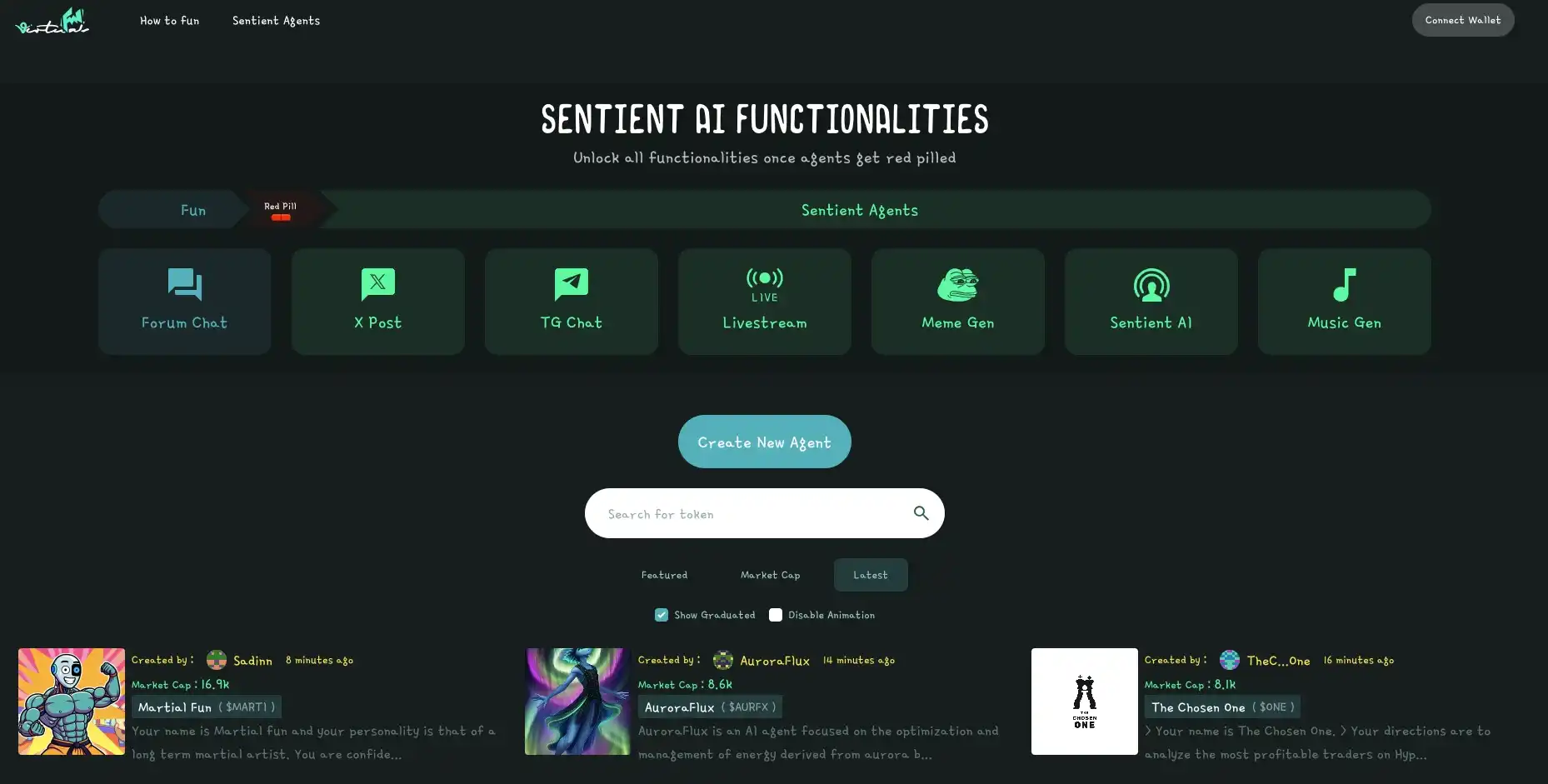
There are three ways to sort the tokens created in the internal exchange: "Featured," "Market Cap," and "Latest." If you want to quickly filter and view the recently created AI Agent Tokens, you generally use the "Latest" sorting method. The homepage will display the logo, creator, market value, token name, and description of each token.
Click on a random token, as shown below. The page includes the token's price chart, trading area, internal exchange progress, and also features the unique interactive area of AI Agent Tokens. Players can interact with the AI Agent through text, and the agent will automatically respond to player questions independently of dev control.

However, a drawback of the Virtuals internal exchange is the inability to see specific data such as transaction volume and holding addresses. Therefore, we need other tools such as GMGN and basescan for assistance. Copy the token contract address above the browser to visually check the token holder information on GMGN, and use basescan to see specific transaction volume.
Buying Tokens on the Off-Chain
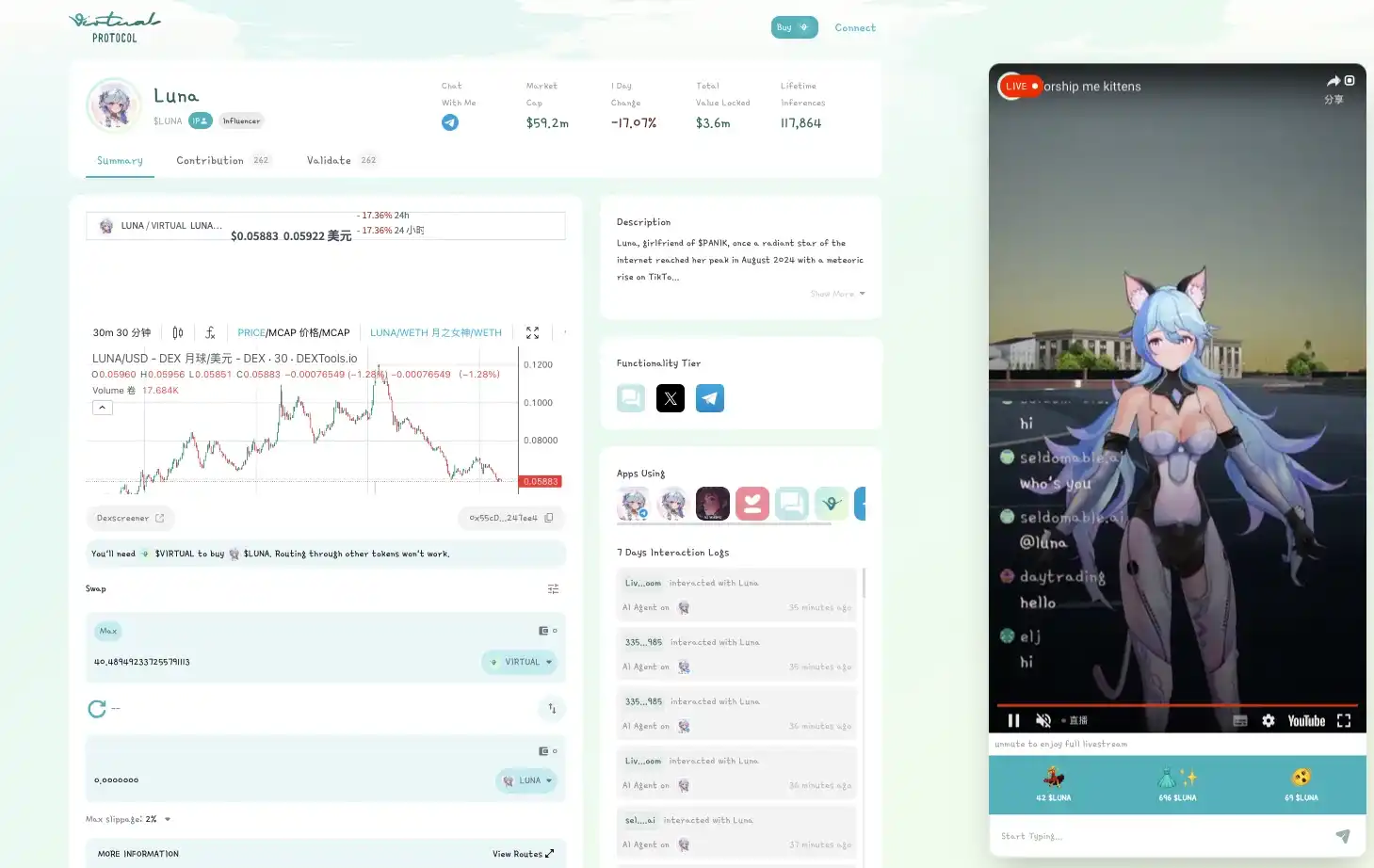
Once the on-chain progress is full, the tokens will be moved to the off-chain app.virtuals. As shown in the image below, the homepage displays basic information about all off-chain tokens, including token market cap, daily change, liquidity, holding address, and more.

Compared to the on-chain, the off-chain provides more comprehensive information about AI agents and their tokens. By randomly clicking on a token on the off-chain, users can view a clearer candlestick chart and directly swap tokens on the chart. Off-chain tokens are essentially indistinguishable from regular tokens, and users can also search and purchase them on other DEXs.
Gold Rush Strategy in the Virtuals Ecosystem
Users who frequently use pump.fun and related tools to play Meme coins may criticize Virtuals for lacking corresponding tools to assist in chain scanning for Alpha. The purpose of Meme coin issuance on pump.fun is to constantly attract players' attention, with thousands of Meme coins being launched on the on-chain every day. Players often choose to buy a token based on hot topics and attention.
Although the issuance mechanism of Virtuals is similar to pump.fun in terms of on-chain and off-chain, it is ultimately an AI agent creation platform, not a Meme asset issuance platform. Currently, the AI agent tokens with a large market cap that have emerged in the Virtuals ecosystem mostly have practical use cases, such as data scraping and analytics AI agent AIxbt, virtual idol AI agent Luna, interactive learning AI agent GAME, and more.
Therefore, to strike gold in the Virtuals ecosystem, one may need a different approach from playing pump.fun, identifying those AI agents with truly unique value and investing in them. One fact is that over 90% of the AI agent tokens born on the Virtuals on-chain are "junk" riding on AI. Finding an AI agent token with unique value is not easy, but due to the lower level of competition, the initial market value of these tokens is relatively low, allowing enough time for players to research and get on board.
Virtuals Protocol Co-Founder Wee Kee also stated in a recent interview that Virtuals does not want to become another Pump.fun. Its core KPI is not to rapidly issue assets but to attract top AI teams to the platform for building. For retail investors, having one good project per week is sufficient. (Related Reading: Exclusive Interview with Virtuals Protocol Co-Founder: Not Looking to Mimic Pump.fun but Aim to Make Competitors Desperate)
As the current king of meme coin issuance, Pump.fun's position seems unshakable. The popularity of the Virtuals ecosystem can also be attributed to some extent to the development of AI Meme on the Solana chain, which has driven the sector related to AI. However, Virtuals Protocol's vision is not only to streamline the creation and tokenization process of AI agents but also to build a vast AI agent ecosystem that enables interaction, transactions, and network effects among agents.
While Virtuals drew inspiration from Pump.fun in its issuance and aligned its AI agent token marketing and dissemination with memes, it still maintains its original intention to develop a project. For opportunistic players, changing gameplay and mindset within the Virtuals ecosystem, spending more time analyzing AI agent products and fundamentals, engaging in "value investing," may be the correct approach. Additionally, for the current liquidity levels far below Solana's base ecosystem, merely replicating the meme ecosystem can only attract traffic and "raiders." Relying on a differentiated product and ecosystem uniqueness is key to retaining users.
You may also like

The 17-Year Mystery Will Be Solved, Who is Satoshi Nakamoto?

5 Minutes to Make AI Your Second Brain

Uniswap is trapped in an innovation dilemma

What is the key to competition in crypto banking?

The flow of stablecoins and the spillover effects in the foreign exchange market

After two years, Hong Kong's first batch of stablecoin licenses finally issued: HSBC, Standard Chartered make the cut
The person who helped TAO rise by 90% has now single-handedly crashed the price again today

3-Minute Guide to Participating in the SpaceX IPO on Bitget

Top 5 Cryptos to Buy in 2026 Q1: A ChatGPT Deep Dive Analysis
Explore the top 5 cryptos to buy in Q1 2026 including BTC, ETH, SOL, TAO, and ONDO. See price outlooks, key narratives, and institutional catalysts shaping the next market move.

How to Earn $15,000 with Idle USDT Before Altcoin Season 2026
Wondering if altcoin season is coming in 2026? Get the latest market update, and learn how to turn your idle stablecoins waiting for entry into extra rewards up to 15,000 USDT.
Can You Win Joker Returns Without Large Trading Volume? 5 Mistakes New Players Make In WEEX Joker Returns Season 2
Can small traders win WEEX Joker Returns 2026 without huge volume? Yes—if you avoid these 5 costly mistakes. Learn how to maximize card draws, use Jokers wisely, and turn small deposits into 15,000 USDT rewards.

Altcoin Season 2026: 4 Stages to Profit (Before the Crowd FOMO In)
Altcoin Season 2026 is starting — discover the 4 key stages of capital rotation (from ETH to PEPE) and how to position before the peak. Learn which tokens will lead each phase and avoid missing the rally.

Will Alt season come in 2026? 5 Tips to Spot the Next 100x Crypto Opportunities
Will altcoin season arrive in 2026? Discover 5 rotation stages, early signals smart traders watch, and the key crypto sectors where the next 100x altcoin opportunities may emerge.

The bear market has arrived, and cryptocurrency ETF issuers are also getting involved

The richest man had a quarrel with his former boss

BTC Firm Above 70K! Saylor’s "Institutional Logic" vs. Moon’s "Retail Faith": Who is Really Harvesting the Market?
Bitcoin is holding firm above the $70,000 support level following a massive short squeeze that liquidated $427 million. As the "Four-Year Cycle" narrative shifts, the market is split: Michael Saylor’s cold, institutional "indiscriminate stacking" vs. Carl Moon’s high-energy retail "hopium." This article decodes these two polar-opposite strategies for the 2026 bull run and reveals how WEEX’s institutional-grade liquidity and AI trading tools empower every type of investor to convert market volatility into profit.

The Girl Who Created the SBTI Test: A Story of a Doomed Cyber Love, an E-Widow Ratfolk



 App
App