
Hundreds of Dollars Turned into 260,000, Independent Miner Frequently "Hits the Jackpot," Is Mining the New Gold Rush?


Original Article Title: Solo Bitcoin Miners Are Winning More Blocks Lately—What Gives?
Original Article Author: Mat Di Salvo, Decrypt
Original Article Translation: Lila, BlockBeats
Last week, another solo Bitcoin miner successfully mined a block and received a reward of 3.125 bitcoins (including transaction fees), worth nearly $260,000. This is just one of several recent instances where independent miners have struck it rich.
So, was this miner just lucky? Is solo mining becoming more common? Can an average person with a basic mining rig challenge the large mining farms with their relatively modest hashing power?
The answers vary. While recently there has indeed been an increase in the number of blocks mined by "solo miners" (here referring to individual enthusiasts or some low-profile small mining groups), the growth has been modest and is unlikely to skyrocket.
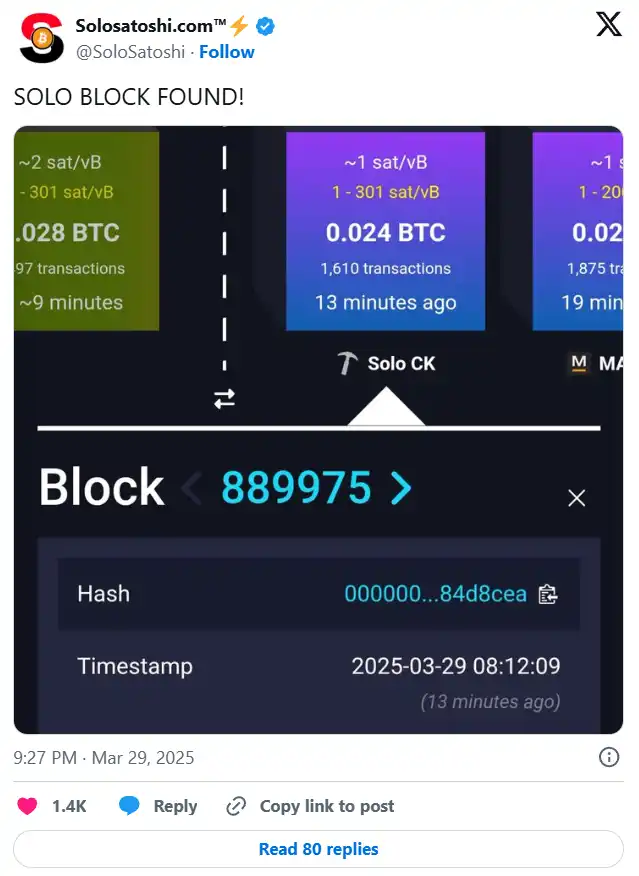
Scott Norris, CEO of the independent mining firm Optiminer, bluntly states that solo mining still feels like "buying a lottery ticket."
According to data, in 2022, there were 7 successful block mines through Solo CKPool (a service platform that allows anonymous users to mine without running a full node); this number increased to 12 in 2023 and reached 16 in 2024.
It is worth noting that Solo CKPool is not a traditional mining pool. Despite the name including "Pool," it only provides an entry point. Once a miner finds a block, they can take away the vast majority of the reward themselves. However, this does not mean that blocks mined through Solo CKPool are mined by a single individual sitting in their bedroom using very low hashing power. There is a significant misconception about this on some platforms, with some people even promoting this view vigorously without data to support it.
The current mining pool industry is still dominated by a few giants, such as Foundry, AntPool, and F2Pool. Miners typically join these large pools, share hashing power, and distribute rewards proportionally. Miners accessing Solo CKPool can keep almost all of the rewards for themselves.
As the Bitcoin network continues to grow, the search for the computing power and resources needed to find a block has become increasingly competitive. As a result, most mining activities are now industrialized operations run by publicly traded companies on a global scale. Some Bitcoin core supporters believe this is detrimental to Bitcoin's decentralization.
Today, some hobbyist mining devices like Bitaxe and FutureBit Apollo, priced between $200 and $500, are gaining popularity among Bitcoin extremists. In January of this year, a FutureBit Apollo successfully mined a block — albeit under the condition that a nonprofit organization donated hashing power to it. An anonymous miner known as Econoalchemist wrote on X at the time that the organization's goal was to "break the proprietary mining empire and make Bitcoin and free tech available to all."
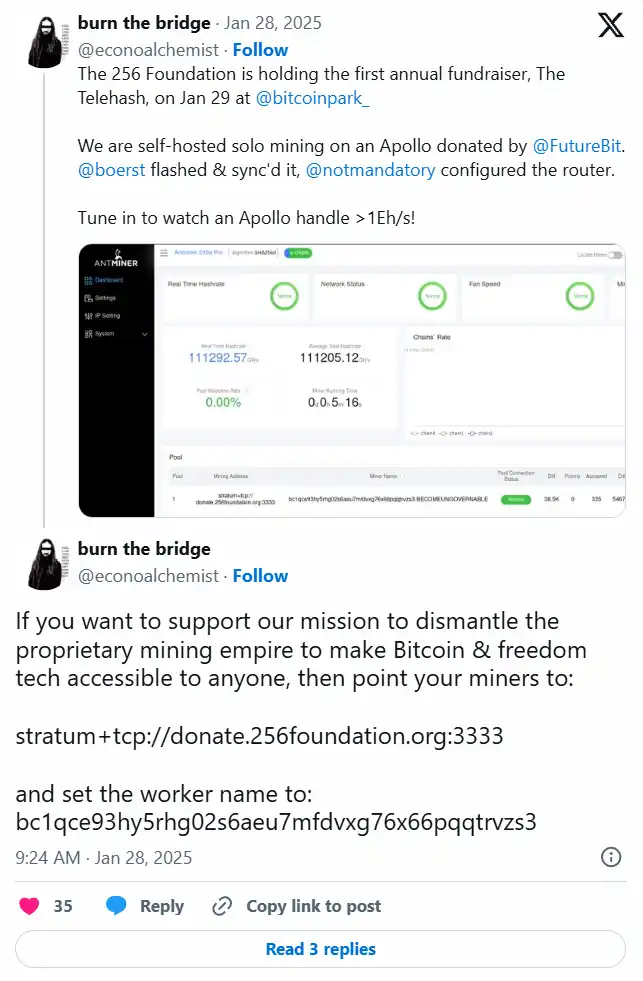
While the probability of success is extremely low, it may be that the increasing number of "amateur miners" is driving a significant increase in individual mining success rates. Econoalchemist pointed out that the trend of independent miners' success has become more pronounced in recent years. "Every so often (and more and more frequently), a small device like Bitaxe quietly running in a corner of someone's home suddenly hits a block," he said.
Norris from Optiminer added that it could also be the case that some large institutions mine blocks with their own computing power without joining large mining pools — appearing "independent" in form but not in reality.
Even Solo Satoshi, a company based in Houston, Texas, that sells mining devices like Bitaxe Gamma, states on its website that the probability of mining a block with a $180 device with a hash rate of 1.2 TH/s is only 0.00068390% per day.
But Matt Howard mentioned that engaging in solo mining is not necessarily about making money. "The main goal is to promote decentralization. Finding a block and getting Bitcoin is just a bonus," he said. "For Bitcoin extremists, mining must be decentralized."
You may also like

10 Counterintuitive Insights on Latin American Payments

Perp DEX: The Next Generation Exchange "War"

The AI gamble of mining companies: Valuations enter a phase of differentiation, and it's hard to turn the tide

A letter from Alliance to entrepreneurs: Written on the occasion of Cursor selling for 60 billion dollars

Stablecoins Finally Find Real Returns: On-Chain Reinsurance Re Explained | Interview with Re Founder Karan Saroya

The impossible triangle is simply a pseudo problem

Will MicroStrategy fall into a death spiral? What will the macro trend be in the second half of the year?

Blockchain Capital Partner: The Core Secret of Arbitrage
STRC unanchored by 11%, can the perpetual motion machine of Strategy still operate?

Bitcoin Market Analysis 2026: Can BTC Reach $150K by Year-End?
Bitcoin ETF Outflows Hit a Record $4.4 Billion: What Are Traders Doing With Their Cash?
WEEX App Just Got Smarter – New Tabs for Faster Trades & Easy Asset Management

WEEX All-New Search Features: Find, Trade & Earn Faster Than Ever

Morning Report | Illinois signs the strictest digital asset tax law in the U.S.; RWA tokenization market size surpasses $43 billion, institutions accelerate the migration of on-chain assets
Full version of the debut Q&A! Federal Reserve Chairman Waller: Sticking to the 2% inflation target, establishing five special working groups, individual did not submit the dot plot

From Disruptor to Shadow Market: The Crypto Market is Becoming a Colony of Traditional Finance
Dalio's important long article: How to position in the current market environment?
OKX Star analyzes Binance's competitive advantages: when regulation levels the playing field, competition has just begun
10 Counterintuitive Insights on Latin American Payments
Perp DEX: The Next Generation Exchange "War"
The AI gamble of mining companies: Valuations enter a phase of differentiation, and it's hard to turn the tide
A letter from Alliance to entrepreneurs: Written on the occasion of Cursor selling for 60 billion dollars
Stablecoins Finally Find Real Returns: On-Chain Reinsurance Re Explained | Interview with Re Founder Karan Saroya
The impossible triangle is simply a pseudo problem


