
 Buy Crypto
- Markets
 Futures
- Spot
- Copy Trade
- Earn
- More
Interpreting Binance Launchpool Project RedStone: A Dark Horse in the Oracle Race Combining Utility and Innovation

Original Author: Poopman
Original Translator: CryptoLeo, Odaily Planet Daily
Editor's Note: Today, according to official sources, Binance Launchpool will launch the 64th project, RedStone (RED), which is a cross-chain oracle spanning EVM and non-EVM chains. Its tokenomics have also been revealed: Launchpool holds 4% of the total token supply, with the initial circulating supply accounting for 28%. This article provides a detailed introduction to RedStone, comparing its advantages and differences with other projects in the same field, and offers a price prediction for the token. The full article reprinted by BlockBeats is as follows:
While the crypto market has been dominated by Meme, Meme, and more Meme in recent months, compared to the end of 2024, the Meme hype has taken a very "twisted" turn, from Trump launching a coin to the recent "Libra scandal," and the market sentiment surrounding Meme has also declined accordingly. Please refer to the graph below for details:
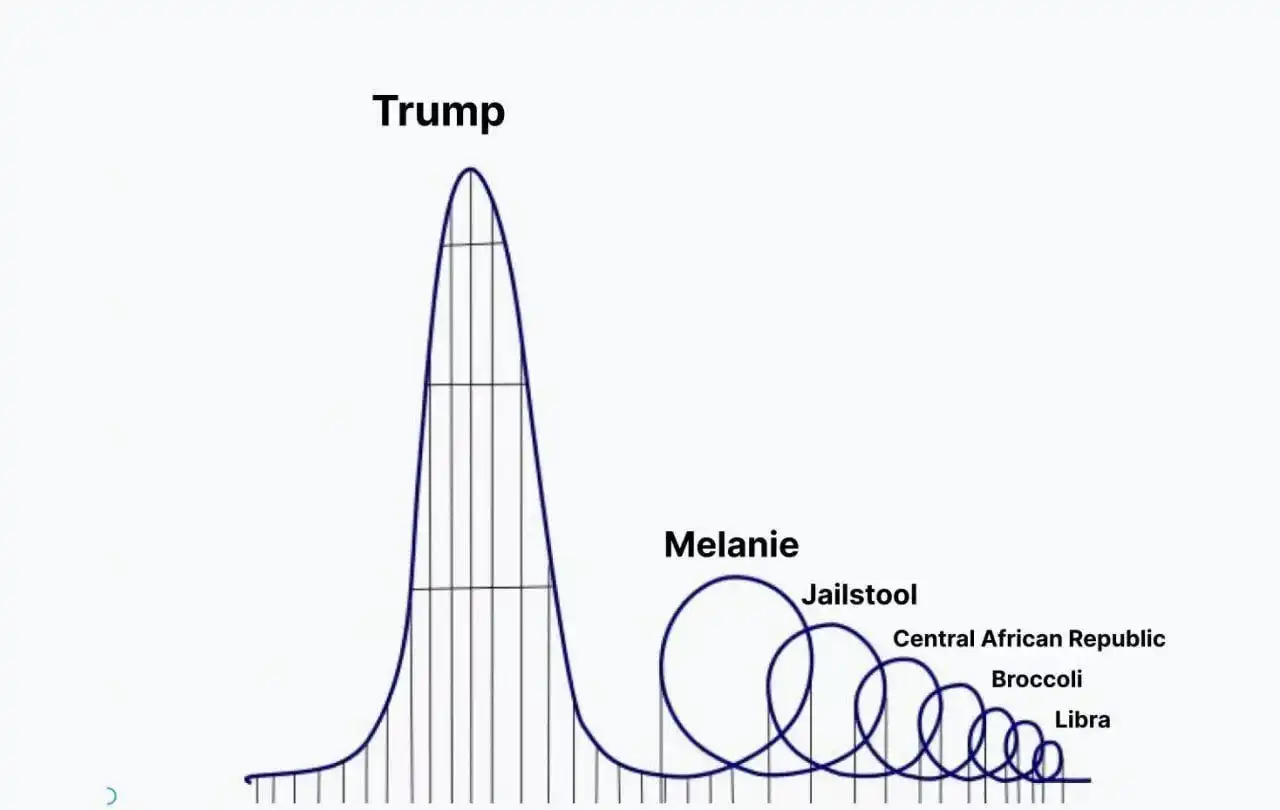
From a data perspective, since the launch of the LIBRA token, pump.fun's daily trading volume (including buying and trading newly issued tokens) has decreased by 33.7% from $184 million to $122 million. Apart from the trading volume, pump.fun has experienced stagnation in other aspects. On Tuesday, the platform registered only 59,000 new wallets, marking a low point since November 17, 2024. Compared to the day of the presidential inauguration of Trump last month, the platform had around 110,000 active wallets. Looking back at the "twisted Meme" phase now, one can't help but miss the AI Agent Meme era a few months ago, but PvP is not the endgame of blockchain—practicality and innovation are the industry's perennial topics.
One of the projects that I personally have a positive outlook on, combining utility and innovation, is the oracle project RedStone. The project completed a $15 million Series A funding round in July 2024, and released its tokenomics a week ago. DeFi KOL Poopman wrote about RedStone yesterday, analyzing its advantages and potential from several angles such as RedStone's advantage in modularization, market share, and tokenomics. Odaily Planet Daily's translation is as follows:
TL;DR
-RedStone's modular architecture, AVS scalability, strong security, and ultra-low latency make it one of the most trusted and fastest oracles in the ecosystem.
-By 2024, with $3.8 billion TVL and over 100 partners, RedStone has become the second-largest oracle provider in the space.
-During the $20 billion settlement and Renzo (ezETH) decoupling in 2024, RedStone demonstrated faster price feed updates, low latency, high stability, and accuracy compared to other oracles.
-Its token RED is a utility token that derives value from data and price feed services. To enhance capital efficiency, RED can be staked as LRT deployed in various DeFi protocols to earn additional rewards.
-Based on Pyth's $20 billion FDV, the estimated USD trading price for RED is around $2. The tokenomics place a stronger emphasis on community growth, with 70% of the tokens locked up within the first 12 months.
The current market cycle has deviated from fundamentals for some time, and it is widely recognized that this is unhealthy for the long-term development of the industry. Many tokens we are familiar with today are merely bubbles or memes, while innovative protocols with real-world demand and widespread adoption potential remain overlooked.
Recently, RedStone Oracle announced their RED token's upcoming TGE. Their tokenomics aim to provide more value to users or token holders.
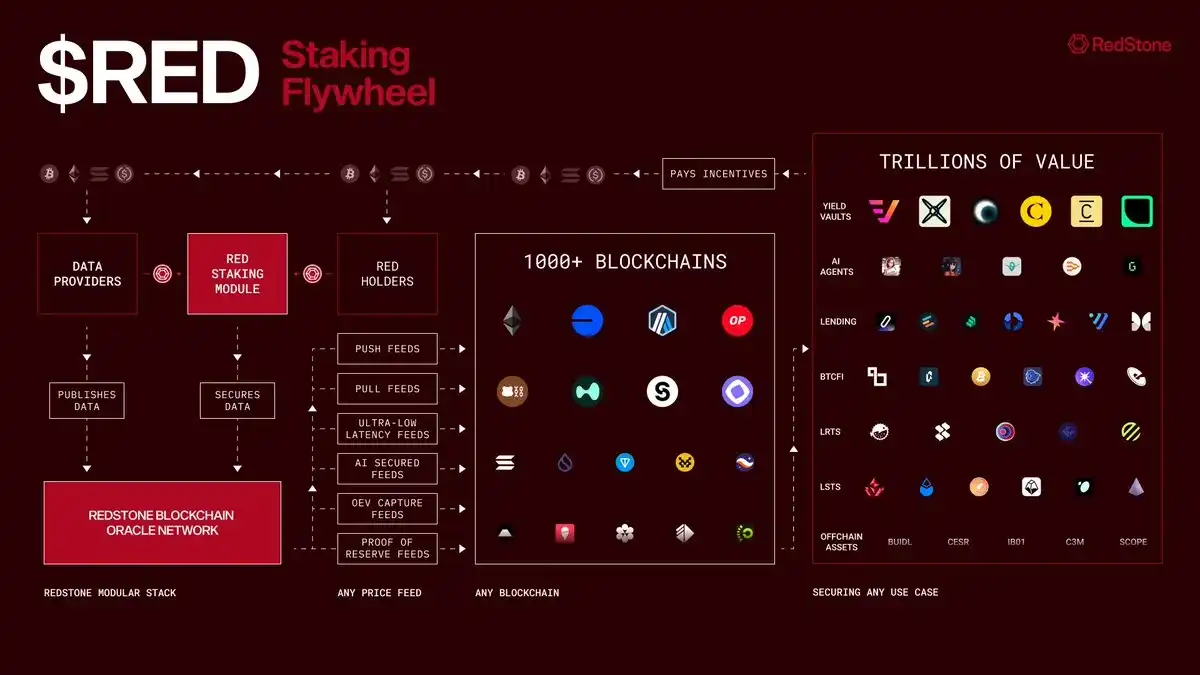
In this article, the author will analyze RedStone's strengths and potential from 5 perspectives:
-RedStone's Features
-RedStone Market Adoption
-Comparison with other oracles
-RED Tokenomics
-RED Potential Valuation
Why is RedStone Better?
As we all know, an oracle is one of the most critical components of blockchain. Without an oracle, a blockchain is merely a closed ecosystem with no access to external data sources. In today's market, every chain and dApp requires an economically efficient, secure, and flexible oracle.
And I believe RedStone has successfully filled this gap.
In recent years, RedStone has integrated and provided price oracles for hundreds of Tier 1 protocols from day one. This includes USDe, Pendle, Morph Blue, Berachain, EtherFi, and Lombard BTC. But what makes RedStone the favorite of many projects?
The reason is simple: security and modularity.
Security Under AVS
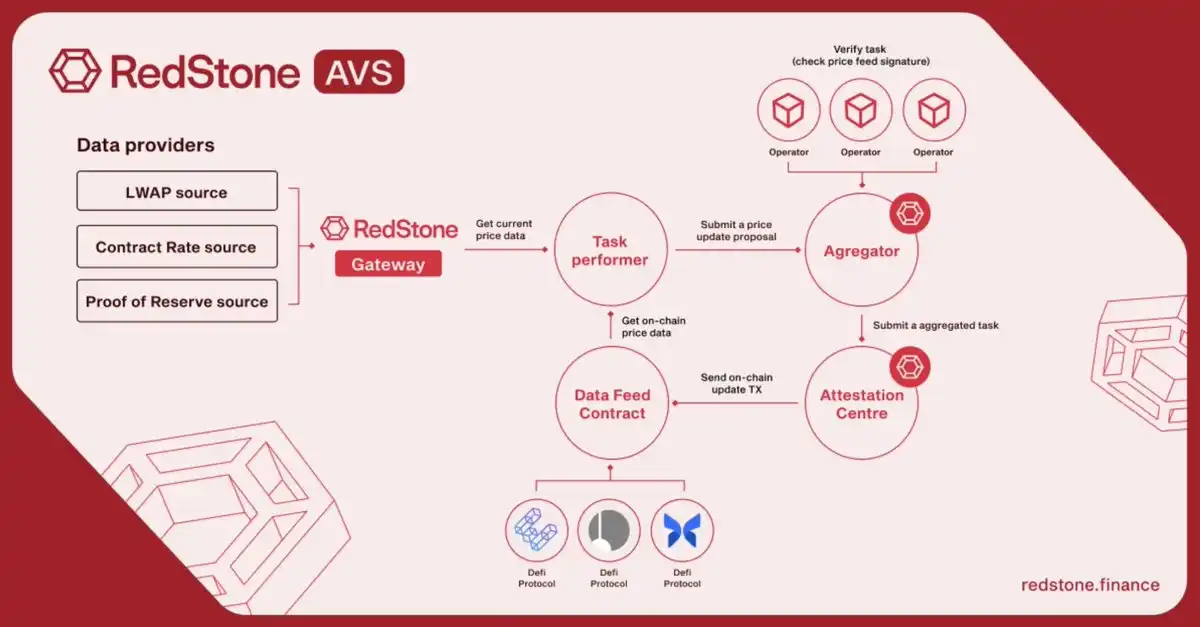
Unlike other oracles, RedStone can achieve more efficient gas spending and scalability by using the EigenLayer AVS framework to validate the accuracy and validity of price feed data.
Odaily Note: AVS stands for Actively Validated Service, which is the most important concept in the Eigenlayer ecosystem. AVS is simply a protocol, service, or system that requires staking to validate a "task." The AVS service itself undertakes the work of fetching prices and reporting prices, while AVS corresponds to its service management contract — Service Manager, which communicates with the Eigenlayer contract and contains the state related to service functionality, such as the operator running the service and the amount of deposit used to protect the service.
The traditional oracle price feed model works by collecting data from various sources and validating it through a Data Definition Language (DDL) and a data consumption module. Due to the on-chain verification process requiring significant gas fees, it becomes quite expensive. With RedStone's AVS, RedStone can provide highly optimized validation gas by processing data off-chain.
The process is as follows: AVS operators fetch market prices and TWAP rates through the data source module, validate their accuracy, and then provide the validation results back on-chain.
Since most of the computation is done off-chain and maintained trustworthy and validated through AVS, RedStone offers a more cost-effective oracle solution compared to other solutions in the space.
Modularity
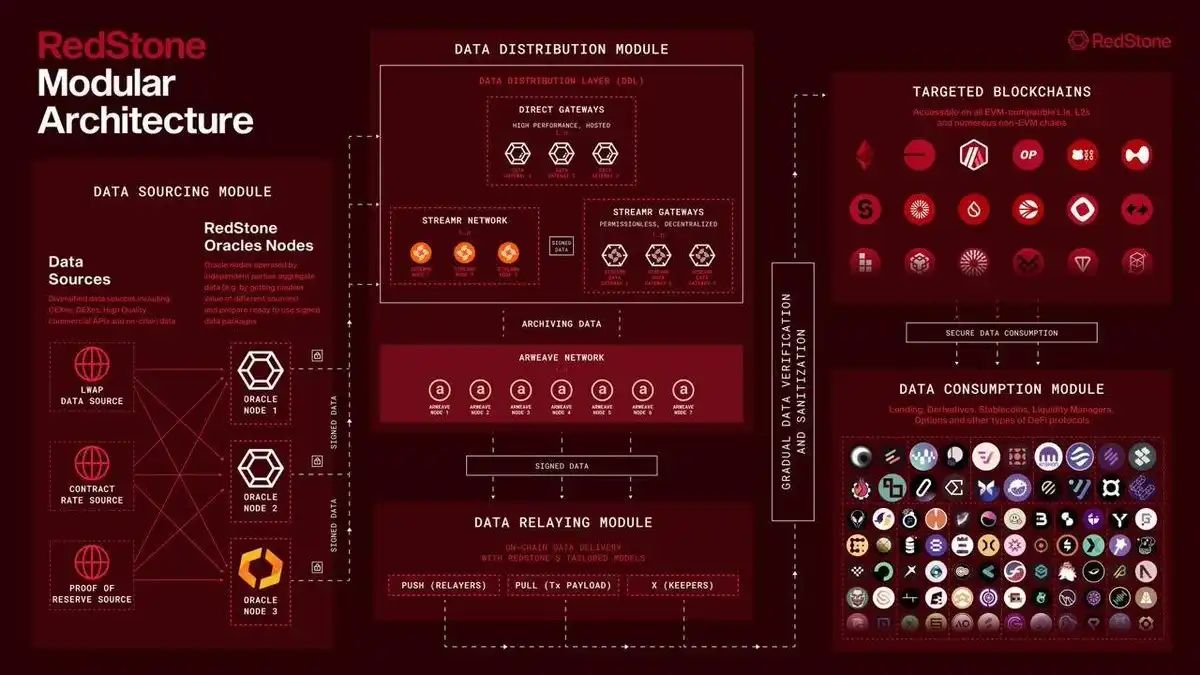
In addition to scalability, modularity is one of RedStone's key advantages. The platform's modules support both pull and push modes. To offer projects greater flexibility, they can choose between a managed or raw oracle data source based on their specific needs. Projects can opt for carefully filtered and validated price feeds or customizable raw data streams to protect their assets.
Odaily Note: The pull model and push model are illustrated below:
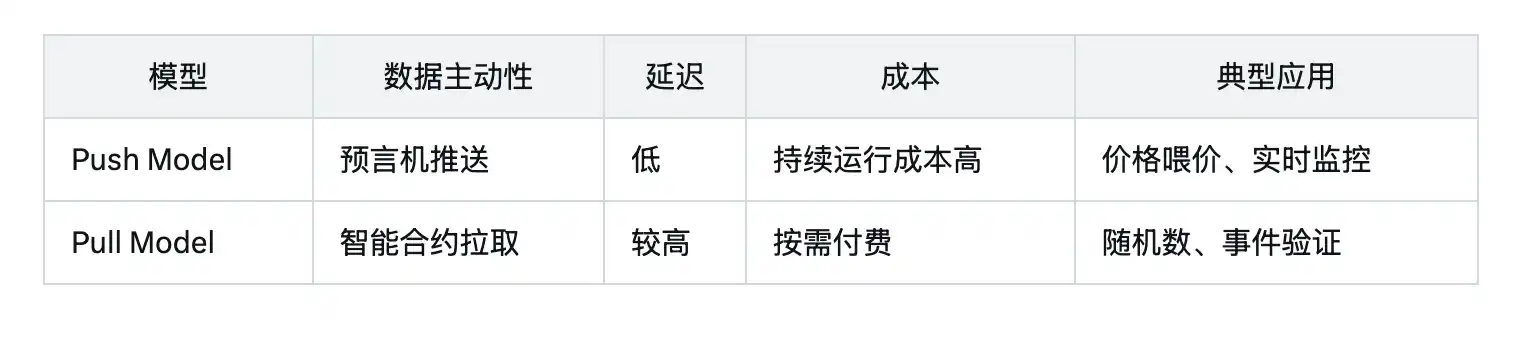
Due to its modular architecture, RedStone infra allows for seamless swapping of components from different systems without compromising system performance or reliability. The plug-and-play nature of the modular design has made RedStone one of the most widely used oracle solutions in today's DeFi innovation and emerging chain systems.
Market Metrics
Customer Growth
RedStone's modular, plug-and-play architecture has driven user growth, establishing it as one of the fastest-growing oracle solutions in the blockchain space.
Throughout 2024, RedStone significantly expanded its footprint, partnering with over 100 new clients and deploying on over 30 chains. With over $6.8 billion TVL, RedStone has become the second-largest multi-chain oracle provider in the industry, while Chainlink remains primarily focused on the ETH ecosystem.
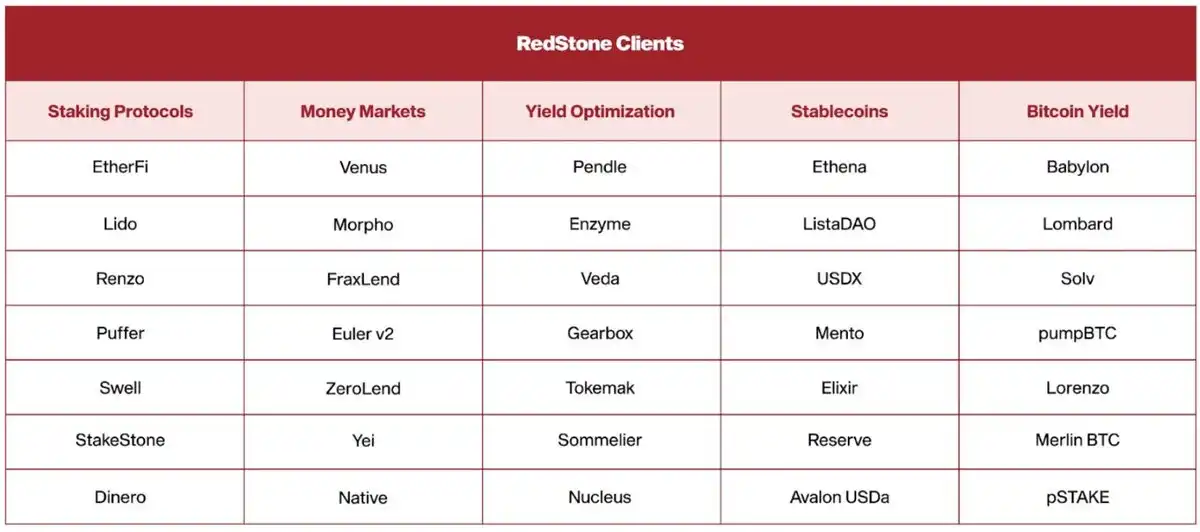
The platform's reputation for reliability continues to attract mainstream DeFi participants. Notable partners include securing $3 billion TVL for Spark (Maker's lending protocol) and providing price feeds for Pendle, Ethena, and other DeFi leaders, as well as various BTC collateral, yield stablecoins, LST, and LRT. The client roster reflects industry confidence in RedStone's reliable and customizable oracle solution.
Price Feed Speed (Low Latency)
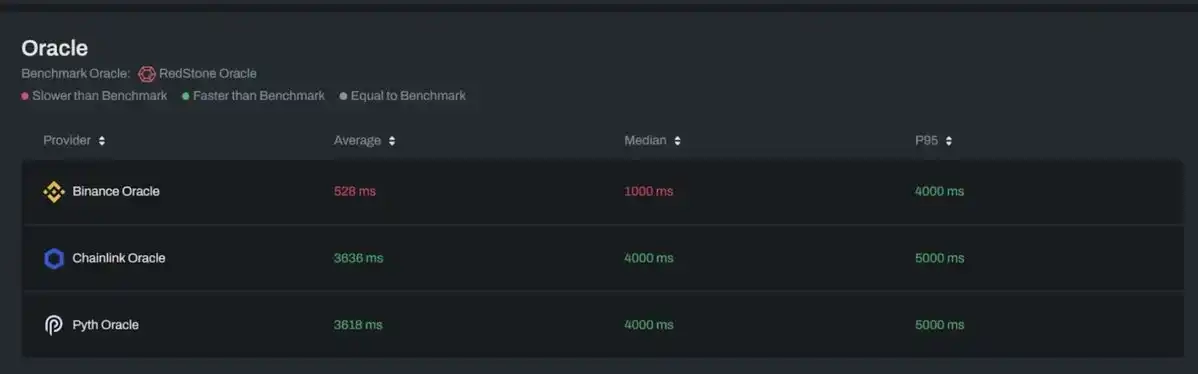
RedStone is considered one of the fastest and most reliable oracles in the field while maintaining decentralization, which is seen as a trilemma. In terms of speed, RedStone's update velocity surpasses that of most centralized oracles (only slightly slower than Binance). RedStone is able to compete with CEXs in speed while retaining decentralization, which is quite impressive.
Stability
RedStone has also demonstrated stability in market volatility, maintaining consistent and accurate price feeds during key moments. During the $2 billion liquidation event in February 2024, RedStone successfully delivered 119,000 updates within 24 hours, with the updates for ETH/USDC price exceeding Chainlink by 30 points, providing more accurate price updates.
In a proven case, during the Renzo (ezETH) decoupling in April 2024, RedStone was able to keep up with price changes better than Chainlink. RedStone issued approximately 40 price updates within just 3 blocks, while Chainlink only pushed around 20 updates during the same period. This indicates that RedStone is actually faster than the market-leading oracle provider. For more details, refer to the Chaos Labs report.
Comparative Advantage: Every oracle project has its own strengths, but RedStone combines the best features into one.
RedStone vs. Other Oracle Differential Comparison
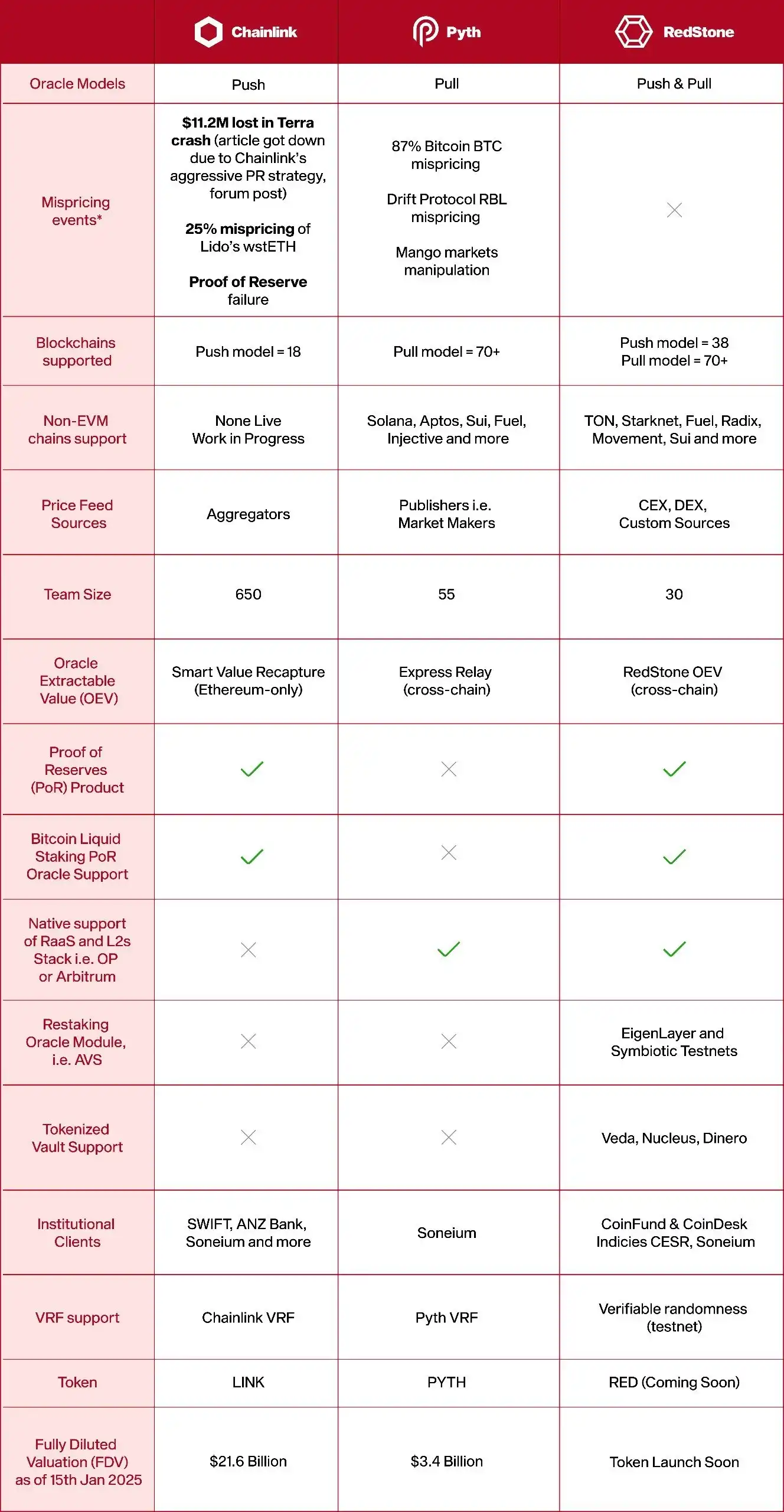
Below is a brief overview of mainstream oracle projects in the current market:
Chainlink: Mainly focused on EVM, OG DeFi, primarily using a push model, providing reliable data through bridging with CCIP and expensive integration setups, supporting only a few blockchains;
Pyth: Mainly targeting non-EVM, Perps market, predominantly using a pull model, utilizing Wormhole as a cross-chain relay, focusing on data feed quality;
RedStone: Any chain, any market, offering push model and pull model, utilizing eigenlayer AVS for cost-effective on-chain validation, featuring reserve proof for wrapped BTC assets, and more.
The following diagram illustrates a differential comparison between the three key oracle providers in the market:
Upcoming TGE, RED Tokenomics
As RedStone expands to thousands of on-chain protocols, the RED token will play a crucial role in decentralized oracles and capturing value from all integrated projects. RedStone's data providers (operators) have full flexibility — they can set any collateral, charge any fees (in any token), or establish any requirements they desire.
RED will serve as a utility token, and holders will be able to stake and delegate it to data providers to receive a certain portion of fees and rewards.
Furthermore, RED will also allow for re-staking, enabling its LRT to be used in any DeFi protocol to unlock additional economic value (similar to stETH).
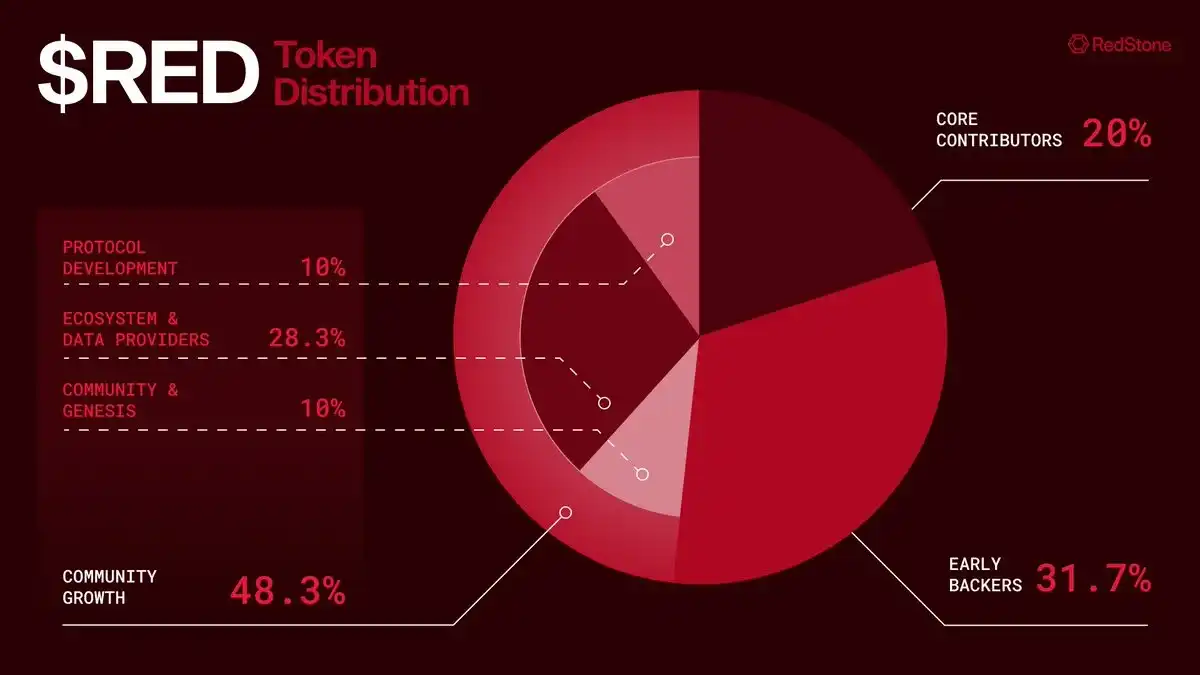
Official data indicates that the total token supply of RED is 1 billion. Of this, the initial circulating supply accounts for 30%. RED will be issued as an ERC-20 token but can later be bridged to Solana, Base, and all other supported networks through the Wormhole native transfer standard.
RED's design is community-centric: a large portion of the token supply (48.3%) will be allocated to a community growth plan, including airdrops, future donation plans, and incentive mechanisms, with 20% allocated to core contributors;
To ensure the long-term sustainability of RED, 70% of RED tokens will be fully locked for 12 months after TGE and gradually unlocked over the following 36 months.
As the RedStone customer base grows, operators will receive more fees, increasing the revenue for RED token holders. Higher yield will lead to a higher token staking rate, ultimately forming a positive feedback loop.
RED Token Valuation
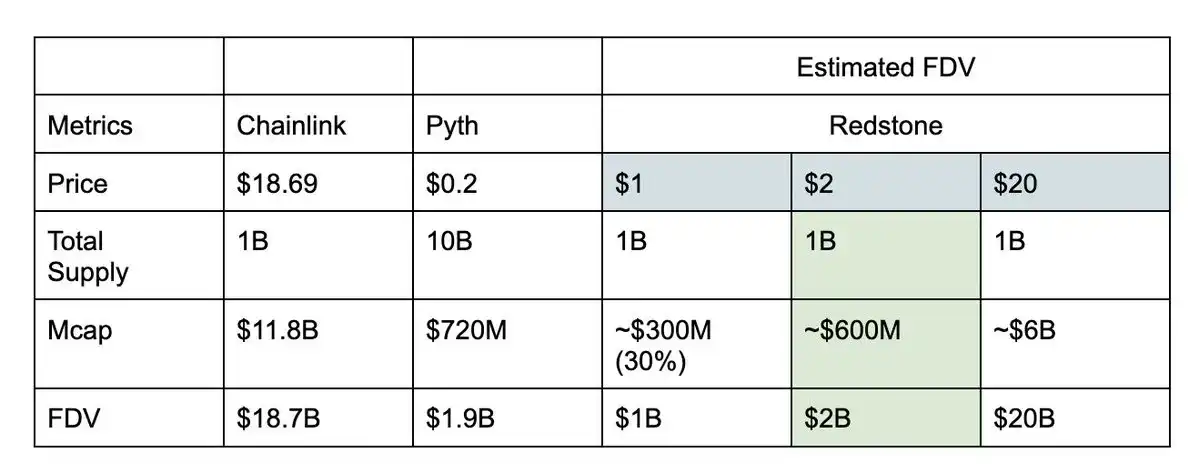
Leading oracle projects in the market have FDVs in the tens of billions of dollars. By comparing RedStone to Chainlink and Pyth, both leading oracle protocols, a better estimate of the RED token price can be inferred:
In the case of a total token supply of 1 billion tokens, an initial price of $1 would result in RedStone's FDV reaching $1 billion. However, considering the current market positioning of the project, $1 seems somewhat conservative.
A better valuation estimation is to compare it with Pyth's $20 billion FDV, taking into account the 30% initial circulating supply, resulting in a price of $2 per token, which is also the RED token price I expect.
If the market conditions improve, RED may achieve Chainlink's FDV, and the token price could rise to $20 per token.
You may also like

Arthur Hayes New Post: It's "No Trade" Time Now

Claude Opus 4.7 Review: Is It Worthy of the Title of Strongest Model?

DWF In-Depth Report: AI Outperforms Humans in Yield Farming Optimization in DeFi, But Complex Transactions Still Lag Behind 5x
The financial tricks of the crypto giant Kraken

When proactive market makers start to take initiative

Massive Whale Movement: Unstaking $84.96 Million in HYPE Tokens
Key Takeaways A crypto whale, known as TechnoRevenant, has unstaked approximately $84.96 million in HYPE tokens. The tokens…

ListaDAO Addresses Third-Party Contract Vulnerability Concerns
Key Takeaways GoPlus Security revealed a vulnerability in a contract resembling those of ListaDAO. ListaDAO confirmed that their…

Security Risks of Fake Ledger Nano S+ Devices Emerging Through Chinese E-Commerce
Key Takeaways Counterfeit Ledger Nano S+ devices are being sold on Chinese e-commerce platforms, posing significant risks to…

Wave of Cyber Attacks Hits DeFi Protocols Post-Drift Hack
Key Takeaways A significant $280 million attack on Drift Protocol set off a chain of security breaches across…
Tom Lee Says ‘Mini Crypto Winter’ Is Over, Sees Ether Above $60K
Key Takeaways: Tom Lee predicts Ether’s resurgence, projecting it to surpass $60,000 in the coming years. Bitmine suffered…

French Government Tackles Rising Crypto Safety Concerns
Key Takeaways: France is intensifying measures to counter the surge in crypto kidnappings and wrench attacks. Since early…
Europe’s Bitcoin Treasury Playbook Unlikely to Mirror US Strategy: PBW 2026
Key Takeaways: European firms are adapting unique Bitcoin treasury strategies due to distinct financial regulations and market dynamics…
Circle Confronts Lawsuit Over $280M Drift Protocol Hack
Key Takeaways: Circle faces a lawsuit for allegedly aiding in the transfer of $230 million in stolen USDC.…
Bitcoin Faces ‘Near-Term Selling Pressure’ Following Surge to $76K: CryptoQuant
Key Takeaways: Bitcoin reaches a multi-month high of $76,000, prompting increased deposits to exchanges. CryptoQuant identifies a peak…

Ethereum Foundation Unveils North Korean Infiltration in Web3
Key Takeaways: The Ethereum Foundation’s ETH Rangers program exposed 100 North Korean operatives infiltrating Web3 companies. The Ketman…

Crypto in Sustained Winter as CEX Volumes Drop 39% in Q1
Key Takeaways: Centralized crypto exchange trading volume fell by 39% in Q1 2026 to $2.7 trillion. March saw…

Bitcoiners Should Prepare for Quantum Computing Now, Urges Adam Back
Key Takeaways: Adam Back emphasizes immediate steps toward quantum-resistant solutions for Bitcoin. Quantum computing may disrupt blockchain security…

Cybersecurity Alert: Counterfeit Ledger Devices on Chinese Market
Key Takeaways: Scammers distribute fake Ledger devices via Chinese marketplaces, risking user crypto assets. Victims of a related…
Arthur Hayes New Post: It's "No Trade" Time Now
Claude Opus 4.7 Review: Is It Worthy of the Title of Strongest Model?
DWF In-Depth Report: AI Outperforms Humans in Yield Farming Optimization in DeFi, But Complex Transactions Still Lag Behind 5x
The financial tricks of the crypto giant Kraken
When proactive market makers start to take initiative
Massive Whale Movement: Unstaking $84.96 Million in HYPE Tokens
Key Takeaways A crypto whale, known as TechnoRevenant, has unstaked approximately $84.96 million in HYPE tokens. The tokens…



 App
App