
Interview with Little Z: CEX Business Insights from an "Listing Expert" | Conversation with KOL





Since October, CEX listing has become a new art. Whether it's ACT, PNUT, or MOODNEG, countless people have become wealthy overnight due to the listing of these new coins. Every wave of players who anticipate the listing of these potential gems holds their breath when CEX makes an announcement, hoping to be the lucky one.
However, apart from early speculation, there is another group of players, similar to little Z, who focus on studying CEX announcements, forming a "listing announcement trading" strategy. Leveraging their understanding of CEX, little Z has not only successfully speculated on some potential listing targets (such as CAT MOODNEG) but has also earned significant profits after CEX announcements (such as PEPE, ACT, OL). Thus, Blockbeats specifically interviewed little Z about the lesser-known practice of announcement trading.
Blockbeats: Since when have you been paying attention to "announcement trading"?
little Z: I entered the market in the previous bull run, around 2021, so I can be considered a seasoned player who has experienced both bull and bear markets. In 2022, I came across an article by the founder of a project on Zhihu (Chinese Q&A website), which was inspired by Vida's article on Zhihu. This inspired me to start researching CEX announcements. In fact, announcements present many opportunities that are often overlooked. For example, during the previous bull market, the listing effects of exchanges like Binance and Coinbase were significant, and many people profited by speculating early. Some individuals also chased after announcements as soon as they were made public and achieved favorable outcomes.
Moreover, during the 2021 bull market, there weren't as many VC coins as there are in this bull run. For instance, some projects listed on certain CEXs would have a market cap in the hundreds of millions or tens of billions upon listing, only to rug pull later on. At that time, many projects started with market caps of just a few million or tens of millions, allowing these "announcement traders" to earn substantial profits by speculating early. Some smart money would explore vulnerabilities in announcements, identify them in advance, and invest. In this current bull run, the listing effects of Upbit and Binance have been positive, but it appears that there isn't as much attention from the Chinese community. I believe that this field is still relatively untapped, so I started researching this type of content later on. However, the tactics in this bull run are quite different from the previous one. The listing effect of Coinbase in this run isn't as strong, and there are few low-cap projects launching on exchanges.
Blockbeats: Could you provide some examples of testing vulnerabilities? And how does smart money discover these vulnerabilities?
little Z: I'll give a few straightforward examples of vulnerabilities. The first vulnerability is engineer oversight. Let's take a certain CEX as an example, which not only has a main webpage but also various announcement pages. For instance, when they want to announce a listing, they will publish it on the announcement webpage. Therefore, there are many interfaces on different websites, and sometimes developers or test engineers may overlook certain things. For example, if they had planned to release a listing announcement at 10 p.m., but the backend leaked the news at 9:50 p.m., and the official announcement was made 10 minutes later, this is a common vulnerability.
Another example is the vulnerability of a test engineer. For example, a CEX's test engineer may like to repeatedly test coins on the same wallet for a particular chain. For instance, if a CEX needs to test a B token on the Solana chain, and the engineer previously tested an A token. So, this wallet may be the one the test engineer has been using all along. Thus, some experts on the chain may capture these test wallets to obtain potential listing information.
Blockbeats: How do you view the listing effect of this round of Coinbase? Why is it much worse compared to the previous round?
Little Z: The performance of Coinbase in this round is indeed not as impressive, and the beneficial effect is not as strong as it used to be. I think this is mainly due to regulatory reasons. However, there are still some coins with a good listing effect. For example, in the RWA sector, ONDO initially listed on Coinbase and then rose by over ten times. Another example is AERO; Aerodrome Finance is a DEX on Coinbase. When it first went live earlier this year, the price was only 0.09. After the listing, the price continuously increased, reaching a high of 2.3 USD, representing a roughly 20-fold increase from the bottom. Of course, this is also attributed to their relatively low market cap after listing. For instance, AERO initially had a market cap of only 10 million USD, making it easier to drive up the price.
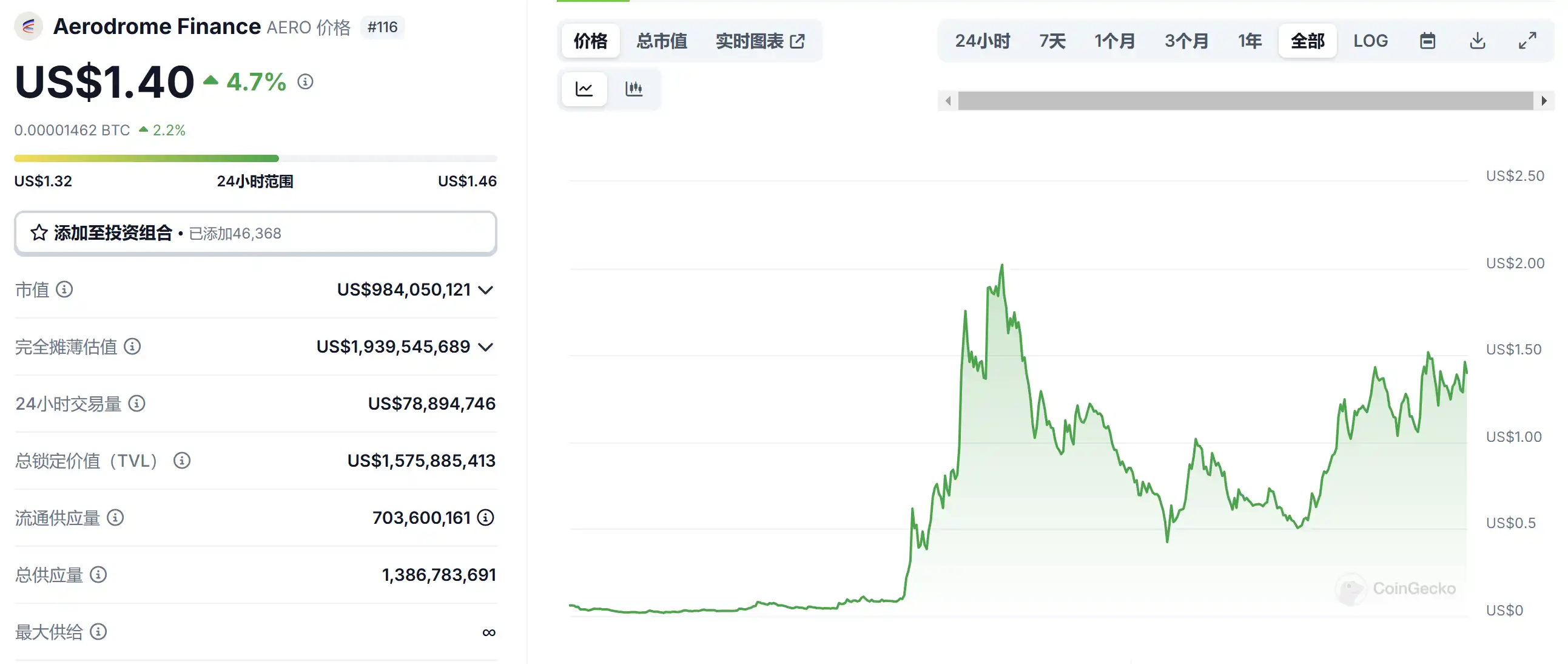
In addition to some low market cap opportunities, there are also opportunities in some high market cap listings, such as some meme coins that got listed. For example, PEPE surged by 50% shortly after listing on Coinbase. Of course, there are also other factors at play, such as Upbit and Robinhood. However, meme coins with higher market caps like WIF and FLOKI also experienced over 30% price increases after listing on Coinbase. Overall, while opportunities still exist, the listing situation in this round of Coinbase is relatively average, possibly due to regulatory reasons. Nevertheless, the bull market brought about by Coinbase this time has sparked a wave of innovation on the base layer. If Ethereum still has a chance, the only savior lies in the base layer ecosystem. All the interesting innovations in the Ethereum ecosystem, such as new concepts like AI pump.fun, have flourished on the base layer, while most innovations on other L2 chains have basically stalled.
Blockbeats: What aspects are you currently researching the most in public announcements?
Little Z: During the previous bull market, I was still a newbie DeFi retail investor, and I just randomly researched various topics, from leverage and smart contracts to blockchain games. In fact, I only started researching announcement-related information from the 23rd to the 24th bull market cycle. My friend developed an announcement monitoring program similar to Formula News, which can track more announcement information from CEXs. Apart from the top-tier CEXs, some second-tier CEXs are also being monitored.
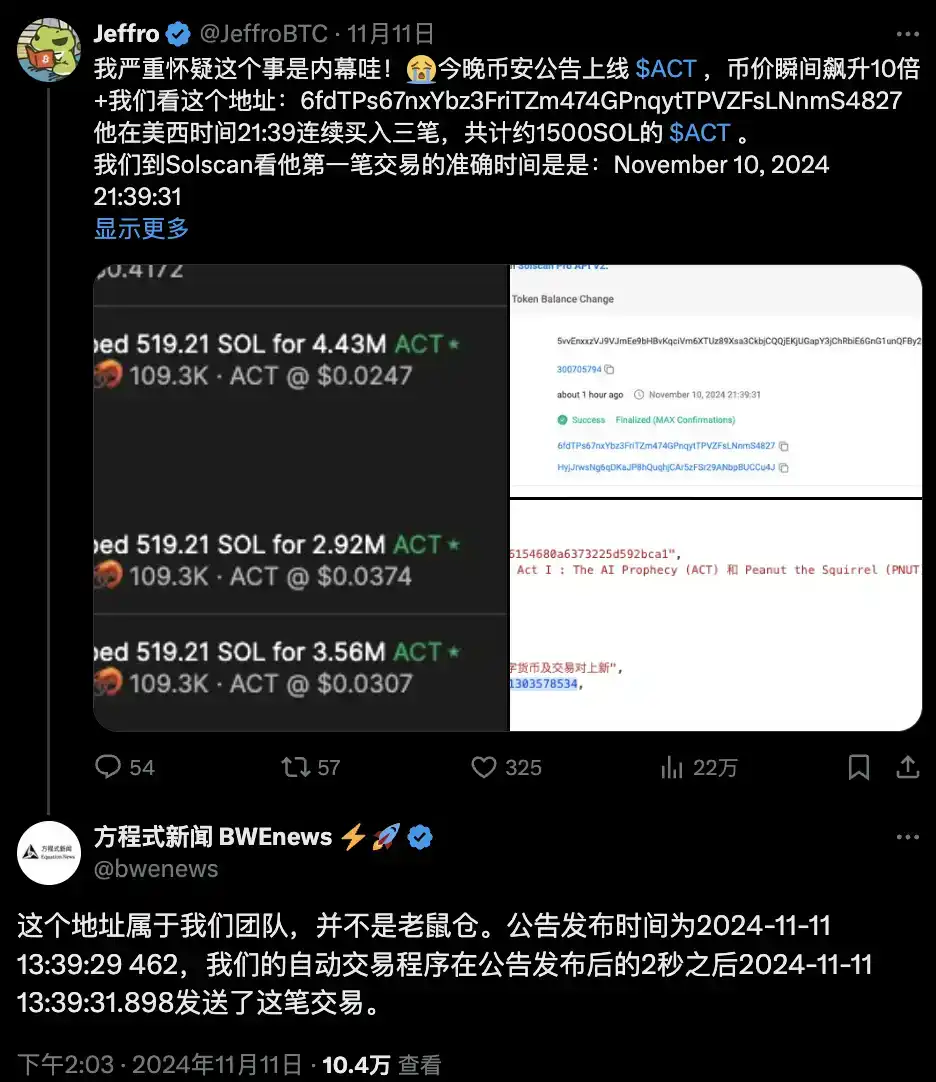
After each CEX announcement, I would research it to see if there are any opportunities. I study the content of the announcement and the news effect, and then constantly review. Later, I gradually learned about news trading, or what is now more commonly referred to as sentiment trading. For example, everyone is more familiar with Formula News, and through this "news trading," they made millions of dollars from ACT. Of course, the Formula trading method requires some technology and may not be suitable for everyone to apply this strategy. So, I started to carefully study some manual trading opportunities, which are more friendly to players who do not have much technology.
For example, there was a case of a capitalization dispute with a16z's Eliza before. In fact, its logic is similar to that of Neiro, but the latter launched on the top-tier CEX. Can it be replicated? I think not necessarily. Eliza also had controversies between the "community" and the "conspiracy group," with both sides fiercely debating. At that time, the uppercase ELIZA was much more hyped compared to the lowercase, and many people, relying on Neiro's previous logic, were pushing for the lowercase, leading to many people getting stuck. At the initial stage of the debate, I did not get involved and kept observing. The decisive moment of this event was when I saw in the HTX announcement that HTX was going to list in lowercase, so that's when I started to get involved. Because this indicated that CEX supported lowercase tokens. The result was indeed that the lowercase eventually surpassed the uppercase.
It's not just the few top CEXs; every CEX announcement holds a hidden clue, but it needs to be analyzed in conjunction with specific hotspots, the overall environment, token fundamentals, and other factors, with each situation requiring a specific approach.
Blockbeats: Can you introduce to us a few more examples of "announcement trading"?
Little Z: Of course. For example, there have been many opportunities in the recent announcements on OKX. For instance, the token OL, which I bought at a price of 0.025 and then sold at 0.1, was an opportunity that very few people actually noticed. On November 18, OKX announced the spot trading of Openloot's native token OL. The deposit was open at 2 p.m. on the same day, a fixed-price trading session from 8 p.m. to 9 p.m. on November 19, and the opening at 9 p.m. Most people stop at this point, or maybe don't even bother to read the announcement. Let's look at the fundamentals of Openloot. Openloot is a NFT trading platform under bigtime games, where users can use OL as a payment method when purchasing or leasing NFTs, purchasing time crystals, and other high-end currencies or buying NFTs from major sales. OL initially only had a circulation of two billion out of a total of 50 billion, making its initial circulation rate very low. When the bigtime game token was first listed, it had a very low opening price. However, bigtime initially restricted regions; Chinese nationals were not allowed to trade directly but had to place orders through an API or deposit bigtime into the exchange, causing many people to be unaware of it. It opened at 0.002 and rose several tens of times within a day.
Therefore, after research, I believe OL has the same low opening gene as bigtime. At the auction stage on November 19, OL's auction price was around 0.02 (finally opening at around 0.025). Based on 0.02, OL's market cap at the circulation was only $4 million. In other words, even if you didn’t get cheap OL chips in the auction, but OL also maintained a market cap of about $10 million for a long time after opening, the risk-reward ratio was still considerable.
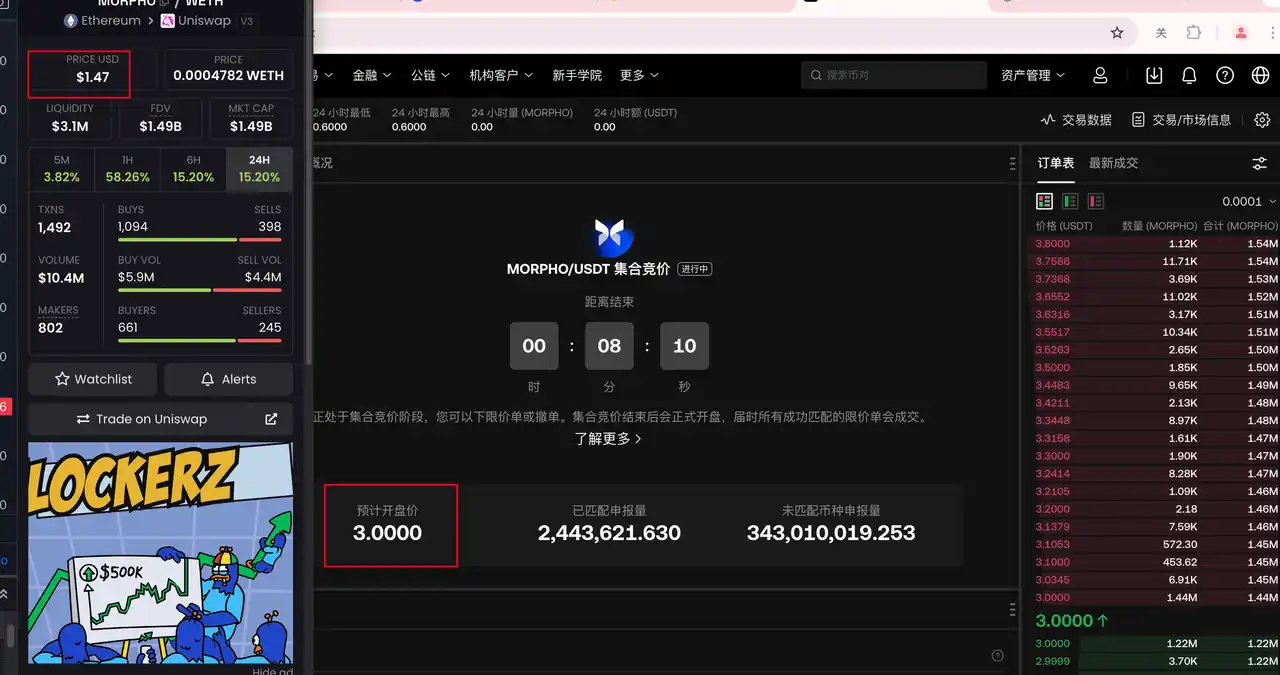
Another example is the recent Morpho. Although MORPHO's market cap is not as "cheap" as OL's, the opportunity still exists. First, it is still important to research the project's fundamentals. MORPHO is a 21-year-old Defi project, just like OL mentioned earlier, with a total supply of 10 billion tokens but only 1 billion tokens in circulation, with a total market cap of around $100 million. A $100 million market cap may not seem high or low to most people and may not offer a favorable risk-reward ratio. However, on November 21st, between 5:05-6:05 PM, MORPHO started a Dutch auction. The opening price of the Dutch auction surged to $4 at one point, although on-chain MORPHO initially traded at $1. After seeing the Dutch auction price, we had about an hour to withdraw tokens on-chain and deposit them into an exchange. Even with a slow withdrawal speed, there were still two hours after listing to exploit the price difference.
So, the key is to research CEX announcements, study all CEX announcements, and look for opportunities that are not easily noticed by others.
Blockbeats: What strategy do you employ after seeing each exchange announcement?
Little Z: You need to look at different types of exchange announcements. Some announcements provide you with lead time, like the OL listing announcement we mentioned earlier, which was released two days in advance. With these two days, you can thoroughly research the coin's fundamentals and information. For example, what is the circulating supply at listing? What is the cost for whales or early adopters? How much of the circulating supply is locked? How much is actually available for sale? How much is allocated to each exchange? These types of announcements give you ample time to study.
Another type of announcement does not give you time to research; you need to be prepared in advance to ambush the opportunity. For example, the coin ACT listed on BN. When you see this announcement, immediately look at its fundamentals, such as market cap, where it is listed, etc. Then quickly buy based on your strategy. The spot market effect is usually much greater than that of futures. When you see that ACT has a market cap of only a few million, buy immediately because the risk-reward ratio is very favorable. A target already listed with a market cap of a few million can be considered very cost-effective. Also, make sure to review and analyze more, such as why you chose these coins and what are their fundamentals. What strategy should you adopt next time in similar situations? However, for these sudden announcements, you need to act quickly. Formula news has earned a lot through this method, and after the ACT event, I believe everyone has gradually begun to understand their trading methods. Some people even follow their addresses specifically.
In addition to spot listings like ACT, there are also contract listings. Usually, we consider the listing effect of spot trading to be much greater than that of contract trading. For example, before being listed on an exchange, MOODENG had a market cap of only 60 million and experienced a long period of downward price movement and wash trading. Although this coin only had a contract, its market cap was low enough, and the fundamental of the project was very strong at the time, so even if it was listed as a contract, it would have a strong listing effect. Buying MOODNE at its market cap at that time might result in a maximum loss of 50%, but once it is listed on Binance spot trading, it is estimated to have a price increase of 3-5 times, providing a significant risk-reward ratio. This strategy can be profitable, but if we assume that a coin already has a market cap of five to six hundred million, then pre-emptive moves or similar strategies may not be very suitable.
Blockbeats: How do you view projects in other ecosystems? For example, the recently popular Desci concept.
Z: The Desci narrative actually began to emerge in 2022, but it was during a bear market. At that time, the market had little liquidity, so this concept did not gain traction. In the bear market of 2022 to 2023, the founder of Coinbase invested in a project called RSC, and he would often promote his project on social media. For a long time, there was no buzz, but in December of last year, there was a sudden surge in interest.
It then quieted down for a long time until this year when BN announced an investment in Bio, followed by some actions related to Desci by CZ in Bangkok and V God. For the details, I won't go into it here. It was these opportunities that reignited interest in the Desci concept this year. Desci is definitely a strong narrative, but this narrative was launched by the "top stream" and not organically fermented from the masses. Narratives that are strongly pushed like this are hard to judge.

For example, concepts led by Coinbase, such as Depin. The entire Depin track is now very quiet. Basically, you will see everyone talking about "meme" and "AI," but very few people talking about Depin. At that time, Coinbase listed many Depin tokens, such as MOBILE HONEY, and later BN also "followed suit" by listing IO. However, the market may not necessarily buy into this strongly pushed concept, as the results have shown. The same applies to Desci, so I think everyone needs to research Desci thoroughly, be prepared to seize opportunities, and be flexible in response.
You may also like

Latest research from 13 top universities including Cornell University: The current state, challenges, and misconceptions of the fusion of Crypto and AI
Deconstructing Anthropic: The Best AI Company, Possibly Also a Type of Organizational Invention

Humanity Protocol Security Incident Escalates: More Than $31 Million Stolen From Related Addresses as Attacker Continues Selling H for ETH
On June 9, according to monitoring by Onchain Lens, more than $31 million has been stolen from addresses linked to Humanity Protocol, and the attack is still ongoing, with the hacker continuously swapping H tokens for ETH. Project founder Terence Kwok later confirmed the security incident on X, saying the issue involved a private key leak.

Bloomberg: As Bitcoin Weakens, Stablecoins and RWA Continue to Drive Expansion in Crypto Businesses
In June, Bloomberg reported that despite Bitcoin falling below $60,000 last week, wiping out about $235 billion in market value within seven days, and dropping close to 50% from last year’s peak, some core businesses in the crypto industry are still expanding, mainly in stablecoins, real-world asset tokenization (RWA), payments, and infrastructure. The report also noted that overall altcoin activity has contracted significantly: altcoin market capitalization has fallen from a peak of about $431 billion in November 2021 to around $170 billion, and among the tens of millions of tokens issued in recent years, fewer than 1,700 still maintain meaningful trading activity.

Galaxy Deep Research Report: How Hyperliquid's HIP-4 Upgrade Changes the Landscape of Prediction Markets?
Binance Research: RWA Market Expected to Expand Nearly 6x from Early 2025, with Public Equities and Onchain Payments Heating Up Together
In June, Binance Research said in its monthly market report that the real-world asset (RWA) market is expected to grow by about 589% from the beginning of 2025. Bond- and money market fund-related RWA expanded by about $6.5 billion, up 83% year over year, while publicly traded equity RWAs grew by about 422%. The report also noted that monthly crypto debit card transaction volume exceeded $747 million in May, up 48.6% year to date.

Japan to Assess a Framework for Yen Stablecoins and Crypto ETFs as Asia’s Compliant Payments Narrative Heats Up
Recently, according to the original report, Japan is considering the launch of yen stablecoins and cryptocurrency ETFs. Public information remains limited at this stage, and there is still no complete policy text, regulatory draft, or clear implementation timeline, so this is better characterized as a “policy discussion” rather than formal implementation. The original wording also noted that advancing stablecoin regulation in Asia is driving XRP usage and supporting growth in the XRPL ecosystem. However, based on currently available public information, there is not enough evidence to directly establish a clear causal relationship between this round of discussion in Japan and XRP or XRPL.

ZachXBT: Humanity private key leak and abnormal surge in H token should be viewed separately
On June 9, according to related disclosures, on-chain investigator ZachXBT posted an update on Humanity’s roughly $31 million security incident, saying that after further analyzing fund flows, he currently tends to believe the project team was not involved in an “inside job” or a self-staged attack. According to him, the official explanation about the private key leak was broadly accurate, but before the token unlock, the price of H had been artificially pushed higher, and the hacker later took advantage of that market environment; therefore, the private key leak and the earlier abnormal price pumping should be regarded as two separate and independent events. This reframing has shifted the market’s understanding of the nature of the incident. Earlier discussion around Humanity had focused on whether the team directly participated in the attack or used the security incident to cover up internal operations. ZachXBT’s latest remarks shift the focus from “whether it was self-theft” to “whether there were pre-unlock market structure issues.” He also questioned whether the team may have.

Morning Report | OpenAI has submitted an S-1 registration statement draft to the U.S. SEC; Morpho completes $175 million financing

Morning Report | BitMine increased its holdings by 126,971 ETH last week; trader Eugene announced his exit from the crypto market

Wang Chuan: How can one not feel anxious after the neighbor Old Wang made thirty times profit by investing in storage stocks? (Seven) - A quarter-century cycle
Cryptocurrency CEXs are flocking to sell US stocks, and traditional brokerages are facing an "uninvited guest."
$75 billion in foreign capital has fled, and South Korean retail investors have absorbed it all using leverage

Japan’s Three Megabanks Plan Joint Stablecoin Issuance in Fiscal 2026
MUFG, SMBC, and Mizuho reportedly plan to jointly issue fiat-pegged stablecoins in fiscal 2026, signaling Japan’s growing push into bank-led digital payment infrastructure.

Humanity Discloses H Token Dual-Chain Attack Details, With Losses on Ethereum and BSC Exceeding $36 Million
Humanity said the H token attack across Ethereum and BSC caused more than $36 million in losses after leaked ProxyAdmin keys enabled malicious contract upgrades and token minting.
White House Discusses CLARITY Act With Law Enforcement Ahead of Senate Vote
The White House discussed the CLARITY Act with law enforcement ahead of a Senate vote, focusing on illicit finance risks and developer protections.

Bitcoin Trading Guide 2026: Strategies for Experienced Traders

What Is XAUT and PAXG? Why Tokenized Gold Is Booming in 2026
Latest research from 13 top universities including Cornell University: The current state, challenges, and misconceptions of the fusion of Crypto and AI
Deconstructing Anthropic: The Best AI Company, Possibly Also a Type of Organizational Invention
Humanity Protocol Security Incident Escalates: More Than $31 Million Stolen From Related Addresses as Attacker Continues Selling H for ETH
On June 9, according to monitoring by Onchain Lens, more than $31 million has been stolen from addresses linked to Humanity Protocol, and the attack is still ongoing, with the hacker continuously swapping H tokens for ETH. Project founder Terence Kwok later confirmed the security incident on X, saying the issue involved a private key leak.
Bloomberg: As Bitcoin Weakens, Stablecoins and RWA Continue to Drive Expansion in Crypto Businesses
In June, Bloomberg reported that despite Bitcoin falling below $60,000 last week, wiping out about $235 billion in market value within seven days, and dropping close to 50% from last year’s peak, some core businesses in the crypto industry are still expanding, mainly in stablecoins, real-world asset tokenization (RWA), payments, and infrastructure. The report also noted that overall altcoin activity has contracted significantly: altcoin market capitalization has fallen from a peak of about $431 billion in November 2021 to around $170 billion, and among the tens of millions of tokens issued in recent years, fewer than 1,700 still maintain meaningful trading activity.
Galaxy Deep Research Report: How Hyperliquid's HIP-4 Upgrade Changes the Landscape of Prediction Markets?
Binance Research: RWA Market Expected to Expand Nearly 6x from Early 2025, with Public Equities and Onchain Payments Heating Up Together
In June, Binance Research said in its monthly market report that the real-world asset (RWA) market is expected to grow by about 589% from the beginning of 2025. Bond- and money market fund-related RWA expanded by about $6.5 billion, up 83% year over year, while publicly traded equity RWAs grew by about 422%. The report also noted that monthly crypto debit card transaction volume exceeded $747 million in May, up 48.6% year to date.


