
 Buy Crypto
- Markets
 Futures
- Spot
- Copy Trade
- Earn
- More
Iran Missile Strike in Dubai: Three Chinese Nationals Tell Their Story 48 Hours Later


Author | Lin Wanwan
The world's busiest international airport, Dubai Airport, has been bombed.
This is no ordinary airport. Atlanta tops the list in total passenger traffic, but relies on domestic flights within the U.S. The true king of international flights is Dubai, a super hub connecting Europe, Asia, and Africa, with 1,200 flights taking off and landing every day. Two hours later, Abu Dhabi Airport was also bombed. The two major airports in the UAE were completely shut down overnight.
Exports have been cut off.
At 4:00 p.m. on February 28, a Chinese developer named Wu returned home from downtown, and heard three loud bangs outside his window. He immediately knew they were missiles. He had heard this sound before while working in Lebanon and Iraq.
The thunderous sound became more and more intense, echoing through the night. He saw a missile being intercepted and exploding in the Marina direction.
"I had only seen this in movies before," he said. "This time, the earth showed me a live-action movie."
The Dubai landmark, Palm Island Hotel, was bombed, the seven-star sailboat hotel caught fire, and interception flames flickered over the top of the world's tallest building, the Burj Khalifa. These names usually appear in travel ads, but now they're in war news.
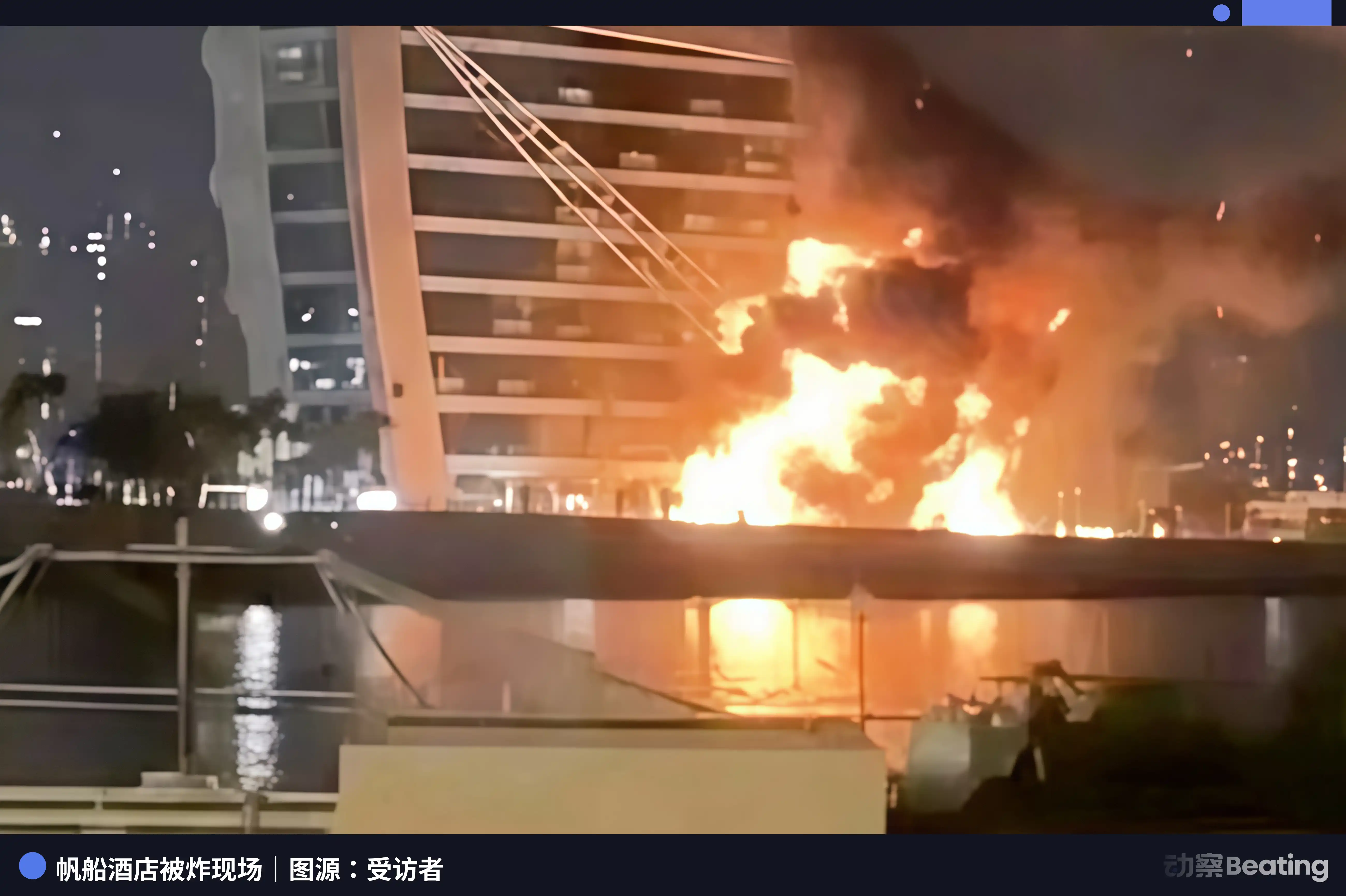
On that morning, the U.S. and Israel joined forces to strike Iran. Iran retaliated within hours, launching missiles towards Israel and the entire Gulf region. Bahrain, Qatar, Kuwait, and Saudi Arabia were all hit. Iran made it very clear that anyone helping the U.S. would be targeted.
As of the time of publication, Iran has launched at least six waves of attacks, with 167 missiles and over five hundred drones.
Changpeng Zhao, CEO of Binance, currently in the UAE, mentioned in an exclusive interview with us, "Rationally speaking, because of the presence of missile defense systems, overall security is fundamentally guaranteed, but those who lack information retrieval capabilities may be more panicked."
In addition, she also mentioned, "Bombing and missile attacks would result in mass casualties. However, the current interception fragments and drone attacks are causing more psychological pressure on the public, and the economic damage is also greater."
The Chinese population in Dubai is growing rapidly, with an estimated 300,000 Chinese residents by 2025. In Longyuan City, Dubai's dragon city, a Chinese goods city built 15 kilometers from the old city in the desert, was once touted as the "largest Chinese trading center outside mainland China." Huawei, Xiaomi, OPPO also have their Middle East headquarters here, and Chinese internet companies see it as a springboard for going global.
Chinese people from various industries such as Web3, trade, tourism, real estate, and finance have taken root in this desert city.
For the past decade, they have been accustomed to the political stability of the UAE, accustomed to zero income tax, accustomed to feeling "the Middle East's chaos has nothing to do with me."
Until the missiles came.
An individual of Chinese descent wrote on social media, "I originally came to Dubai to avoid taxes, but now I'm hiding in a bomb shelter to avoid bombs."
We interviewed four individuals in Dubai to discuss the real situation with them.
Even after being bombed, you can still order takeout
Wu works in Dubai on developer tools, lives near Marina, not far from the entrance to Palm Jumeirah. This location is usually a selling point, but now it's a problem: it's close to the US military base in Jebel Ali.
On the afternoon of February 28, at 4 p.m., he had just finished eating near the Burj Khalifa, had just returned home, and heard three loud bangs outside his window.
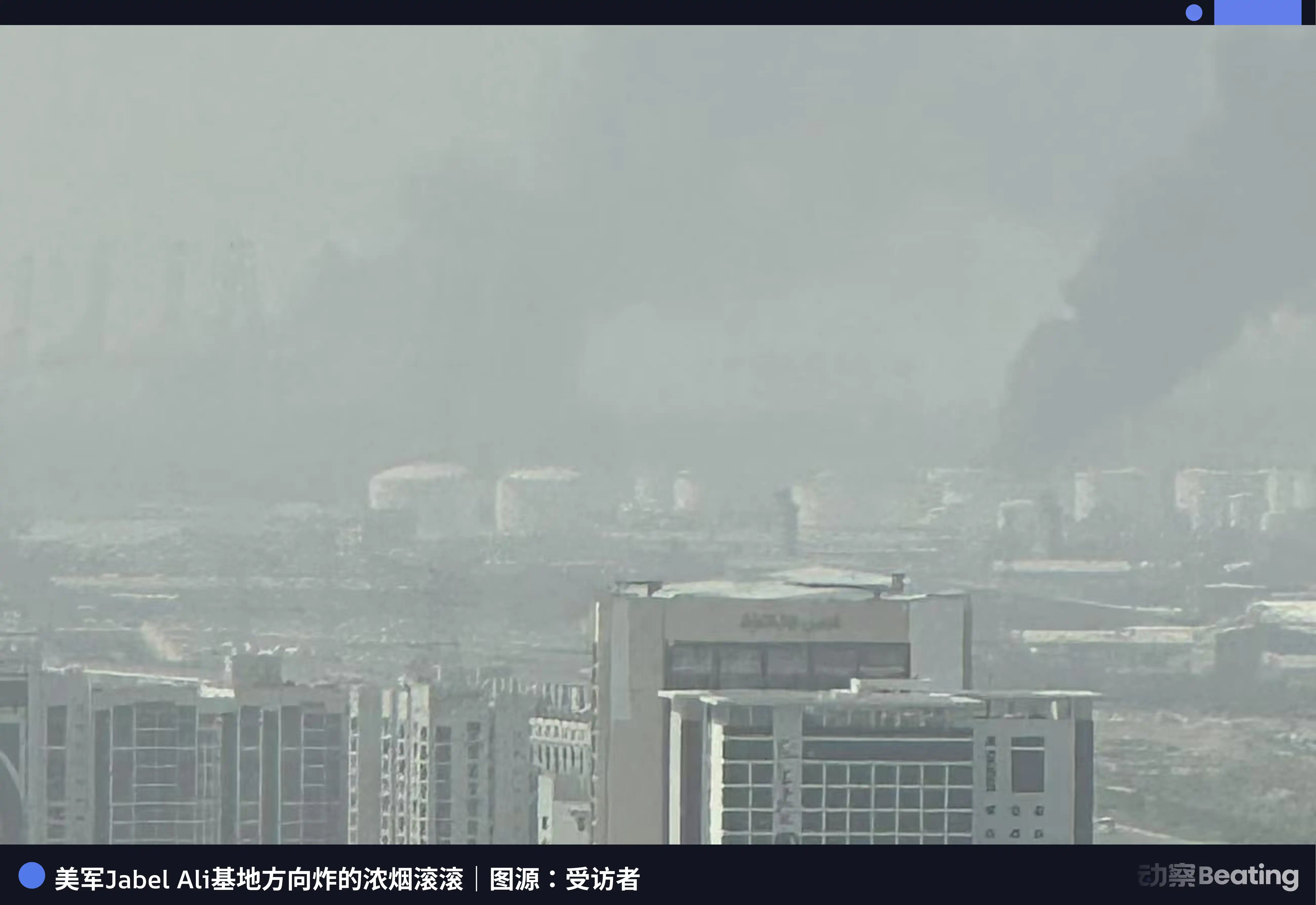
Without hesitation, he had heard this sound before while participating in developer events in Lebanon and Iraq.
But those places don't have missile defense systems; once a bomb drops, that's it, you just need to avoid the bombing area. Dubai is different; it has THAAD. The missile might be intercepted and detonated in the air, or it might be hit off course, causing it to land randomly, making it easy to hit civilian areas.
The thunderous sounds grew more frequent, mixed with sirens and ambulances. Almost everyone on the street was calling their families to ensure everyone's safety, moving hastily.
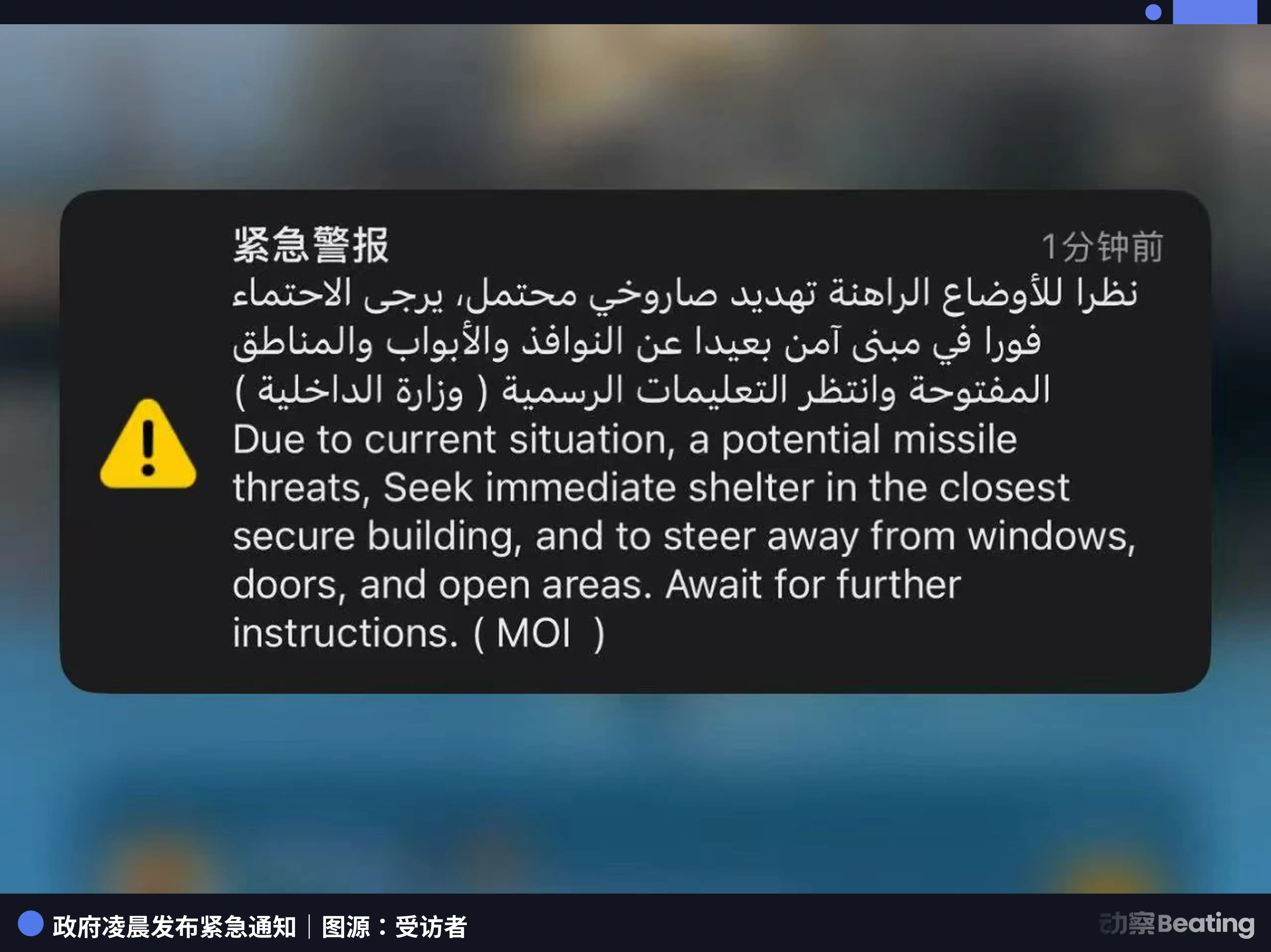
In the middle of the night, his phone blared a government alert. Beep beep beep beep beep, piercing, non-stop for three to four minutes. Then, the building's alarms went off too. He and his wife headed to the underground parking garage.
The garage was already full of people. Some were holding children, some were stuffing mineral water and biscuits into the trunk. The engines were still running, ready to go at any moment. In the worst-case scenario, they would drive away.
The next morning at 8 a.m., a loud bang woke his wife up. She nudged him: "It was particularly close just now." He looked out the window, and the glass was trembling. The glass of the building across was also shaking.
But the government didn't issue an alert today; he guessed they didn't want to create panic or perhaps believed that civilian areas wouldn't be bombed.
However, most of the city continued to operate normally, without the panic reported in the media.
Wu went downstairs to the supermarket. The shelves were full, with milk and bread available, and no one was rushing to grab items. He ordered from McDonald's, and it was delivered in half an hour; the delivery guy even joked with him upon delivery.
But the situation was different at the Chinese supermarket. He tried to place an order at 9:30 p.m. last night, but the system said it was too busy. He tried again at 10 p.m., but still couldn't place the order. Today, the goods hadn't been delivered. The official explanation was that too many people were buying, and they couldn't keep up with the demand.
Wu's British neighbor left early in the morning, dragging a suitcase and walking fast.
Currently evacuating in roughly three directions:
One, someone drove overnight to Oman, the only neighboring country not hit by Iran, but the road to Oman is now almost impassable.
Two, someone evacuated to Al Ain, in the middle of the desert, with a high probability that missiles will not hit the desert.
Three, there are still people moving to Sharjah, where there are no military facilities. The border crossing is estimated to be already blocked.
Wu plans to wait and see. "Iran cannot have an unlimited number of missiles, so the situation is expected to be more manageable in the future." Yesterday, officials said they intercepted 137 missiles out of 132, and today there were another dozen explosions.
The escape route will also be chosen from these three directions. Water and food have already been placed in the car, with an emergency kit carried at all times.
He has a friend who works in sales at the airport. When Terminal 3 was hit by a missile, he immediately sent a message: Smoking, evacuating. The Chinese have a peer-to-peer network that is faster than official channels and more accurate than the media. Information about which building was hit, which intersection was closed, and which supermarket still has supplies is all shared in WeChat groups.
Chinese friends living in the city center are starting to move out, looking for shorter buildings because the Burj Khalifa is just too tall and conspicuous. The Sail Hotel and the Palm Jumeirah have also been hit, leading to suspicions that Iran seems to be interested in landmarks.
He said that if Iran continues to cause chaos like this, he may consider leaving. "Trust is hard to establish. Once it's broken, you can't go back."
Now all that can be done is to wait. Wait to see if the US will stop, if Iran will finish, if the sounds are getting closer or farther away.
Want to stroll over to the bombed site
Mason lives in Dubai's Silicon Valley, near a US military base, which he has never taken seriously.
On February 28, while having lunch, a missile struck a hotel on Dubai's Palm Jumeirah landmark. After finishing his meal, he wanted to drive over to the site to take a look, but the navigation showed that the road to the bombed site was completely congested, so he had to give up.
Mason didn't feel scared, "perhaps because it's too far from me."
Just 10 minutes before our conversation, he heard another explosion, this time right above his head. The missile was intercepted and exploded in the air, making a huge sound. He looked out the window and saw people still strolling downstairs.
Just last night, several of his phones rang one after another. The government's alert pierced through the night, advising to avoid going outside as much as possible and to keep the windows slightly open. He heard a tearing sound from the sky, unable to tell if it was a fighter jet or a missile, but it flew past, not exploding nearby. Then he went to sleep.
Waking up in the morning and refreshing the news, Mason learned that Terminal 3 was hit by a drone at 1 am. Mason had planned to fly to Milan to watch the Winter Paralympics, but now the airport is shut down indefinitely. Videos of the airport are circulating all over Twitter, and after taking a quick look, he found them to be a mix of truth and falsehood.
Some people have started evacuating. Among the Dubai locals Mason was with, someone who works as a tour guide mentioned that VIP clients are leaving, but the border to Oman is completely congested. Normally, getting a visa involves waiting in long lines, and now it's out of the question. Someone asked Mason if he wanted to leave as well. He did some quick calculations in his head: over 1000 kilometers to Saudi Arabia, a few hundred kilometers to Oman. "Going to Oman now might be even more dangerous. Who knows what we might encounter along the way."
Mason decided to stay put.
"It's all exaggerated," he said about those online videos. "The sailboat hotel is a landmark, so if it exploded, someone would film it, and then it spreads like wildfire."
Mason believes that modern missiles are precision-guided, targeting military bases, and they wouldn't be randomly bombing everywhere. Unless they were intercepted, missile fragments might fall elsewhere.
He has a friend who works in real estate, and they just had a conversation. Several clients who were planning to come to Dubai to view properties can no longer make it. "Holidays will definitely be affected," but he thinks it's only temporary. The real issue is how people outside perceive the situation. If a plane comes flying here and a missile flies as well, what then? And if they come here but can't fly back, what will they do?
"If you plan to come here, you need to be prepared in your mind."
Mason is still thinking about going to see the sailboat hotel that was bombed. He wanted to see the scene for himself. The security guard advised against going out, leaving him somewhat regretful.
Alert That Pierces Through Do Not Disturb Mode
Olivia lives in a densely populated residential area, 8 kilometers away from the coastline. That coastline faces Iran, and landmarks like the sailboat hotel, Palm Jumeirah, and Dubai Marina are all on that side.
On February 28, in the afternoon, she was taking a nap when she woke up to a bunch of messages on WeChat asking if she was safe, which made her realize something was wrong. A few hours later, she heard an explosion outside her window. Her windows were reinforced with original double-layered glass plus an additional double layer she added herself, totaling four layers of glass, yet the sound still came through very loudly.
She had a medical aesthetic appointment scheduled but canceled it directly. However, people's lives downstairs were not greatly affected. By the poolside, some were still sunbathing because it was the weekend.
Three more explosions happened consecutively at night. Fighter jets were patrolling the skies before bedtime, rumbling past repeatedly. She fell asleep around midnight, only to be woken up by the entire family because an alert pierced through the Do Not Disturb mode. Three people at home with four to five phones each, all ringing simultaneously with the alert.
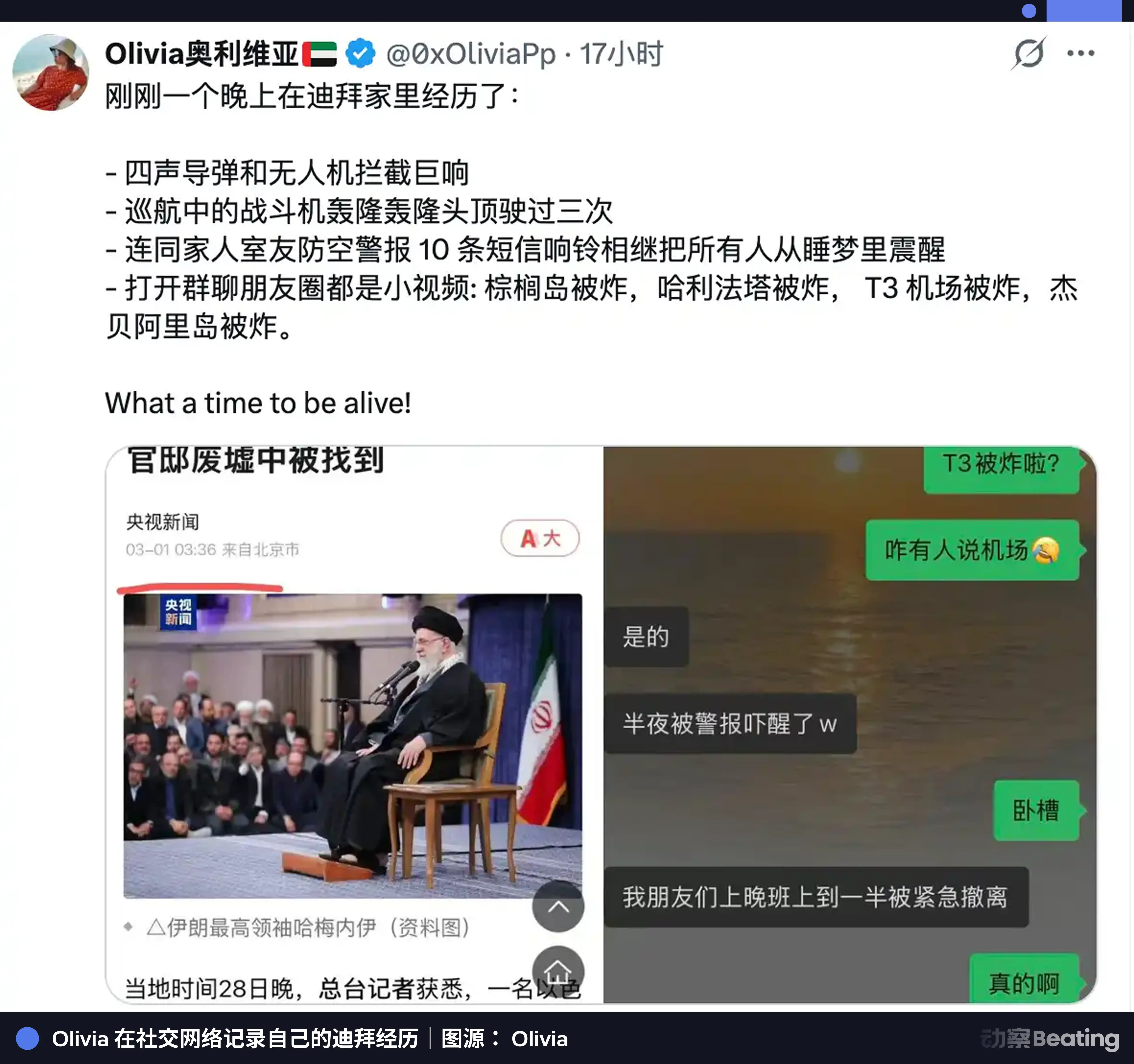
A group member went to Oman and got stuck in traffic. Her friend is the founder of a company in New York. He sent the employee on a business trip to Oman overnight and then flew them back to the US on a private jet.
Originally planned to return to China in March or April, the airport is now closed indefinitely. If unable to leave, the plan is to detour to neighboring countries and then fly out.
Scary videos are circulating online, but she doesn't think it's that exaggerated.
Olivia believes the situation will improve. As Ayatollah Khamenei has already passed away, the remaining people are fighting to the end. "Once they run out of ammunition, this will all be over."
When the call dropped, she mentioned not sleeping well last night and planned to take a nap.
Wait for the Wind to Stop
Dubai has no four seasons. Just hot and hotter.
However, these days, 300,000 Chinese people are feeling a different kind of temperature. Uncertainty.
Wu saw a neighbor holding a child in the garage, Mason was thinking about going to the Sail Hotel to see the ruins, Olivia set her phone to Do Not Disturb but the alarms still came through. He Yi was right—those with information retrieval ability are not too flustered, but that underlying noise persists. The rumbling outside the window, the alarms on the phone, the constantly updating messages in the group. Which building was bombed, which road is blocked, which supermarket still has supplies.
We are all refreshing, all waiting.
Waiting for the US to back down, waiting for Iran to finish, waiting for the airport to reopen, waiting for that "everything is back to normal" notification.
Some people left overnight. Some decided to stay. Some are sunbathing by the pool, some are putting their passports and cash in their emergency bags. Everyone's choice is neither right nor wrong, just a gamble.
Most Chinese people who come to Dubai are not here for adventure. On the contrary, it's for certainty. Tax certainty, regulatory certainty, business certainty. In thirty years, this city has established an order in the desert.
The Palm Jumeirah, the Sail Hotel, the Burj Khalifa are all monuments to this order. People can overcome the desert, can create prosperity in desolation.
But some things are beyond human control.
When two countries break down in negotiations, the missiles start flying. It doesn't matter if you picked a side, if you're a good person, how much tax you've paid over the years, how many people you've employed, or how many buildings you've constructed. You just happen to be here.
This is the world of 2026. Flights can be grounded, borders can be sealed, carefully planned lives can be disrupted in an afternoon. Not because you did something wrong, just because on the chessboard of geopolitics, no one asked the opinion of the chess pieces.
Wu said that if the situation stabilizes, he might stay. "Perhaps it will be even more peaceful in the future."
Maybe this is the calmness that only those who have experienced it possess. After this round, the discussions that need to be had will be had, and the pauses that need to be taken will be taken. That's how the history of the Middle East is written — with back-and-forth actions, but life goes on.
Mason also wanted to go see the bombed site. Perhaps just to confirm those images, confirm that he really lived through all of this, confirm that the city is still there, and he is still here.
Another sound was heard outside the window.
It's hard to tell if it's a missile or interception, far or near.
It doesn't matter. The sound is still in the distance, so the days can still go on. McDonald's is still delivering, the supermarket still has supplies, if the alarm sounds, go to the garage; if not, just continue sleeping.
Three hundred thousand Chinese people, just waiting like this.
Waiting for the wind to stop.
Interview Acknowledgment: Vinko, Beca, Sleepy, Tomas
You may also like

What Is an XRP Wallet? The Best Wallets to Store XRP (2026 Updated)
An XRP wallet lets you safely store, send, and receive XRP on the XRP Ledger. Learn what wallets support XRP and discover the best XRP wallets for beginners and long-term holders in 2026.

What are the Top AI Crypto Coins? Render vs. Akash: 5 Gems Solving the 2026 GPU Crisis
What are the best AI crypto coins for the 2026 cycle? Beyond the hype, we analyze top tokens like RNDR, AKT, and FET that provide real-world solutions to the global GPU shortage and the rise of autonomous agents.

What Is a Token in AI? What Is an AI Token + 3 Gems You Can't Miss in 2026
The era of AI hype has transitioned into an era of utility. As we move through Q2 2026, the market is no longer rewarding "narrative-only" projects. At WEEX Research, we are seeing a massive capital rotation into Decentralized Compute (DePIN) and Autonomous Agent coordination layers. This guide analyzes which AI tokens are capturing institutional liquidity and how to spot high-conviction setups in a maturing market.

Consumer-grade Crypto Global Survey: Users, Revenue, and Track Distribution

Prediction Markets Under Bias

Stolen: $290 million, Three Parties Refusing to Acknowledge, Who Should Foot the Bill for the KelpDAO Incident Resolution?

ASTEROID Pumped 10,000x in Three Days, Is Meme Season Back on Ethereum?

ChainCatcher Hong Kong Themed Forum Highlights: Decoding the Growth Engine Under the Integration of Crypto Assets and Smart Economy

Why can this institution still grow by 150% when the scale of leading crypto VCs has shrunk significantly?

Anthropic's $1 trillion, compared to DeepSeek's $100 billion

Geopolitical Risk Persists, Is Bitcoin Becoming a Key Barometer?

Annualized 11.5%, Wall Street Buzzing: Is MicroStrategy's STRC Bitcoin's Savior or Destroyer?
An Obscure Open Source AI Tool Alerted on Kelp DAO's $292 million Bug 12 Days Ago

Mixin has launched USTD-margined perpetual contracts, bringing derivative trading into the chat scene.
The privacy-focused crypto wallet Mixin announced today the launch of its U-based perpetual contract (a derivative priced in USDT). Unlike traditional exchanges, Mixin has taken a new approach by "liberating" derivative trading from isolated matching engines and embedding it into the instant messaging environment.
Users can directly open positions within the app with leverage of up to 200x, while sharing positions, discussing strategies, and copy trading within private communities. Trading, social interaction, and asset management are integrated into the same interface.
Based on its non-custodial architecture, Mixin has eliminated friction from the traditional onboarding process, allowing users to participate in perpetual contract trading without identity verification.
The trading process has been streamlined into five steps:
· Choose the trading asset
· Select long or short
· Input position size and leverage
· Confirm order details
· Confirm and open the position
The interface provides real-time visualization of price, position, and profit and loss (PnL), allowing users to complete trades without switching between multiple modules.
Mixin has directly integrated social features into the derivative trading environment. Users can create private trading communities and interact around real-time positions:
· End-to-end encrypted private groups supporting up to 1024 members
· End-to-end encrypted voice communication
· One-click position sharing
· One-click trade copying
On the execution side, Mixin aggregates liquidity from multiple sources and accesses decentralized protocol and external market liquidity through a unified trading interface.
By combining social interaction with trade execution, Mixin enables users to collaborate, share, and execute trading strategies instantly within the same environment.
Mixin has also introduced a referral incentive system based on trading behavior:
· Users can join with an invite code
· Up to 60% of trading fees as referral rewards
· Incentive mechanism designed for long-term, sustainable earnings
This model aims to drive user-driven network expansion and organic growth.
Mixin's derivative transactions are built on top of its existing self-custody wallet infrastructure, with core features including:
· Separation of transaction account and asset storage
· User full control over assets
· Platform does not custody user funds
· Built-in privacy mechanisms to reduce data exposure
The system aims to strike a balance between transaction efficiency, asset security, and privacy protection.
Against the background of perpetual contracts becoming a mainstream trading tool, Mixin is exploring a different development direction by lowering barriers, enhancing social and privacy attributes.
The platform does not only view transactions as execution actions but positions them as a networked activity: transactions have social attributes, strategies can be shared, and relationships between individuals also become part of the financial system.
Mixin's design is based on a user-initiated, user-controlled model. The platform neither custodies assets nor executes transactions on behalf of users.
This model aligns with a statement issued by the U.S. Securities and Exchange Commission (SEC) on April 13, 2026, titled "Staff Statement on Whether Partial User Interface Used in Preparing Cryptocurrency Securities Transactions May Require Broker-Dealer Registration."
The statement indicates that, under the premise where transactions are entirely initiated and controlled by users, non-custodial service providers that offer neutral interfaces may not need to register as broker-dealers or exchanges.
Mixin is a decentralized, self-custodial privacy wallet designed to provide secure and efficient digital asset management services.
Its core capabilities include:
· Aggregation: integrating multi-chain assets and routing between different transaction paths to simplify user operations
· High liquidity access: connecting to various liquidity sources, including decentralized protocols and external markets
· Decentralization: achieving full user control over assets without relying on custodial intermediaries
· Privacy protection: safeguarding assets and data through MPC, CryptoNote, and end-to-end encrypted communication
Mixin has been in operation for over 8 years, supporting over 40 blockchains and more than 10,000 assets, with a global user base exceeding 10 million and an on-chain self-custodied asset scale of over $1 billion.

$600 million stolen in 20 days, ushering in the era of AI hackers in the crypto world
Vitalik's 2026 Hong Kong Web3 Summit Speech: Ethereum's Ultimate Vision as the "World Computer" and Future Roadmap
On the same day Aave introduced rsETH, why did Spark decide to exit?
Full Post-Mortem of the KelpDAO Incident: Why Did Aave, Which Was Not Compromised, End Up in Crisis Situation?
What Is an XRP Wallet? The Best Wallets to Store XRP (2026 Updated)
An XRP wallet lets you safely store, send, and receive XRP on the XRP Ledger. Learn what wallets support XRP and discover the best XRP wallets for beginners and long-term holders in 2026.
What are the Top AI Crypto Coins? Render vs. Akash: 5 Gems Solving the 2026 GPU Crisis
What are the best AI crypto coins for the 2026 cycle? Beyond the hype, we analyze top tokens like RNDR, AKT, and FET that provide real-world solutions to the global GPU shortage and the rise of autonomous agents.
What Is a Token in AI? What Is an AI Token + 3 Gems You Can't Miss in 2026
The era of AI hype has transitioned into an era of utility. As we move through Q2 2026, the market is no longer rewarding "narrative-only" projects. At WEEX Research, we are seeing a massive capital rotation into Decentralized Compute (DePIN) and Autonomous Agent coordination layers. This guide analyzes which AI tokens are capturing institutional liquidity and how to spot high-conviction setups in a maturing market.



 App
App