
 Buy Crypto
- Markets
 Futures
- Spot
- Copy Trade
- Earn
- More
Iranian Missile Heading Toward UAE, Claude Also Within Range


Original Article Title: "AI Within Cannon Range"
Original Article Author: David, DeepFlow Tech
On March 1st, Iran's missiles and drones struck the Gulf region, with one of them hitting a data center belonging to Amazon in the UAE.
The data center caught fire, lost power, and around 60 cloud services went down.
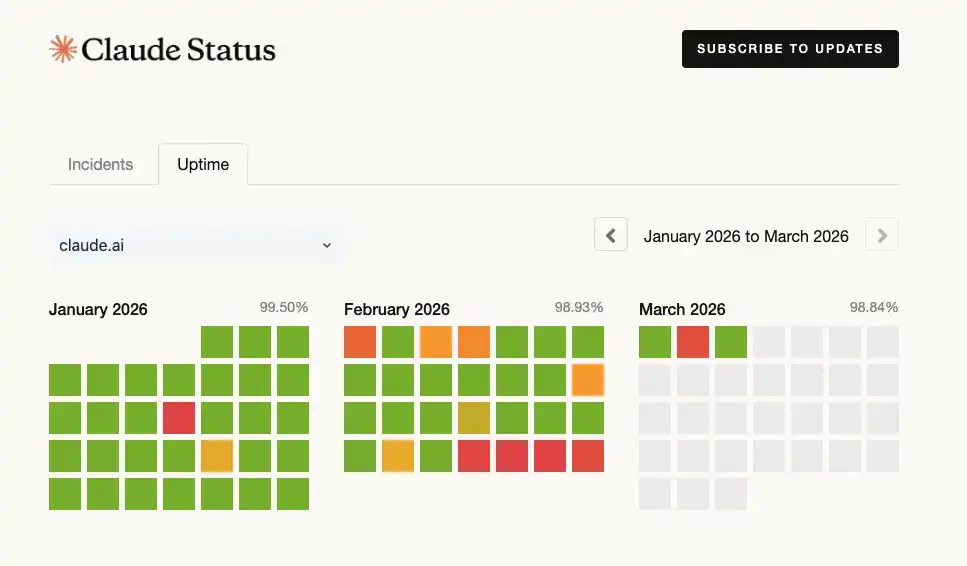
One of the world's largest AI systems, Claude, was running on Amazon's cloud. On the same day, Claude experienced a global outage.
Anthropic's official statement cited a surge in users overwhelming the servers.
As of the time of writing, there were still complaints on social media about Claude's service being unavailable; on the prominent prediction market Polymarket, there is already a prediction topic about "Claude experiencing several more outages in March."
If it is eventually confirmed to be Iran's doing, this will be the first time in human history:
A commercial data center physically destroyed in a war.
However, why would a civilian data center be targeted?
Let's rewind two days. On February 28th, the U.S. and Israel jointly bombed Iran, killing Supreme Leader Khamenei and a group of senior officials.
A significant portion of the intelligence analysis, target identification, and battlefield simulations for this airstrike were assisted by Claude. Through a collaboration with the military and the data analytics company Palantir, Claude had long been integrated into the U.S. military's intelligence system.
Ironically, just hours before the airstrike, Trump had ordered a full ban on Anthropic because Anthropic refused to hand over AI to the Pentagon without restrictions. But bans aside, the war had to be fought.
The public statement is that it would take at least six months to remove Claude from the military's systems.
So, while the ban was still fresh, the U.S. military took Claude along to bomb Iran. Then Iran retaliated, and a missile hit the data center running Claude's AI.

Image Source: Bloomberg
The data center was most likely not targeted for bombing, just collateral damage. But regardless of whether the missile was aimed at the data center, one thing is certain:
Truth is within the cannon's reach, and so is AI. On both sides of the cannon — the firing end and the receiving end.
AI Megaproject Built on Top of the Middle Eastern Powder Keg
Over the past three years, Silicon Valley has moved half of the AI industry to the Middle East Gulf.
The reason is simple. The UAE and Saudi Arabia have the world's richest sovereign wealth funds, cheap electricity, and one rule:
If you want to serve my customers, the data must reside in my territory.
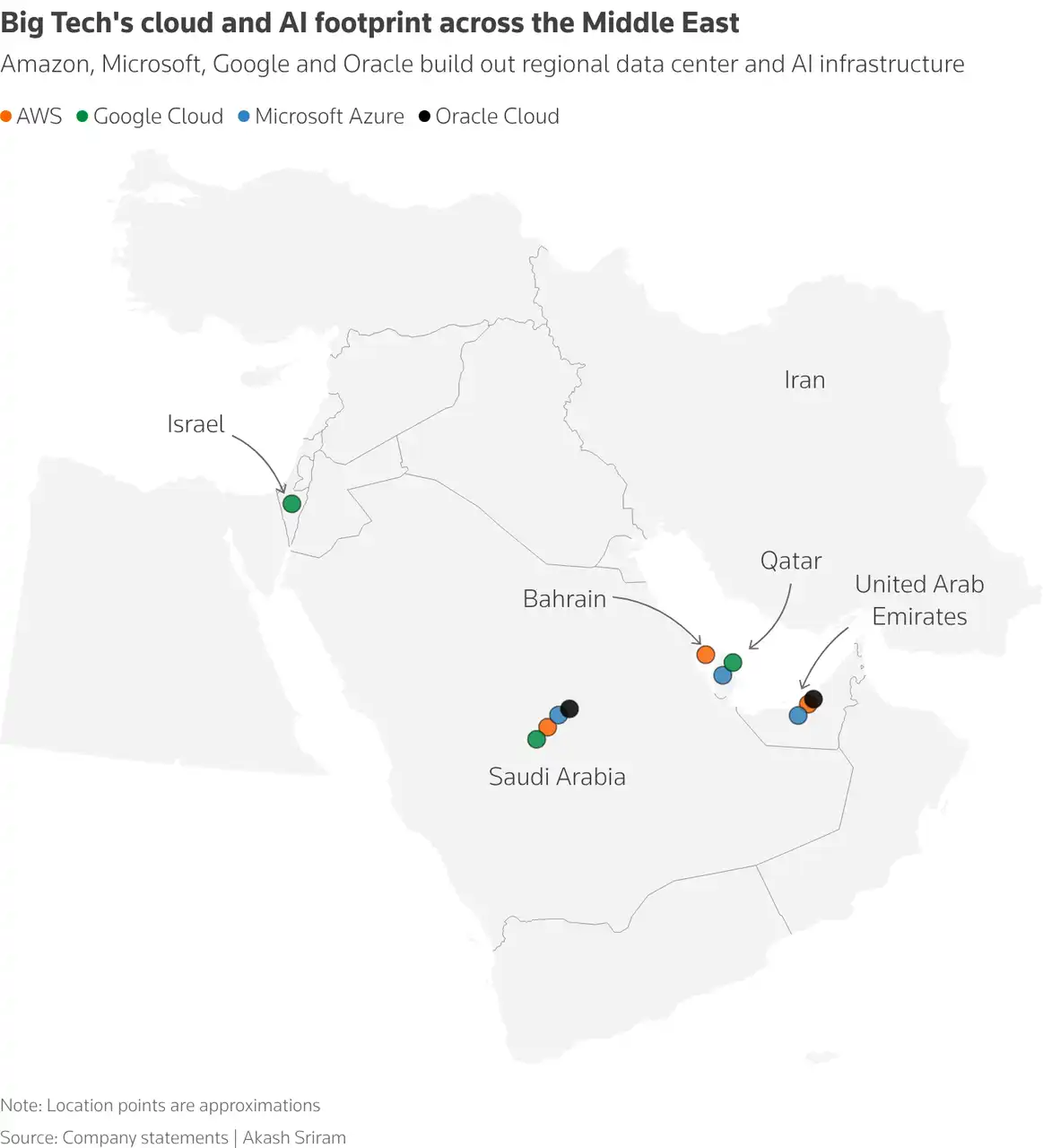
So Amazon has opened data centers in the UAE and Bahrain, and is poised to invest $5.3 billion in Saudi Arabia for another one; Microsoft has nodes in the UAE and Qatar, and has already built in Saudi Arabia.
OpenAI, in partnership with Nvidia and SoftBank, is building an AI hub in the UAE for over $30 billion, touted as the largest computing hub outside the U.S.
In January of this year, the U.S. just got the UAE and Qatar to sign an agreement called "Pax Silica." Translated, it means "Silicon Peace," which sounds lovely.
At the core of the agreement is controlling the flow of chips to ensure that advanced chips do not fall into Chinese hands.
In exchange, the UAE secured an annual import license for hundreds of thousands of Nvidia's most advanced processors. Abu Dhabi's G42 cut ties with Huawei, and Saudi AI companies pledged not to buy Huawei equipment...
The entire AI infrastructure in the Gulf, from chips to data centers to models, is now fully aligned with the U.S.
These agreements consider everything, from chip export controls, data sovereignty, investment reciprocity, to technology leakage risks.
But not a single one considered that someone might use a missile to bomb the data center.
An international security scholar at Qatar University made a pertinent remark upon seeing the Amazon data center on fire, which the author found quite fitting:
"These security frameworks are designed for supply chain control and political alignment, physical security was never on the agenda."
Cloud computing has told a decade-long story of elasticity, redundancy, and decentralization. But a data center is a physical building with an address, walls, a roof, and coordinates. No matter how advanced your chips are, if the data center is bombed, it's bombed.
“The Cloud” is a metaphor; the data center is not.
AI may appear ethereal, running on code, floating in the clouds. But the code runs on chips, the chips are housed in data centers, and data centers sit on the Earth.
Who Will Protect AI?
In this instance, Amazon's data center can be considered collateral damage, or perhaps, an unintended target.
But what about next time?
Amid escalating global geopolitical tensions, if there's an AI model in your data center helping an adversary with target recognition, the adversary has every reason to consider your data center a legitimate military target.
This issue is one that international law has yet to address.
Existing rules of war cover “dual-use facilities,” but those provisions reference factories and bridges; no one ever thought about data centers.
A data center that processes banking transactions during the day and conducts military intelligence analysis at night—does it qualify as civilian or military?
In times of peace, data center sites are chosen based on latency, electricity costs, policy incentives... When war breaks out, none of that matters. What matters is how close your data center is to the nearest military installation.
So, this recent bombing has begun to shift everyone’s attention.
Previously, everyone was discussing the same anxiety—whether AI would replace their jobs. But no one was talking about the other question:
Before AI replaces you, how vulnerable is AI itself?
A regional conflict caused the Middle East node of the world’s largest cloud provider to go down for an entire day, and that was just one data center.
There are nearly 1300 hyperscale data centers in the world today, with 770 more under construction. These data centers are consuming more and more electricity, water, and money while carrying an increasing load—your deposits, your medical records, your takeout orders, even military intelligence for a country...
Yet, the solutions to protect these data centers may still be limited to fire suppression systems and backup generators.
When AI becomes a country’s infrastructure, its security becomes everyone’s concern. Who will protect AI? The cloud providers? The Pentagon? Or the UAE's air defense system?
This question was purely theoretical just three days ago. Not anymore.
AI is within the cannon shot. And it's not just AI, actually. In this day and age, what isn't within the cannon shot?
You may also like

ChainCatcher Hong Kong Themed Forum Highlights: Decoding the Growth Engine Under the Integration of Crypto Assets and Smart Economy

Why can this institution still grow by 150% when the scale of leading crypto VCs has shrunk significantly?

Anthropic's $1 trillion, compared to DeepSeek's $100 billion

Geopolitical Risk Persists, Is Bitcoin Becoming a Key Barometer?

Annualized 11.5%, Wall Street Buzzing: Is MicroStrategy's STRC Bitcoin's Savior or Destroyer?

An Obscure Open Source AI Tool Alerted on Kelp DAO's $292 million Bug 12 Days Ago

Mixin has launched USTD-margined perpetual contracts, bringing derivative trading into the chat scene.
The privacy-focused crypto wallet Mixin announced today the launch of its U-based perpetual contract (a derivative priced in USDT). Unlike traditional exchanges, Mixin has taken a new approach by "liberating" derivative trading from isolated matching engines and embedding it into the instant messaging environment.
Users can directly open positions within the app with leverage of up to 200x, while sharing positions, discussing strategies, and copy trading within private communities. Trading, social interaction, and asset management are integrated into the same interface.
Based on its non-custodial architecture, Mixin has eliminated friction from the traditional onboarding process, allowing users to participate in perpetual contract trading without identity verification.
The trading process has been streamlined into five steps:
· Choose the trading asset
· Select long or short
· Input position size and leverage
· Confirm order details
· Confirm and open the position
The interface provides real-time visualization of price, position, and profit and loss (PnL), allowing users to complete trades without switching between multiple modules.
Mixin has directly integrated social features into the derivative trading environment. Users can create private trading communities and interact around real-time positions:
· End-to-end encrypted private groups supporting up to 1024 members
· End-to-end encrypted voice communication
· One-click position sharing
· One-click trade copying
On the execution side, Mixin aggregates liquidity from multiple sources and accesses decentralized protocol and external market liquidity through a unified trading interface.
By combining social interaction with trade execution, Mixin enables users to collaborate, share, and execute trading strategies instantly within the same environment.
Mixin has also introduced a referral incentive system based on trading behavior:
· Users can join with an invite code
· Up to 60% of trading fees as referral rewards
· Incentive mechanism designed for long-term, sustainable earnings
This model aims to drive user-driven network expansion and organic growth.
Mixin's derivative transactions are built on top of its existing self-custody wallet infrastructure, with core features including:
· Separation of transaction account and asset storage
· User full control over assets
· Platform does not custody user funds
· Built-in privacy mechanisms to reduce data exposure
The system aims to strike a balance between transaction efficiency, asset security, and privacy protection.
Against the background of perpetual contracts becoming a mainstream trading tool, Mixin is exploring a different development direction by lowering barriers, enhancing social and privacy attributes.
The platform does not only view transactions as execution actions but positions them as a networked activity: transactions have social attributes, strategies can be shared, and relationships between individuals also become part of the financial system.
Mixin's design is based on a user-initiated, user-controlled model. The platform neither custodies assets nor executes transactions on behalf of users.
This model aligns with a statement issued by the U.S. Securities and Exchange Commission (SEC) on April 13, 2026, titled "Staff Statement on Whether Partial User Interface Used in Preparing Cryptocurrency Securities Transactions May Require Broker-Dealer Registration."
The statement indicates that, under the premise where transactions are entirely initiated and controlled by users, non-custodial service providers that offer neutral interfaces may not need to register as broker-dealers or exchanges.
Mixin is a decentralized, self-custodial privacy wallet designed to provide secure and efficient digital asset management services.
Its core capabilities include:
· Aggregation: integrating multi-chain assets and routing between different transaction paths to simplify user operations
· High liquidity access: connecting to various liquidity sources, including decentralized protocols and external markets
· Decentralization: achieving full user control over assets without relying on custodial intermediaries
· Privacy protection: safeguarding assets and data through MPC, CryptoNote, and end-to-end encrypted communication
Mixin has been in operation for over 8 years, supporting over 40 blockchains and more than 10,000 assets, with a global user base exceeding 10 million and an on-chain self-custodied asset scale of over $1 billion.

$600 million stolen in 20 days, ushering in the era of AI hackers in the crypto world
Vitalik's 2026 Hong Kong Web3 Summit Speech: Ethereum's Ultimate Vision as the "World Computer" and Future Roadmap
On the same day Aave introduced rsETH, why did Spark decide to exit?
Full Post-Mortem of the KelpDAO Incident: Why Did Aave, Which Was Not Compromised, End Up in Crisis Situation?

After a $290 million DeFi liquidation, is the security promise still there?
ZachXBT's post ignites RAVE nearing zero, what is the truth behind the insider control?

Vitalik 2026 Hong Kong Web3 Carnival Speech Transcript: We do not compete on speed; security and decentralization are the core
In-depth Analysis of RAVE Events: Short Squeeze, Crash, and Quantitative Financial Models of Liquidity Manipulation

Eve of Ceasefire, US Military Fires on Iranian Vessel | Rewire News Morning Brief

Figma's stock price drops over 7%, will Claude Design be the terminator?




 App
App