
Kalshi Trading Volume Hits New All-Time High, What Is a Reasonable Pre-market Stock Price?

Original Title: "Kalshi Trading Volume Hits New High, What Is a Reasonable Pre-market Stock Price?"
Original Author: Wenser, Odaily Planetary Daily
During the market downturn, the prediction market became one of the most eye-catching tracks in the crypto market. In early February, during a market crash, BTC and ETH once fell by over 10%, but the prediction market trading remained active, with a weekly transaction volume reaching 26.39 million times, setting a new historical high. At the same time, as the largest compliant prediction market platform in the U.S., Kalshi also took the lead in the race with a trading volume of over 9.5 billion USD in January this year, setting a new record for monthly trading volume. Following this is a new round of market pricing for Kalshi's pre-market stock price.
The question we are going to discuss today is — what should be the reasonable range for the pre-market stock price of Kalshi, which is expected to become the "number one stock in the prediction market"?
Overview of existing pricing on Coin-Stock tokenized trading platforms: PreStocks, Jarsy
As of the time of writing, there is a significant price difference in the pre-market pricing of Kalshi's stock on the two major Coin-Stock tokenized trading platforms:
On the PreStocks platform, Kalshi's pre-market stock price includes two prices —
One price is the token price at the implied market value (market liquidity pricing level), with a single share price of around $369;
The other price is the calibrated price at the capital market value (existing funding pricing level), with a single share price of around $364.
On the Jarsy platform, the pre-market price per share of Kalshi has already risen to around $504.
It is worth mentioning that compared to when we previously wrote the article "Will the pre-market stock price of the "leading stock in the prediction market" Kalshi rise by over 20%, can you still buy?", the pre-market prices of Kalshi's stock on the two platforms have all experienced varying degrees of ups and downs. The pricing at that time was as follows:
· On PreStocks, Kalshi's implied market value is about $14 billion, with a single share priced at around $407;
· On Jarsy, Kalshi's market valuation is $11 billion, with a per-share price of $450.
In other words, the price on the PreStocks platform dropped from around $407 to $369; while on the Jarsy platform, the price increased from $450 to around $504.
For comparison, there have also been some changes in the pre-market pricing of Kalshi's stock in the traditional financial markets:
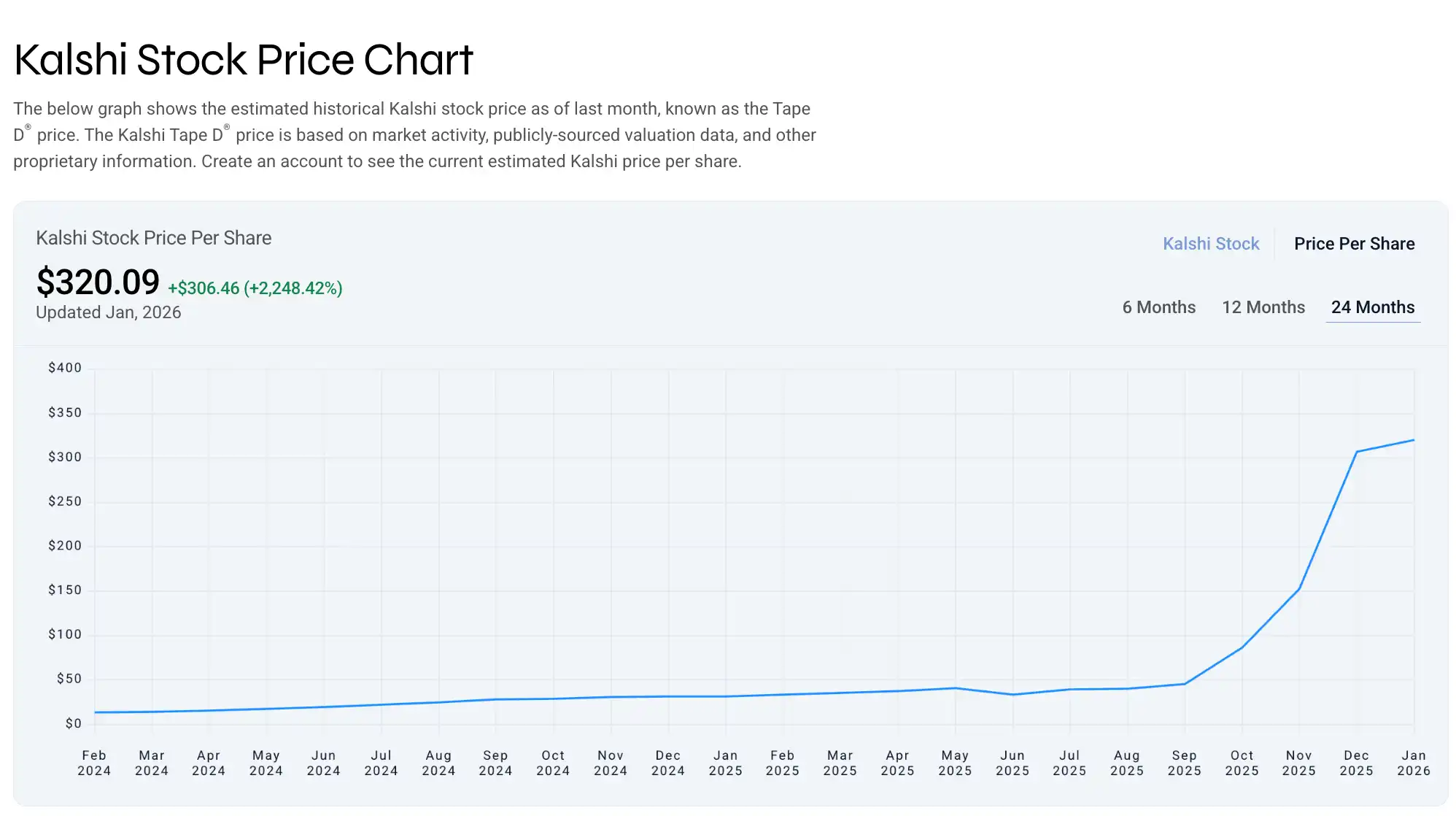
· On the Nasdaq Private Market, Kalshi's per-share price has increased from around $307 to around $320;
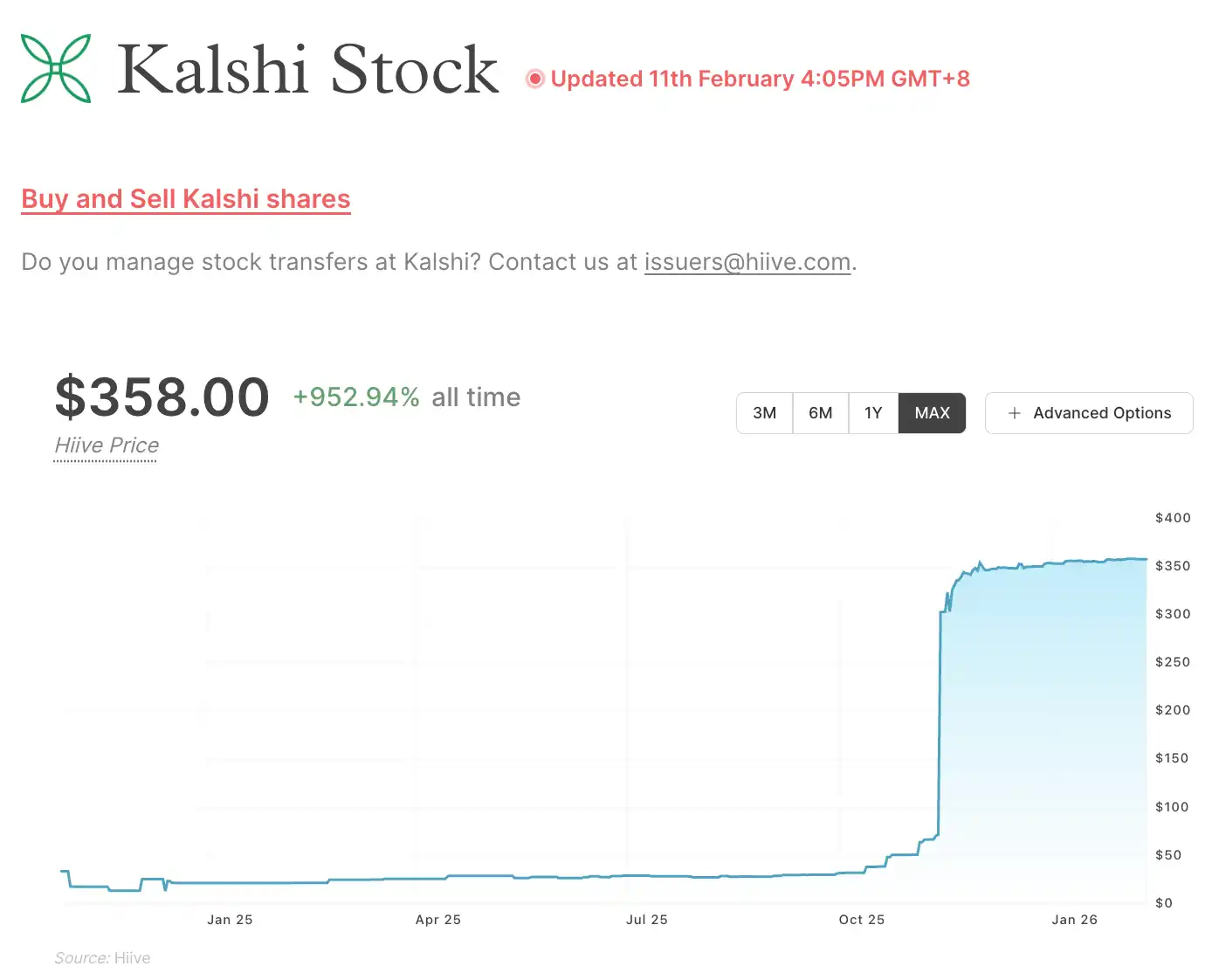
· On Hiive, Kalshi's per-share price has increased by $1 from around $357 to around $358.
Kalshi Stock Pre-Market Fair Pricing Range: $320-$423
Last year, Kalshi completed a $1 billion Series E funding round, valuing the company at $11 billion.
Based on the previously mentioned market values and corresponding stock prices, the number of Kalshi shares is approximately 30.72 million to 34.30 million.
Specifically, the share calculation is as follows:
· Using a $11 billion market cap and the pre-market prices of $320 and $358 in the traditional financial markets, the number of Kalshi shares is approximately 30.72 million to 34.37 million;
· Using the implied market cap/token price on the PreStocks platform, the capitalization/stock calibration price, the number of Kalshi shares is approximately 34.27 million to 34.30 million;
· Using the pre-market purchase price per share on the Jarsy platform, with a maximum market cap for Kalshi of $18.665 billion and a per-share price of $604.84, the number of shares is approximately 30.86 million.
Based on the above information, we can make the following deductions:
First, based on an $11 billion valuation, the pre-market pricing range for Kalshi shares is approximately $320-$358, indicating that currently the pricing on platforms like PreStocks and Jarsy is relatively high in the crypto market.
Secondly, Kalshi's trading volume reached $9.5 billion in January, close to the overall $10 billion scale of the prediction market in October last year; in October last year, its market share was about 50% of the prediction market, so, based on this, Kalshi's current market capitalization is at least $15 billion.
Thirdly, based on a $15 billion valuation, and considering Kalshi's stock count range, the pre-market pricing range for Kalshi's stock is around $436 to $488.
Therefore, if Kalshi's stock count meets expectations, based on a $15 billion implied valuation, a conservative estimate for Kalshi's pre-market stock pricing range would be $320 to $378 (calculated based on the average of the lowest prices in the pricing range); an optimistic estimate would be $358 to $423 (calculated based on the average of the highest prices in the pricing range).
Based on the above data-driven conclusions, the Jarsy platform views Kalshi's pre-market stock pricing as high, while the PreStocks platform presents some arbitrage opportunities.
In addition, the latest stock tokenization trading platform, Tessera, also plans to subsequently open public equity offerings.
Based on Polymarket's "15-Minute Cryptocurrency Price Movement" market trading volume and fee ratio static calculation, at the current trading volume and transaction structure, if Polymarket introduces a similar fee model across all markets, it is estimated to bring in $418 million in annual revenue to the platform.
As a prediction market platform with higher trading volume and fees, looking forward to the favorable timing of the 2026 sports event bonanza, Kalshi's annual revenue is expected to surpass this estimated revenue of Polymarket. Therefore, the subsequent capital markets may further drive up Kalshi's pre-market stock pricing.
You may also like

The U.S. government prohibits foreigners from using Fable 5, Anthropic issues a rebuttal

The other side of Musk's trillion-dollar fortune: 85% cannot be sold

Citibank releases "2030 Asset Tokenization Market Outlook": 6 major trends may create a $8.2 trillion market

The trillion-dollar valuation test: Are the three major super IPOs a celebration for tech stocks or a nightmare for the crypto market?

Morning Report | Digital Asset completes $355 million financing led by a16z Crypto; Meta completes operational separation from Manus

a16z Crypto Partner: Cash flow is the moat

Cryptocurrency market makers collectively seek change as it becomes increasingly difficult to make money

How TradeXYZ, xStocks, and Alpaca break down the SpaceX IPO into three different strategies

$75 billion in risk asset redistribution: How will SpaceX's IPO affect U.S. stocks and Bitcoin?

Why Is BlackRock Investing $5 Billion in the SpaceX IPO?
Morning News | CME Group launches Nasdaq Cryptocurrency Index futures; Asset management giant Janus Henderson strategically invests in Ethena

Bitcoin Layer 2 Network Botanix: Why Did We Choose to Dissolve?

Why did Oracle deliver the strongest financial report in history, yet its stock price fell?
When the P2P illicit funds from ten years ago turned into 60,000 bitcoins
Dialogue with OmenX Founder: Why does the prediction market need an evolution from "spot" to "derivatives"?
Galaxy in-depth report: Is Solana still worth paying attention to?
Young people in South Korea make a "final effort" in the epic bull market
The pricing controversy of Trade.xyz exposes the fatal weakness of Pre-IPO perpetual contracts
The U.S. government prohibits foreigners from using Fable 5, Anthropic issues a rebuttal
The other side of Musk's trillion-dollar fortune: 85% cannot be sold
Citibank releases "2030 Asset Tokenization Market Outlook": 6 major trends may create a $8.2 trillion market
The trillion-dollar valuation test: Are the three major super IPOs a celebration for tech stocks or a nightmare for the crypto market?
Morning Report | Digital Asset completes $355 million financing led by a16z Crypto; Meta completes operational separation from Manus
a16z Crypto Partner: Cash flow is the moat


