
 Buy Crypto
- Markets
 Futures
- Spot
- Copy Trade
- Earn
- More
Looking Back at Alpaca Finance: When FUD Turns into a Brief Wealth Code

Original Article Title: "Looking Back at Alpaca: When FUD Becomes a Fleeting Wealth Code"
Original Source: DeepFlow Tech
These days, the soon-to-be delisted "Alpaca Coin" $ALPACA from Binance has been active on the market stage, with a $30 million circulating market value stirring up over $10 billion in total trading volume. On April 24, Binance announced the delisting of four tokens, including Alpaca Finance ($ALPACA), scheduled for May 2.
The news of "Binance delisting" is usually a significant FUD event for a project — delisting implies reduced liquidity, shrinking trading volume, and often a sharp price drop or even collapse for the token.
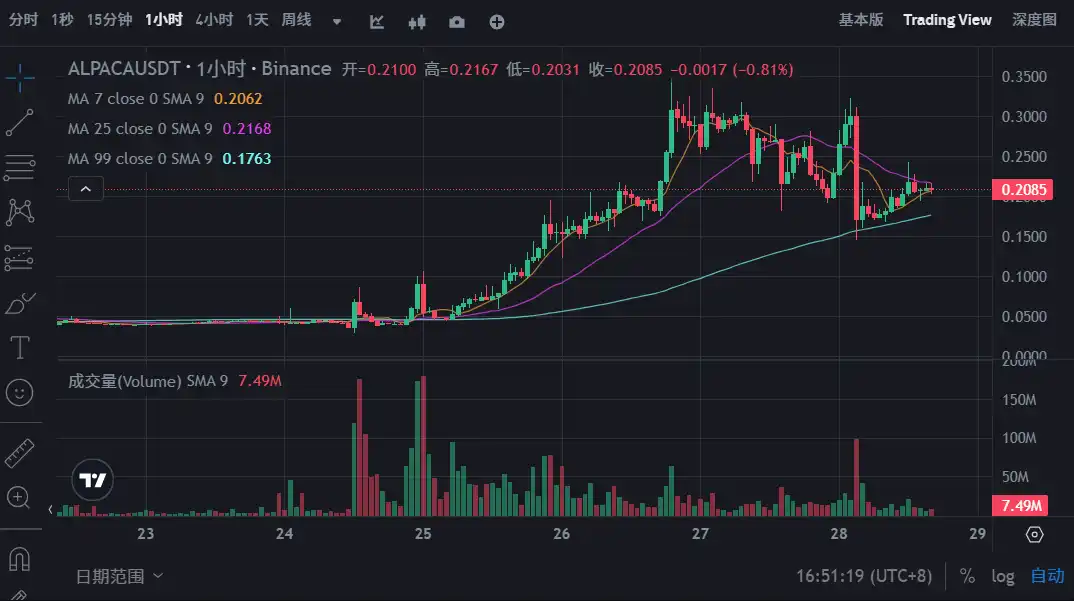
However, after the delisting announcement, $ALPACA experienced a roughly 30% price drop in a short period (based on Binance spot trading), but then the price surged nearly 12x in three days, skyrocketing from $0.029 to a peak of $0.3477. Simultaneously, the open interest (OI) of $ALPACA futures contracts far exceeded its token market value multiple times, ushering in a brutal long vs. short battle around $ALPACA.
Fee Settlement Acceleration Intensifies Long vs. Short Battle
Subsequently, Binance adjusted the funding rate rules, shortening the maximum fee rate settlement period to every hourly (up to 2%), further intensifying the fierce long vs. short battle. Longs not only profited from driving up the price but also continued to "eat" the high funding rate. Longs kept "eating and holding" for several days, leading $ALPACA's price to engage in a high-stakes battle at elevated levels for almost four days.
With an hourly settlement and a -2% fee rate, under the premise of 1x leverage, a short position held for a day would lose at least 48% of the principal. Despite bearing such a high rate, there were still funds willing to continue shorting.
In the intense battle, some noticed that large-scale follow traders with million-dollar positions had been consistently shorting $ALPACA with high leverage, eventually leading to liquidations involving hundreds of millions of dollars of user funds.
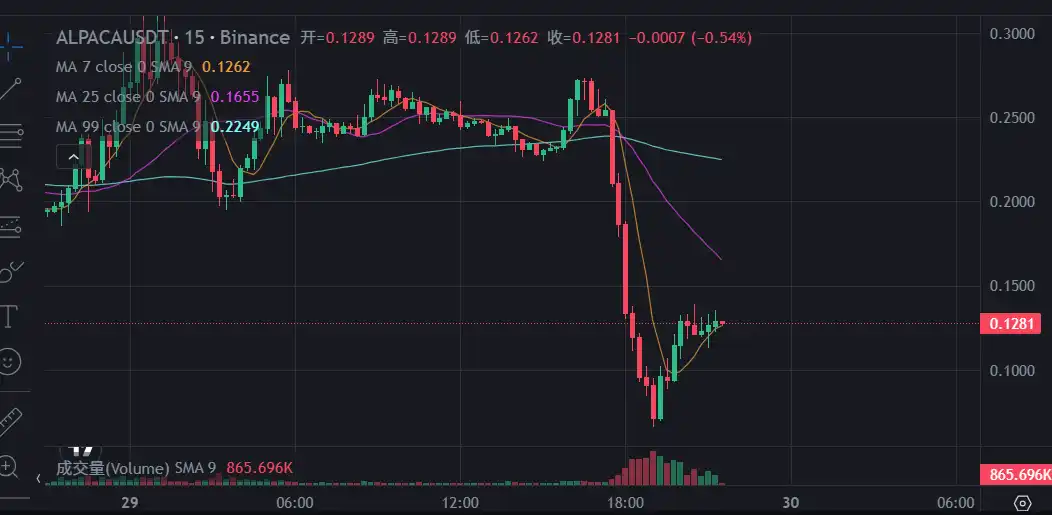
On April 29, Binance raised the $ALPACA contract rate limit to ±4%. For shorts, another increase in the fee rate limit would exponentially raise the cost of shorting. However, despite the rule change that should have discouraged shorts, the price of $ALPACA "counterintuitively" plummeted from $0.27 to around $0.067.
No Absolute Trading Rule
As the trading volume and attention gradually shift, the $ALPACA story may have come to an end.
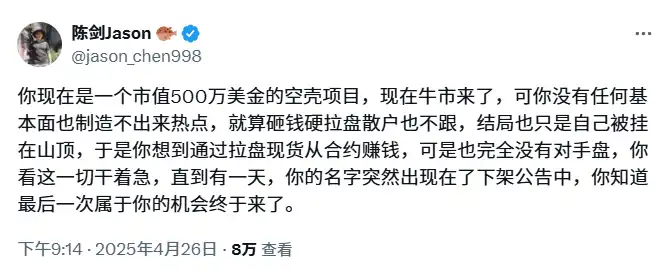
Looking back at this billion-dollar-scale farce, in some ways, $ALPACA these days can be seen as a kind of meme—brought a massive amount of attention by the delisting bearish news, allowing the "red is also red" principle to be fully leveraged in price fluctuations. At the same time, with a relatively low circulating market cap at the same level of environment (top-tier trading platforms) (bottoming out at less than $4 million), highly controlled chip holdings, and continuously stimulating player's nerves with high volatility price swings, even the image of a "alpaca" can be associated with a meme.
Although the image is cute, for users truly involved in the game, these days can perhaps only be described as "bloody." The appearance of crazy bullish moves on bearish news, and the smooth fall on the news of the "explosion," $ALPACA's complex recent trend has overturned the usual "sell the news" logic and has also overturned many people's positions.
Evidently, the boundary between "good news" and "bad news" has gradually blurred, and the previous single judgment logic has gradually become inapplicable to the constantly evolving market. In its place is the violent manipulation of human nature dominating, with ever-refreshing liquidation data gradually taking over the market. Describing this evolutionary direction as "barbaric growth" may be more appropriate.
However, everything has two sides, and as some feel confused, others feel excited. This farce is not a bad thing for everyone. For many participants who are pursuing price volatility excitement and have outstanding abilities, the alpaca's recent behavior is even a rare opportunity to make a big profit.
There are also voices suggesting that behind the market makers shorting at all costs with copy trading user funds is a hunt for retail investors' funds, as the movie tagline says, "The aristocrat's money is all returned, and the commoners' money is split 70/30." The truth of the statement is hard to judge at the moment, but what can be confirmed is that even if the actual situation is not as dark, the ultimate winner in this manipulation will not be the average user.
In the absence of adequate regulatory measures, $ALPACA may not be the last time this market sees a crazy manipulation. As of the completion of this article, $ALPACA's price is still experiencing intense fluctuations, and perhaps there will be more exciting "performances" before the official delisting.
However, in the precarious price game, there is hardly a safe haven for uninformed participants. Under the hunt of attention and liquidity, perhaps less watching and more action is the retail investor's most positive expected value (EV) move. Those who see major news and abnormal price movements and think, "the opportunity has come," are not just retail investors but also the long-awaiting project teams.
You may also like

Morning News | The Hong Kong Securities and Futures Commission announced the regulatory framework for secondary market trading of tokenized investment products; Strategy increased its holdings by 34,164 bitcoins last week; KAIO completed a strategic fi...

What Is an XRP Wallet? The Best Wallets to Store XRP (2026 Updated)
An XRP wallet lets you safely store, send, and receive XRP on the XRP Ledger. Learn what wallets support XRP and discover the best XRP wallets for beginners and long-term holders in 2026.

What are the Top AI Crypto Coins? Render vs. Akash: 5 Gems Solving the 2026 GPU Crisis
What are the best AI crypto coins for the 2026 cycle? Beyond the hype, we analyze top tokens like RNDR, AKT, and FET that provide real-world solutions to the global GPU shortage and the rise of autonomous agents.

What Is a Token in AI? What Is an AI Token + 3 Gems You Can't Miss in 2026
The era of AI hype has transitioned into an era of utility. As we move through Q2 2026, the market is no longer rewarding "narrative-only" projects. At WEEX Research, we are seeing a massive capital rotation into Decentralized Compute (DePIN) and Autonomous Agent coordination layers. This guide analyzes which AI tokens are capturing institutional liquidity and how to spot high-conviction setups in a maturing market.

Consumer-grade Crypto Global Survey: Users, Revenue, and Track Distribution

Prediction Markets Under Bias

Stolen: $290 million, Three Parties Refusing to Acknowledge, Who Should Foot the Bill for the KelpDAO Incident Resolution?

ASTEROID Pumped 10,000x in Three Days, Is Meme Season Back on Ethereum?

ChainCatcher Hong Kong Themed Forum Highlights: Decoding the Growth Engine Under the Integration of Crypto Assets and Smart Economy

Why can this institution still grow by 150% when the scale of leading crypto VCs has shrunk significantly?

Anthropic's $1 trillion, compared to DeepSeek's $100 billion

Geopolitical Risk Persists, Is Bitcoin Becoming a Key Barometer?

Annualized 11.5%, Wall Street Buzzing: Is MicroStrategy's STRC Bitcoin's Savior or Destroyer?
An Obscure Open Source AI Tool Alerted on Kelp DAO's $292 million Bug 12 Days Ago

Mixin has launched USTD-margined perpetual contracts, bringing derivative trading into the chat scene.
The privacy-focused crypto wallet Mixin announced today the launch of its U-based perpetual contract (a derivative priced in USDT). Unlike traditional exchanges, Mixin has taken a new approach by "liberating" derivative trading from isolated matching engines and embedding it into the instant messaging environment.
Users can directly open positions within the app with leverage of up to 200x, while sharing positions, discussing strategies, and copy trading within private communities. Trading, social interaction, and asset management are integrated into the same interface.
Based on its non-custodial architecture, Mixin has eliminated friction from the traditional onboarding process, allowing users to participate in perpetual contract trading without identity verification.
The trading process has been streamlined into five steps:
· Choose the trading asset
· Select long or short
· Input position size and leverage
· Confirm order details
· Confirm and open the position
The interface provides real-time visualization of price, position, and profit and loss (PnL), allowing users to complete trades without switching between multiple modules.
Mixin has directly integrated social features into the derivative trading environment. Users can create private trading communities and interact around real-time positions:
· End-to-end encrypted private groups supporting up to 1024 members
· End-to-end encrypted voice communication
· One-click position sharing
· One-click trade copying
On the execution side, Mixin aggregates liquidity from multiple sources and accesses decentralized protocol and external market liquidity through a unified trading interface.
By combining social interaction with trade execution, Mixin enables users to collaborate, share, and execute trading strategies instantly within the same environment.
Mixin has also introduced a referral incentive system based on trading behavior:
· Users can join with an invite code
· Up to 60% of trading fees as referral rewards
· Incentive mechanism designed for long-term, sustainable earnings
This model aims to drive user-driven network expansion and organic growth.
Mixin's derivative transactions are built on top of its existing self-custody wallet infrastructure, with core features including:
· Separation of transaction account and asset storage
· User full control over assets
· Platform does not custody user funds
· Built-in privacy mechanisms to reduce data exposure
The system aims to strike a balance between transaction efficiency, asset security, and privacy protection.
Against the background of perpetual contracts becoming a mainstream trading tool, Mixin is exploring a different development direction by lowering barriers, enhancing social and privacy attributes.
The platform does not only view transactions as execution actions but positions them as a networked activity: transactions have social attributes, strategies can be shared, and relationships between individuals also become part of the financial system.
Mixin's design is based on a user-initiated, user-controlled model. The platform neither custodies assets nor executes transactions on behalf of users.
This model aligns with a statement issued by the U.S. Securities and Exchange Commission (SEC) on April 13, 2026, titled "Staff Statement on Whether Partial User Interface Used in Preparing Cryptocurrency Securities Transactions May Require Broker-Dealer Registration."
The statement indicates that, under the premise where transactions are entirely initiated and controlled by users, non-custodial service providers that offer neutral interfaces may not need to register as broker-dealers or exchanges.
Mixin is a decentralized, self-custodial privacy wallet designed to provide secure and efficient digital asset management services.
Its core capabilities include:
· Aggregation: integrating multi-chain assets and routing between different transaction paths to simplify user operations
· High liquidity access: connecting to various liquidity sources, including decentralized protocols and external markets
· Decentralization: achieving full user control over assets without relying on custodial intermediaries
· Privacy protection: safeguarding assets and data through MPC, CryptoNote, and end-to-end encrypted communication
Mixin has been in operation for over 8 years, supporting over 40 blockchains and more than 10,000 assets, with a global user base exceeding 10 million and an on-chain self-custodied asset scale of over $1 billion.

$600 million stolen in 20 days, ushering in the era of AI hackers in the crypto world
Vitalik's 2026 Hong Kong Web3 Summit Speech: Ethereum's Ultimate Vision as the "World Computer" and Future Roadmap
On the same day Aave introduced rsETH, why did Spark decide to exit?
Morning News | The Hong Kong Securities and Futures Commission announced the regulatory framework for secondary market trading of tokenized investment products; Strategy increased its holdings by 34,164 bitcoins last week; KAIO completed a strategic fi...
What Is an XRP Wallet? The Best Wallets to Store XRP (2026 Updated)
An XRP wallet lets you safely store, send, and receive XRP on the XRP Ledger. Learn what wallets support XRP and discover the best XRP wallets for beginners and long-term holders in 2026.
What are the Top AI Crypto Coins? Render vs. Akash: 5 Gems Solving the 2026 GPU Crisis
What are the best AI crypto coins for the 2026 cycle? Beyond the hype, we analyze top tokens like RNDR, AKT, and FET that provide real-world solutions to the global GPU shortage and the rise of autonomous agents.
What Is a Token in AI? What Is an AI Token + 3 Gems You Can't Miss in 2026
The era of AI hype has transitioned into an era of utility. As we move through Q2 2026, the market is no longer rewarding "narrative-only" projects. At WEEX Research, we are seeing a massive capital rotation into Decentralized Compute (DePIN) and Autonomous Agent coordination layers. This guide analyzes which AI tokens are capturing institutional liquidity and how to spot high-conviction setups in a maturing market.



 App
App