
 Buy Crypto
- Markets
 Futures
- Spot
- Copy Trade
- Earn
- More
Magic Eden Airdrop Launch: How to Claim? Can It Reignite the NFT Market?

Original Article Title: "Explaining Magic Eden (ME) Airdrop Rules, Claim Steps, and Future Plans"
Original Article Author: CryptoLeo, Odaily Planet Daily
At 3 a.m. on December 5th, Beijing Time, the Magic Eden Foundation launched the ME Token Airdrop Lookup page. Prior to this, Magic Eden released the ME tokenomics, with a total token supply of 1 billion, of which 12.5% (125 million tokens) would be immediately unlocked and airdropped to eligible Magic Eden users, while an additional 22.5% of the supply (225 million ME tokens) would be set aside to incentivize future users of the ME Foundation's related protocols and platform.
For more detailed tokenomics, please refer to: "Magic Eden Token Generation Event is Coming, What Preparations Should Be Made to Claim the Airdrop?"
Overall Allocation Principle
The ME token aims to reward users of SOL, BTC, and EVM wallets who provide on-chain economic activity, and the ME airdrop allocation will be assessed based on three main aspects: real users (referred to by Magic Eden as Organic users), cross-chain activity, and loyalty.
Organic users can also be seen as Magic Eden's genuine users, with Magic Eden's organic usage being a key part of ME allocation. The more a wallet's address behavior transactions resemble real users, the more likely they are to receive rewards, while non-organic transaction addresses have been identified, meaning that Magic Eden has already filtered out some bot users.
On platform X, some users have expressed that they hold a large amount of tokens but receive a relatively small share of ME tokens or are deemed non-organic users.
Four Main Sections of the Lookup Page
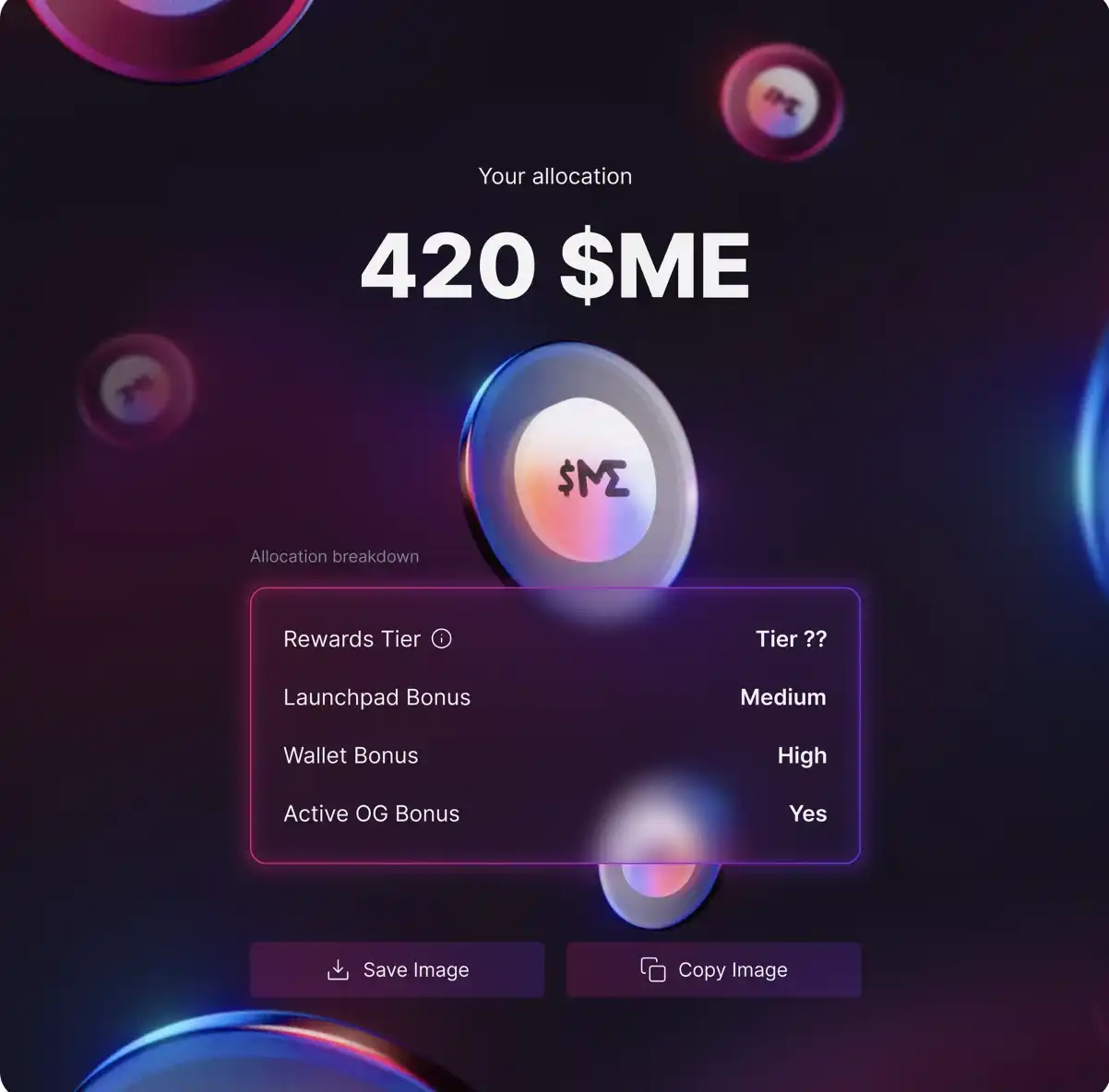
As Magic Eden is a multi-chain protocol that covers both tokens and NFTs and is preparing to cover over 15 chains by the end of the year, this airdrop lookup is unique in that it allows users to connect multiple wallets, and the displayed ME is the sum of ME that multiple eligible wallets can claim.
An airdrop is divided into four sections, with each section contributing to the total airdropped token amount. The four sections are as follows: one main section, Rewards Tiers, and three secondary sections: Launchpad Bonus, Wallet Bonus, Active OG Bonus.
Main Rewards Tier Section
The Rewards Tier is the wallet's reward level and is the main criterion for assessing the ME airdrop share. The Tier is related to the diamond quantity we mentioned earlier, and the diamond quantity is related to the transaction activity of the wallet connected by the user. However, if a user has multiple qualifying wallets, they can all be connected to the airdrop query interface, and their Rewards Tier will display the highest wallet level among all wallets.
The displayed Tier level is not related to the number of connected wallets. For example, if a user has multiple qualifying wallets and each wallet carries out a small amount of transactions, the user can receive a larger overall ME airdrop share, but their Rewards Tier will be lower. Conversely, if a user has only a few qualifying wallets, and each wallet has a large transaction volume, the user may have a higher Rewards Tier, but the ME share that can be obtained from a few wallets' transaction volume may be lower than the ME share that can be obtained from the total transaction volume of more wallets. Of course, users who focus only on one wallet address and have excellent data in all aspects do not need to worry about this.
So far, the highest level I have seen is Tier 1, and the lowest level is Tier 14, but the ME Foundation allocation rules website has not clearly outlined the relationship between the diamond quantity and the level.
The data of the secondary sections will display the best data of all connected wallets. For example, if a user has 3 wallets, one wallet has a lot of Launchpad activity, another wallet has a lot of Wallet activity, and one wallet has been transacting for a long time, the overall allocation will show the best statistical data for each wallet.
Launchpad Bonus
The assessment criteria for the Launchpad Bonus are mainly divided into: High, Medium, Low, and - (representing zero). This section mainly involves minting and cross-chain minting NFTs on the MagicEden Launchpad. However, the use of the Launchpad is seen as a secondary criterion for the airdrop reward quantity. If a wallet has no diamond balance, engaging only in Launchpad activity will not earn any ME airdrop share.
Wallet Bonus
The evaluation criteria for the Wallet Bonus are also four: High, Medium, Low, and - (representing zero), representing wallet activity, including but not limited to NFT cross-chain transactions, cross-chain token swaps in the Magic Eden Wallet, runestone transactions, and Lucky Buy. (Odaily Note: Lucky Buy is a new feature launched by Magic Eden in September, allowing buyers to purchase NFTs below market price. The adoption of this feature is based on a percentage system, where the system determines the percentage of the NFT list price the user wants to use and the user's probability of winning. Buyers can participate in bidding when purchasing NFTs. If the bid is successful, Magic Eden will make up the difference, and the seller will still receive the full list price amount of their NFT. Even if the purchase is not successful, NFT buyers can receive "diamond" rewards, which is also a way to earn Magic Eden diamonds.)
Wallet activity is also a secondary criterion for the airdrop reward amount. If a wallet has no transaction balance and cannot obtain an ME airdrop share based solely on wallet usage.
Active OG Bonus
The Active OG Bonus represents user loyalty, with the assessment criteria being: Yes and No. The Active OG Bonus represents addresses that were among the early adopters of the protocol and have been active since then. This means that if a user is an early adopter but their address has not been used for a long time, they will not be considered for the Active OG Bonus.

The OG early adopter criteria can be referenced using the MagicTicket. MagicEden released a tweet in February 2022 stating that MagicEden conducted a MagicTicket airdrop (total of 30,602 tokens) based on its inception date (September 17, 2021) to reward the Solana NFT ecosystem, as follows:
Users who made their first transaction within one month of its inception will receive an OG Ticket (6,348 tokens);
Users who made their first transaction between mid-October 2022 and mid-December 2022 will receive a Degen Ticket (7,162 tokens);
Users who made their first transaction after December 2022 will receive a Normie Ticket (17,092 tokens).
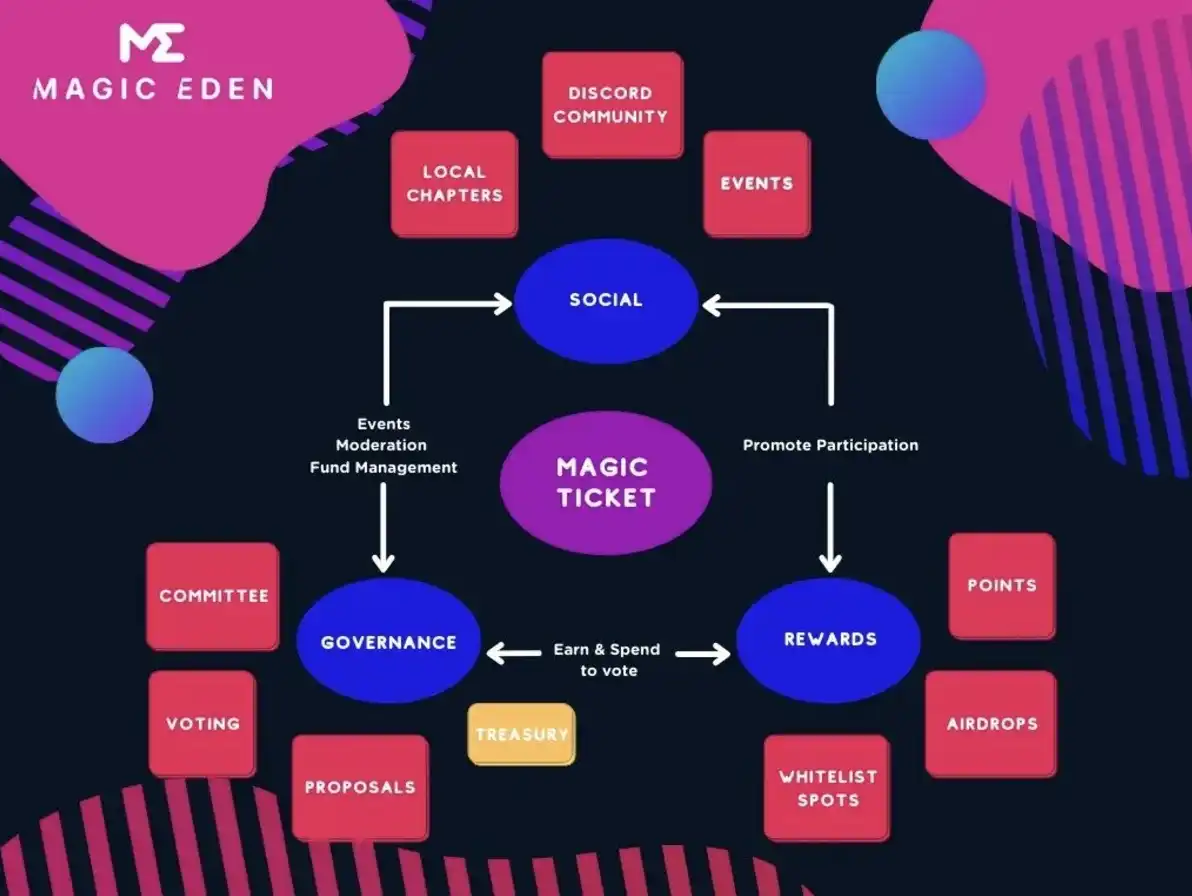
The MagicTicket winner has three types of benefits, which include participation in community governance, rewards, and social interactions. For example, they can create proposals, vote, and also receive additional points (diamonds), whitelist status, and airdrops.
Airdrop Query Tutorial
The airdrop query process is divided into three steps:
- Download the ME Wallet application on your mobile phone, then import the Magic Eden wallet using the mnemonic phrase. Previously, MagicEden had launched the process for claiming testME tokens as part of the ME test coin distribution process. You can refer to: "Magic Eden to Open testME Airdrop Claim, Early Guide to Familiarize You with the Process";
- Use the scan QR code function on the app to scan the ME Foundation's QR code, and then sign in randomly on your mobile device;
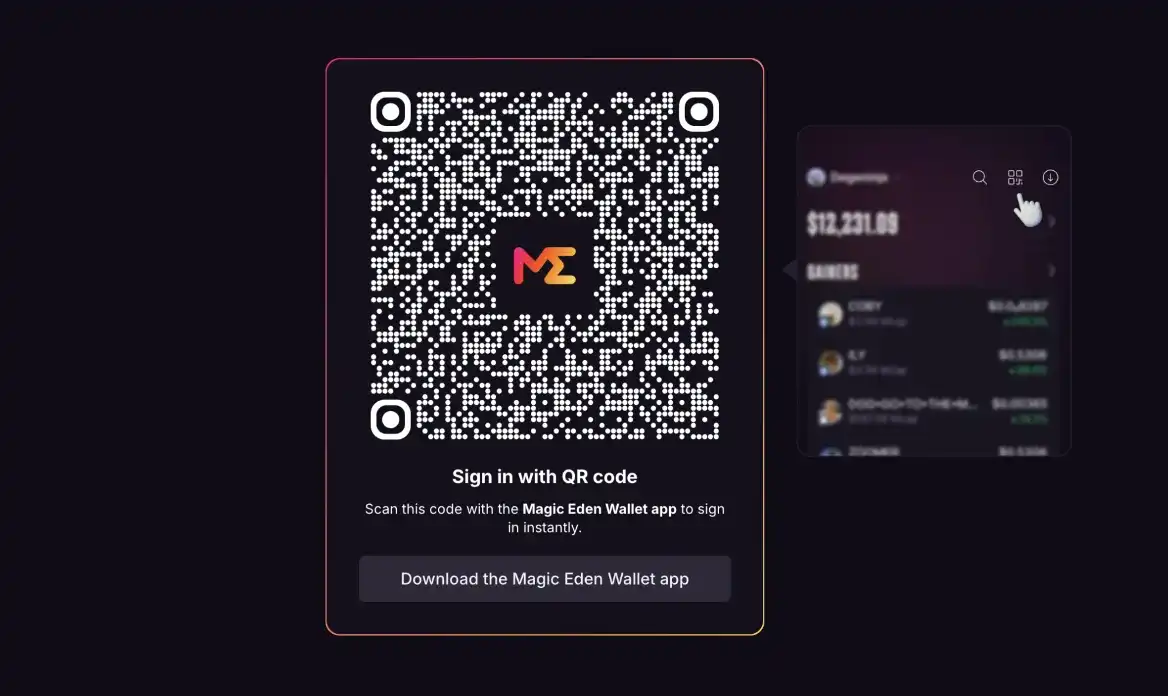
- Once logged in, as mentioned earlier, users should connect as many wallets as possible that have transacted on Magic Eden, such as BTC, ETH, SOL, etc. The more eligible wallets added, the better.

After connecting, you will be able to see your allocation amount on the query interface.
Conclusion
The ME token claim is scheduled for December 10th. Jack Lu, co-founder and CEO of Magic Eden, has previously outlined some key points for the ecosystem and community development post the ME launch:
- Magic Eden will serve as everyone's entry point into the cryptocurrency space, enabling the trading of assets on all chains;
- Magic Eden is integrating ME into its reward system;
- By executing an all-chain, all-asset, all-community strategy, Magic Eden aims to build a strong cross-cryptocurrency maxi community.
Currently, ME is trading on OKX pre-market between 3.5 USDT and 4 USDT, and Coinbase International announced on November 20th that it would support ME by listing ME perpetual contracts on its Pre-Launch market. One might look forward to Coinbase incorporating ME into its listing roadmap.
Furthermore, with the recent resurgence of old coins in the meme coin sector and the continuous rise of new coins, yesterday's NFT sector tokens also saw significant gains. APENFT (NFT) rose by 38.94%, SuperVerse (SUPER) by 21.62%, Apecoin (APE) by 18.85%, and Blur (BLUR) by 6.84%. The market rotation seems to indicate that the focus is not solely on Meme PvP, as other sectors are gradually heating up.
After ME goes live, we may not expect Magic Eden to pump NFTs, but perhaps we can believe that ME, committed to "all chains, all assets," will see some decent gains in the future.
You may also like

The 17-Year Mystery Will Be Solved, Who is Satoshi Nakamoto?

5 Minutes to Make AI Your Second Brain

Uniswap is trapped in an innovation dilemma

What is the key to competition in crypto banking?

The flow of stablecoins and the spillover effects in the foreign exchange market

After two years, Hong Kong's first batch of stablecoin licenses finally issued: HSBC, Standard Chartered make the cut
The person who helped TAO rise by 90% has now single-handedly crashed the price again today

3-Minute Guide to Participating in the SpaceX IPO on Bitget

Top 5 Cryptos to Buy in 2026 Q1: A ChatGPT Deep Dive Analysis
Explore the top 5 cryptos to buy in Q1 2026 including BTC, ETH, SOL, TAO, and ONDO. See price outlooks, key narratives, and institutional catalysts shaping the next market move.

How to Earn $15,000 with Idle USDT Before Altcoin Season 2026
Wondering if altcoin season is coming in 2026? Get the latest market update, and learn how to turn your idle stablecoins waiting for entry into extra rewards up to 15,000 USDT.
Can You Win Joker Returns Without Large Trading Volume? 5 Mistakes New Players Make In WEEX Joker Returns Season 2
Can small traders win WEEX Joker Returns 2026 without huge volume? Yes—if you avoid these 5 costly mistakes. Learn how to maximize card draws, use Jokers wisely, and turn small deposits into 15,000 USDT rewards.

Altcoin Season 2026: 4 Stages to Profit (Before the Crowd FOMO In)
Altcoin Season 2026 is starting — discover the 4 key stages of capital rotation (from ETH to PEPE) and how to position before the peak. Learn which tokens will lead each phase and avoid missing the rally.

Will Alt season come in 2026? 5 Tips to Spot the Next 100x Crypto Opportunities
Will altcoin season arrive in 2026? Discover 5 rotation stages, early signals smart traders watch, and the key crypto sectors where the next 100x altcoin opportunities may emerge.

The bear market has arrived, and cryptocurrency ETF issuers are also getting involved

The richest man had a quarrel with his former boss

BTC Firm Above 70K! Saylor’s "Institutional Logic" vs. Moon’s "Retail Faith": Who is Really Harvesting the Market?
Bitcoin is holding firm above the $70,000 support level following a massive short squeeze that liquidated $427 million. As the "Four-Year Cycle" narrative shifts, the market is split: Michael Saylor’s cold, institutional "indiscriminate stacking" vs. Carl Moon’s high-energy retail "hopium." This article decodes these two polar-opposite strategies for the 2026 bull run and reveals how WEEX’s institutional-grade liquidity and AI trading tools empower every type of investor to convert market volatility into profit.

The Girl Who Created the SBTI Test: A Story of a Doomed Cyber Love, an E-Widow Ratfolk



 App
App