
Monero's Market Cap Surges $1.5 Billion in One Day: Why Aren't Hackers Loving Bitcoin Anymore?

Yesterday, the "ancient" privacy coin Monero ($XMR), which had been silent for a long time, suddenly surged. It skyrocketed 30% in a single day, reaching a peak price of $329, marking a new high since 2021. What is this 11-year-old old coin? And why did it suddenly surge?
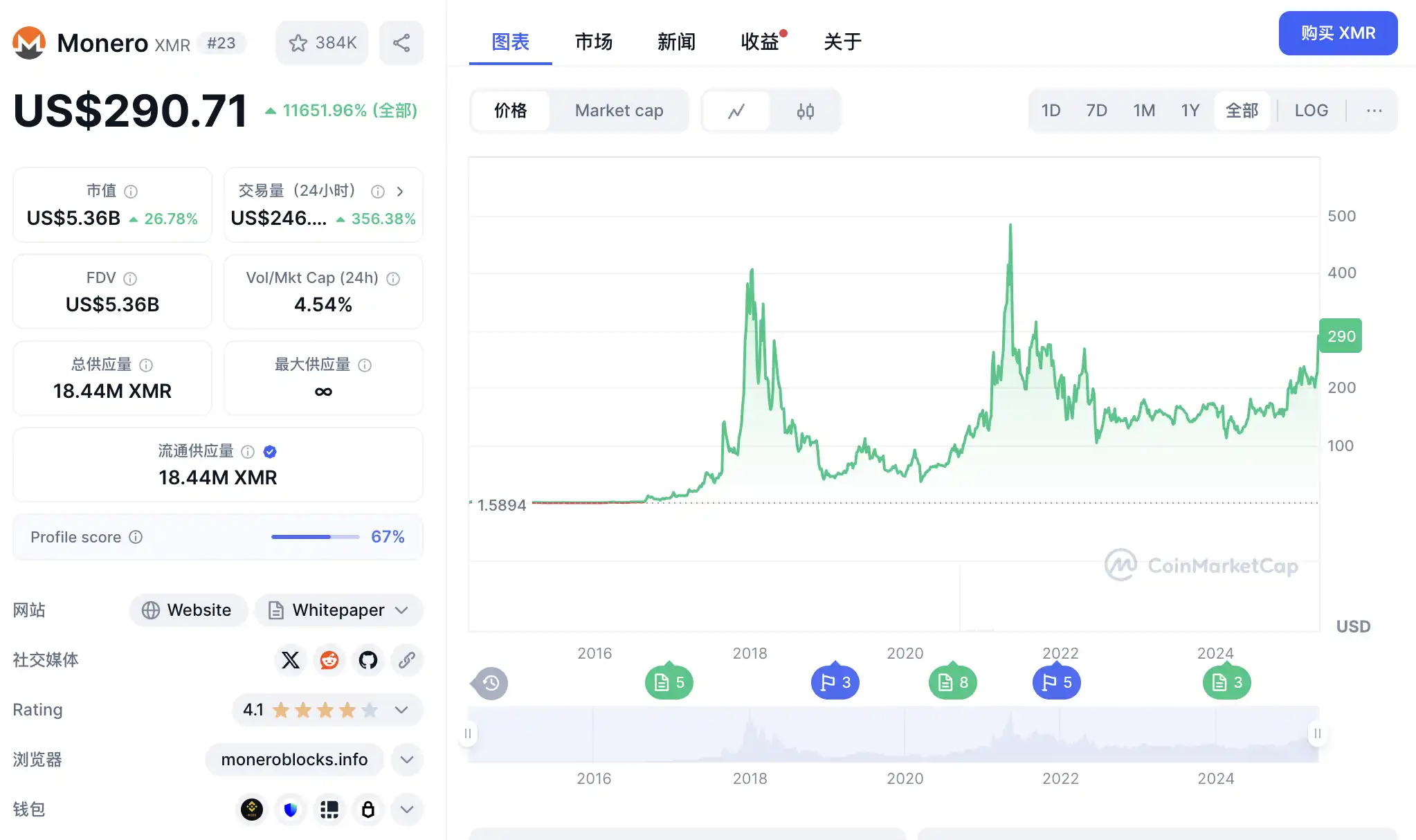
The Most OG Privacy Coin
In 2013, Nicolas van Saberhagen published the "CryptoNote" protocol, upon which Monero was born in April 2014 and transitioned to RandomX in 2019.
Monero uses technologies such as ring signatures, stealth addresses, and RingCT to hide the transaction sender, receiver, and amount. This high level of anonymity gives it an advantage in terms of privacy protection. Monero's modular code structure has been appreciated by one of the Bitcoin core maintainers, Wladimir J. van der Laan.
However, while maintaining privacy, it also makes it difficult to meet regulatory anti-money laundering (AML) and counter-terrorism financing (CTF) requirements. As one of the most well-known privacy coins, it is a token with two sides. On the one hand, it focuses on privacy, decentralization, and scalability, which is loved by many who embrace liberalism. On the other hand, it has also become a breeding ground for criminals.
A Criminal's "Favorite"
In the late summer of 2016, with the arrest of "Silk Road" founder Ross William Ulbricht, law enforcement agencies gained traceability technology for Bitcoin. Major darknet markets like AlphaBay began to abandon Bitcoin in favor of the more untraceable Monero. North Korea's Lazarus Group hackers also favored using Monero to "clean" assets, leading Monero to experience its first market capitalization breakthrough in 2016, going from $5 million to $185 million, accompanied by rapid transaction volume growth.
2020 was the second hot period for Monero. That year, the terrorist organization ISIS updated its website, stating they would no longer accept Bitcoin donations and instead switch to the more private Monero. The reason is if ISIS had a large Bitcoin reserve, as a terrorist organization, it might be difficult to transfer or cash out, as confirmed in a report by Chainalysis, stating ISIS held less than $100,000 in Bitcoin, similar to most other terrorist organizations. Also in the same year, darknet market sales increased by 70% YoY, with Monero becoming one of the main payment tools due to its privacy features, accounting for 45% of the market, almost on par with Bitcoin.
Dark web transactions, fraud, ransomware extortion, and hackers' coin laundering have made Monero infamous, thanks to the widespread adoption in "underground trade." In 2020, XMR's token price rose from $50 at the beginning of the year to $150 by the end of the year, reaching $450 by mid-2021.
Key of Freedom
Although Monero has long been associated with "crime," it is just a technological tool. The Monero development team has always maintained a "code neutrality" stance. They emphasize that "Monero is designed for the everyday use of ordinary people, and any technology can be misused, just like cash." They do not cooperate with criminal activities nor have any connections to criminal organizations.
Therefore, from another perspective, it upholds the "transaction freedom" of Bitcoin and is highly supported by many geeks who advocate "libertarianism," "privacy first," and "decentralization against censorship." Many in the community believe it is the real Bitcoin.
John McAfee, the founder of the first antivirus software McAfee, is one of them. He stated in numerous occasions before his death that "Monero is one of the truly anonymous cryptocurrencies, while Bitcoin is not truly anonymous." He admired Monero's technical prowess and privacy features. The anonymity and untraceability of Monero align well with McAfee's long-standing advocacy of "privacy libertarianism."
Even the "Bitcoin Jesus" Roger Ver "defected." In his first public interview after being released on bail in 2024, Roger stated that he decided to abandon Bitcoin and instead favor tokens like Monero, which can provide more privacy. "Most people are now using custodial wallets, which are not wallets at all but merely accounts. They offer no more privacy than your account at a U.S. bank or on PayPal. Fortunately, there are other cryptocurrencies like Monero that can provide more privacy protection."
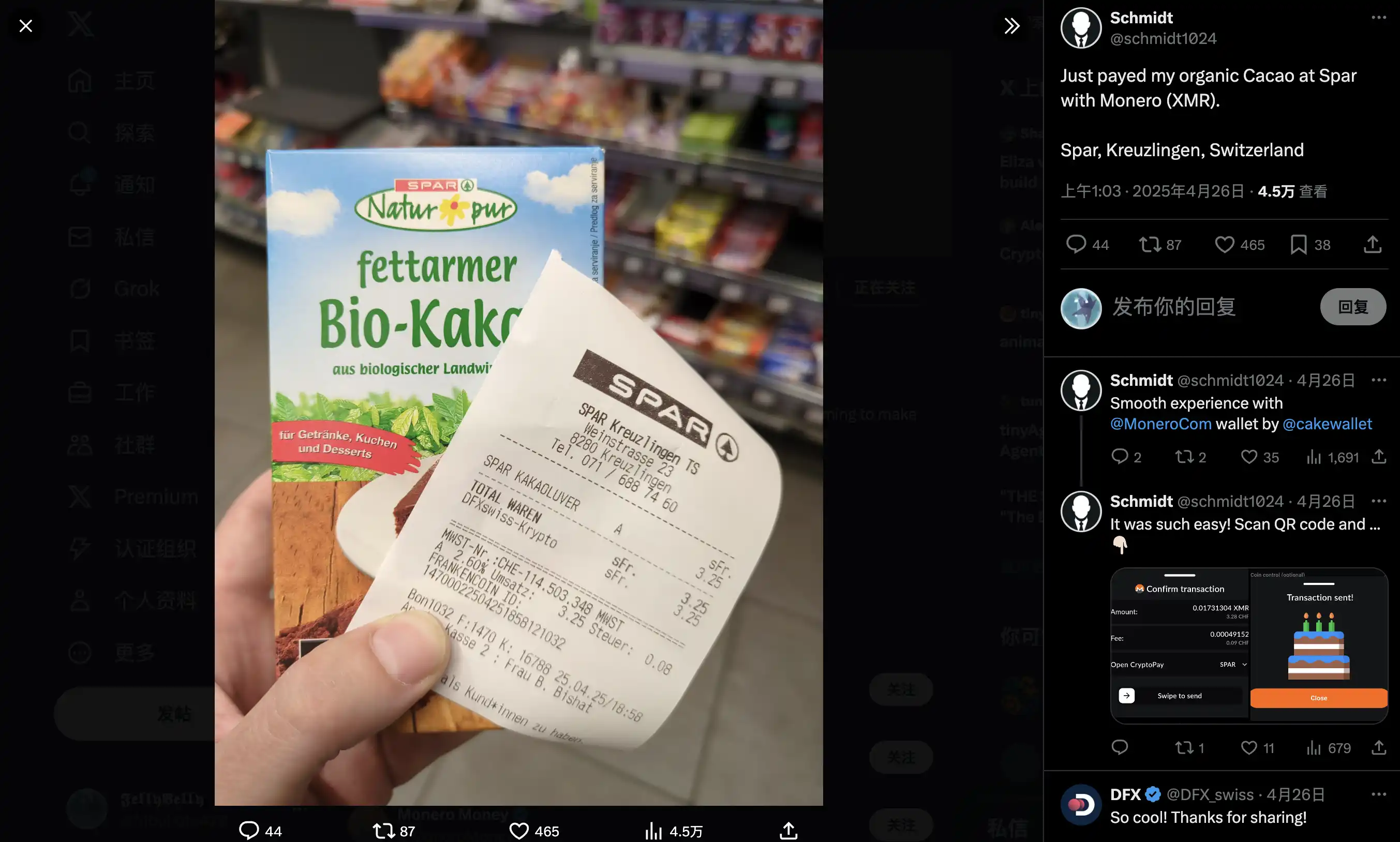
In regions with active cryptocurrency communities, some e-commerce or independent merchants accept Monero as a payment method, such as some tech-related online stores selling "hardware wallets or cryptocurrency peripheral tech products," or offline retail stores. Community member Schmidt even shared a receipt for purchasing a low-fat organic cocoa drink at Spar using Monero.
Note: SPAR is one of the world's largest food retail chains, founded in 1932 by Adriaan van Well in the Netherlands. With over 13,900 stores across 48 countries, the Kloten store purchased by the community member is in Switzerland and has garnered attention for accepting cryptocurrency assets such as Bitcoin and Monero.
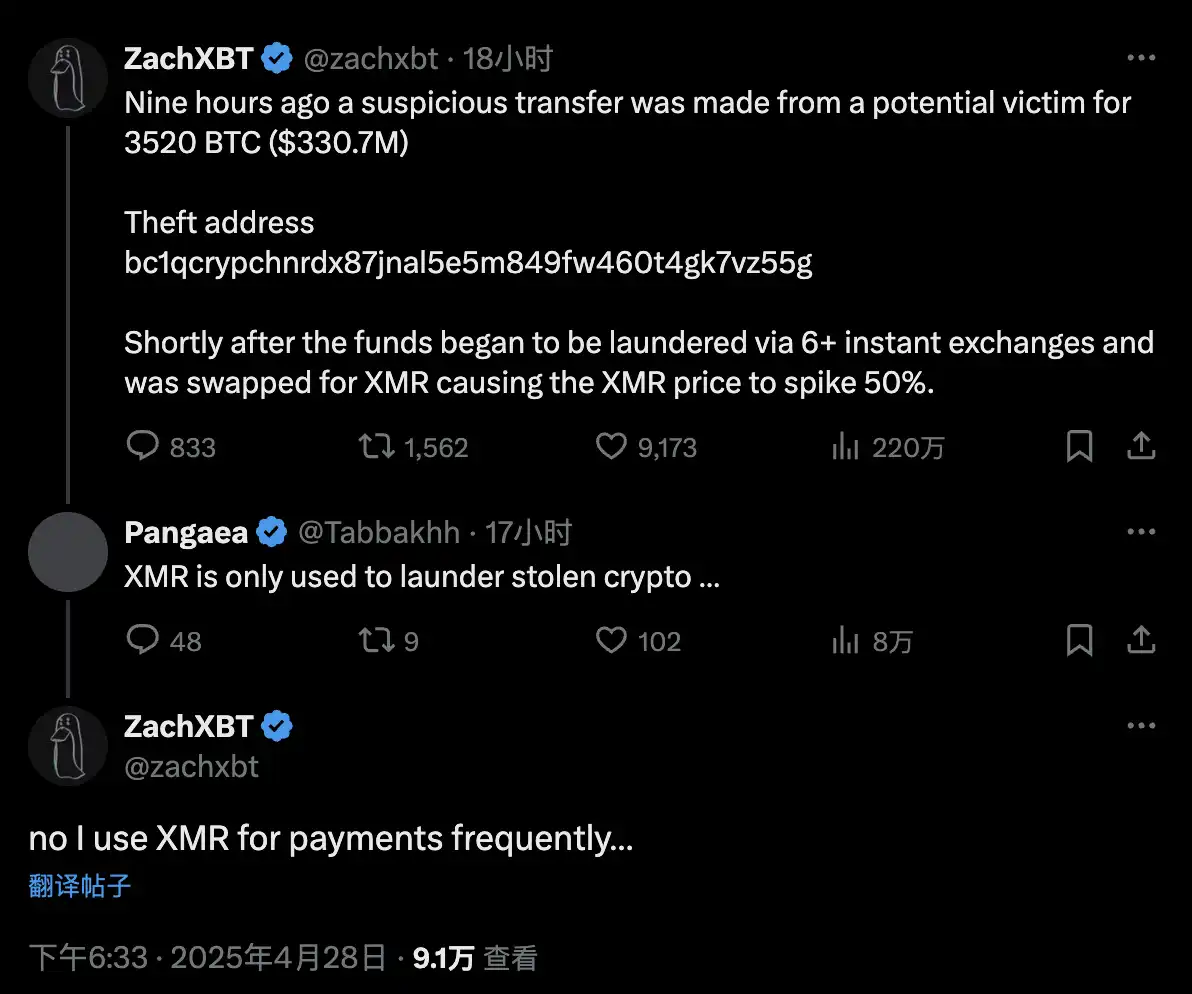
When the Monero community was criticized for using Monero as a "privacy coin for money laundering," renowned on-chain detective ZachXBT countered by saying, "No, I often use Monero for payments," indicating that he is also a Monero enthusiast.
Short-term Pump or Price Discovery?
Stolen Funds Flowing In
On social media, on-chain detective ZachXBT posted, "Nine hours ago, a suspicious transaction occurred from a certain address, involving 3520 Bitcoins (approximately $330.7 million). Subsequently, these funds were laundered through more than 6 instant trading platforms and converted into Monero, causing a 50% surge in Monero's price."
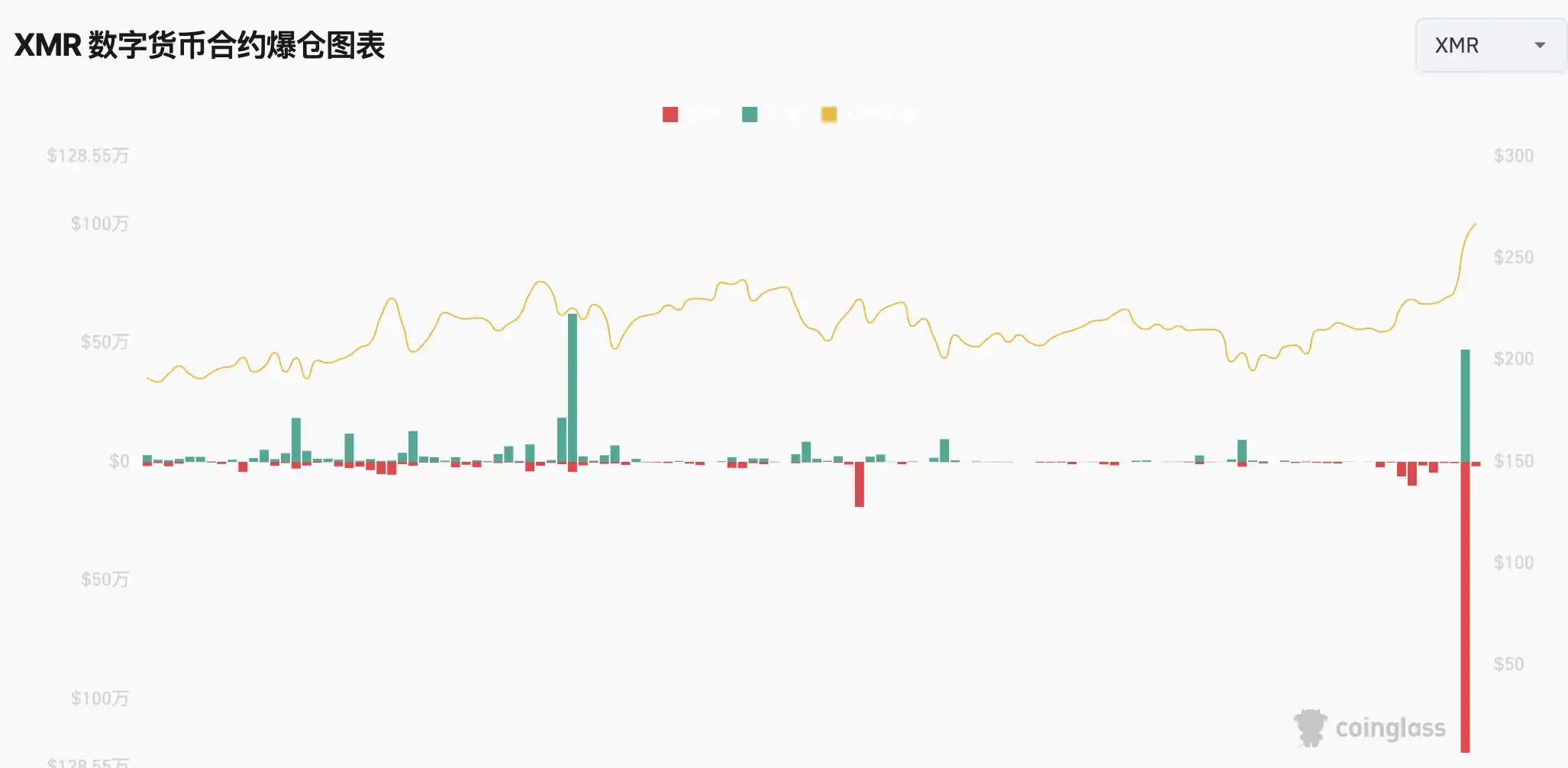
This also led to a massive closure of short positions on the token, forcing traders to buy back assets. With the increasing demand for spot trading, this further added to the upward pressure. These combined factors may have contributed to Monero's recent sudden surge.
Positive Project Developments
Some analysts believe that the growing anticipation of the Monero EP159 and EP160 upgrade proposals is also one of the factors behind this surge. This proposal would make Monero more compliance-friendly, allowing users to provide transaction proof without exposing sensitive private information. The community believes that this upgrade may see Monero, which was delisted from major CEX exchanges following the 2024 EU update on anti-money laundering regulations, relisted on compliant top-tier CEXs such as Binance and Coinbase.
Additionally, the first DeFi project in the Monero ecosystem, Tari, is set to launch and merge mine with Monero, with its mainnet scheduled to go live on May 6th. Many in the Monero community are eagerly anticipating the arrival of this project.

Once a tool is created, concepts of good and evil imbue it with various meanings. Monero is now a symbol of cryptocurrency, balancing between "freedom" and "regulation," and hovering between "human rights" and "crime." The inherent good and evil of human nature are infinitely magnified here, much like when Einstein commented on the atomic bomb, saying, "Science and technology are a double-edged sword; they can benefit humanity or destroy the world."
You may also like

Tidal Investment: We still have a positive outlook on the AI industry chain, but the reasons have changed

Former SpaceX engineer reconstructs the financial execution system using first principles

Why Is PAXG Price Different From Gold? 5 Reasons Crypto Traders Should Know

The cryptocurrency industry has entered the "Show Me" era: merely relying on vision is no longer enough

WEEX OpenAPI 101: 5 Powerful Modules, AI Trading Tools, and Grab Up to 70% Revenue Opportunities
Learn how WEEX OpenAPI connects traders, developers, AI agents, and trading platforms. Discover WEEX API features, Binance-compatible integration, automated trading workflows, revenue opportunities, and ecosystem possibilities.

Morning News | The draft amendment to the People's Bank of China Law aims to clarify the legal status of digital renminbi; South Korea will transfer about 40 unregistered virtual asset service providers to law enforcement agencies

Interpreting the Ethereum Foundation's new structure: Reaffirming self-sovereignty amid institutional trends

Interview with NDV Founder Jason Huang: Popping the AI Bubble and the Myth of Microstrategy, Seeking the Ultimate Ace in the Crypto Market
Morning Report | Former Ethereum Foundation researcher establishes Ethlabs; EU Parliament Economic Committee passes digital euro regulatory proposal

Dragonfly partner Haseeb: The fastest-growing companies in the future may all be stuck at 149 people

How xBubble Breaks the Deadlock in VC's Heavy Investment in the OPC Economy

The encrypted unicorn Blockstream is deeply embroiled in a serious fraud case

Morning Report | The South Korean Financial Services Commission plans to expand the regulatory sandbox to include virtual assets; the parent company of the New York Stock Exchange, ICE, has reached a partnership with OKX to jointly establish a cryptocu...

Exclusive Interview with Strategy CEO: Putting Aside the Sale of 32 BTC, the 60 Trillion AI Intelligence is the Ultimate Fate of Bitcoin

TRON revitalizes the image of the bull, creating a more approachable brand character

Will the STRC issuance price discussed with ChatGPT really fall into a death spiral?

The foundation retreats, Ethlabs steps forward: Ethereum welcomes its largest restructuring in history

NYSE Parent ICE and OKX Launch Joint Venture: What It Means for Tokenized Stocks
ICE and OKX have announced a joint venture focused on tokenized stocks, but stock futures are already live across crypto markets. Here's what the partnership means, how stock futures work, and why traders are paying attention.
Tidal Investment: We still have a positive outlook on the AI industry chain, but the reasons have changed
Former SpaceX engineer reconstructs the financial execution system using first principles
Why Is PAXG Price Different From Gold? 5 Reasons Crypto Traders Should Know
The cryptocurrency industry has entered the "Show Me" era: merely relying on vision is no longer enough
WEEX OpenAPI 101: 5 Powerful Modules, AI Trading Tools, and Grab Up to 70% Revenue Opportunities
Learn how WEEX OpenAPI connects traders, developers, AI agents, and trading platforms. Discover WEEX API features, Binance-compatible integration, automated trading workflows, revenue opportunities, and ecosystem possibilities.
Morning News | The draft amendment to the People's Bank of China Law aims to clarify the legal status of digital renminbi; South Korea will transfer about 40 unregistered virtual asset service providers to law enforcement agencies


