
 Buy Crypto
- Markets
 Futures
- Spot
- Copy Trade
- Earn
- More
More absurd than knowing about the war in advance is knowing in advance about the assassination of Soleimani


On February 28, the United States and Israel jointly launched a strike against Iran, resulting in the death of Iran's Supreme Leader Ayatollah Khamenei.
Since Trump publicly challenged Iran in early January and ordered an aircraft carrier to the Middle East, the question of "when will the strike happen" has never ceased. Almost everyone has been saying "it's about to happen," but hardly anyone can pinpoint the exact day when it will definitely occur.
Of course, there are indeed people who can provide a specific date and are willing to wager real money against the non-believers. These individuals are soldiers, intelligence personnel, and other insiders who are on standby on the aircraft carrier, awaiting orders to strike.
For these insiders holding classified information, the prediction market Polymarket has become the best channel for them to monetize their insider information: they can bet on whether a certain event will occur, and if their prediction is correct, they can profit based on the amount wagered and real-time odds.
For those with an absolute informational advantage, this kind of bet was a foregone conclusion from the start.
Betting on the Military Operation Outcome, the Battlefield Brothers Earned $1.6 Million
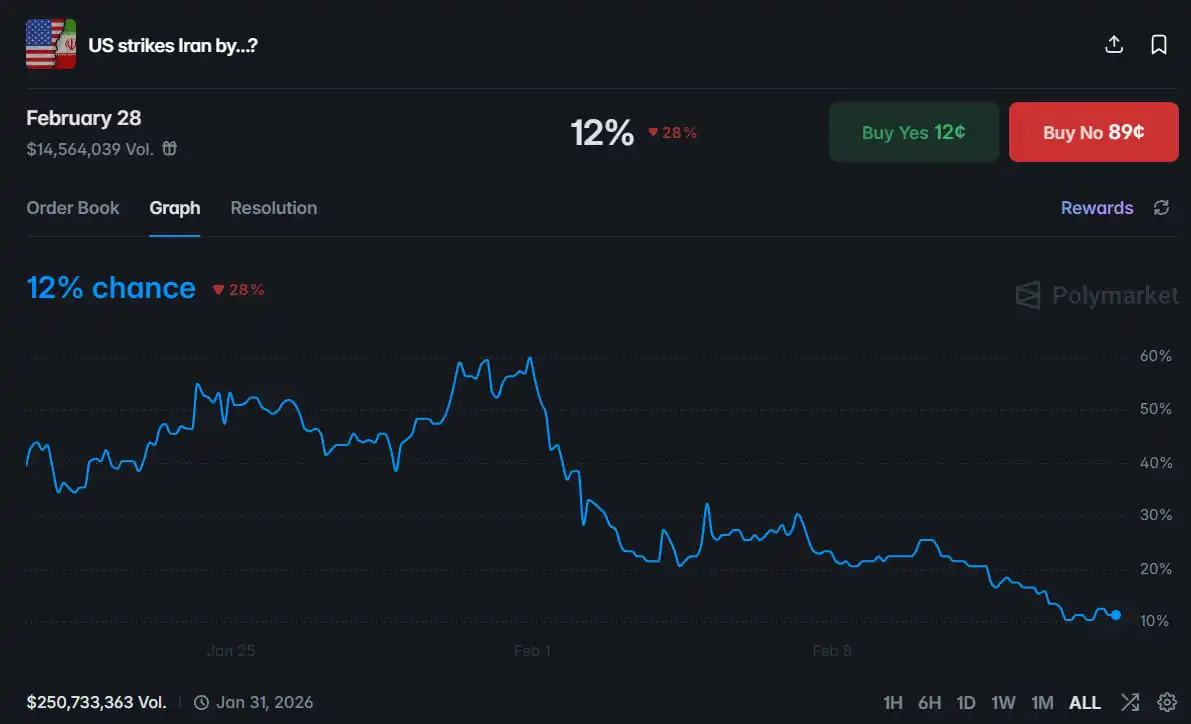
Over the past two months, the question of "Will the United States strike Iran by a certain date" has been a central trading theme on the prediction market. In this market, three accounts collectively earned over $700,000 by betting on "the United States will strike Iran by February 28."
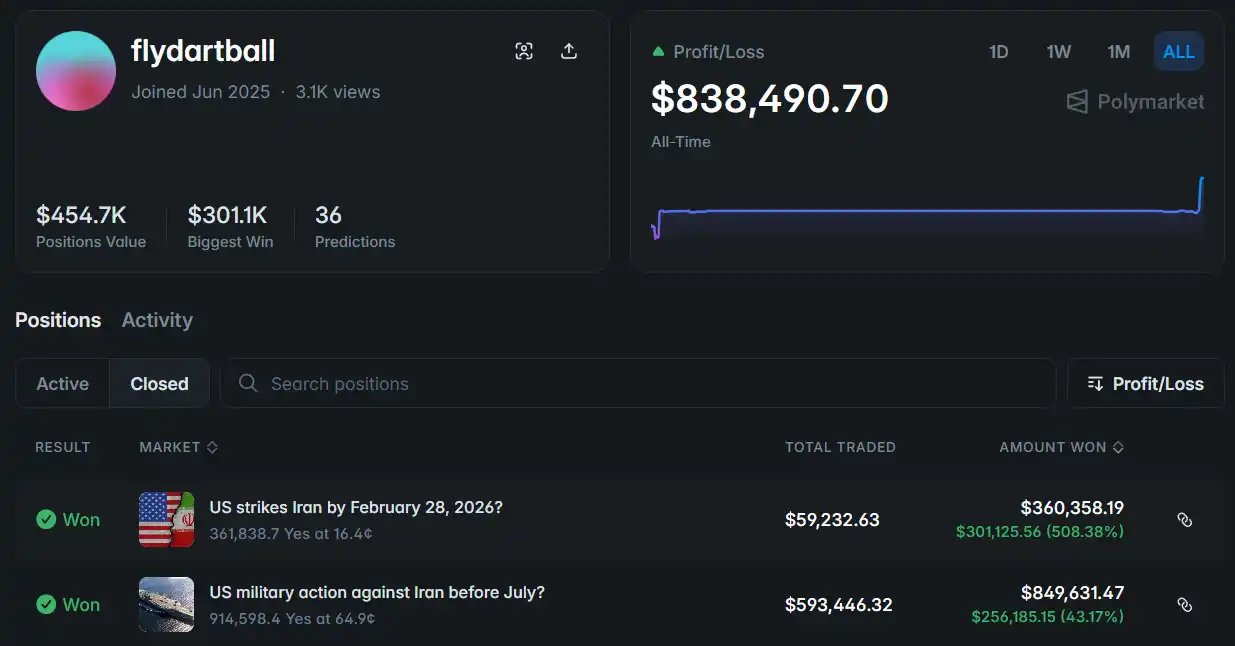
Two of these accounts were newly registered in February, with no other trading records besides betting on Iran-related events—it was almost as if they were born for this event: bet on the strike, wait for it to happen, then profit and exit.
The third account is more unique. It was created on June 17, 2025, and started betting on "the United States will take military action against Iran" on the same day. On June 22, Trump announced strikes on three core nuclear facilities in Iran, resulting in a $256,000 profit for the account. For the next full six months, the account had no trading activity—until the eve of this round of strikes when it became active again, betting on Iran being struck and earning $301,000.
The signs were quite clear, but the story did not end there.
After Iran was struck by the U.S. and Israel on February 28, these three accounts did not stop. They turned the $700,000 they had just earned into a bet on "Iran's Supreme Leader Khamenei will step down on February 28." At this point, less than 12 hours remained until the end of February, and Iran's official statement had just been released stating that "Khamenei will make a statement regarding this strike." To most traders, this was seen as an extremely high-risk bet.
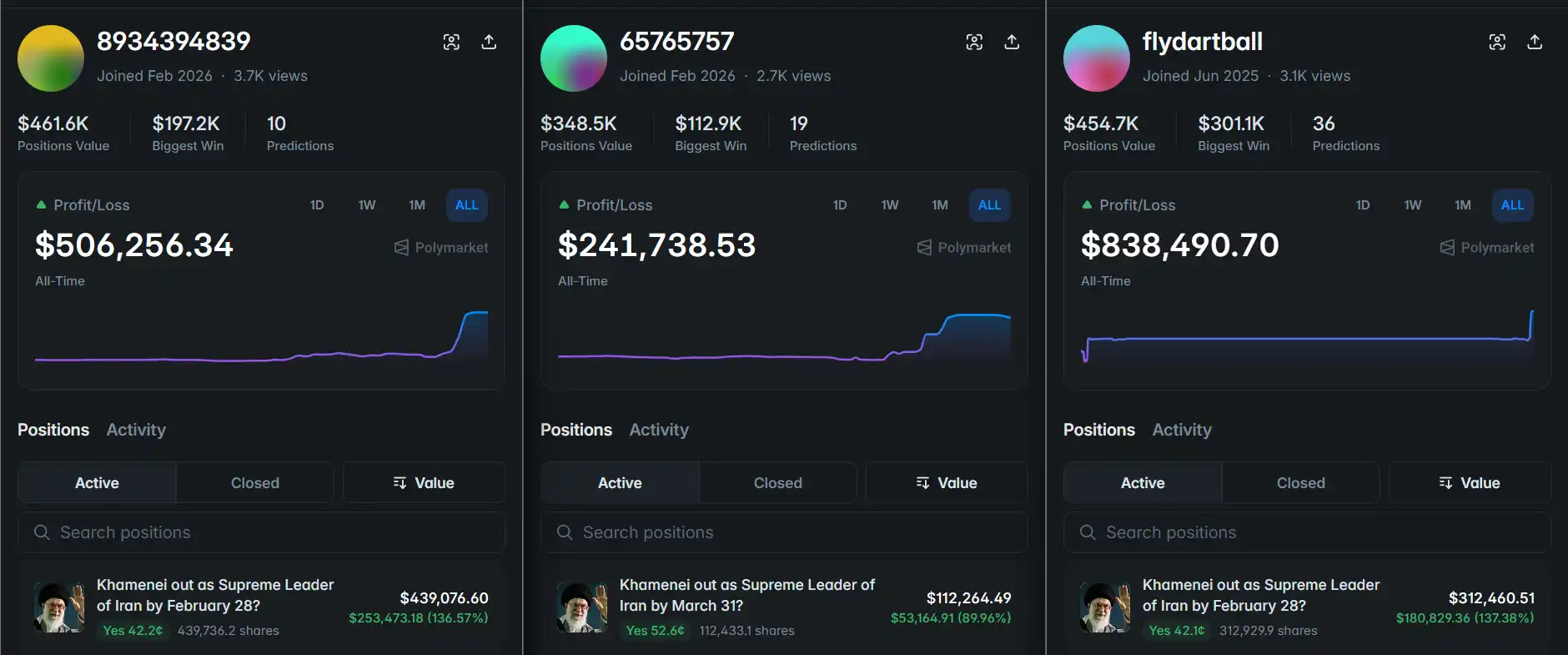
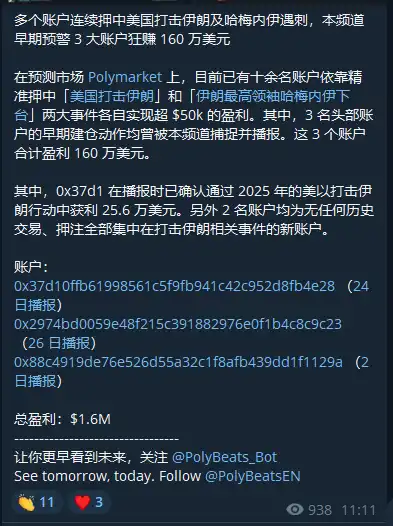
The final outcome was already well known: Al-Hameiney was killed in the airstrike. Three accounts profited approximately $1.6 million in total from events surrounding the Iran strike. The monitoring channel PolyBeats provided continuous coverage of the three individuals' betting behavior since February, with each opening position occurring before the event unfolded, thus revealing the progression of the conflict to the public in advance.
The First Predictive Market Insider Trading Case with Criminal Records
A similar situation occurred during the "Twelve-Day War" last June. However, this time, the insider trader was eventually identified and convicted. This also marked the first case in predictive market insider trading history to leave a formal criminal record.
In mid-June 2025, during Israel's strike on Iran, an account named ricosuave666 accurately predicted the timing of the strike and peace talks, earning $150,000. After cashing out the profit, the account remained dormant for a long time until it became active again on January 6, 2026, betting on Israel striking Iran.
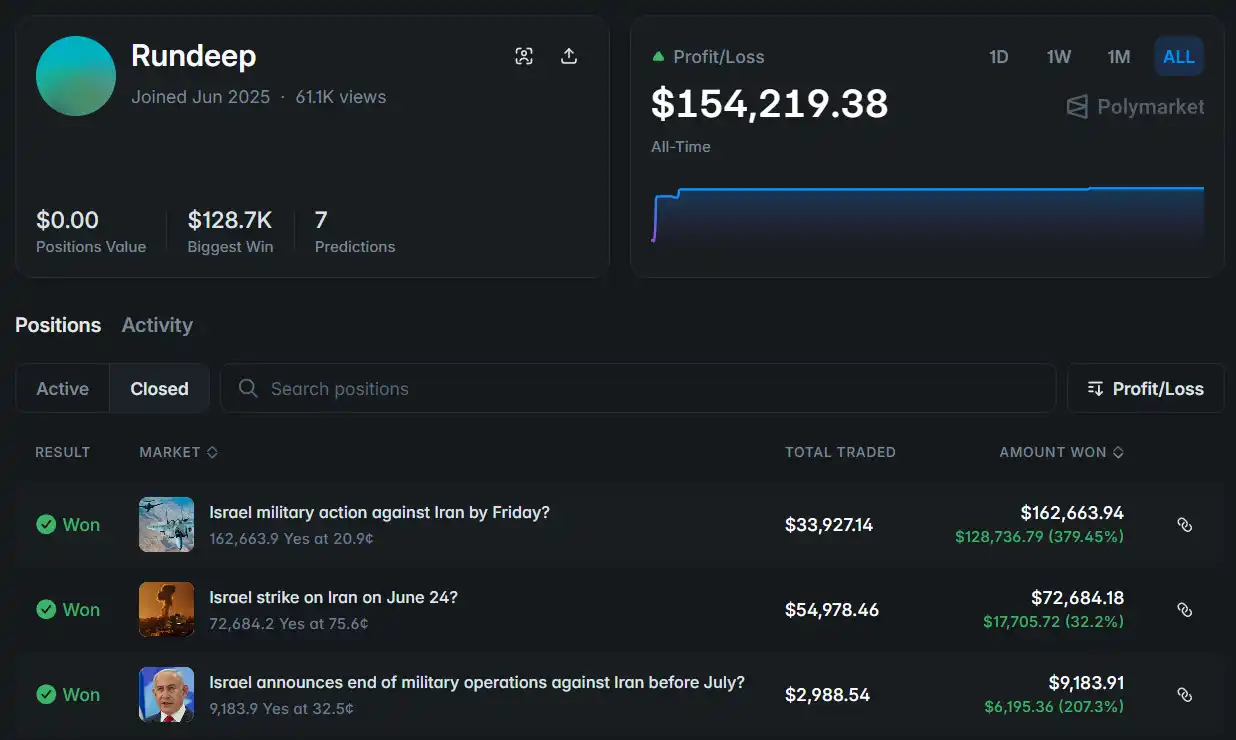
However, this time, the situation quickly reversed. Due to its prophet-like flawless trading, ricosuave666 reentered the predictive market, and its actions betting on the same topic were widely publicized.
Having their insider trading exposed may be the last thing an insider wants to see.
On the day after the bet, the account liquidated its position and rebranded as Rundeep, attempting to evade attention. On February 12th, the Israeli Ministry of Defense, Shin Bet, and Israeli Police jointly announced the arrest of the two citizens behind the account, with charges including serious security offenses, bribery, and obstruction of justice.
The investigation revealed that ricosuave666 was operated by an Israeli Defense Forces reserve soldier and a civilian: the reserve soldier used confidential operational intelligence acquired during service to pass information to the civilian, who then bet on relevant military actions on Polymarket.
Similar to the three accounts in this round, PolyBeats identified ricosuave666 as a suspected insider with privileged information within an hour of their opening position on January 6th, and continued to track their betting, liquidation, and rebranding actions.
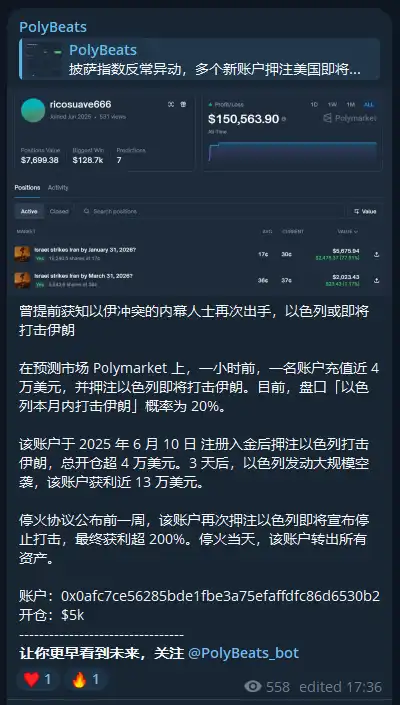
On the day of ricosuave666's arrest, Roy Yanovsky, Head of the Crime Affairs Department and reporter for the Israeli public broadcaster Kan News, stated in the Israel Channel 12 news: "Israel's enemies are using the prediction market Polymarket as a key source of military intelligence."
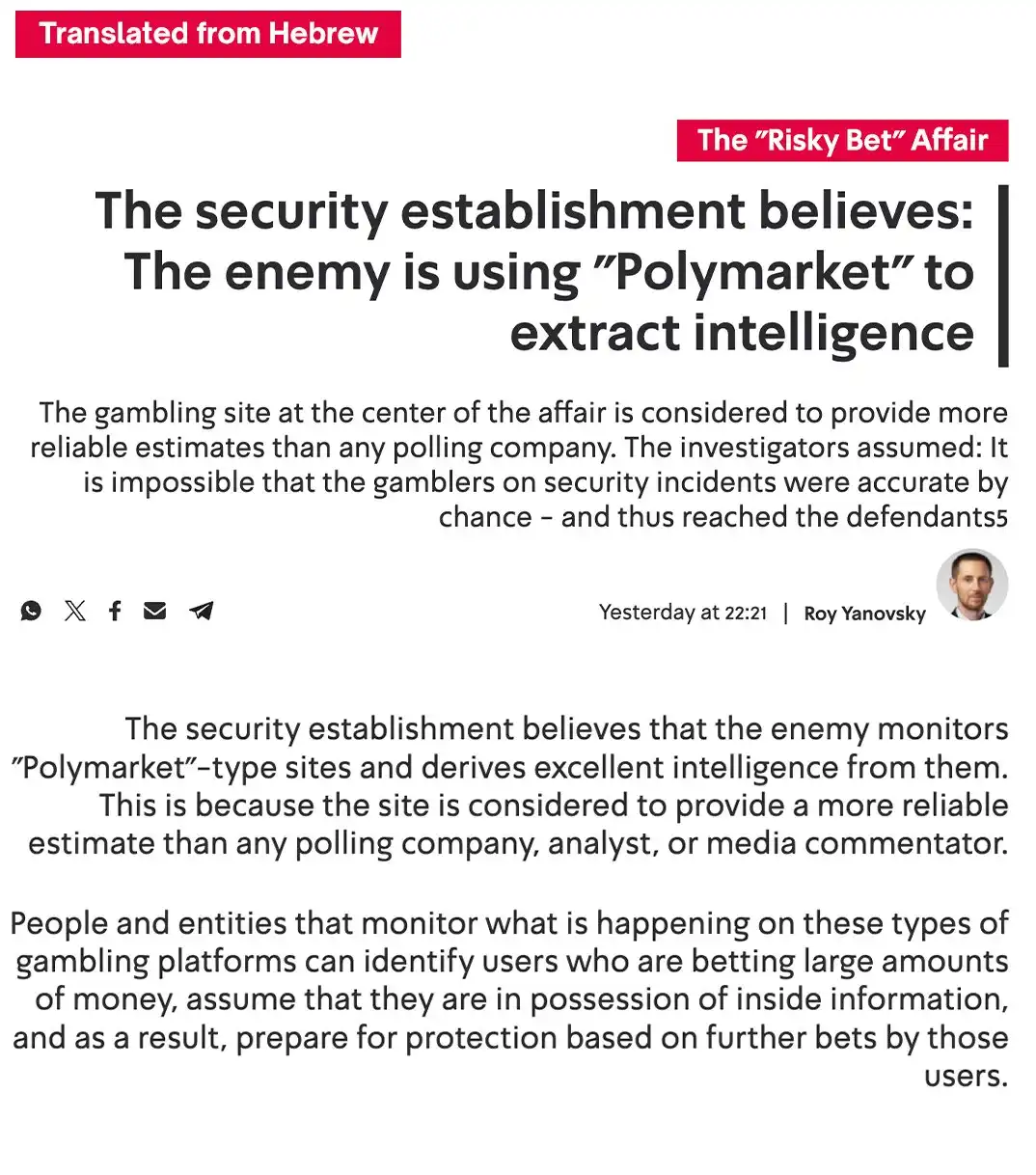
This statement is not unfounded, as evidenced by the three accounts in this round of the Iran strike incident. Even with the precedent of ricosuave666, for some frontline personnel willing to risk it all, the threat of incarceration is not enough to deter them from exchanging military secrets for substantial returns.
The combination of blockchain and prediction markets has created a dual structure: on one hand, the anonymity of on-chain addresses provides a cash-out mechanism for insiders; on the other hand, the public transparency of on-chain transactions allows all operations to be traced, analyzed, and interpreted.
When transaction data is open to everyone, as long as someone can understand these anomalous betting behaviors, perhaps they can foresee the future outline before the event actually takes place.
You may also like

Consumer-grade Crypto Global Survey: Users, Revenue, and Track Distribution

Prediction Markets Under Bias

Stolen: $290 million, Three Parties Refusing to Acknowledge, Who Should Foot the Bill for the KelpDAO Incident Resolution?

ASTEROID Pumped 10,000x in Three Days, Is Meme Season Back on Ethereum?

ChainCatcher Hong Kong Themed Forum Highlights: Decoding the Growth Engine Under the Integration of Crypto Assets and Smart Economy

Why can this institution still grow by 150% when the scale of leading crypto VCs has shrunk significantly?

Anthropic's $1 trillion, compared to DeepSeek's $100 billion

Geopolitical Risk Persists, Is Bitcoin Becoming a Key Barometer?

Annualized 11.5%, Wall Street Buzzing: Is MicroStrategy's STRC Bitcoin's Savior or Destroyer?

An Obscure Open Source AI Tool Alerted on Kelp DAO's $292 million Bug 12 Days Ago

Mixin has launched USTD-margined perpetual contracts, bringing derivative trading into the chat scene.
The privacy-focused crypto wallet Mixin announced today the launch of its U-based perpetual contract (a derivative priced in USDT). Unlike traditional exchanges, Mixin has taken a new approach by "liberating" derivative trading from isolated matching engines and embedding it into the instant messaging environment.
Users can directly open positions within the app with leverage of up to 200x, while sharing positions, discussing strategies, and copy trading within private communities. Trading, social interaction, and asset management are integrated into the same interface.
Based on its non-custodial architecture, Mixin has eliminated friction from the traditional onboarding process, allowing users to participate in perpetual contract trading without identity verification.
The trading process has been streamlined into five steps:
· Choose the trading asset
· Select long or short
· Input position size and leverage
· Confirm order details
· Confirm and open the position
The interface provides real-time visualization of price, position, and profit and loss (PnL), allowing users to complete trades without switching between multiple modules.
Mixin has directly integrated social features into the derivative trading environment. Users can create private trading communities and interact around real-time positions:
· End-to-end encrypted private groups supporting up to 1024 members
· End-to-end encrypted voice communication
· One-click position sharing
· One-click trade copying
On the execution side, Mixin aggregates liquidity from multiple sources and accesses decentralized protocol and external market liquidity through a unified trading interface.
By combining social interaction with trade execution, Mixin enables users to collaborate, share, and execute trading strategies instantly within the same environment.
Mixin has also introduced a referral incentive system based on trading behavior:
· Users can join with an invite code
· Up to 60% of trading fees as referral rewards
· Incentive mechanism designed for long-term, sustainable earnings
This model aims to drive user-driven network expansion and organic growth.
Mixin's derivative transactions are built on top of its existing self-custody wallet infrastructure, with core features including:
· Separation of transaction account and asset storage
· User full control over assets
· Platform does not custody user funds
· Built-in privacy mechanisms to reduce data exposure
The system aims to strike a balance between transaction efficiency, asset security, and privacy protection.
Against the background of perpetual contracts becoming a mainstream trading tool, Mixin is exploring a different development direction by lowering barriers, enhancing social and privacy attributes.
The platform does not only view transactions as execution actions but positions them as a networked activity: transactions have social attributes, strategies can be shared, and relationships between individuals also become part of the financial system.
Mixin's design is based on a user-initiated, user-controlled model. The platform neither custodies assets nor executes transactions on behalf of users.
This model aligns with a statement issued by the U.S. Securities and Exchange Commission (SEC) on April 13, 2026, titled "Staff Statement on Whether Partial User Interface Used in Preparing Cryptocurrency Securities Transactions May Require Broker-Dealer Registration."
The statement indicates that, under the premise where transactions are entirely initiated and controlled by users, non-custodial service providers that offer neutral interfaces may not need to register as broker-dealers or exchanges.
Mixin is a decentralized, self-custodial privacy wallet designed to provide secure and efficient digital asset management services.
Its core capabilities include:
· Aggregation: integrating multi-chain assets and routing between different transaction paths to simplify user operations
· High liquidity access: connecting to various liquidity sources, including decentralized protocols and external markets
· Decentralization: achieving full user control over assets without relying on custodial intermediaries
· Privacy protection: safeguarding assets and data through MPC, CryptoNote, and end-to-end encrypted communication
Mixin has been in operation for over 8 years, supporting over 40 blockchains and more than 10,000 assets, with a global user base exceeding 10 million and an on-chain self-custodied asset scale of over $1 billion.

$600 million stolen in 20 days, ushering in the era of AI hackers in the crypto world
Vitalik's 2026 Hong Kong Web3 Summit Speech: Ethereum's Ultimate Vision as the "World Computer" and Future Roadmap
On the same day Aave introduced rsETH, why did Spark decide to exit?
Full Post-Mortem of the KelpDAO Incident: Why Did Aave, Which Was Not Compromised, End Up in Crisis Situation?

After a $290 million DeFi liquidation, is the security promise still there?
ZachXBT's post ignites RAVE nearing zero, what is the truth behind the insider control?




 App
App