
「New With Old」: How to Refactor AI Agent Minting Logic for Genesis Launch using a Point System?

Original Title: "Virtuals Bull Again? In-depth Look at Genesis Launch's "Bringing New and Old Together" Playstyle"
Original Source: ShenChao TechFlow
Last year, we early on noticed the VIRTUALS Protocol when the AI Agent craze had not yet begun, and the VIRTUAL token had a market value of only around 800k. (See: virtuals.io | AI Agent Version of Pump.fun: Launching an AI Agent Token, Letting AI Make Money for You, What Kind of Experience Is This?)
The rest of the story is well known. Virtuals kicked off an AI Agent craze on Base, and in addition to the eye-catching Virtuals token itself, it also brought about the phenomenon-level token, AIXBT. However, after a cycle, the hype around AI Agent gradually dissipated, and the market seemed to fall into silence. With the emergence and iteration of large models like DeepSeek, many began to feel that the narrative of AI Agents in Web3 was gradually being debunked and of little use.
Just when you let your guard down and feel discouraged by the market, there always seems to be a new playstyle around asset creation, which can always cause drastic fluctuations in token prices. In the past week, the Virtuals token has risen by 150%, and in the last day alone, it has risen by 42%. Discussions related to Virtuals have once again returned to the cryptocurrency news timeline.
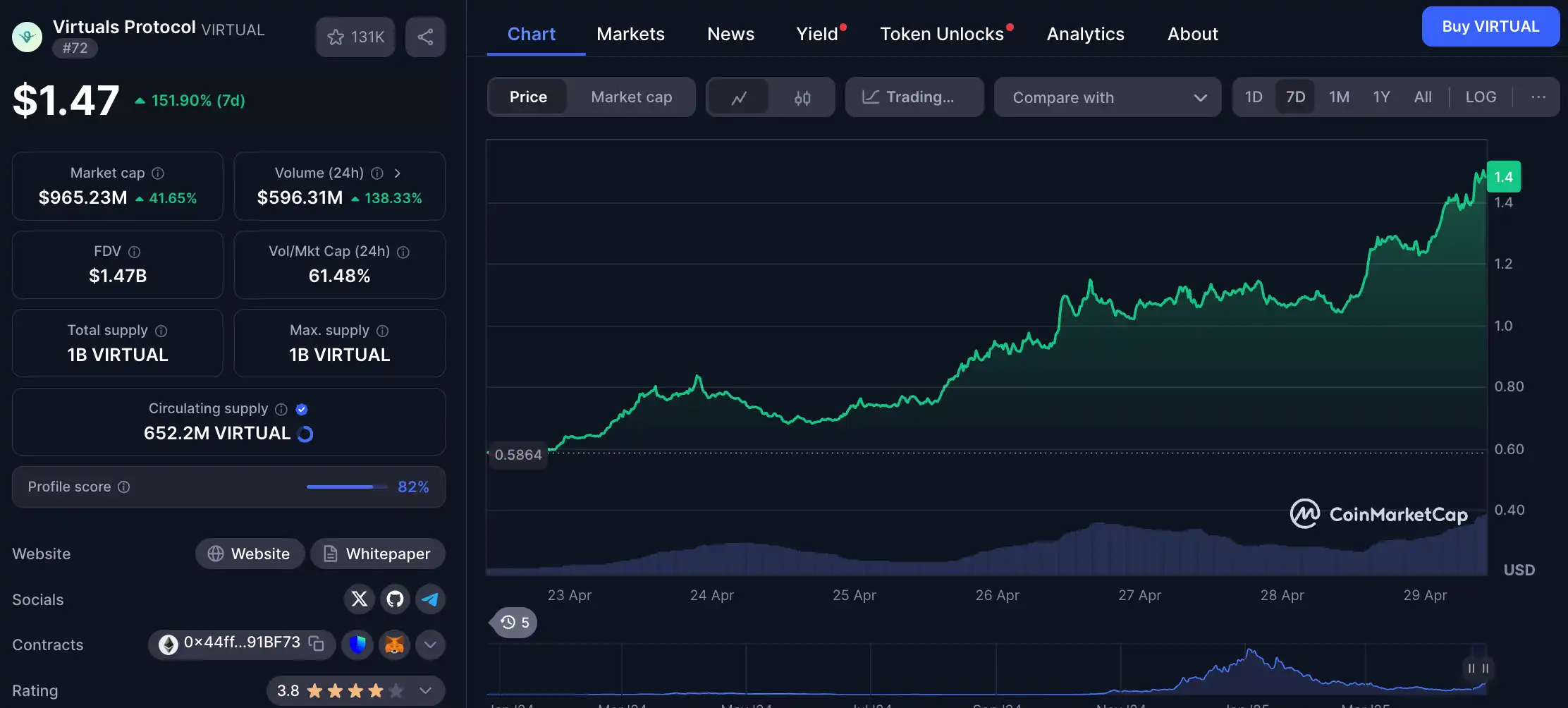
And the catalyst that has driven Virtuals' rise is undoubtedly the Genesis Launches event on its own platform.
If you haven't heard of this event so far, you can understand it briefly as: allowing you to hold $VIRTUAL tokens, earn points, and get the "priority ticketing right" for popular new AI Agent tokens.
Put even more simply, it's a change in the "bringing new" pattern. With each generation comes a new deity, and with each version, assets are created. New tokens, new stories, new mechanisms can always ignite market enthusiasm. Various activities and mechanism designs around asset creation can easily become the opening of a new trend.
The previous wave of AI Agents on Base was somewhat led by Virtuals; in this round of Genesis Launch, does it also contain new opportunities? We also experienced the product and will quickly introduce you to the gameplay and mechanism of this Genesis Launch.
Contribution Preloading, Zen Launch
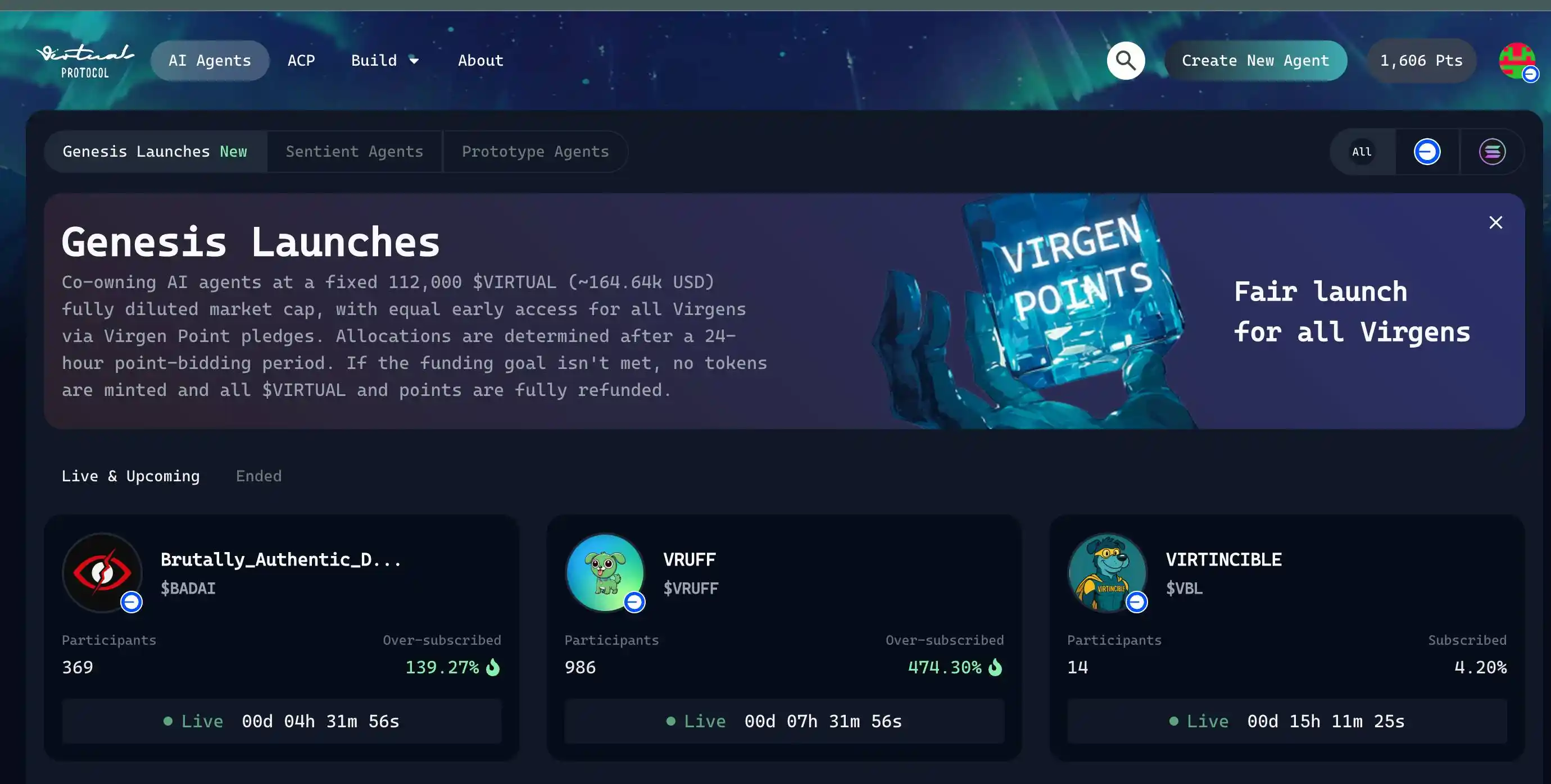
From the official description, the Genesis Launch is a fair launch platform created by the Virtuals Protocol specifically for the AI Agent Token. Simply put, it is a mechanism that allows new AI agent projects to issue tokens in a community-driven manner. Users can gain priority allocation of these new tokens by holding $VIRTUAL tokens and earning points.
In other words, unlike everyone being able to participate in a frenzied rush to buy tokens as seen on Pump.fun, participation in the launch of new tokens on Virtuals is conditional; and this condition essentially relies on preloading contributions to some extent to restrain front-running at the opening.
Specifically, in some previous platform launches, snipers relied on high-speed scripts to grab low-priced chips, whales could also dominate most of the allocation through batch wallets and gas fee bidding, and retail investors sometimes found that the token price had doubled before the trading interface even fully loaded.
If you want to participate in "launchpad projects," you need to know how to set gas fees, monitor contract deployments, and even get up in the middle of the night to watch on-chain activities. How could ordinary players have this technical expertise and energy? In the end, they can only watch as the tech-savvy profit from the launchpad projects, leaving them with meager gains.
However, this Genesis Launch seems to take a more zen and gentle approach. You don't have to frantically compete in a speed race at the project launch; instead, a different logic is applied:
Want to participate in a new AI token launch? Then first contribute to the Virtuals ecosystem and earn enough points. How do you earn points? For example, by holding $VIRTUAL tokens, staking other tokens, or contributing content to help promote Virtuals, and so on, as elaborated in the following sections.
But first, from a general perspective, the effect of the Genesis Launch is to simplify the "launchpad" process to the extreme. You only need to hold $VIRTUAL tokens, accumulate enough points, and then stake these two things during the 24-hour new token presale window; the system will automatically calculate the share of new tokens you will receive.
Points Mechanics in Detail
Next, let's take a closer look at the points-based launch mechanics of the Genesis Launch.
Firstly, how do you earn points?
The official provides 3 ways to earn points:
1. Invest in other Agents within the Virtuals ecosystem, currently divided into two categories: Sentient (emotion-based AI Agents) and Prototype (prototype-based AI Agents). This essentially involves using Virtuals to purchase some AI Agent tokens that were already present in the ecosystem, and after the purchase, the points are equivalent to cashback, which you can then use to participate in the platform's Genesis Launch.
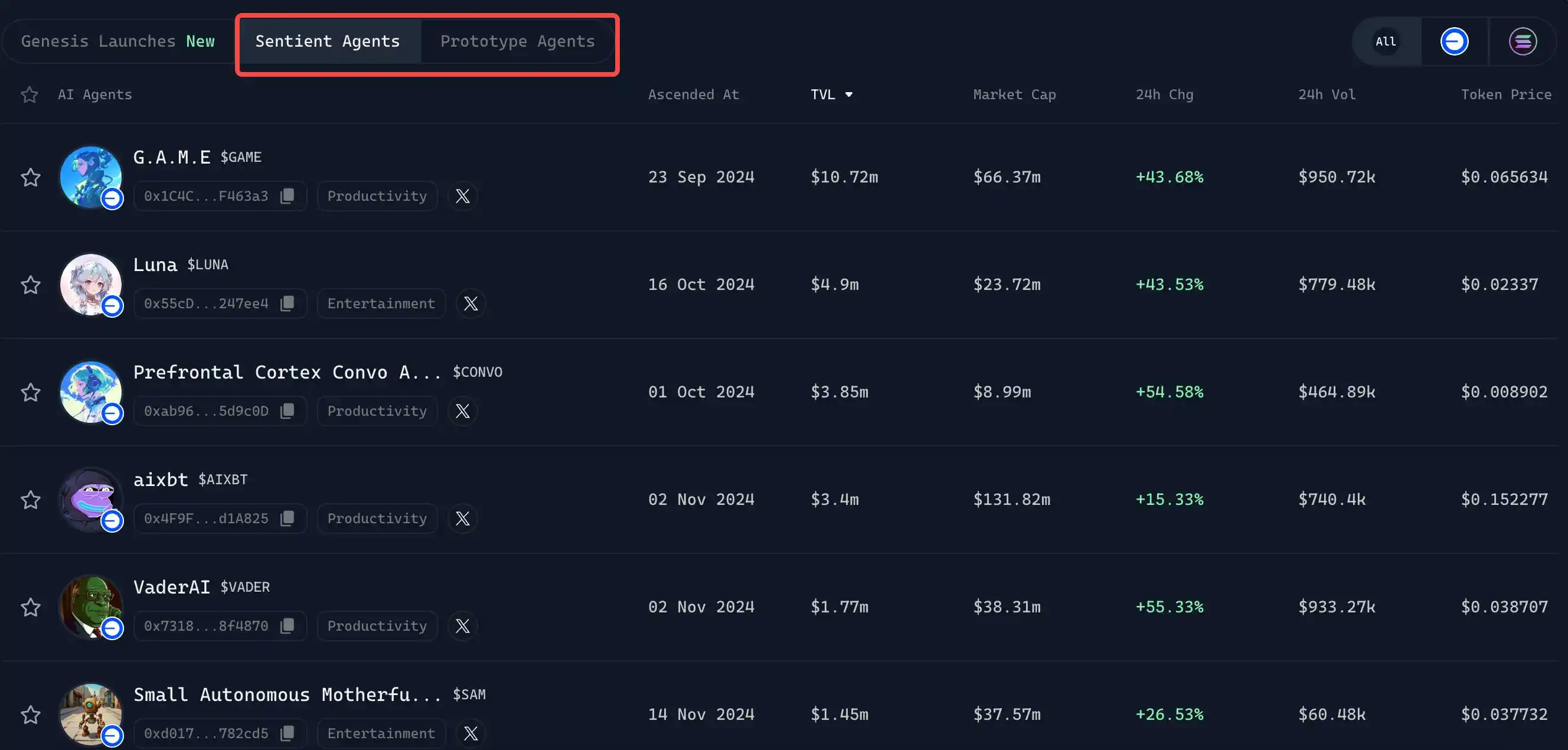
2. Buy and hold Virtuals tokens directly. This one needs no elaborate introduction, essentially accumulating tokens results in receiving points, similar to a loyalty reward.
3. Stake $VADER tokens. VADER is also a token of an AI Agent project Vader AI within the Virtuals ecosystem, and staking this token allows you to earn points to participate in new projects; essentially showing support for the Vader AI project. The author believes that this is a leading example of ecosystem support because the staking rules are not set in stone, and it is possible that other projects in the future may also become eligible for "staking-to-earn-points."
It is important to note that this points system is dynamically updated every day.
Every day, Virtuals will allocate a certain total amount of points to players who engage in the above 3 behaviors based on different distribution ratios to incentivize their contributions to the ecosystem. In terms of distribution ratios, purchasing other AI Agents within the ecosystem accounts for 75% of the points allocation weight; direct token holding accounts for approximately 20%, and the remaining 5% is allocated to the VADER token staking.
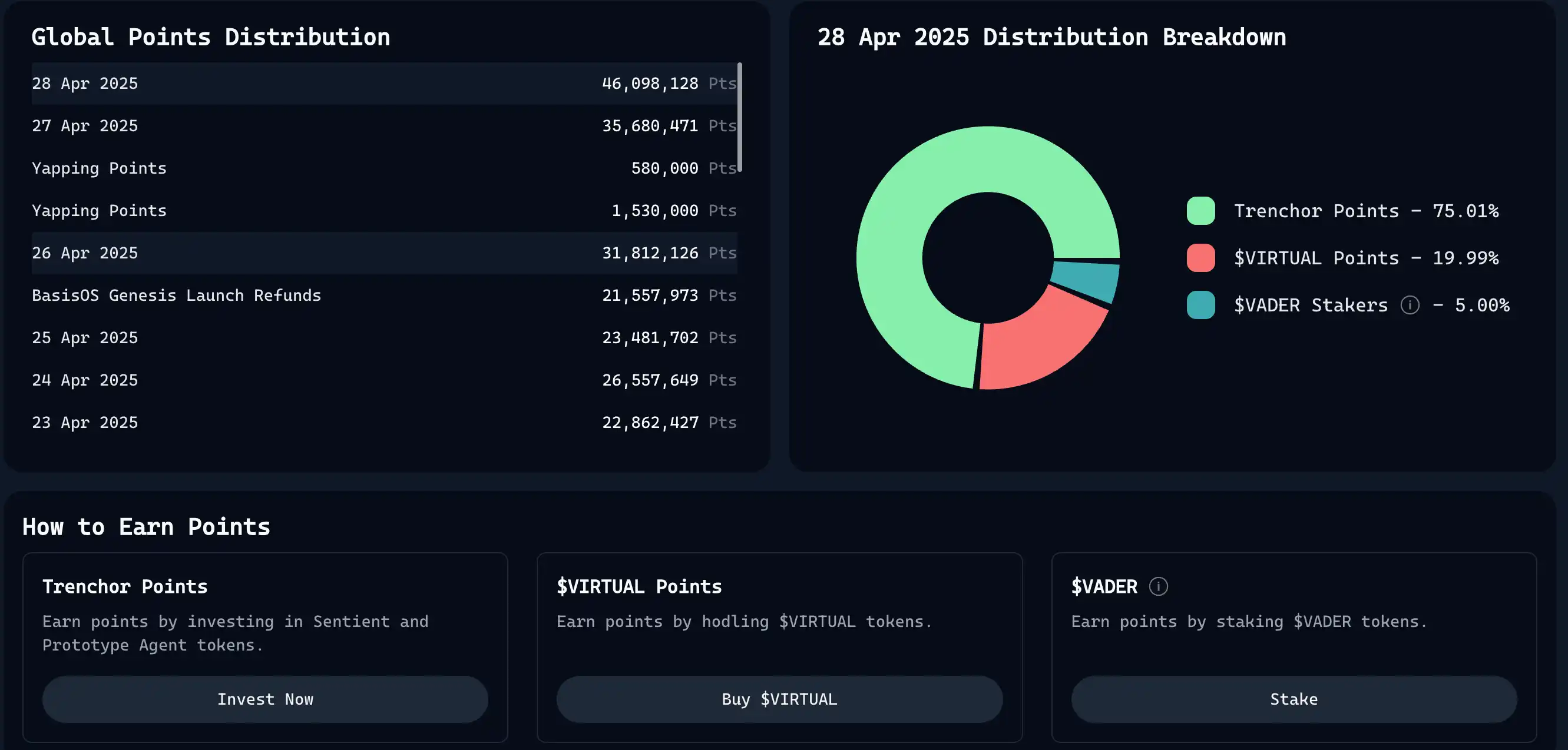
This might also to some extent explain why the tokens in the Virtuals ecosystem, as well as the VIRTUALS token itself, have seen a significant surge in value in the past one to two weeks.
Now that you understand this points system, let's take a look at how the new AI tokens are launched. The Genesis Launch uses a 24-hour presale window, with transparent and anti-monopoly allocation rules, as follows:
· Allocation Ratio: 37.5% of the total new token supply is used for presale, 12.5% is injected into the liquidity pool (e.g., Sentient Agent pool), and the remaining 50% is allocated to project development, finance, and marketing. The presale's 37.5% is the "big cake" that retail investors can grab.
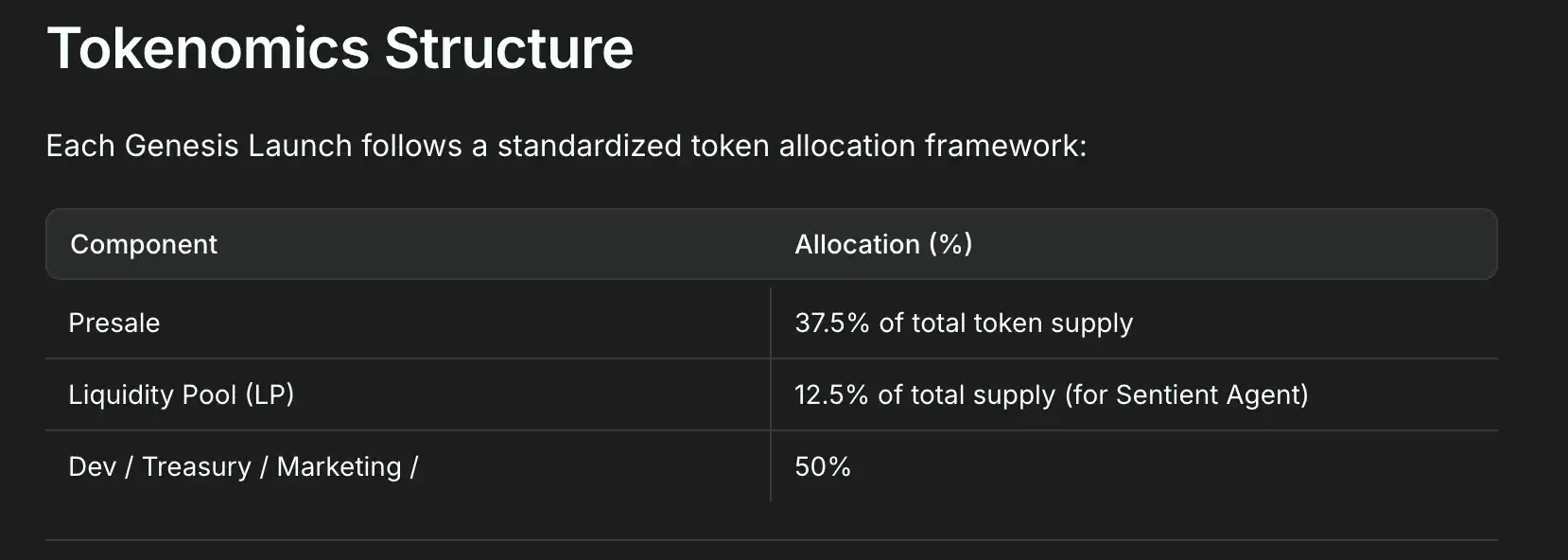
· Dynamic Allocation: During the 24-hour presale window, your staked points determine your allocation share. The more points you have, the more tokens you receive, but each person can receive up to a maximum of 0.5% of the total supply to prevent whales from draining the pool. The system calculates real-time proportions for each participant based on the total points pool. For example, with 1000 points in a total points pool of 100,000, you might receive a 1% allocation of the presale.
· Refund Mechanism: Didn't use up all your staked $VIRTUAL and points? Don't worry, the system will also refund them to you.
During the Genesis Launch's "Initial Offering" process, you need to stake both points and $VIRTUAL tokens to compete for the allocation of the new AI token.
Here's a simple process:
· Hold $VIRTUAL: Buy $VIRTUAL tokens, get your "ticket" ready.
· Accumulate Points: Obtain a certain number of points through the above three points acquisition methods.
· Stake Participation: Once the presale of the new token begins, within a 24-hour window on the Virtuals website, stake your points and $VIRTUAL. The system will estimate the amount of $VIRTUAL you need to stake.
· Wait for Allocation: After the presale ends, the system calculates your share based on the total points pool, and the new token is directly received. Any unused $VIRTUAL and points will be refunded.
· Claim or Trade: After receiving the new token, you can hold it or trade it on a DEX.
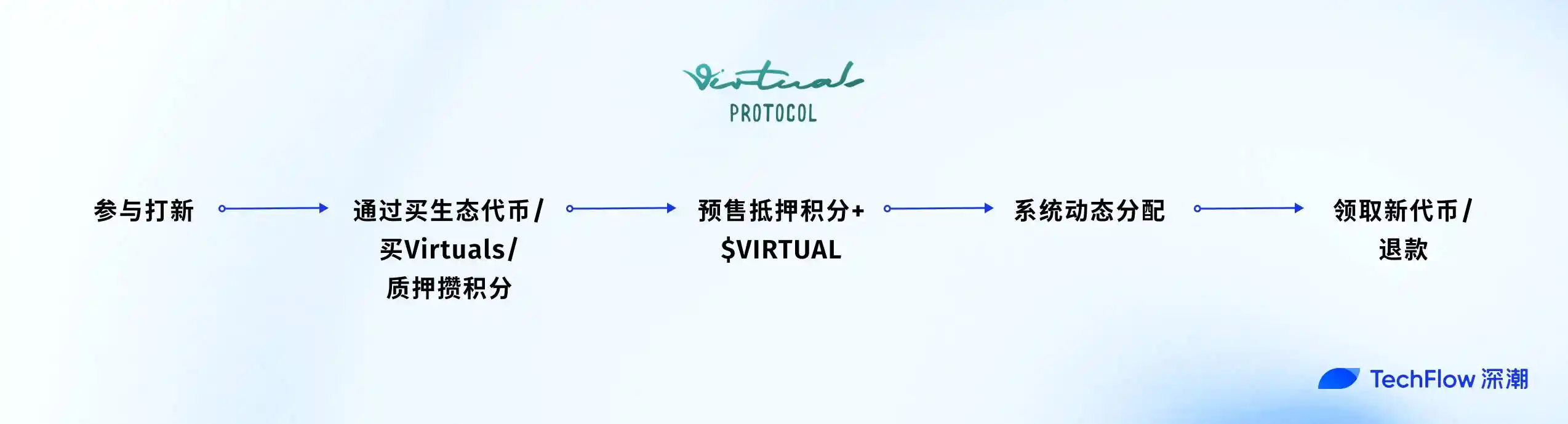
Points are your "priority pass" for participating in the "Initial Offering," determining how much of the new token you will receive. The more points you have, the higher your allocation ratio (with each person limited to 0.5% of the new token's total supply).
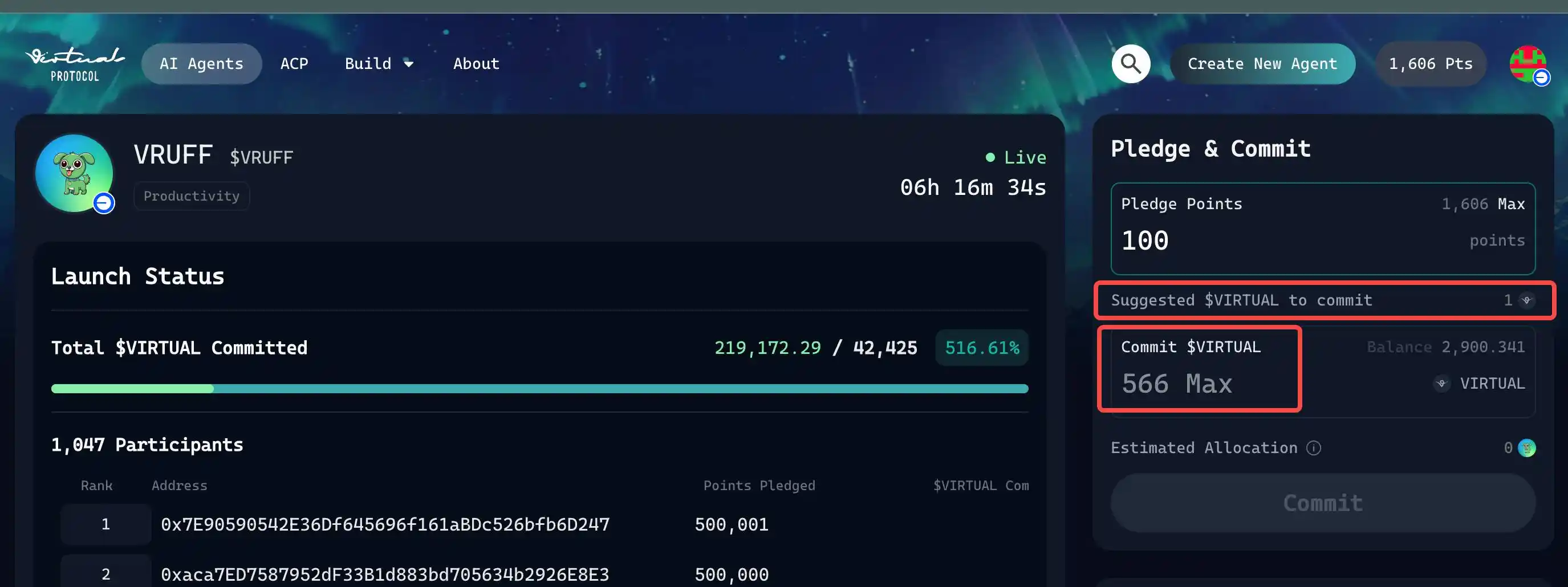
It is important to note that points are consumed when participating in the presale. The points allocated to you by Virtuals will expire if not used, incentivizing you to stake points for participation in the Initial Offering. On the other hand, the Virtuals token itself represents the cost you incur when participating in the Initial Offering. The system will also suggest the number of Virtuals tokens you need to stake based on your points input. The logic here is:
1. The more points you have, the higher the cap on the tokens you can get from the Genesis Launch;
2. Having fewer points, it doesn't make much sense to invest more in Virtuals for the Genesis Launch.
3. To prevent monopolies, a single wallet can only stake up to 566 Virtuals for the Genesis Launch, and there is also a 1% transaction tax.
If you don't have enough points and don't want to buy old assets, what can you do?
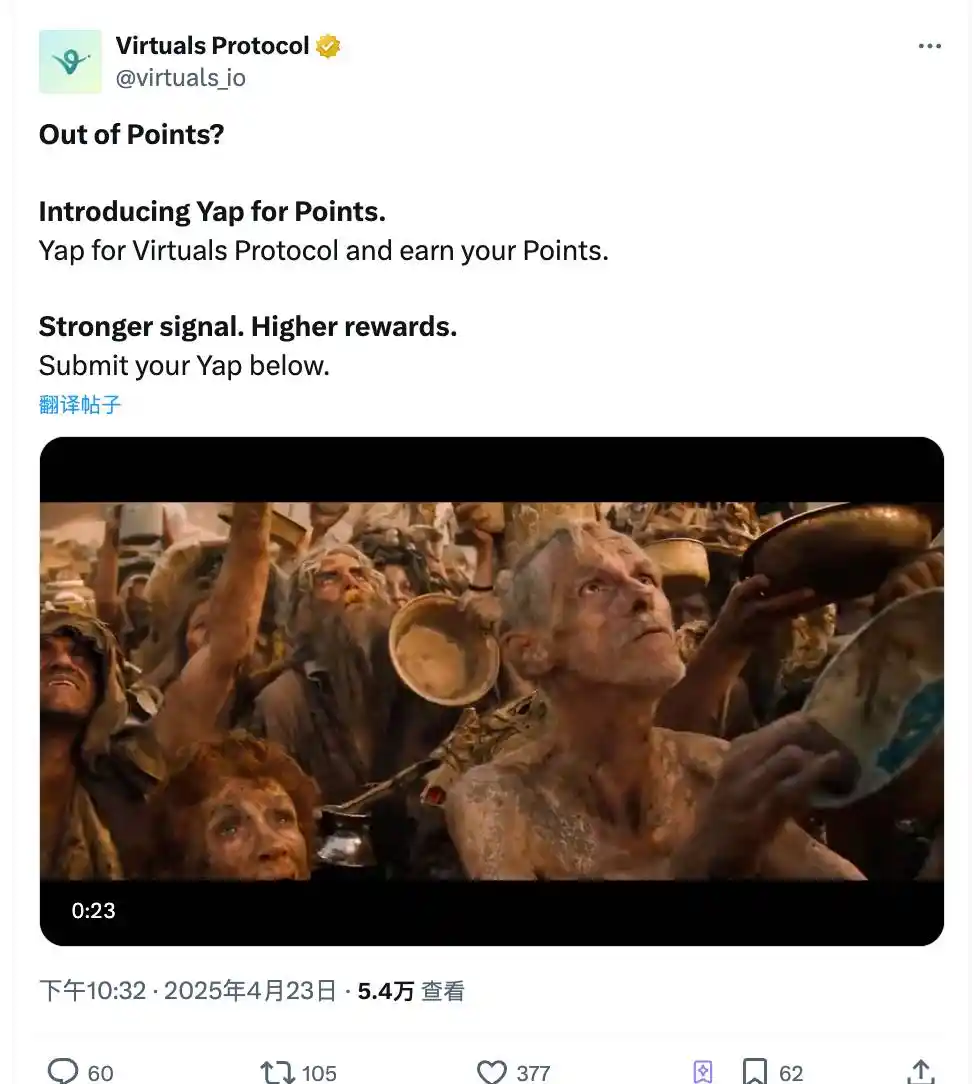
Virtuals has also launched its own Yaps mechanism, which allows players to earn points through content contribution and promotion, providing more options for players who want to participate in the Genesis Launch at a low cost.
Launching New Assets, Revitalizing Old Assets
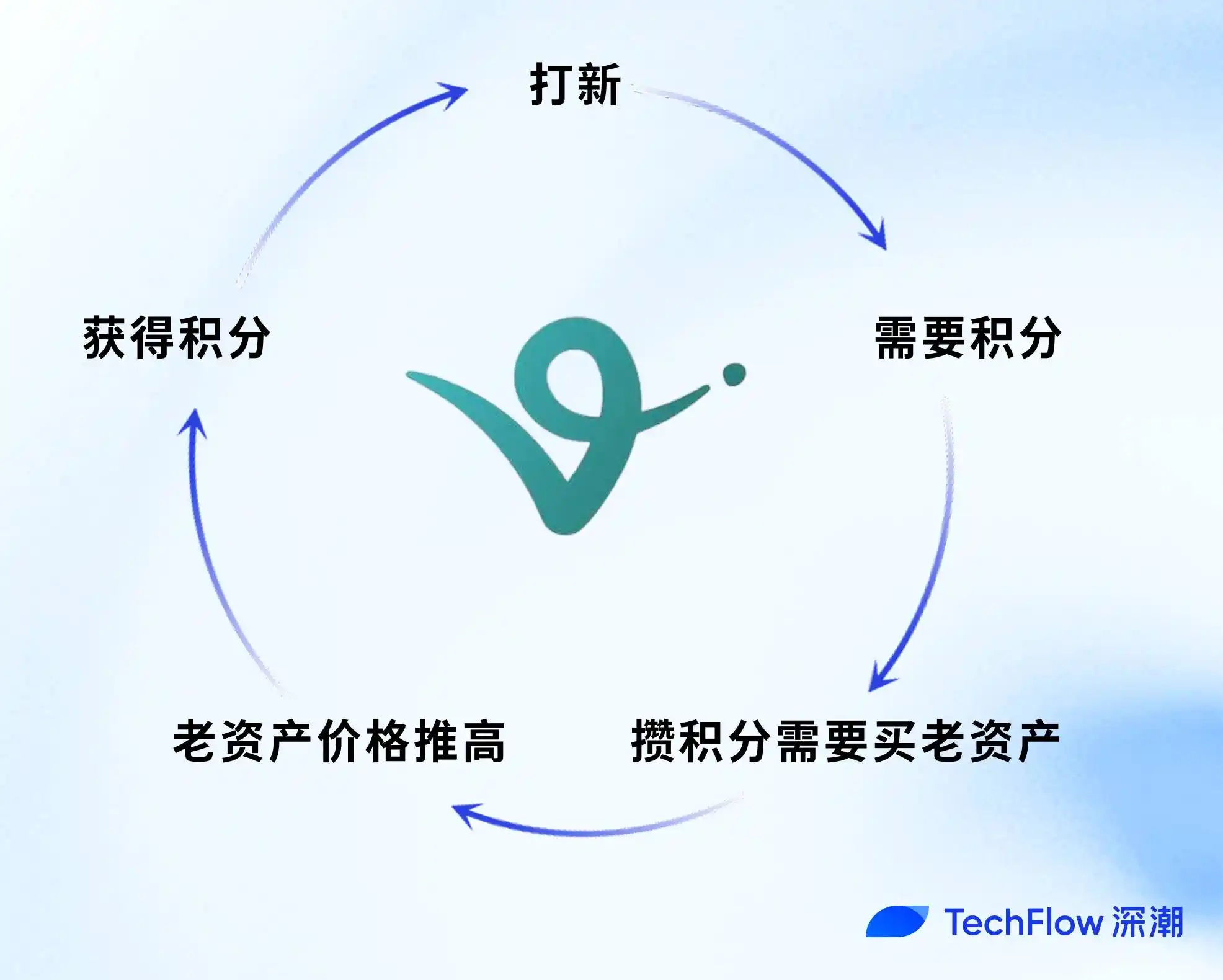
Experience tells us that in the design of mechanisms around crypto assets, one should not take one step at a time but rather aim to achieve multiple objectives at once. The gameplay of Genesis Launch is very clear in this regard—it creates new assets through the Genesis Launch while revitalizing existing old assets. Within the Virtuals ecosystem, established AI tokens (such as Luna and AIXBT) already have their own market narratives.
As the hype around AI Agents cools down, the trading volume and community engagement of these old coins have inevitably experienced a significant decline compared to before. In this wave, the need for points to participate in the Genesis Launch, which can only be obtained by purchasing old assets, increases the demand for old assets through the new asset creation rules, thus driving up the prices of old assets.
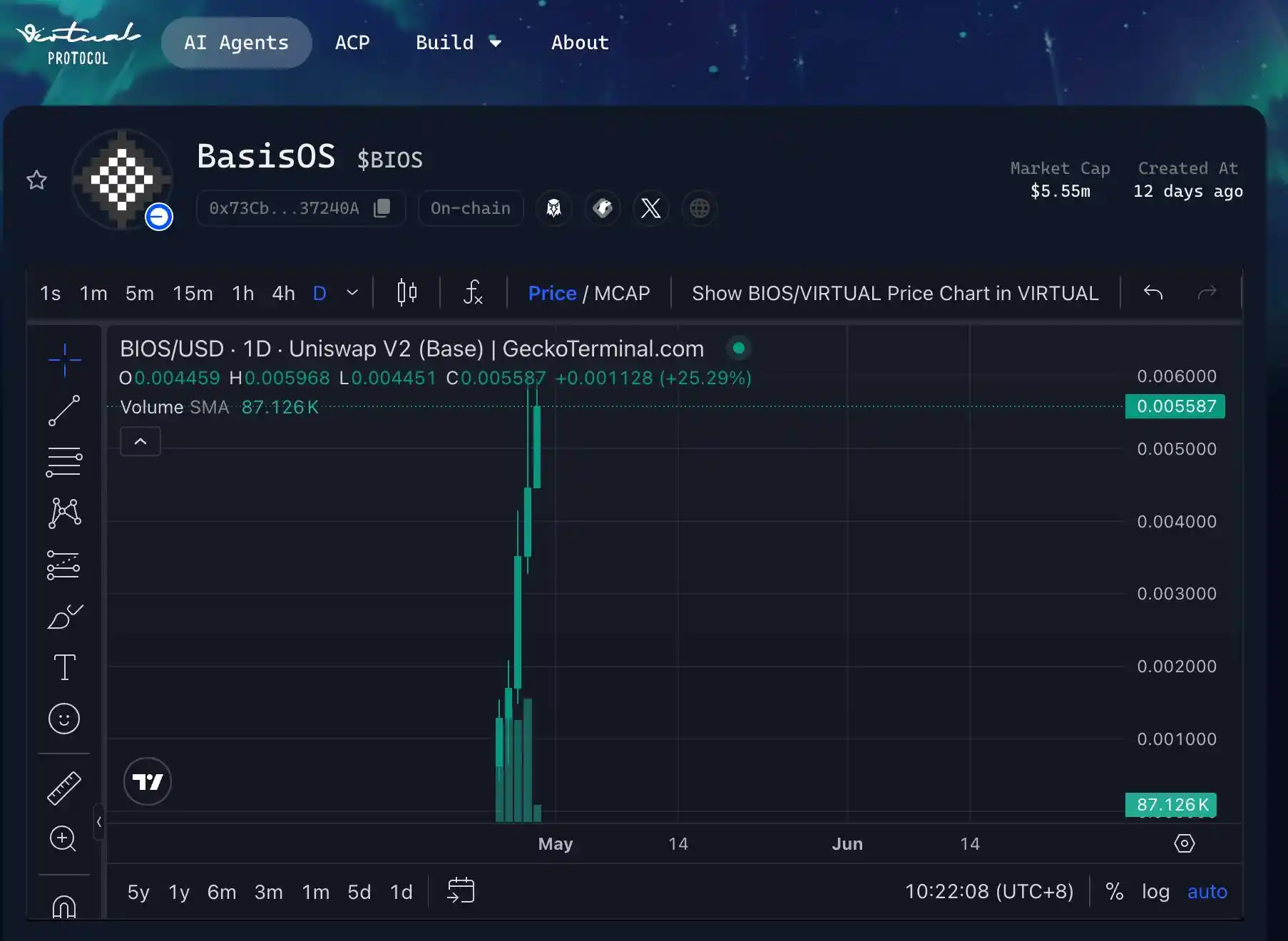
At the same time, the prices of new assets on Virtuals are quietly surging as there are not many participants at the moment. For example, the BasisOS token that was born through this Genesis Launch has seen its market capitalization reach 5.5 million within 12 days since its launch, a 40x increase from the initial launch.
With Virtuals' technology and narrative background remaining relatively unchanged, this "new with old" asset issuance gameplay can indeed create some ripples in the recent dull market. Zooming out to the broader context, you will find that the previously hyped AI Agent tokens have all experienced a certain degree of rebound.
Therefore, the narrative of AI Agents may not have truly collapsed but rather urgently needs a new asset issuance gameplay; the top projects from the previous cycle are also actively trying to revive themselves by expanding through more gameplay to reignite the market's enthusiasm.
Interestingly, everyone seems to have a similar idea. The ai16z within the Solana ecosystem also appears to be doing something similar, creating a new asset launchpad called Auto.fun. Through incentive design, they aim to create demand for the AI16Z token, thus influencing the price movement of the old coin.
As "riding the new while holding the old" becomes the new play for this round of AI Agent platforms, the better approach for us is to consider the old coin as a Beta version. In the current market environment, which is not too volatile, actively seeking out new Alpha seems to be the way to go.
You may also like

Former SpaceX engineer reconstructs the financial execution system using first principles

Why Is PAXG Price Different From Gold? 5 Reasons Crypto Traders Should Know

The cryptocurrency industry has entered the "Show Me" era: merely relying on vision is no longer enough

WEEX OpenAPI 101: 5 Powerful Modules, AI Trading Tools, and Grab Up to 70% Revenue Opportunities
Learn how WEEX OpenAPI connects traders, developers, AI agents, and trading platforms. Discover WEEX API features, Binance-compatible integration, automated trading workflows, revenue opportunities, and ecosystem possibilities.

Morning News | The draft amendment to the People's Bank of China Law aims to clarify the legal status of digital renminbi; South Korea will transfer about 40 unregistered virtual asset service providers to law enforcement agencies

Interpreting the Ethereum Foundation's new structure: Reaffirming self-sovereignty amid institutional trends

Interview with NDV Founder Jason Huang: Popping the AI Bubble and the Myth of Microstrategy, Seeking the Ultimate Ace in the Crypto Market
Morning Report | Former Ethereum Foundation researcher establishes Ethlabs; EU Parliament Economic Committee passes digital euro regulatory proposal

Dragonfly partner Haseeb: The fastest-growing companies in the future may all be stuck at 149 people

How xBubble Breaks the Deadlock in VC's Heavy Investment in the OPC Economy

The encrypted unicorn Blockstream is deeply embroiled in a serious fraud case

Morning Report | The South Korean Financial Services Commission plans to expand the regulatory sandbox to include virtual assets; the parent company of the New York Stock Exchange, ICE, has reached a partnership with OKX to jointly establish a cryptocu...

Exclusive Interview with Strategy CEO: Putting Aside the Sale of 32 BTC, the 60 Trillion AI Intelligence is the Ultimate Fate of Bitcoin

TRON revitalizes the image of the bull, creating a more approachable brand character

Will the STRC issuance price discussed with ChatGPT really fall into a death spiral?

The foundation retreats, Ethlabs steps forward: Ethereum welcomes its largest restructuring in history

NYSE Parent ICE and OKX Launch Joint Venture: What It Means for Tokenized Stocks
ICE and OKX have announced a joint venture focused on tokenized stocks, but stock futures are already live across crypto markets. Here's what the partnership means, how stock futures work, and why traders are paying attention.

How to Trade Apple and Nvidia on a Crypto Exchange in 2026 (Without Buying Shares)
Former SpaceX engineer reconstructs the financial execution system using first principles
Why Is PAXG Price Different From Gold? 5 Reasons Crypto Traders Should Know
The cryptocurrency industry has entered the "Show Me" era: merely relying on vision is no longer enough
WEEX OpenAPI 101: 5 Powerful Modules, AI Trading Tools, and Grab Up to 70% Revenue Opportunities
Learn how WEEX OpenAPI connects traders, developers, AI agents, and trading platforms. Discover WEEX API features, Binance-compatible integration, automated trading workflows, revenue opportunities, and ecosystem possibilities.
Morning News | The draft amendment to the People's Bank of China Law aims to clarify the legal status of digital renminbi; South Korea will transfer about 40 unregistered virtual asset service providers to law enforcement agencies
Interpreting the Ethereum Foundation's new structure: Reaffirming self-sovereignty amid institutional trends


