
Other than disavowing oneself, what is Vitalik thinking about

In a Crypto space that is almost no longer considered part of the tech sector, Ethereum founder Vitalik is a rare figure still concerned with the advancement of blockchain technology.
Starting in the second half of 2025, he began to extensively publish long threads on Twitter, with a frequency, length, and breadth of topics that are rare in his public expressions over the past decade. This does not seem like a successful founder preaching, but more like an anxious thinker trying to reignite something in the ruins.
We have compiled all his public tweets from 2025 to the present and found that his range of topics is extremely wide: from underlying consensus mechanisms to upper-layer social governance, from cryptography to AI ethics, from geopolitics to social media, all bear traces of his deep thinking.
Within these various topics, we attempt to distill the keywords he most frequently mentions and the core propositions he cares most about. These musings are not only about the future of Ethereum but also seem to be the answer to where the entire crypto industry should go.
The Shift in Underlying Narrative
In 2025, Vitalik repeatedly emphasized that Ethereum's underlying narrative must shift. It is no longer the "world computer" trying to run everything but is intended to become "internet-grade public infrastructure" like Linux or BitTorrent, or rather, "the TCP/IP of finance."
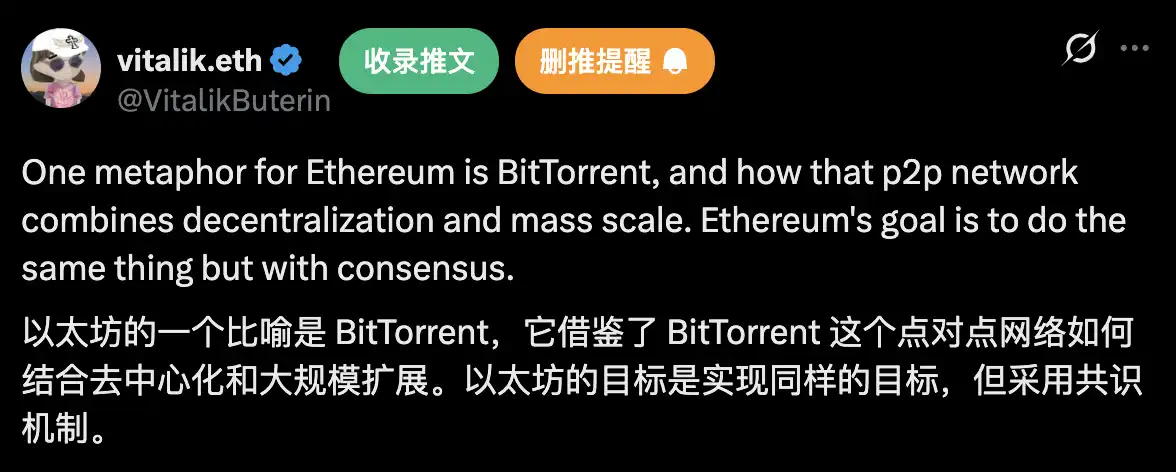
TCP/IP is the underlying communication protocol of the Internet. It does not belong to any company yet underpins the entire network's operation. By relinquishing control over upper-layer applications, it has gained absolute neutrality and robustness.
This is precisely the new direction Vitalik has found for Ethereum. A more mature, more pragmatic decentralization: a neutral foundational layer that cannot be controlled by a single entity, a cornerstone that allows all financial activities to run permissionlessly.
"Ethereum should operate like Linux or BitTorrent: open, decentralized infrastructure that no one owns but is powerful and trustworthy enough to enable the whole world to build on it."
This means that Ethereum's valuation logic is also undergoing a change. Its core value cannot be measured by a commercial company's P/E ratio or user growth. Its value does not lie in how many users or profits it has like Facebook or Amazon but in its infrastructure capability to hold value deposits and support application development.
This shift in narrative signifies that Ethereum must confront a harsh reality: when "tokenization" itself can no longer provide emotional premium, it must revert to value creation. The acceptance of Ethereum by Wall Street and traditional finance both validates its value and brings about challenges.
Wall Street Has Arrived
Following the Bitcoin spot ETF, giants like BlackRock, JPMorgan, and Fidelity have begun heavy involvement in Ethereum in 2025. They are no longer satisfied with simple asset allocation but are delving deep into the infrastructure layer. BlackRock has launched an Ethereum-based tokenization fund, JPMorgan's Onyx platform processes billions of dollars in daily on-chain transactions.
The influx of institutions, like a double-edged sword, is both an endorsement of legitimacy and a direct challenge to Ethereum's decentralized soul. As BlackRock and Bitmine hold more Ethereum, will the founders' influence diminish? How will Ethereum balance institutional demands with its decentralized ethos?
Vitalik's stance is: welcome, but not cater.
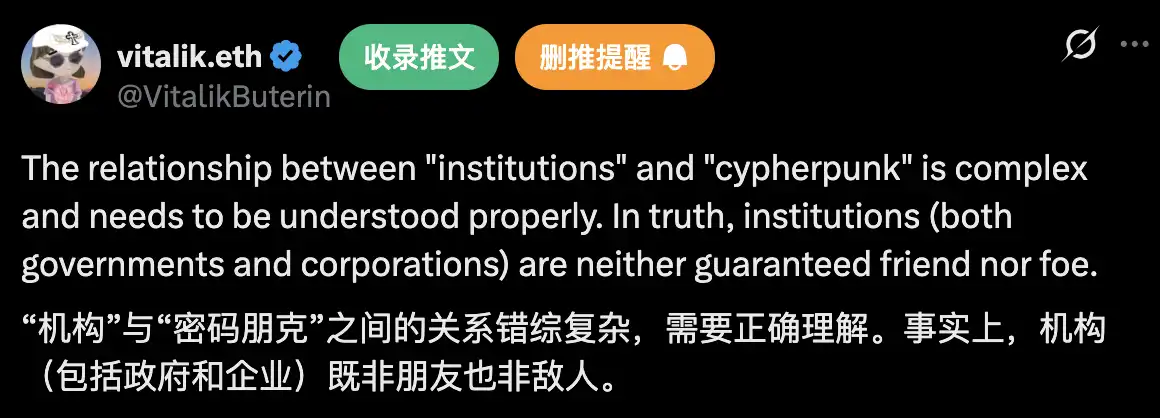
In a post on Farcaster, he described the relationship between institutions and cypherpunks as a complex relationship that needs to be properly understood, stating that "institutions (whether government or corporate) are neither inevitable friends nor inevitable enemies."
However, he believes unconstrained institutionalization poses two major risks, both of which directly target the foundation of decentralization.
First is the alienation of the core community. Vitalik bluntly stated in an interview, "It's very easy to drive others away. If Ethereum only pursues commercial usability, ignoring its technical and social aspects, then it will adopt Wall Street's 'greed is good' mentality, which is exactly what many of us came here to escape."
This is fundamentally a decentralized crisis at the community level: if the original builders leave, Ethereum will lose its source of ideas and vitality.
Second is the risk of wrong technical choices. Institutional pressure may lead Ethereum to make decisions that compromise its accessibility.
For example, to meet the demand for high-frequency trading, the block time is reduced to 150 milliseconds. This means that only institutions with professional data centers and low-latency networks can run nodes, while regular users will be completely excluded, potentially further concentrating node operations in financial hubs like New York, undermining geographical decentralization.
Faced with these risks, Vitalik's initial solution was a clear division of responsibilities: the L1 base layer would maintain absolute decentralization, focusing on global censorship resistance and other traits that Wall Street cannot replicate.
「The Layer 1 base layer should remain powerful, open, and directly accessible. It should allow individuals, companies, and governments to build on it without relying on any centralized institution.」 Meanwhile, institutions could build their own "compliant" applications on L2.
However, this "L1 Anti-Censorship, L2 Pro-Compliance" approach encountered new challenges in practice.
New Positioning of L2
On February 3, 2026, Vitalik published a lengthy article on X, making a significant adjustment to Ethereum's L2 strategy.
The original Ethereum scaling roadmap positioned L2 as "Ethereum's branded shard," inheriting Ethereum's security and decentralization to become an extension of the mainnet.
However, reality proved disappointing. Vitalik directly criticized that most L2 solutions were still in the phase of relying on centralized sequencers, essentially more like a "centralized database wearing blockchain clothes."
These L2 solutions, which raised billions and were valued at tens of billions, refused decentralization for commercial interests (MEV income, regulatory compliance, rapid iteration). Their tokens saw high valuations post-launch, low circulation, and a continuous decline in price.
These general-purpose L2 solutions, in fact, align well with a term Vitalik often uses to criticize products of centralized tech giants — "corposlop."
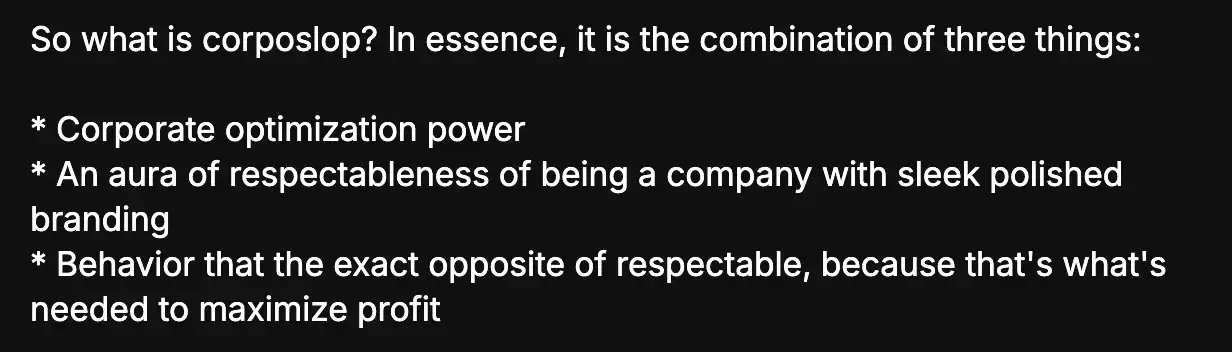
Vitalik's creation of the term "corposlop" can be understood as: corporate garbage dressed in shiny attire. Possessing strong commercial capabilities and exquisite branding, but in reality, companies and their products engage in unethical practices to pursue profit.
Vitalik did not hold back in his comments on this type of L2:
「This may be right for your customers. But clearly, if you do this, then you are not 'scaling Ethereum.'」
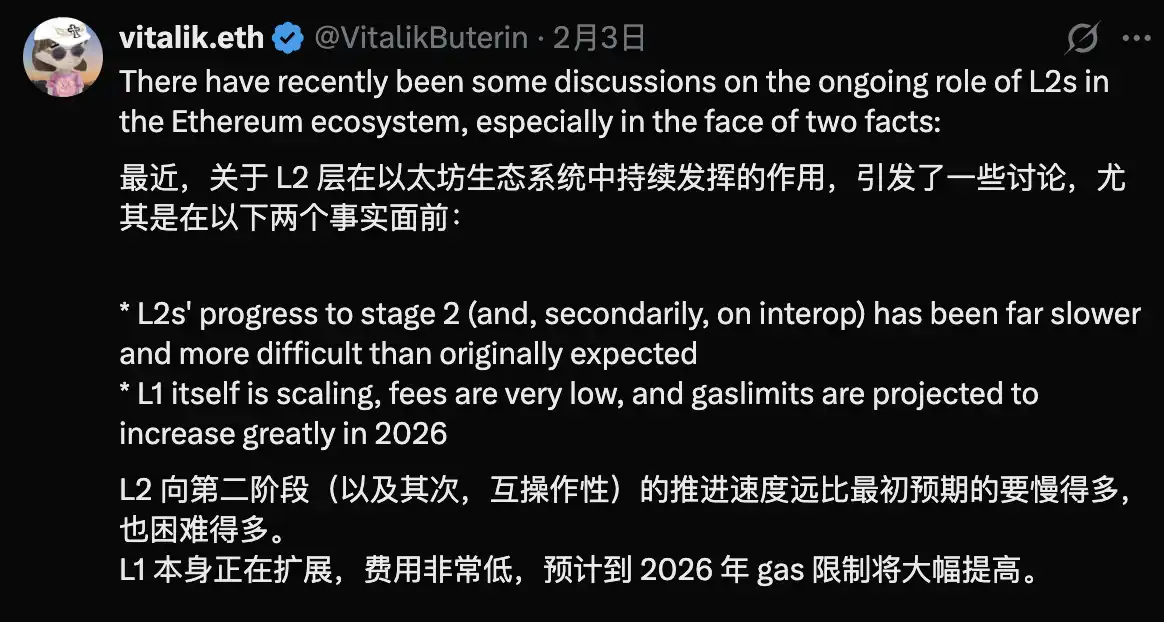
While progress in L2 decentralization has been slow, progress in L1 scalability has unexpectedly been rapid. Fees are already very low, and the gas limit is expected to significantly increase by 2026. The core value of L2 as a "scaling tool" is being diluted.
Therefore, Vitalik has pointed out a new path for L2:
"We should stop seeing L2 as Ethereum's 'brand sharding.' L2 can no longer be satisfied with just being 'a little faster than L1' and must find its unique value."
He believes that the future value of L2 lies in specialized functionality and innovation. For example, innovation in non-financial areas such as privacy, AI, and social aspects; efficiency optimizations for specific applications (application chains); or providing ultra-low-latency transaction sequencing.
He even proposes that L2 can explore some "non-computationally verifiable" functions, meaning those whose outcomes cannot be proven solely through on-chain computation and require external world information (like an oracle) or social consensus (like a decentralized court) to adjudicate.
This pushes Ethereum's scaling roadmap into a new phase: a stronger L1 as the cornerstone of security and trust, complemented by a more diverse, functionally varied, and more imaginative L2 ecosystem.
Privacy as Top Priority
If we were to track the most frequently mentioned concept by Vitalik in 2025, "privacy" would definitely top the list. His emphasis on privacy also points to a core centralized issue in today's society—information control.
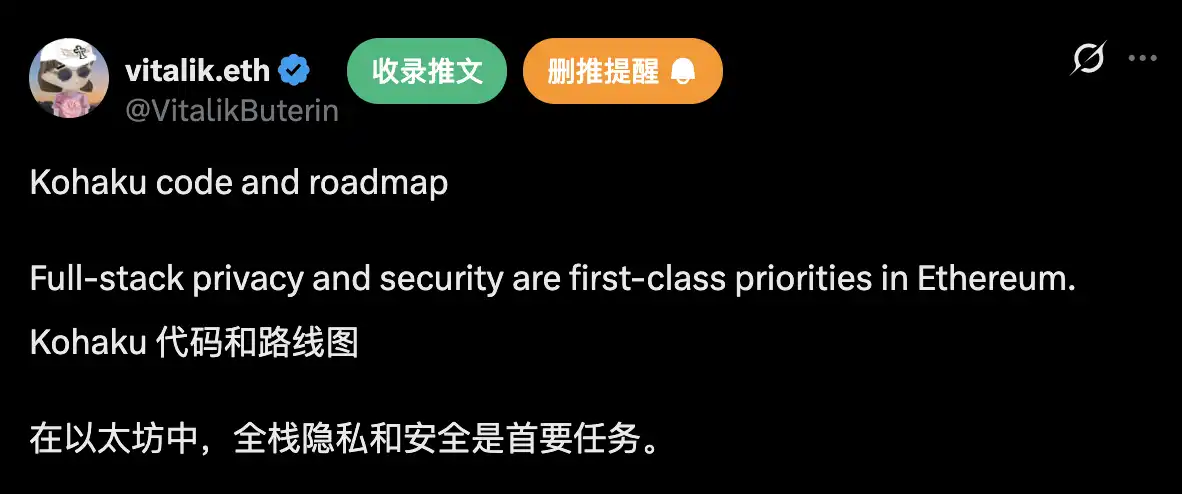
In October 2025, Vitalik elevated privacy to Ethereum's "first-class priority." He admitted that early neglect of privacy was a reluctant move because the technology was immature at the time. But now, with the maturity of zero-knowledge proof technologies like ZK-SNARKs, privacy can no longer be postponed.
"Privacy is a crucial safeguard for decentralization: whoever owns information holds power, so we need to avoid centralized control of information."
In a blockchain without privacy, every transaction and every vote you make is exposed to everyone. When power can be exerted through tracking on-chain data, the blockchain's "permissionlessness" becomes an empty phrase.
This struggle for information control is particularly evident in the stablecoin field. Stablecoins are the largest intersection between the crypto world and traditional finance, with billions of dollars flowing through the chain daily. Whoever controls stablecoin anchoring, issuance, and circulation controls the lifeblood of the crypto economy.
In this regard, Vitalik pointed out that the core struggle in the crypto industry is no longer "Innovation vs Regulation," but "Control vs Independence," with stablecoins being the main battleground of this struggle.
On the technical path, Vitalik has outlined the direction for privacy: through ZK-SNARKs and Privacy Pools, achieve "selective disclosure": users can prove the legitimacy of the source of funds to regulatory bodies while protecting transaction details without revealing all information.
From this perspective, privacy is a necessary condition for Ethereum to become a true "global digital public infrastructure." It ensures that Ethereum is not just a transparent financial ledger but also a digital society that can protect individual freedom, resist censorship, and allow users to safely "stand together."
Only when users have privacy protection can they securely participate in collective actions, express dissent, support sensitive causes without fear of tracking and retaliation. This is a necessary foundation for true decentralization.
Building Trust for AI
The reason privacy is given such a high priority is also closely linked to the rise of AI. The rapid advancement of AI has greatly enhanced the data collection and analysis capabilities of big tech companies, exponentially increasing the risks of "surveillance capitalism."
Vitalik's concerns are not unfounded. Palantir provides large-scale data surveillance services to the US government and intelligence agencies, Worldcoin collects iris data from hundreds of millions globally, Meta uses user chat records to train models.
AI controlled by a few giants, opaque, and not guided by values, is becoming the most powerful centralized tool in human history.
As early as November 2024, Vitalik warned of the risks of centralized AI, citing OpenAI as an example:
"OpenAI has now become CloseAI: first, they sacrificed open-source for safety, and this year, they sacrificed safety for profit."
However, Vitalik believes that the crypto community cannot turn a blind eye to AI but must proactively engage, using the power of decentralization to guide the development direction of AI.
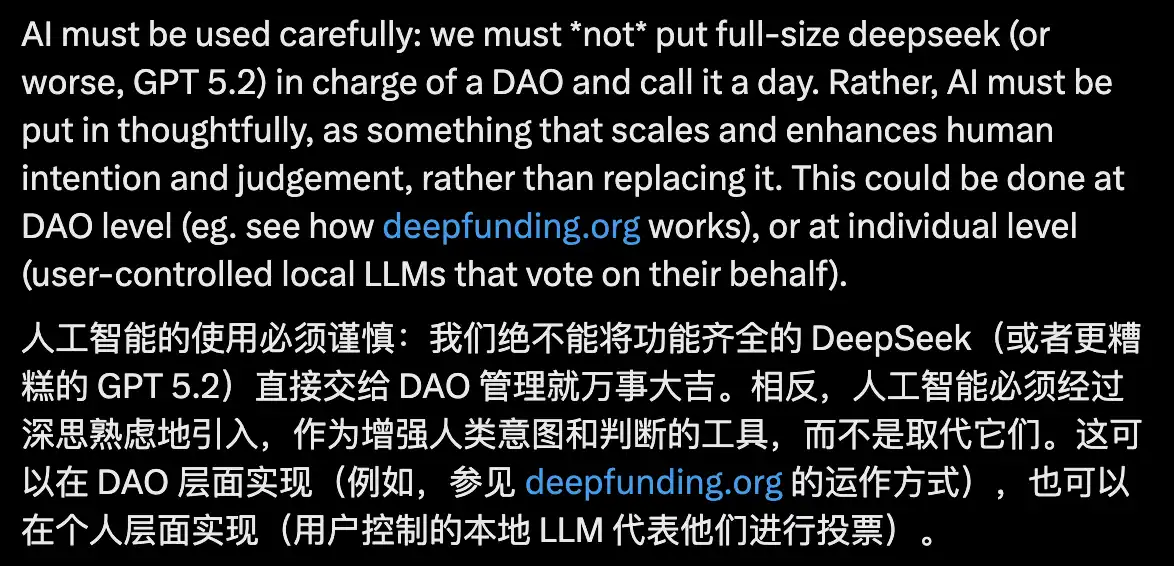
「AI must be used carefully: we must never allow a large language model to govern a DAO... Instead, AI must be placed within a larger, human-driven system and act as a component of it.」
This is exactly the purpose behind the Ethereum Foundation establishing the dAI (decentralized AI) team and introducing the ERC-8004 protocol. ERC-8004 provides on-chain "identity" and "credit profile" for AI agents, making AI behavior traceable and auditable.
The core issue it aims to address is: as AI agents increasingly replace humans in performing tasks, how can they trust each other?
In a centralized model, this issue is addressed by the platform. You trust OpenAI, so you trust its AI. But this means all trust is concentrated in the hands of a few giants.
ERC-8004 offers a decentralized path: through on-chain identity and behavior records, AI agents can establish verifiable reputations without relying on centralized platform endorsements. This allows the AI ecosystem to potentially operate in a decentralized manner, like DeFi, rather than being monopolized by a few giants.
Vitalik's vision is clear: since AI is an unstoppable trend, instead of passively accepting a powerful tool controlled by a few giants, it is better to proactively set boundaries for it within Ethereum's decentralized system (identity, payments, privacy, security) to ensure it serves an open, free society rather than becoming the new era's centralized weapon of power.
Decentralized Social Networking
After building a decentralized balance of power for the two major centers of power in finance and AI, Vitalik turned his attention to the core domain of human digital life: social networks.
He believes that the current centralized social platforms have fundamental issues. Their algorithms sacrifice the true value of content in pursuit of short-term engagement and ad revenue, ultimately leading to information silos, decreased content quality, and absolute control of users by the platforms.
In January 2026, the decentralized social networking track experienced a series of "earthquakes." Platform X banned APIs to combat "brushing" projects, Farcaster was acquired, and Lens Protocol handed over leadership to Mask Network. This series of upheavals highlighted the vulnerability of the existing model.
It was against this backdrop that on January 21, Vitalik posted a long article announcing a "full return to decentralized social networking" and deeply criticized the past decade's SocialFi model.
“Crypto social projects often go astray. We in the crypto space too often think that if you insert a speculative token into something, that's called 'innovation'.”
He pointed out incisively that in the past, the crypto industry has achieved little success in content incentives, stemming from a lack of an effective “quality filter mechanism” rather than insufficient incentives. The token's value reflects popularity and hype rather than content quality. The 2023 hype of Friend.tech is a typical example, with its token price plummeting by 99%, and the platform being almost abandoned.
Vitalik appreciates Substack's model because it proves that building a healthy economic system around high-quality content is entirely possible, with its core being “subscriber creators” delivering quality content, rather than “creating price bubbles for them.”
Based on this, he proposed a novel solution: establishing a non-tokenized, small-scale curation DAO.
This DAO filters high-quality creators through member voting and uses some of the revenue to buy back their tokens. This way, the role of speculators shifts from “hype pricing” to “predicting the DAO's selection,” thereby directing market forces toward discovering quality content.
But in Vitalik's view, the key to solving the problem is not to create more complex speculative tools, but to return to the technology itself by breaking platform monopolies through decentralization.
“There is no simple trick to solve these problems. But there is an important starting point: more competition. Decentralization is a way to achieve this: a shared data layer where anyone can build their client on top of it.”
To this end, he practices what he preaches. Vitalik claims that since early 2026, all his social activities have been carried out through Firefly. Firefly is a client that aggregates multiple platforms like X, Lens, Farcaster, etc., not relying on any single platform's API but through the concept of a “shared data layer,” allowing users to seamlessly transition to a more open and decentralized social environment while retaining their existing habits.
Embers in the Ruins
After examining Vitalik's thoughts on various topics over the past year, a common thread gradually becomes clear: what he cares most about and wants to adhere to is a return to the original intention of decentralization and a commitment to going beyond financial speculation.
Whether it's confronting Wall Street, establishing identities for AI, defending privacy, or rebuilding decentralized social networks, every topic points to the same core: in an era of centralizing power expansion, how to use technology to safeguard individual freedom and sovereignty.
In 1993, Eric Hughes wrote in the "Cypherpunk Manifesto":
"We cannot expect governments, corporations, or other large, faceless organizations to grant us privacy out of their beneficence. It is to their advantage to speak of us, and we should expect that they will speak. ... If we are to have any privacy, we must create it ourselves."
Thirty years later, we understand the weight of these words more than ever before. Tech giants wield information weapons with data and AI, and geopolitical conflicts threaten to turn any centralized system into a tool of power play. In the current global landscape, a truly neutral, open digital public infrastructure has never been more crucial.
While the entire crypto industry is still searching for the next 100x coin, in days of dwindling industry innovation, there are still those guarding the ember in the ruins.
This kind of perseverance may not necessarily "win" in the end. But at least there are thinkers in this industry who do not peddle the illusion of overnight riches or cater to short-term hype, but instead, through thought and action, embody the ancient creed:
"Cypherpunks write code."
And they live by building a more open, more equitable future for this increasingly divided world.
You may also like

What is the connection between Huang Zheng of Pinduoduo and blockchain?

The other side of Musk's trillion-dollar fortune: 85% cannot be sold

The U.S. government prohibits foreigners from using Fable 5, Anthropic issues a rebuttal

Citibank releases "2030 Asset Tokenization Market Outlook": 6 major trends may create a $8.2 trillion market

The trillion-dollar valuation test: Are the three major super IPOs a celebration for tech stocks or a nightmare for the crypto market?

Morning Report | Digital Asset completes $355 million financing led by a16z Crypto; Meta completes operational separation from Manus

a16z Crypto Partner: Cash flow is the moat

Cryptocurrency market makers collectively seek change as it becomes increasingly difficult to make money

How TradeXYZ, xStocks, and Alpaca break down the SpaceX IPO into three different strategies
$75 billion in risk asset redistribution: How will SpaceX's IPO affect U.S. stocks and Bitcoin?

Why Is BlackRock Investing $5 Billion in the SpaceX IPO?
Morning News | CME Group launches Nasdaq Cryptocurrency Index futures; Asset management giant Janus Henderson strategically invests in Ethena

Bitcoin Layer 2 Network Botanix: Why Did We Choose to Dissolve?

Why did Oracle deliver the strongest financial report in history, yet its stock price fell?
When the P2P illicit funds from ten years ago turned into 60,000 bitcoins
Dialogue with OmenX Founder: Why does the prediction market need an evolution from "spot" to "derivatives"?
Galaxy in-depth report: Is Solana still worth paying attention to?
Young people in South Korea make a "final effort" in the epic bull market
What is the connection between Huang Zheng of Pinduoduo and blockchain?
The other side of Musk's trillion-dollar fortune: 85% cannot be sold
The U.S. government prohibits foreigners from using Fable 5, Anthropic issues a rebuttal
Citibank releases "2030 Asset Tokenization Market Outlook": 6 major trends may create a $8.2 trillion market
The trillion-dollar valuation test: Are the three major super IPOs a celebration for tech stocks or a nightmare for the crypto market?
Morning Report | Digital Asset completes $355 million financing led by a16z Crypto; Meta completes operational separation from Manus


