
 Buy Crypto
- Markets
 Futures
- Spot
- Copy Trade
- Earn
- More
Paradigm's Math Problem: $12.7 Billion, Too Big for a Single Crypto Fund


Let's start with a math problem.
A VC firm manages $12.7 billion in assets. Its previous fund raised $850 million. The fund before that was $2.5 billion.
The direction is reversed.
The scale is shrinking, not because they can't raise money, but because there aren't enough worthwhile targets to bet on. Now, the firm wants to reverse this trend. Where does it need to look for the next sufficiently large pool?
On February 28, 2026, The Wall Street Journal provided the answer: cryptocurrency investment firm Paradigm is raising a new fund of up to $1.5 billion, expanding its investment focus to artificial intelligence, robotics, and other cutting-edge technologies.
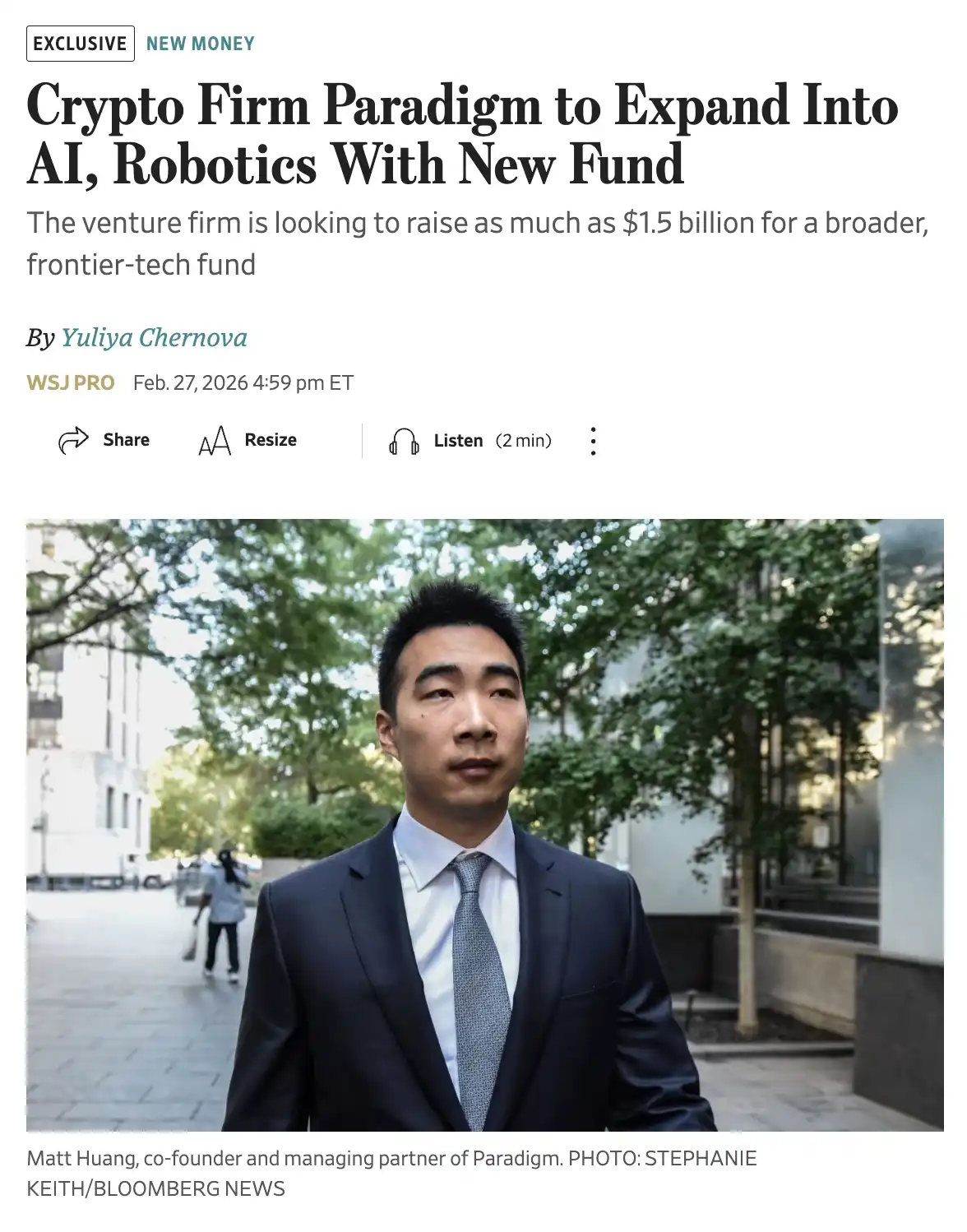
This is not a sudden decision. It is a math problem that has been in the works for some time, only revealing its answer today.
Lay Out the Numbers First
In 2025, global cryptocurrency VC investment reached $49.8 billion. Sounds like good news. But looking at this number alone would lead to a misunderstanding.
In the same year, the number of crypto VC deals plummeted by about 60% year-on-year, from around 2900 deals to 1200 deals. Money is increasing, projects are decreasing. Funds flowing into the crypto space are increasingly concentrated on a few large transactions rather than spread across hundreds of early-stage projects.
For the vast majority of small to medium-sized funds, this may not be a problem. But for Paradigm, it's a structural challenge. Managing $12.7 billion in assets, Paradigm is one of the world's largest cryptocurrency-exclusive VCs. Its issue is not finding projects but finding a sufficient number of large, early-stage projects that can deploy funds of this magnitude while maintaining its accustomed return expectations.
In 2021, Paradigm raised the largest cryptocurrency fund in history, a $25 billion fund. In 2024, it announced its third fund, a $8.5 billion fund, only a third of the previous fund.
This contraction is not a sign of weakness but a proactive adjustment to a narrower market. However, it also indicates one thing: relying solely on crypto, Paradigm has struggled to find a path forward for its scale.
After FTX, Paradigm Starts Asking a Question
To understand today's $15 billion, we must first go back to November 2022.
That month, FTX imploded. Sam Bankman-Fried's empire turned to ashes in a matter of days, taking with it the money of countless institutions. Paradigm's on-paper investment in FTX was $278 million. Ultimately reduced to zero.
For a top-tier institution known for being "research-driven" and priding itself on a technical eye, this was not just a bad debt. It was a public judgment error that required explanation to LPs, the market, and themselves.
What happened next seemed rather peculiar at the time. In 2023, someone noticed a subtle change on Paradigm's official website: all mentions of "crypto" and "Web3" had been quietly scrubbed, replaced with the more neutral term "technology investment."
This change was made without any official announcement, but was quickly noticed by the community, sparking intense discussions. The biggest concern was: Is Paradigm running away?
Co-founder Matt Huang had to come out and do damage control. He tweeted that Paradigm was "more excited about crypto than ever," adding, "The advancements in AI are too incredible to ignore. Framing AI and crypto as zero-sum is a popular but mistaken narrative. We don't subscribe to it. Both are fascinating and will have significant overlap."

This was a PR natured clarification, but it also revealed a truth: internally, Paradigm had been seriously considering AI.
After FTX, the question that had to be answered was: What to bet on for the next decade?
Matt Huang is Already Providing the Answer
If you only look at Paradigm's official announcements, the company's transformation seems to have just begun today. But if you look at Matt Huang's actual actions over the past two years, you'll find that he is no longer just a crypto investor.
In 2024, Paradigm invested $50 million in Nous Research. Nous Research is an AI infrastructure company focused on the research and development of open-source large language models. This was not an "exploratory" small-scale trial; $50 million was Paradigm's serious bet size.
In February of this year, Paradigm also co-published EVMbench with OpenAI, a benchmarking tool to evaluate the ability of different AI models to detect and patch smart contract security vulnerabilities. The core infrastructure of cryptocurrency met AI capability assessment, bringing these two worlds to the same table.
At the same time, Matt Huang was also building another company: Tempo. This is a stablecoin payment infrastructure company where Matt Huang is a co-founder, and his board membership at Stripe aligns closely with this direction. Stripe established a strategic partnership with Paradigm in 2025, and that same year, Stripe also introduced a stablecoin payment product.
Putting all this together, Matt Huang isn't "going into AI"; he has been living at the intersection of AI and crypto for at least two years now.
His bet is not on AI, nor on crypto, but on the convergence of these two things at some point. And when AI agents start needing to execute transactions on-chain, when robots need a programmable monetary system, that point of impact is Paradigm's next main battlefield.
Why AI×Crypto Instead of an AI Pivot
For Paradigm, venturing into AI does not mean it is competing with a16z or Sequoia for the same set of projects.
There is a narrative mistake that is easy to make: interpreting Paradigm's new fund as "yet another VC pivoting to AI." But if it were just that, it would have no advantage; the general AI track is already crowded with traditional VC behemoths with deeper backgrounds and stronger resources.
Paradigm's real logic is this: it does not intend to compete for the general AI cake; it aims to bet on the intersection that others have not yet fully grasped.
AI agents are one of the hottest concepts right now. These intelligent entities capable of autonomously performing tasks have begun to replace humans in various scenarios: search, code writing, data analysis, process management. But there is one thing they have not solved yet: money.
When an AI agent needs to make payments, receive payments, transfer funds between different services, what does it use? PayPal? A bank account? These systems are designed for humans, require identity verification, human authorization, and are not compatible with machine autonomous execution logic.
But stablecoins can. Smart contracts can. Programmable money can.
That's why Matt Huang is working on both Tempo (stablecoin payments) and investing in Nous Research (AI infrastructure): he believes these two tracks will eventually converge, and Paradigm has the ability to bet on both sides and reap the greatest rewards at the moment of convergence.
This is not a transformation, it's an expansion. An expansion into a territory he believes others haven't fully grasped yet.
LP Needs a New Narrative
There is also a practical dimension that must be made clear.
Paradigm's LPs, the institutions and individuals who have entrusted their money to its management, saw the ambition of raising $2.5 billion in 2021 shrink to a restrained $850 million in 2024.
With such a stark difference in fund sizes between the two rounds, an explanation is needed. What's even more needed is a convincing narrative about the next fund.
“Continuing to invest in early-stage crypto projects” is a story that struggled to support a $1.5 billion fundraising target in 2024. But “leveraging the technological edge of crypto, entering frontier tech in the AI and robotics age” can.
In 2025, 61% of global VC funding flowed into the AI track, totaling around $258.7 billion. This is the largest pool in today's venture capital arena. The $1.5 billion Paradigm is raising this time is meant to tap into this pool, rather than continue to guard a shrinking lake. For LPs, this is a bigger story and a more credible growth logic.
Now, let's go back to 2023. That year, when Matt Huang was forced to come out and clarify the website redesign incident, he said this: “AI and crypto are not zero-sum competition.”
At that time, this statement seemed more like a defense. To appease the community, halt LP panic, and carve out space to explore AI. But reread in today's context, it sounds more like a prelude.
Paradigm took three years to emerge from the ruins of FTX. It didn't choose the simplest path of downsizing, focusing on crypto, and waiting for the next bull market. It chose a more challenging path, with greater imaginative space: betting on the fusion of AI and crypto, establishing positions in both tracks, and then waiting for the moment they converge.
Today, this $1.5 billion fund is a milestone along the road.
Matt Huang has not yet publicly responded to today's Wall Street Journal article. But his Tempo is still under construction, Nous Research is still running, and EVMbench has been released.
He doesn't need to explain anymore. Those actions have spoken louder than any statement.
You may also like

Morning News | The Hong Kong Securities and Futures Commission announced the regulatory framework for secondary market trading of tokenized investment products; Strategy increased its holdings by 34,164 bitcoins last week; KAIO completed a strategic fi...

What Is an XRP Wallet? The Best Wallets to Store XRP (2026 Updated)
An XRP wallet lets you safely store, send, and receive XRP on the XRP Ledger. Learn what wallets support XRP and discover the best XRP wallets for beginners and long-term holders in 2026.

What are the Top AI Crypto Coins? Render vs. Akash: 5 Gems Solving the 2026 GPU Crisis
What are the best AI crypto coins for the 2026 cycle? Beyond the hype, we analyze top tokens like RNDR, AKT, and FET that provide real-world solutions to the global GPU shortage and the rise of autonomous agents.

What Is a Token in AI? What Is an AI Token + 3 Gems You Can't Miss in 2026
The era of AI hype has transitioned into an era of utility. As we move through Q2 2026, the market is no longer rewarding "narrative-only" projects. At WEEX Research, we are seeing a massive capital rotation into Decentralized Compute (DePIN) and Autonomous Agent coordination layers. This guide analyzes which AI tokens are capturing institutional liquidity and how to spot high-conviction setups in a maturing market.

Consumer-grade Crypto Global Survey: Users, Revenue, and Track Distribution

Prediction Markets Under Bias

Stolen: $290 million, Three Parties Refusing to Acknowledge, Who Should Foot the Bill for the KelpDAO Incident Resolution?

ASTEROID Pumped 10,000x in Three Days, Is Meme Season Back on Ethereum?

ChainCatcher Hong Kong Themed Forum Highlights: Decoding the Growth Engine Under the Integration of Crypto Assets and Smart Economy

Why can this institution still grow by 150% when the scale of leading crypto VCs has shrunk significantly?

Anthropic's $1 trillion, compared to DeepSeek's $100 billion

Geopolitical Risk Persists, Is Bitcoin Becoming a Key Barometer?

Annualized 11.5%, Wall Street Buzzing: Is MicroStrategy's STRC Bitcoin's Savior or Destroyer?
An Obscure Open Source AI Tool Alerted on Kelp DAO's $292 million Bug 12 Days Ago

Mixin has launched USTD-margined perpetual contracts, bringing derivative trading into the chat scene.
The privacy-focused crypto wallet Mixin announced today the launch of its U-based perpetual contract (a derivative priced in USDT). Unlike traditional exchanges, Mixin has taken a new approach by "liberating" derivative trading from isolated matching engines and embedding it into the instant messaging environment.
Users can directly open positions within the app with leverage of up to 200x, while sharing positions, discussing strategies, and copy trading within private communities. Trading, social interaction, and asset management are integrated into the same interface.
Based on its non-custodial architecture, Mixin has eliminated friction from the traditional onboarding process, allowing users to participate in perpetual contract trading without identity verification.
The trading process has been streamlined into five steps:
· Choose the trading asset
· Select long or short
· Input position size and leverage
· Confirm order details
· Confirm and open the position
The interface provides real-time visualization of price, position, and profit and loss (PnL), allowing users to complete trades without switching between multiple modules.
Mixin has directly integrated social features into the derivative trading environment. Users can create private trading communities and interact around real-time positions:
· End-to-end encrypted private groups supporting up to 1024 members
· End-to-end encrypted voice communication
· One-click position sharing
· One-click trade copying
On the execution side, Mixin aggregates liquidity from multiple sources and accesses decentralized protocol and external market liquidity through a unified trading interface.
By combining social interaction with trade execution, Mixin enables users to collaborate, share, and execute trading strategies instantly within the same environment.
Mixin has also introduced a referral incentive system based on trading behavior:
· Users can join with an invite code
· Up to 60% of trading fees as referral rewards
· Incentive mechanism designed for long-term, sustainable earnings
This model aims to drive user-driven network expansion and organic growth.
Mixin's derivative transactions are built on top of its existing self-custody wallet infrastructure, with core features including:
· Separation of transaction account and asset storage
· User full control over assets
· Platform does not custody user funds
· Built-in privacy mechanisms to reduce data exposure
The system aims to strike a balance between transaction efficiency, asset security, and privacy protection.
Against the background of perpetual contracts becoming a mainstream trading tool, Mixin is exploring a different development direction by lowering barriers, enhancing social and privacy attributes.
The platform does not only view transactions as execution actions but positions them as a networked activity: transactions have social attributes, strategies can be shared, and relationships between individuals also become part of the financial system.
Mixin's design is based on a user-initiated, user-controlled model. The platform neither custodies assets nor executes transactions on behalf of users.
This model aligns with a statement issued by the U.S. Securities and Exchange Commission (SEC) on April 13, 2026, titled "Staff Statement on Whether Partial User Interface Used in Preparing Cryptocurrency Securities Transactions May Require Broker-Dealer Registration."
The statement indicates that, under the premise where transactions are entirely initiated and controlled by users, non-custodial service providers that offer neutral interfaces may not need to register as broker-dealers or exchanges.
Mixin is a decentralized, self-custodial privacy wallet designed to provide secure and efficient digital asset management services.
Its core capabilities include:
· Aggregation: integrating multi-chain assets and routing between different transaction paths to simplify user operations
· High liquidity access: connecting to various liquidity sources, including decentralized protocols and external markets
· Decentralization: achieving full user control over assets without relying on custodial intermediaries
· Privacy protection: safeguarding assets and data through MPC, CryptoNote, and end-to-end encrypted communication
Mixin has been in operation for over 8 years, supporting over 40 blockchains and more than 10,000 assets, with a global user base exceeding 10 million and an on-chain self-custodied asset scale of over $1 billion.

$600 million stolen in 20 days, ushering in the era of AI hackers in the crypto world
Vitalik's 2026 Hong Kong Web3 Summit Speech: Ethereum's Ultimate Vision as the "World Computer" and Future Roadmap
On the same day Aave introduced rsETH, why did Spark decide to exit?
Morning News | The Hong Kong Securities and Futures Commission announced the regulatory framework for secondary market trading of tokenized investment products; Strategy increased its holdings by 34,164 bitcoins last week; KAIO completed a strategic fi...
What Is an XRP Wallet? The Best Wallets to Store XRP (2026 Updated)
An XRP wallet lets you safely store, send, and receive XRP on the XRP Ledger. Learn what wallets support XRP and discover the best XRP wallets for beginners and long-term holders in 2026.
What are the Top AI Crypto Coins? Render vs. Akash: 5 Gems Solving the 2026 GPU Crisis
What are the best AI crypto coins for the 2026 cycle? Beyond the hype, we analyze top tokens like RNDR, AKT, and FET that provide real-world solutions to the global GPU shortage and the rise of autonomous agents.
What Is a Token in AI? What Is an AI Token + 3 Gems You Can't Miss in 2026
The era of AI hype has transitioned into an era of utility. As we move through Q2 2026, the market is no longer rewarding "narrative-only" projects. At WEEX Research, we are seeing a massive capital rotation into Decentralized Compute (DePIN) and Autonomous Agent coordination layers. This guide analyzes which AI tokens are capturing institutional liquidity and how to spot high-conviction setups in a maturing market.



 App
App