
PinPet × VELA: Solana's First Atomic Swap Engine and Yield Hedging Protocol, Reframing the DeFi Financial Paradigm

 Prefer us on Google

Source: VELA
1. The Current State of the Traditional DeFi Industry: The Fractured "Patchwork Financial System"
Despite the current DeFi ecosystem having built infrastructure covering trading, lending, and derivatives, its underlying structure still remains in the stage of a "patchwork-style finance." Taking the Solana ecosystem as an example, users often need to execute transactions on Raydium, leverage on Solend, and route liquidity through Jupiter. The multiple cross-protocol operations not only significantly increase interaction complexity but also continuously erode capital efficiency with each path switch, ultimately resulting in typical "liquidity fragmentation." More importantly, this structure exposes risks outside the system, as the current mainstream leverage mechanisms heavily rely on oracles. Once the market experiences drastic fluctuations, the delay between price changes and liquidation execution often directly leads to liquidation and bad debt risks. At the same time, traditional AMMs have limited support for complex trading instructions, causing users to bear additional slippage losses at the opening stage, putting the trades at a disadvantage from the start. Ultimately, DeFi's current issues are not merely performance-related but stem from a structural imbalance: liquidity, execution, and risk management are fragmented, making the whole system operate more like an inefficient "financial factory." In this context, the industry's true breakthrough direction is no longer just single-point optimization but moving towards higher-level unified execution and atomic integration.
2. PinPet: Solana's Pioneering Atomic Financial Engine, Reframing the DeFi Execution System
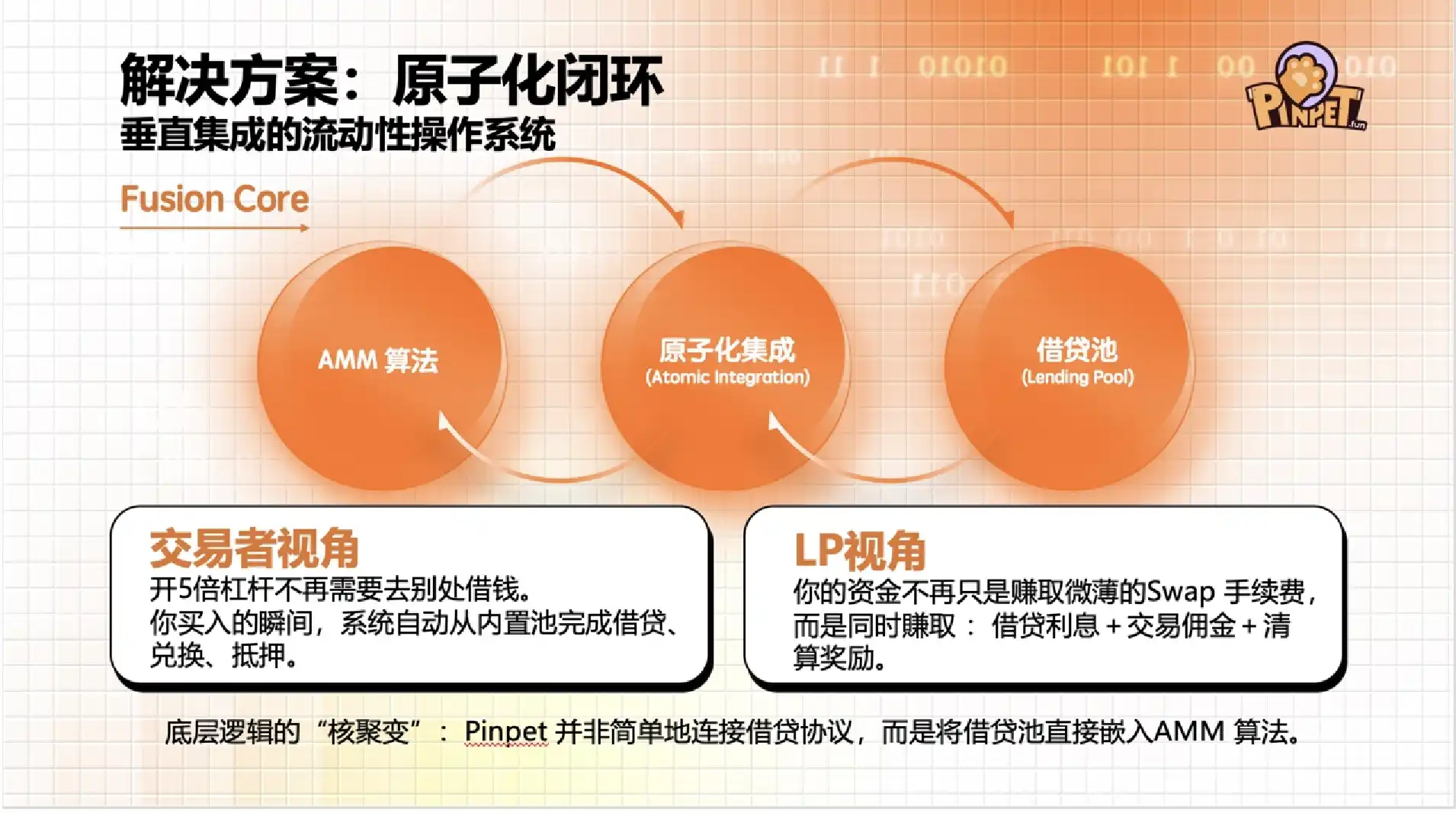
Addressing the structural issues of fractured execution paths and low capital efficiency in traditional DeFi, PinPet has proposed a more foundational solution through "atomic integration" to reframe the financial execution system. As a next-generation decentralized trading protocol built on Solana, PinPet does not simply concatenate AMM and lending modules but deeply integrates automated market makers (AMMs) with automated lending pools to form a vertically integrated liquidity operating system at the protocol's core. In this architecture, users no longer need to complete multi-step operations across protocols but can efficiently perform asset swaps, leverage openings, fund borrowing, and real-time settlement in a single transaction. This "atomic execution" mechanism ensures that all operations either succeed entirely or roll back entirely, fundamentally eliminating the uncertainty brought by intermediate states.
From a user's perspective, trading and leverage are no longer two separate steps, as the system automatically handles borrowing, exchanging, and collateralizing at the moment of opening a position; and from a liquidity provider's (LP) perspective, funds are no longer restricted to receiving a single swap fee but can participate in the distribution of lending interest, trading fees, and liquidation rewards simultaneously. The key lies in PinPet not merely "connecting" different financial modules but embedding lending capabilities directly into the AMM algorithm through the Fusion Core, enabling transactions, leverage, and risk management to be completed in the same logic. This shift from "combination" to "fusion" not only significantly shortens the execution path and enhances capital efficiency but also truly constructs an atomic financial engine that unifies various financial elements.
-- Price
III. Core Barrier and Business Closed Loop: PinPet's Structural Advantage and Value Capture Capability
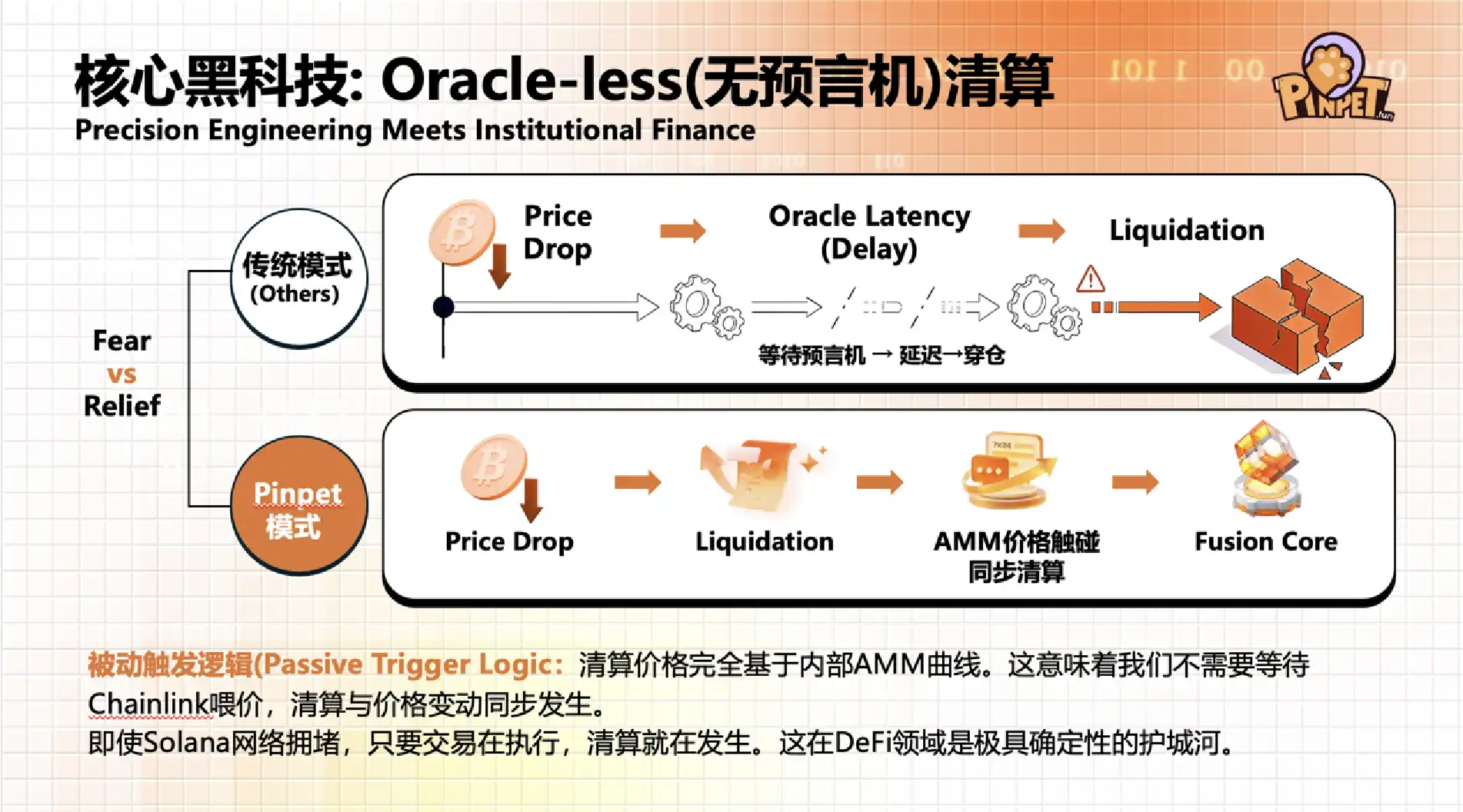
PinPet's core competitiveness lies not only in "atomic execution," but in a structural advantage formed under the unity of execution determinism, system performance, and value capture capability. First, in terms of risk control mechanism, PinPet achieves "price touch equals settlement" synchronous execution through oracle-less clearing, directly embedding the clearing logic into the AMM curve, thereby compressing the chain-like process of "price update—evaluation—execution" in traditional DeFi into a single step. This mechanism not only eliminates the liquidation risk brought by oracle delays but also transforms clearing from an external response to an internal systemic capability, maintaining determinism even under extreme market conditions and network congestion, and constructing a "mathematical-level" risk control moat.
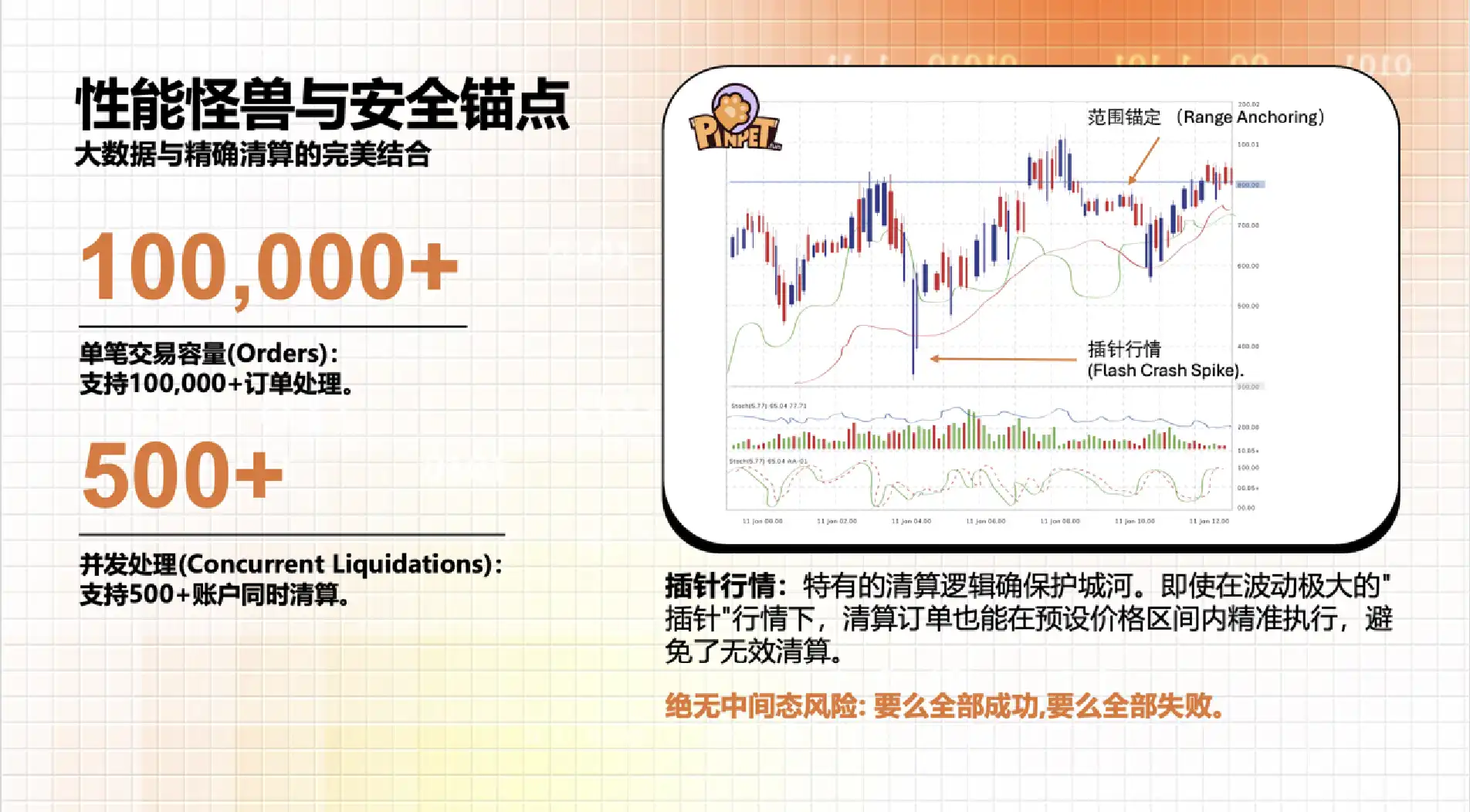
Building on this foundation, its performance architecture further strengthens its system advantages. PinPet supports high-concurrency order processing and multi-account synchronous clearing, and ensures effective clearing even in volatile market conditions through an interval anchoring mechanism. Meanwhile, under the atomic execution model, the system has no intermediate state risk—all operations are either fully completed or fully rolled back—giving it a natural advantage in high-frequency and leverage trading scenarios.
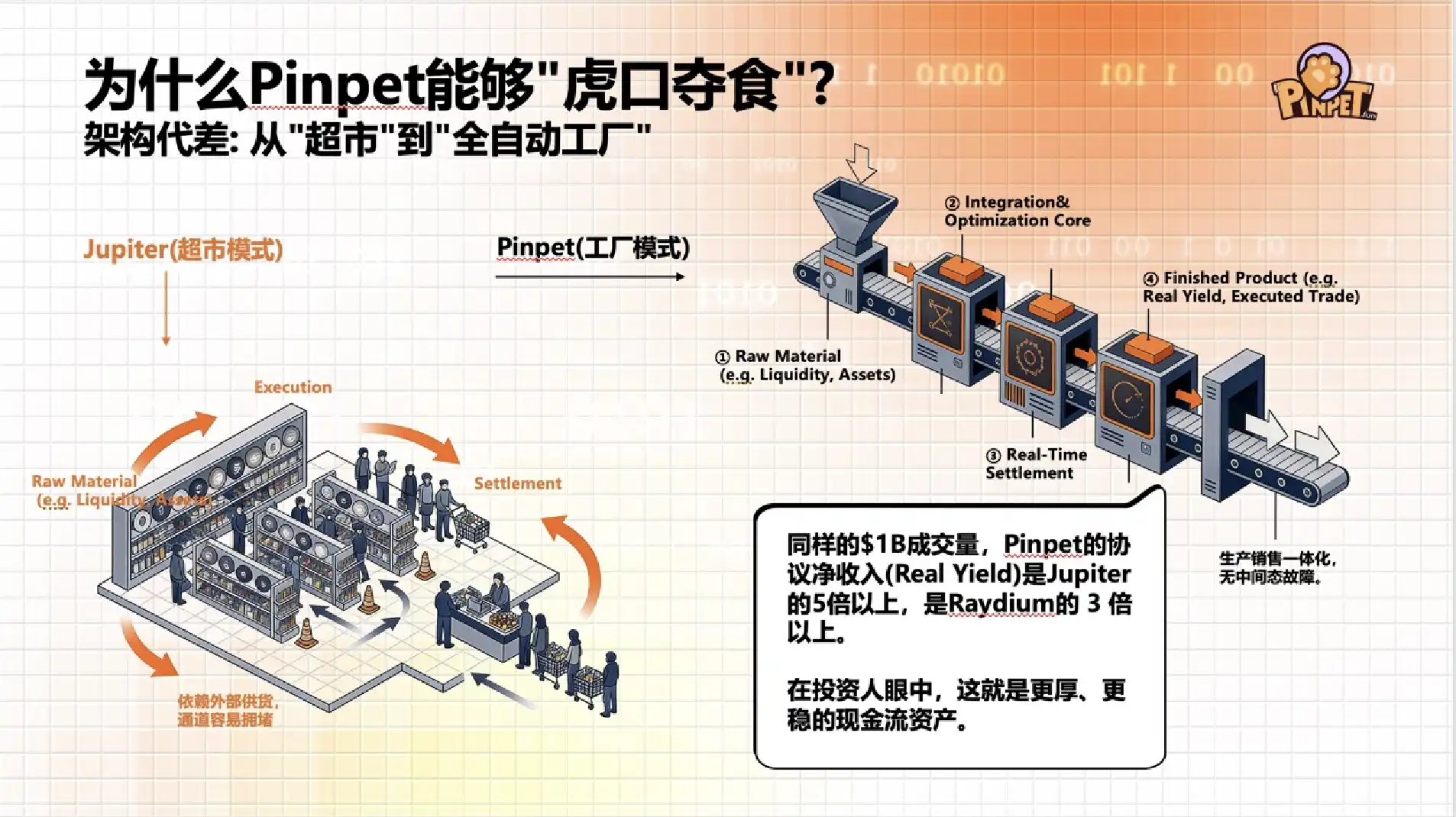
Compared to mainstream protocols like Jupiter and Raydium, PinPet, through single-tran
saction atomic closed-loop and oracle-less clearing, completes trading, lending, and clearing in the same system, not only significantly shortening the execution path but also forming a cost differential advantage in capital efficiency and risk control. More importantly, this architecture directly translates into an enhancement of the business model—by covering the entire process of transaction, lending, and clearing with a 1% full-chain fee rate, PinPet is able to capture the full lifecycle value of assets, establish a multi-source cash flow structure, and have stronger profit-making ability and valuation support at the same transaction scale.
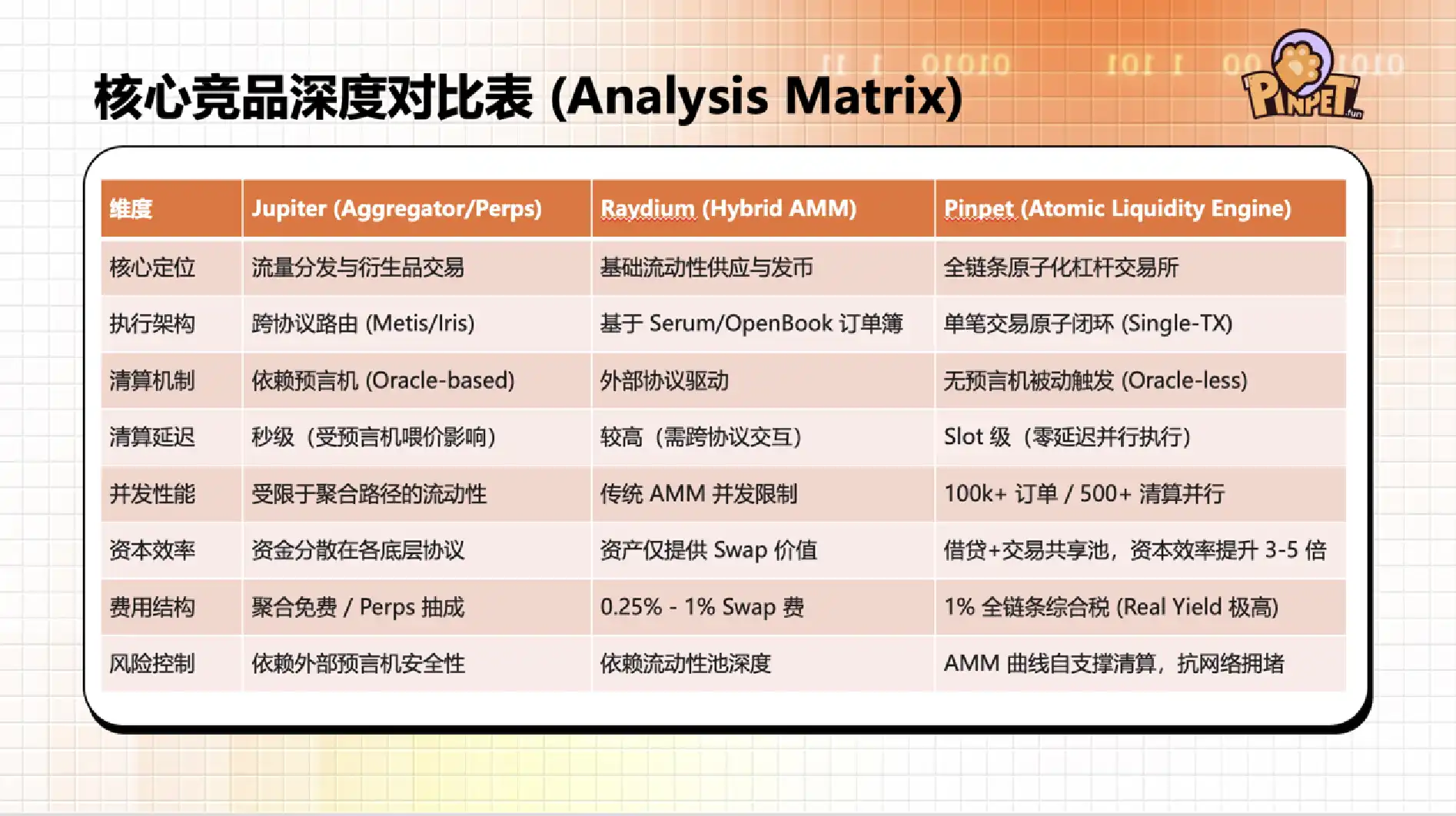
Essentially, this difference is a paradigm shift in architecture. Jupiter is more like a liquidity "supermarket," while PinPet is closer to a "fully automated financial factory," completing the entire process from liquidity integration to transaction execution to clearing settlement internally. It is this shift from "path optimization" to "value production" that enables PinPet to establish an irreplicable structural barrier.
IV. VELA: Native Yield Hedging Protocol, Rethinking On-Chain Revenue Logic
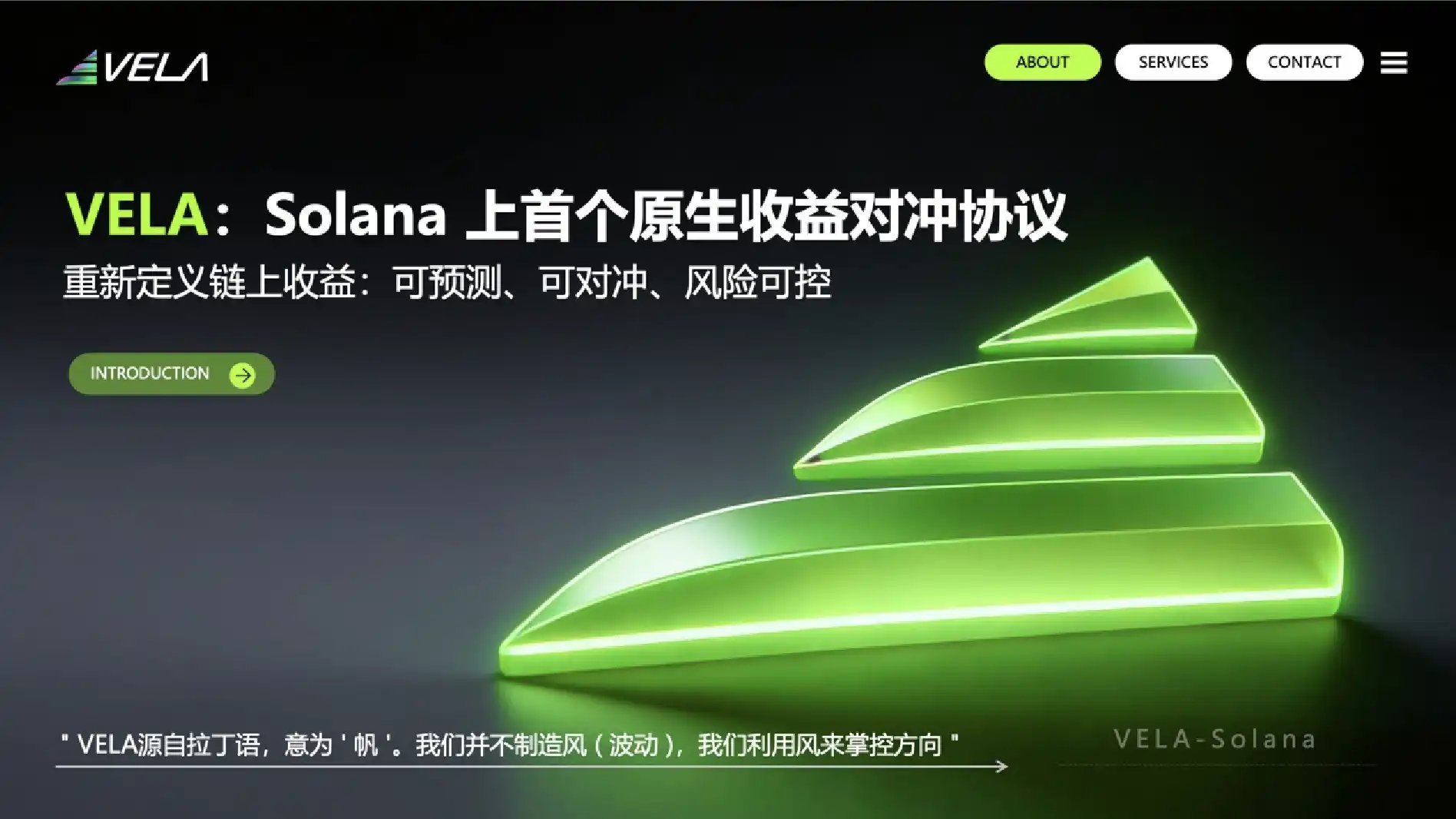
VELA is derived from Latin, meaning "sail." A sail moves forward with the help of the wind, controlling the direction, and crossing through uncertainty. In the crypto market, price fluctuations are like the wind, unavoidable but can be utilized, guided, and hedged against. VELA is built on this logic to structure its revenue system. As a native yield hedging protocol built on Solana and the flagship project of the PinPet ecosystem, VELA focuses not on "how to earn higher yields," but on the true source and sustainability of on-chain revenue.
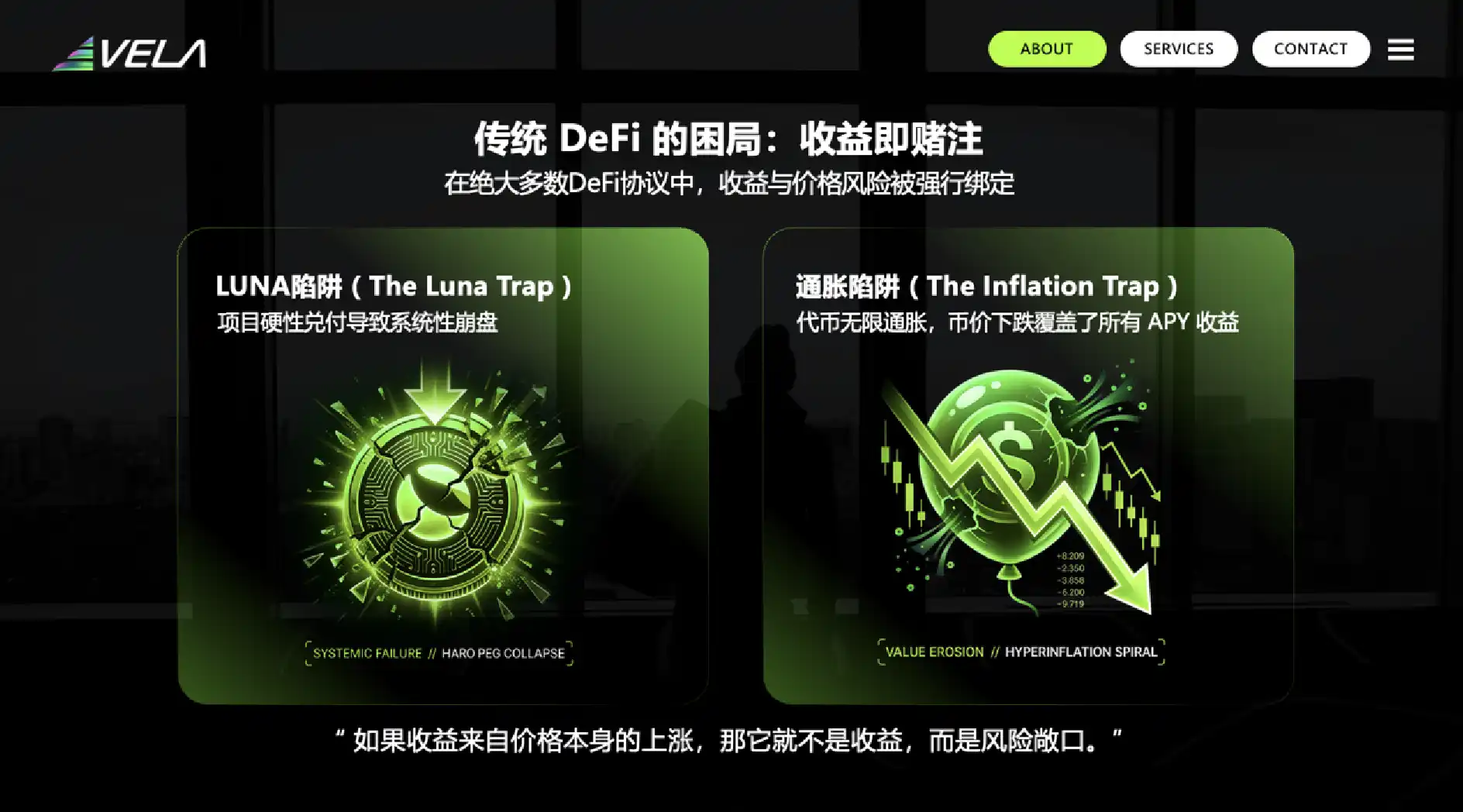
In traditional DeFi, yield and price risk are inherently intertwined, with the majority of APYs essentially being implicit bets on market direction. Once the market reverses, the so-called yield quickly turns into risk, whether it's a systemic collapse or an inflationary model, the root cause is: yield is just an unexplicit risk exposure. In other words, if yield relies on price increases, it is not genuine yield.
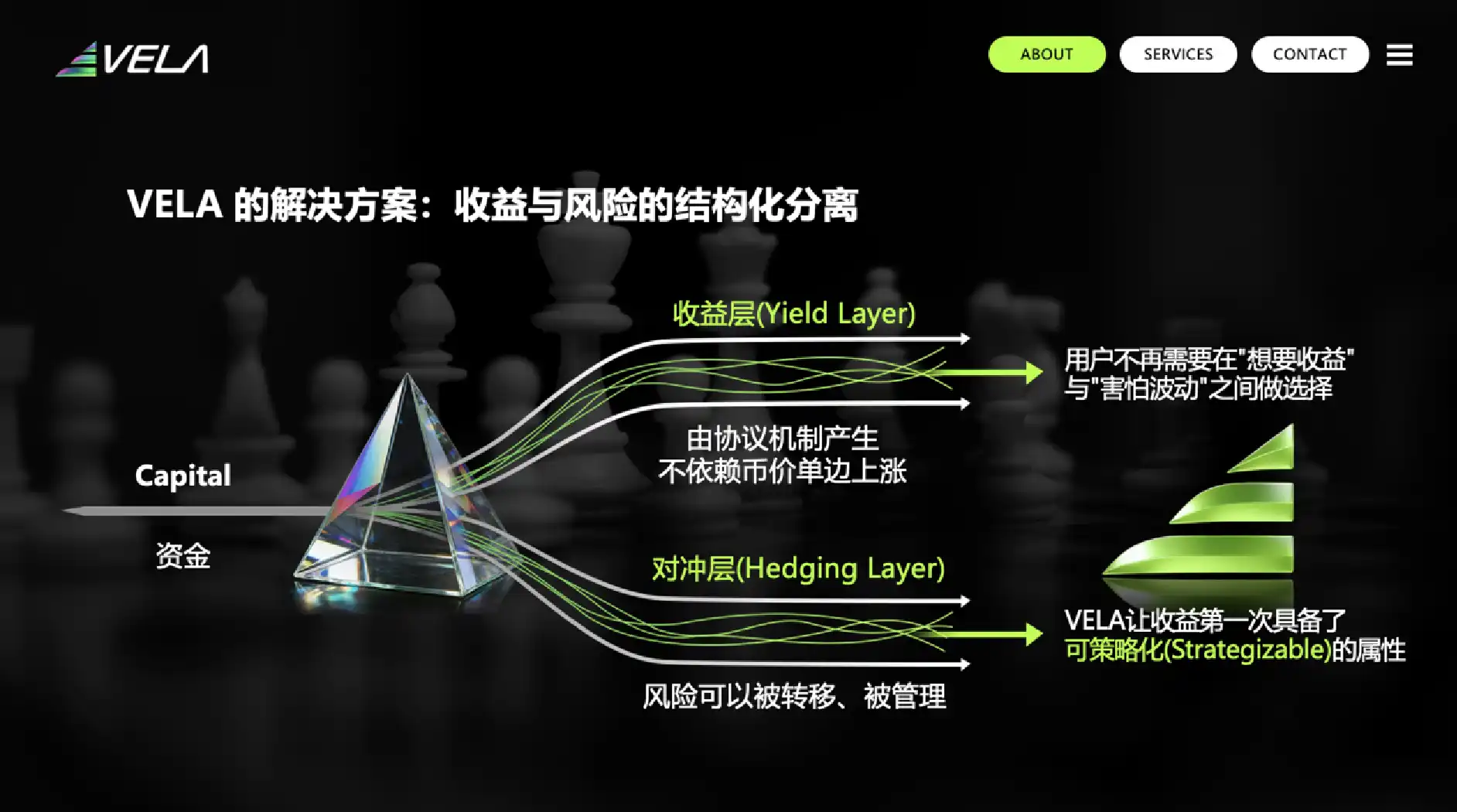
VELA's core lies in structurally separating yield from risk. Through the design of the Yield Layer and the Hedging Layer, where yield is protocol-generated and no longer dependent on a one-way market, price risk can be transferred and managed, giving yield for the first time a strategic and controllable attribute. Its establishment relies on the underlying atomic execution capability, enabling yield generation, hedging, and settlement to take place within the same system, and this is precisely the infrastructure provided by PinPet.
Essentially, VELA is not a simple yield product but a "yield hub" on top of PinPet, with its value lying in transforming volatility from an uncontrollable variable into a manageable resource. As the market shifts from chasing APY to focusing on yield quality, VELA's structured yield model signifies that DeFi is moving from "yield depending on the market" to a new stage of "manageable yield."
Section Five: How to Participate: Enter the VELA Ecosystem and Seize the Yield Hub Opportunity
Regarding the participation process, VELA provides a relatively clear entryway. Users can participate in its revenue model by depositing assets, receiving stable interest returns in different periods, with yield settling on a simple interest daily basis, and the principal returned at maturity. At the core of this mechanism is that the yield comes from the protocol structure, not solely relying on price increases, thus enhancing predictability to a certain extent. Moreover, VELA controls the pace of fund inflows through dynamic throttling and a single address limit mechanism, preventing early dominance by whales, and with a phased reduction model, yield gradually converges, forming long-term value support. Additionally, the node system and community incentive mechanism provide users with a higher-level participation path, enabling them to not only earn yields but also participate in ecosystem growth.
Fundamentally speaking, participating in VELA is not just about earning interest, but entering the "Yield Hub" of the PinPet ecosystem. As the underlying transaction and settlement scale expands, the value captured by VELA will also increase in sync, giving it a structural opportunity for early participation.
Six, Conclusion: Value Space in the Early Stage
From the current progress, since the launch of the VELA ecosystem on April 7, the participation heat has continued to rise, and the market has provided preliminary validation of its revenue model. At the same time, PinPet and VELA have completed the CertiK Skynet audit, which has to some extent enhanced the system's security and stability.
More importantly, the entire PinPet ecosystem is still in its early stages. By comparison, the most representative launch platform on Solana, Pump.fun, has accumulated revenues of billions of dollars, and its ecosystem's leading asset once reached a market value of about $4 billion. In contrast, as the flagship token of the PinPet ecosystem, VELA currently has a market value of only about $40 million. Until the underlying transaction scale and ecosystem potential are fully unleashed, there is still a significant mismatch between valuation and future value capture ability.
With the continuous development of PinPet, Solana's pioneering atomized transaction engine, VELA as the first project launched in the ecosystem is expected to attract more funds and traffic focus, and its value will gradually be reflected as the ecosystem grows.
CertiK Skynet Audit: https://skynet.certik.com/projects/vela
PinPet: https://pinpet.fun
Vela Ecosystem: Vela.vip
This article is contributed content and does not represent the views of BlockBeats
This content is provided for general informational purposes only and doesn't constitute financial, investment, legal, or tax advice. Any events, rewards, online promotions, or related information mentioned herein should not be considered a recommendation, solicitation, or invitation to purchase, sell, trade, or otherwise deal in any crypto assets. Crypto assets are highly volatile and may result in loss. The availability of WEEX services, products, and related events may vary by region. You are responsible for ensuring that your participation is in accordance with applicable local laws and regulations.
You may also like
Tokenized Stocks Reach $111 Million in DeFi

Uniswap Achieves AAA Rating Among 128 Tokens

Why the CyberLeek Token Existed Three Days Before the GTA 6 Leak Video
Financial AI Platform Oro Secures $3 Million Funding Led by MH Ventures and Mapleblock Capital
Top 20 Cryptocurrencies by Social Mentions According to LunarCrush

HertzFlow Reveals List of Individual Investors Including Raydium

Pirated 'The Odyssey' Copies Contain Crypto-Stealing Malware

Customs Launches First Stationary Scanner for Railway Cars

Ray Dalio Holds 1% Bitcoin, Prefers Gold Investment
30 Ukrainian Hospitals Begin Generating Electricity

Goolsbee: A Ray of Hope for Inflation in the Service Sector

Raydium confirms that the legacy AMM pool was attacked, resulting in a loss of $1.34 million, and the official treasury will fully compensate

Specter: A certain old liquidity pool on Raydium is suspected to have been attacked, with hackers stealing approximately 1.34 million dollars in assets
Over 20 counterfeit Western Union stablecoin USDPT tokens have appeared on Solana

2026 Report on Investor Relations and Token Transparency in the Cryptocurrency Industry
Solana launches Agent Skills, supporting AI agents to interact with the blockchain
PUMP Valuation Breakdown: On-chain Data Disproves the "Fake Volume" Theory, Where Does the Real Discount Come From?

U.S. Oil (USOR) Price Prediction 2026–2030
Key Takeaways U.S. Oil (USOR) is a speculative Solana-based crypto project that aims to index the United States…
Silently claiming the top spot in the Solana DEX market share, how did HumidiFi achieve this?
bbSOL TVL Surpasses $500 Million, Enters Solana's Top 10

Solana Network DEX Hits Over $2.6 Billion in Trading Volume in the Last 24 Hours, Ranking First Globally

By 2025, DeFi on-chain earnings will reach 8 billion dollars, with over half of stablecoin deposit yields lower than U.S. Treasury bonds
Business Opportunities of Tokenized Stocks

Pump.fun is adding support for tokens issued on its competitor's platform and other non-native assets.

Pump.fun mobile version now supports tokens and other non-native assets issued on competing platforms
BonkFun Cuts Creator Fees to Zero: Are We Witnessing a New Era in Meme Coin Launchpad Wars?
Key Takeaways BonkFun has eliminated creator fees for its “BONK Classic” launches, with a reduced swap fee of…
Coinbase to List Raydium (RAY)
Coin Listing Roadmap Update on Coinbase: RAY, ENERGY, ELSA, and FUN
Solana Ecosystem Apps Hit $23.9 Billion in Annual Revenue, Up 46% Year-Over-Year, Reaching All-Time High

IPFLOW.FUN's first Chinese skit token "All-In Fun" has successfully completed its public sale, with its price surging over 300% upon listing.
Tokenized Stocks Reach $111 Million in DeFi
Uniswap Achieves AAA Rating Among 128 Tokens
Why the CyberLeek Token Existed Three Days Before the GTA 6 Leak Video
Financial AI Platform Oro Secures $3 Million Funding Led by MH Ventures and Mapleblock Capital
Top 20 Cryptocurrencies by Social Mentions According to LunarCrush
HertzFlow Reveals List of Individual Investors Including Raydium

Contents
Latest articles


Latest coin listings on WEEX


