
 Buy Crypto
- Markets
 Futures
- Spot
- Copy Trade
- Earn
- More
Robinhood Secures 'Trump Account': Enabling Millions of Newborns to Access the Stock Market

Original Title: "Robinhood Gained a New Batch of Stock Investors, with the Oldest Being 1 Year Old and the Youngest -3 Years Old"
Original Author: Azuma, Odaily Planetary Daily
On April 6, local time, the U.S. Department of the Treasury officially announced the latest development regarding "Trump Accounts" — The Bank of New York Mellon (BNY) has been selected as the U.S. government's designated financial agent, responsible for managing the initial accounts; Robinhood, on the other hand, will collaborate with BNY to serve as the broker and initial trustee of the "Trump Accounts."
All parties will work together to support the Treasury Department's goal of ensuring that every eligible American newborn can quickly and easily access the "Trump Accounts."
What is a "Trump Account"?
The so-called "Trump Account," also known as a 530A account, was established by the then U.S. President Trump on June 9, 2025, based on the "Bigger and Better" Act. It is a tax-deferred investment account plan aimed at setting up government-sponsored savings accounts for U.S. citizen children born between January 1, 2025, and January 1, 2029.
The initial funding of the "Trump Account" mainly comes from government appropriations, private donations, and family deposits. The federal government will provide $1,000 in initial funding for each account; Dell founder Michael Dell and his wife announced a $6.25 billion donation last December to open accounts for 25 million children from families with a median income below $150,000, injecting $250 into each account; parents, friends, and other specific individuals can also deposit funds into the designated accounts, but they can only deposit up to $5,000 per child per year.
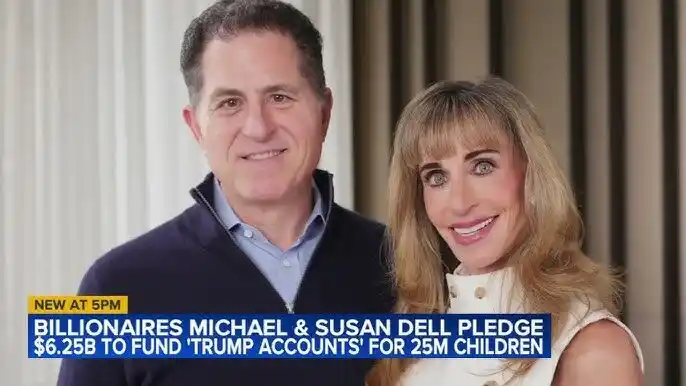
Odaily Note: Michael Dell and his wife, who donated $6.25 billion, Trump called this "one of the most generous acts in American history."
On the investment side, the "Trump Account" will be limited to investing in low-cost investment funds or exchange-traded funds (ETFs) tracking broad stock price indices such as the "S&P 500," and cannot be used to invest in specific industry indices or sector indices.
The use of funds is also restricted, and until the child reaches 18 years of age on January 1 of the same year when they become a legal adult, the funds in the account may not be withdrawn for any reason (unless the child passes away or the funds are transferred to another similar restricted account). After the child turns 18, the account will be treated similarly to a traditional individual retirement account (IRA).
According to the current plan, the "Trump Account" is tentatively scheduled to start accepting initial deposits on July 4, 2026 (the 250th anniversary of the US Declaration of Independence), which coincides with the eve of the 2026 midterm elections and is expected to become a key policy "move" for the Republican Party to attract voters.
How big is the potential scale?
According to Statista's statistics, after 2020, the annual average birth rate in the US fluctuated around 3.6 million.
Using this data as a baseline, during the planned coverage period from January 1, 2025, to January 1, 2029, the estimated number of newborns in the US is expected to reach around 14.4 million. If the federal government were to open a $1,000 "Trump Account" for each child, this would mean a massive fund of $14.4 billion;
With potential private donations and family deposits, this number will continue to grow to hundreds of billions of dollars;
If this plan can continue as a long-term initiative after 2029, the potential scale will be even more exaggerated.
Due to its long-term lock-in, passive investment, continuous additions, and other operational characteristics, the "Trump Account" will fundamentally become a long-term passive fund pool potentially worth hundreds of billions of dollars. Rather than just a child welfare attribute, this seems more like establishing a long-term funding channel between fiscal policy and the capital market, directly integrating the future generation into the stock market system.
Main Beneficiary: Robinhood?
After the "Trump Account" plan was made public, financial institutions such as JPMorgan Chase, Charles Schwab, and Robinhood began fierce competition around related services. With the US Treasury Department officially designating Robinhood as the broker and initial trustee yesterday, Robinhood, having secured its "ticket," is expected to be one of the most direct beneficiaries of the plan.
The most immediate benefit lies on the user side. Based on the current policy coverage scope, the "Trump Account" will correspond to millions of newborn accounts, and the access points to these accounts will be through a unified app—in other words, Robinhood will gain a group of potential users bound to the platform from birth, with the oldest being only 1 year old and the youngest not even born yet... More importantly, these users are not one-time traffic but potential long-term customers.
A children's account will transition to a long-term investment account similar to an IRA after the age of 18, meaning Robinhood has the opportunity to directly onboard these users into adult investment behavior, further extending to ETFs, options, and even crypto assets, among other business scenarios. From a lifecycle perspective, this is almost the longest possible user path a brokerage can acquire.
The favorable impact on the asset side is equally significant. Funds in a "Trump Account" have a clear long-term lock-in feature and are unlikely to be withdrawn before the child reaches adulthood. At the same time, the investment scope is limited to index funds. Such funds represent high-quality custodial assets for brokerages—low volatility, long retention, and predictable scale.
Furthermore, Robinhood's past core label has been a "retail trading platform," with growth highly dependent on market trends and trading activity. The "Trump Account" introduces low-frequency, long-term, and passive investment funds, which are more akin to the capital attributes of traditional wealth management business. As the proportion of such funds increases, it will also enhance Robinhood's business diversity to some extent, filling in relative gaps.
Additionally, endorsed policy decisions also carry symbolic significance. Participation in an account plan led by the Treasury Department has allowed Robinhood to enter the U.S. government's financial infrastructure system for the first time, not only enhancing its institutional-level credibility but also providing new narrative space for its future expansion into retirement accounts, long-term investments, and wealth management businesses.
From a political perspective, the "Trump Account" is a crucial policy bargaining chip for the Republican Party in the midterm elections; from a capital market perspective, this plan introduces an institutionalized long-term funding source for the U.S. stock market. Robinhood happens to stand at the intersection of both—the moment millions of newborns yet to enter society have already been "automatically onboarded," this policy design revolving around votes has quietly paved the way for Robinhood for a growth trajectory that may last for over a decade.
You may also like

The 17-Year Mystery Will Be Solved, Who is Satoshi Nakamoto?

5 Minutes to Make AI Your Second Brain

Uniswap is trapped in an innovation dilemma

What is the key to competition in crypto banking?

The flow of stablecoins and the spillover effects in the foreign exchange market

After two years, Hong Kong's first batch of stablecoin licenses finally issued: HSBC, Standard Chartered make the cut
The person who helped TAO rise by 90% has now single-handedly crashed the price again today

3-Minute Guide to Participating in the SpaceX IPO on Bitget

Top 5 Cryptos to Buy in 2026 Q1: A ChatGPT Deep Dive Analysis
Explore the top 5 cryptos to buy in Q1 2026 including BTC, ETH, SOL, TAO, and ONDO. See price outlooks, key narratives, and institutional catalysts shaping the next market move.

How to Earn $15,000 with Idle USDT Before Altcoin Season 2026
Wondering if altcoin season is coming in 2026? Get the latest market update, and learn how to turn your idle stablecoins waiting for entry into extra rewards up to 15,000 USDT.
Can You Win Joker Returns Without Large Trading Volume? 5 Mistakes New Players Make In WEEX Joker Returns Season 2
Can small traders win WEEX Joker Returns 2026 without huge volume? Yes—if you avoid these 5 costly mistakes. Learn how to maximize card draws, use Jokers wisely, and turn small deposits into 15,000 USDT rewards.

Altcoin Season 2026: 4 Stages to Profit (Before the Crowd FOMO In)
Altcoin Season 2026 is starting — discover the 4 key stages of capital rotation (from ETH to PEPE) and how to position before the peak. Learn which tokens will lead each phase and avoid missing the rally.

Will Alt season come in 2026? 5 Tips to Spot the Next 100x Crypto Opportunities
Will altcoin season arrive in 2026? Discover 5 rotation stages, early signals smart traders watch, and the key crypto sectors where the next 100x altcoin opportunities may emerge.

The bear market has arrived, and cryptocurrency ETF issuers are also getting involved

The richest man had a quarrel with his former boss

BTC Firm Above 70K! Saylor’s "Institutional Logic" vs. Moon’s "Retail Faith": Who is Really Harvesting the Market?
Bitcoin is holding firm above the $70,000 support level following a massive short squeeze that liquidated $427 million. As the "Four-Year Cycle" narrative shifts, the market is split: Michael Saylor’s cold, institutional "indiscriminate stacking" vs. Carl Moon’s high-energy retail "hopium." This article decodes these two polar-opposite strategies for the 2026 bull run and reveals how WEEX’s institutional-grade liquidity and AI trading tools empower every type of investor to convert market volatility into profit.

The Girl Who Created the SBTI Test: A Story of a Doomed Cyber Love, an E-Widow Ratfolk



 App
App