
 Buy Crypto
- Markets
 Futures
- Spot
- Copy Trade
- Earn
- More
Stop Looking for the Sword in the Same Place: The Current Bitcoin Market Is Not a Replay of the 2022 Bear Market

Original Article Title: Why Comparing Today's BTC to 2022 Is Absolutely Unprofessional
Original Article Author: Garrett, Crypto Analyst
Original Article Translation: Yuliya, PANews
Lately, some analysts have started comparing the current Bitcoin price trend to that of 2022. Although the short-term price patterns may appear somewhat similar, the comparison is entirely absurd from a long-term perspective. Whether looking at long-term price patterns, the macroeconomic backdrop, or investor composition and holding structures, the underlying logic has fundamentally shifted.
One of the biggest mistakes in analyzing and trading financial markets is focusing solely on short-term, surface-level statistical similarities while overlooking the long-term, macro, and fundamental driving factors.
A Starkly Different Macro Backdrop
In March 2022, the United States was clearly in a high inflation and rate-hike cycle primarily driven by:
· Excess liquidity unleashed during the COVID-19 pandemic.
· The outbreak of the Ukraine conflict, which significantly exacerbated inflation.
In that environment, risk-free rates kept rising, liquidity was systematically drained, and financial conditions continued to tighten. Therefore, capital's primary objective was risk aversion. What we saw in the Bitcoin market was a distribution structure at a high level typical of a tightening cycle.
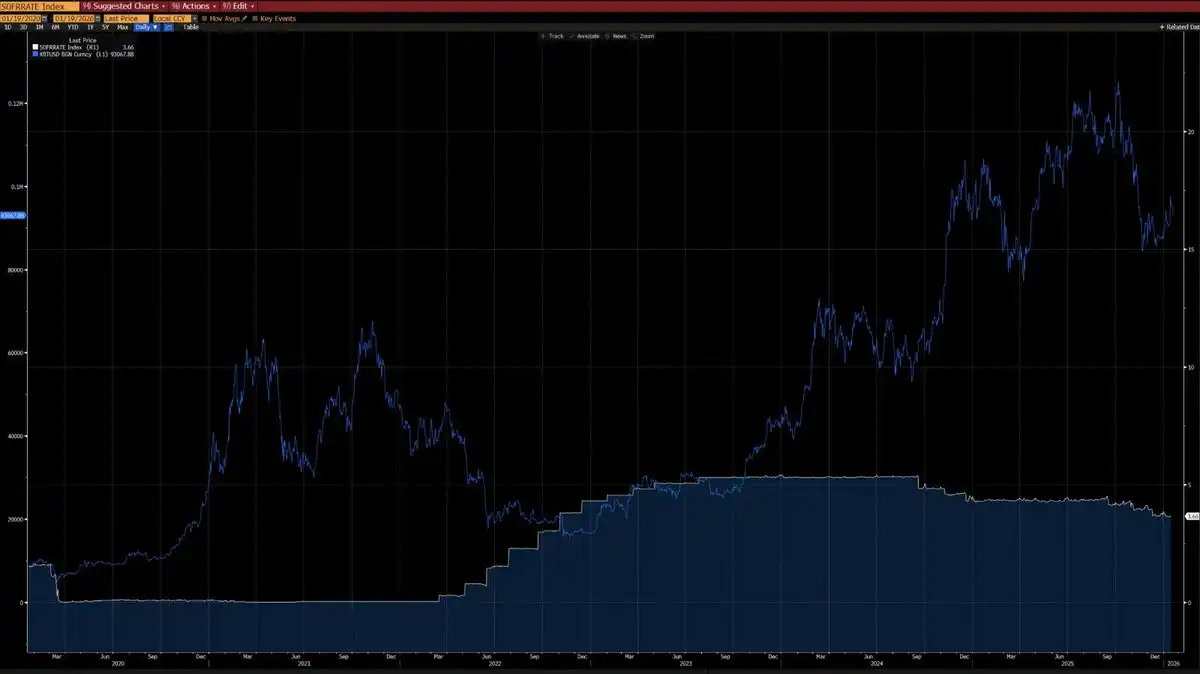
While the current macro environment is exactly the opposite:
· The Ukraine conflict is easing (partly due to U.S. efforts to lower inflation and rates).
· The Consumer Price Index (CPI) and U.S. risk-free rates are decreasing.
· More importantly, the AI technology revolution has significantly increased the likelihood of the economy entering a long-term inflation decline period. Therefore, in a larger cycle, rates have already entered a cutting phase.
· Central bank liquidity is being reinjected into the financial system.
All of this defines capital behavior as "risk preference."
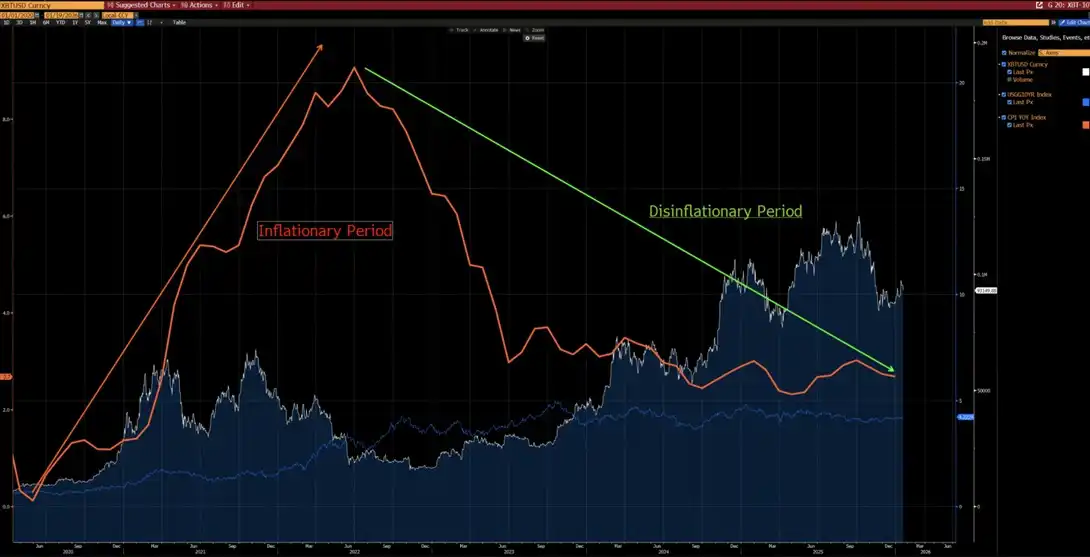
Chart analysis shows that since 2020, there has been a clear negative correlation between the Bitcoin price and CPI's year-on-year change — Bitcoin tends to fall during inflationary periods and rise during inflation declines. In the AI-driven technological revolution, a long-term inflation decline is a high-probability event, a view echoed by Elon Musk, thus reinforcing this point.
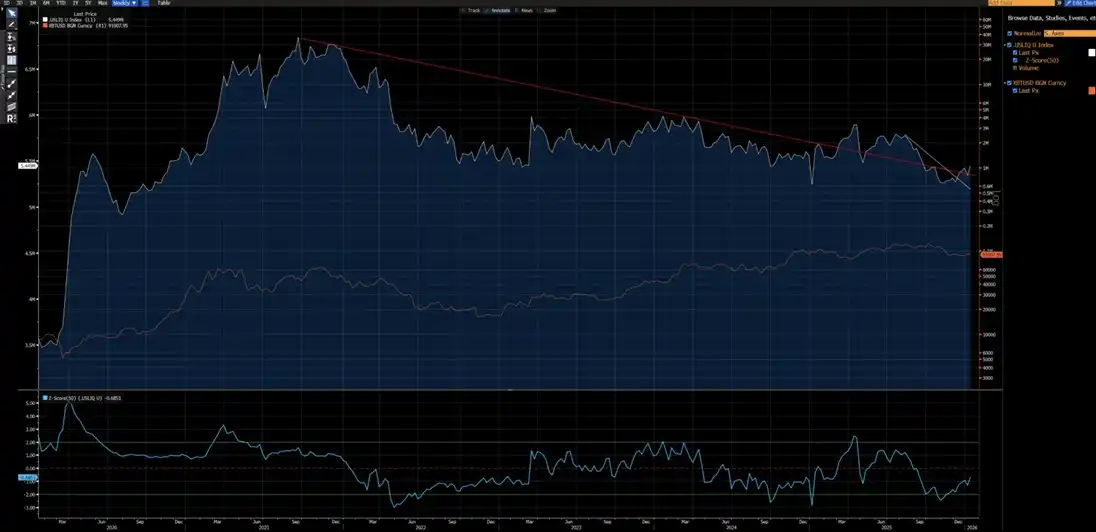
Furthermore, since 2020, Bitcoin has shown a strong correlation with the US Liquidity Index (except for a short-term distortion in 2024 due to ETF inflows). Currently, the US Liquidity Index has broken above both its short-term (white line) and long-term (red line) downtrend lines, signaling a new uptrend ahead.
Different Technical Structures
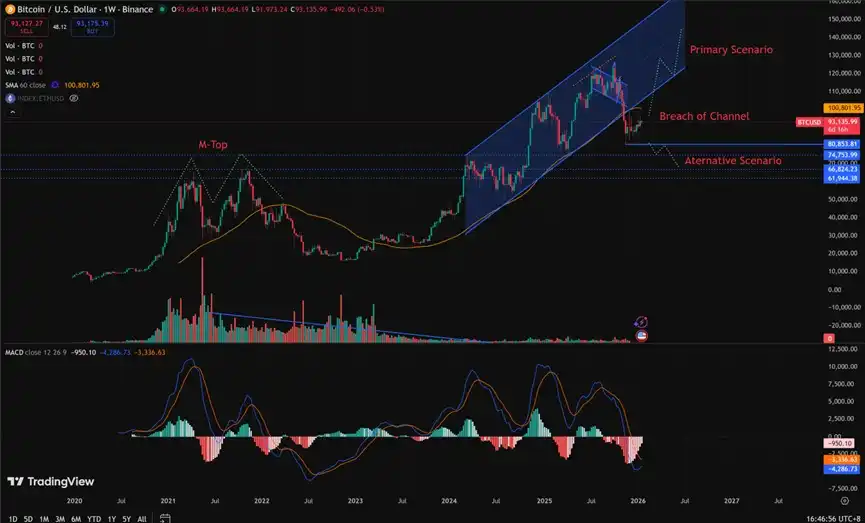
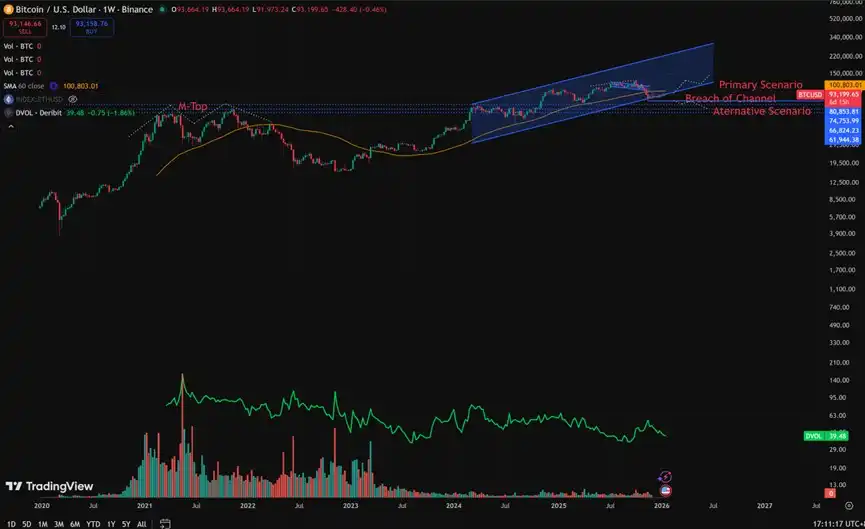
· 2021–2022: The market exhibited a weekly chart M-top structure, usually associated with a long-term market top that can suppress prices for a considerable amount of time.
· 2025: The current market is displaying a weekly chart breakdown from an ascending channel. From a probabilistic standpoint, this is more likely a "bear trap," with prices expected to rebound back into the channel.
Of course, the possibility of the market evolving into a bear market similar to 2022 cannot be entirely ruled out. However, the $80,850 to $62,000 range has seen extensive consolidation and turnover. The previous significant accumulation phase has provided a much superior risk-to-reward ratio for establishing bullish positions now: the upside potential significantly outweighs the downside risk.
What Conditions Are Needed to Replicate a 2022-style Bear Market?
To replicate a bear market of a similar magnitude to that of 2022, the following indispensable conditions must be met:
A new round of inflationary shock or a significant geopolitical crisis comparable to that of 2022.
· Central banks around the world resume interest rate hikes or quantitative tightening (QT).
· Price decisively and sustainably falls below $80,850.
· Any claims of a structural bear market arriving before these conditions are met would be premature and subjective speculation rather than objective analysis.
Different Investor Structures
· 2020–2022: This was a market dominated by retail investors, with limited institutional participation, especially lacking long-term allocators.
· 2023–Present: The introduction of a Bitcoin spot ETF brought in structurally long-term holders. These institutions have effectively locked up the supply, sharply reduced token velocity, and significantly dampened market volatility.
Whether from a macroeconomic or quantitative perspective, 2023 marks a structural inflection point for Bitcoin as an asset. Bitcoin's volatility pattern has shifted from a historical range of 80%–150% to 30%–60%, reflecting a fundamental change in its asset behavior.
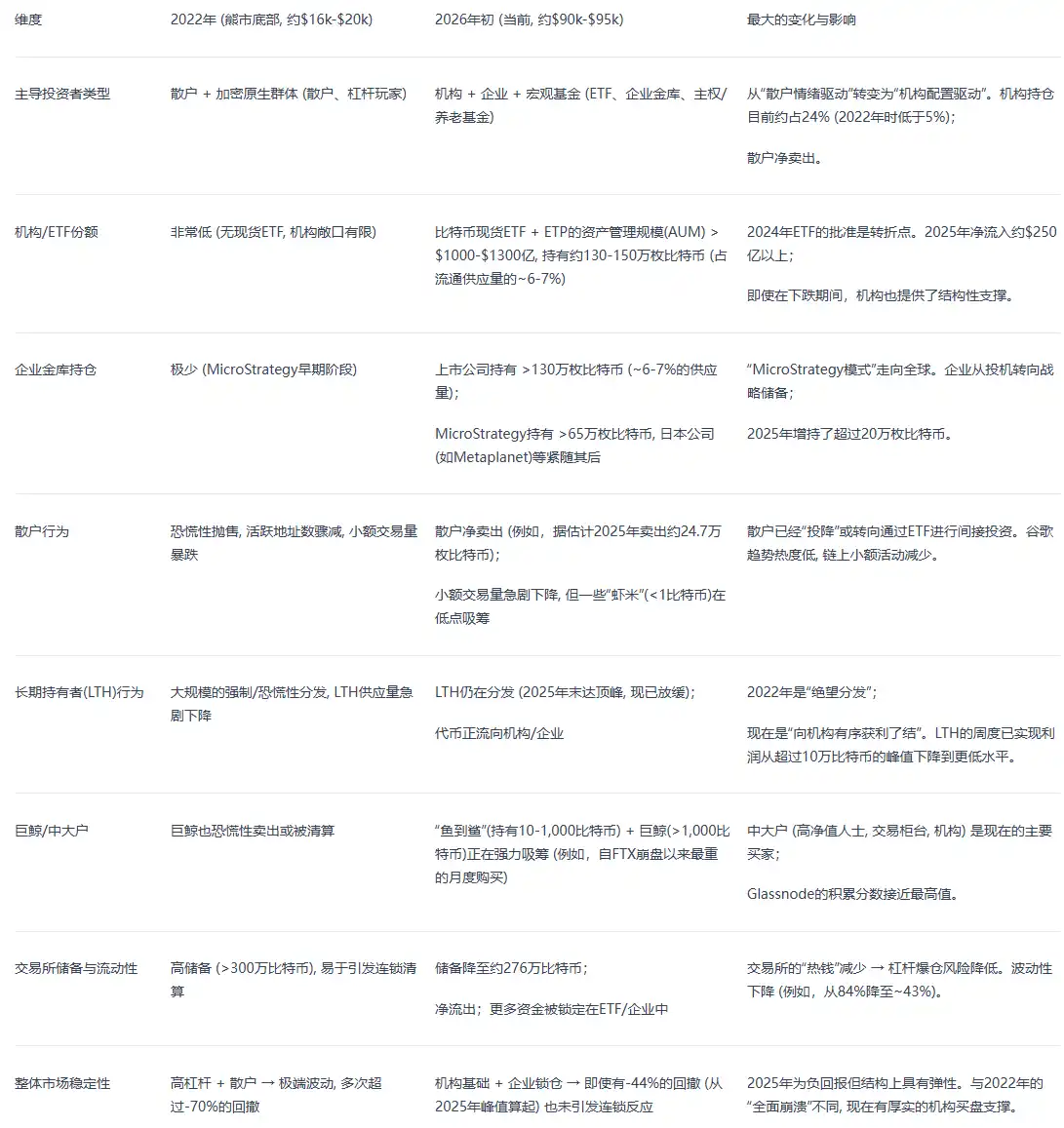
Core Structural Differences (Current vs. 2022)
The biggest difference in Bitcoin investor structure between the present (early 2026) and 2022 is that the market has transitioned from being "retail-driven, high-leverage speculation" to "institutionally driven, structurally long-term holding."
In 2022, Bitcoin witnessed a classic "crypto-native bear market," driven by retail panic selling and cascading liquidations of leveraged positions. Today, however, Bitcoin's operating environment has entered a more mature institutional era characterized by:
· Stable underlying demand.
· Locked-in supply.
· Institutional-grade volatility.
The following is a core comparison based on on-chain data (e.g., Glassnode, Chainalysis) and institutional reports (e.g., Grayscale, Bitwise, State Street) as of mid-January 2026 (when Bitcoin's price was in the $90k–$95k range).
You may also like

Tom Lee's Ethereum Thesis: Why the Man Who Called the Last Cycle Is Doubling Down on Bitmine
Tom Lee is emerging as one of Ethereum’s most influential supporters. From Fundstrat to Bitmine, his Ethereum thesis combines staking yield, treasury accumulation, and long-term network value. Here is why “Tom Lee Ethereum” has become one of crypto’s most watched narratives.

Naval personally takes the stage: The historic collision between ordinary people and venture capital

a16z Crypto: 9 Charts to Understand the Evolution Trends of Stablecoins

Refutation of Yang Haipo's "The End of Cryptocurrency"

Can a hairdryer earn $34,000? Interpreting the reflexivity paradox of prediction markets

6MV Founder: In 2026, the "landmark turning point" for crypto investment has arrived

Abraxas Capital Mints $2.89 Billion USDT: Liquidity Boost or Just More Stablecoin Arbitrage?
Abraxas Capital just received $2.89 billion in freshly minted USDT from Tether. Is this a bullish liquidity injection for crypto markets, or is it business as usual for a stablecoin arbitrage giant? We analyze the data and the likely impact on Bitcoin, altcoins, and DeFi.
A VC from the Crypto world said AI is too crazy, and they are very conservative
The Evolutionary History of Contract Algorithms: A Decade of Perpetual Contracts, the Curtain Has Yet to Fall

Kicked out by PayPal, Musk aims to make a comeback in the cryptocurrency market

Solana ETF News: What Is a Solana ETF and Why Is Goldman Sachs Betting $108 Million on SOL?
Solana ETF news today shows Goldman Sachs disclosed a $108M position while total SOL ETF inflows reached $1.45B. Analysts now expect up to $6B in institutional demand as Solana trades 71% below its all-time high.

Bitcoin ETF News Today: $2.1B Inflows Signal Strong Institutional Demand for BTC
Bitcoin ETFs news recorded $2.1B inflows over 8 consecutive days, marking one of the strongest recent accumulation streaks. Here’s what the latest Bitcoin ETF news means for BTC price and whether the $80K breakout level is next.
Michael Saylor: Winter is Over – Is He Right? 5 Key Data Points (2026)
Michael Saylor tweeted yesterday “Winter‘s Over.” It is short. It is bold. And it has the crypto world talking.
But is he right? Or is this just another CEO pumping his bags?
Let us look at the data. Let us be neutral. Let us see if the ice has really melted.

WEEX Bubbles App Now Live Visualizes the Crypto Market at a Glance
WEEX Bubbles is a standalone app designed to help users quickly understand complex crypto market movements through an intuitive bubble visualization.

Polygon co-founder Sandeep: Writing after the chain bridge chain explosion

Major Upgrade on Web: 10+ Advanced Chart Styles for Deeper Market Insights
To deliver more powerful and professional analysis tools, WEEX has rolled out a major upgrade to its web trading charts—now supporting up to 14 advanced chart styles.
Morning Report | Aethir secures a $260 million enterprise contract with Axe Compute; New Fire Technology acquires Avenir Group's trading team; Polymarket's trading volume surpassed by Kalshi

Why a Million-Follower Crypto KOL Chooses WEEX VIP?
Discover why top crypto KOL Carl Moon partnered with WEEX. Explore the WEEX VIP ecosystem, 1,000 BTC protection fund, and exclusive rewards for serious traders.
Tom Lee's Ethereum Thesis: Why the Man Who Called the Last Cycle Is Doubling Down on Bitmine
Tom Lee is emerging as one of Ethereum’s most influential supporters. From Fundstrat to Bitmine, his Ethereum thesis combines staking yield, treasury accumulation, and long-term network value. Here is why “Tom Lee Ethereum” has become one of crypto’s most watched narratives.


 App
App