
 Buy Crypto
- Markets
 Futures
- Spot
- Copy Trade
- Earn
- More
Successive Core Team "Heroes" Depart, Has Aave's DAO Dream Crumbled?

Original Title: "Key Contributors Successively Leaving, Has Aave's DAO Dream Been Shattered?"
Original Author: Bootly, BitpushNews
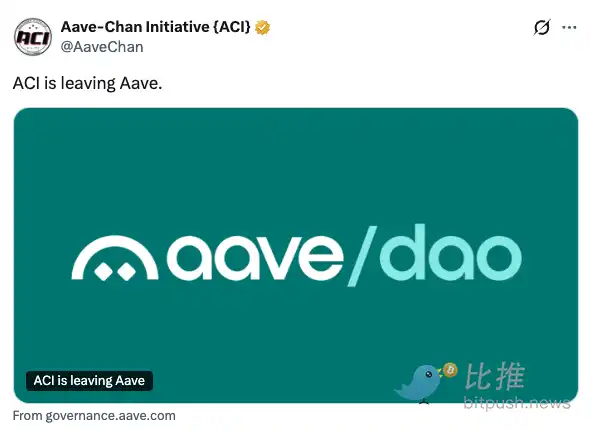
On March 3, the Aave protocol's core governance team Aave Chan Initiative (ACI) announced it would shut down operations and leave AAVE.
This is the second major contributor to leave within two weeks—previously on February 20, the development team behind the Aave V3 codebase, BGD Labs, announced their exit.
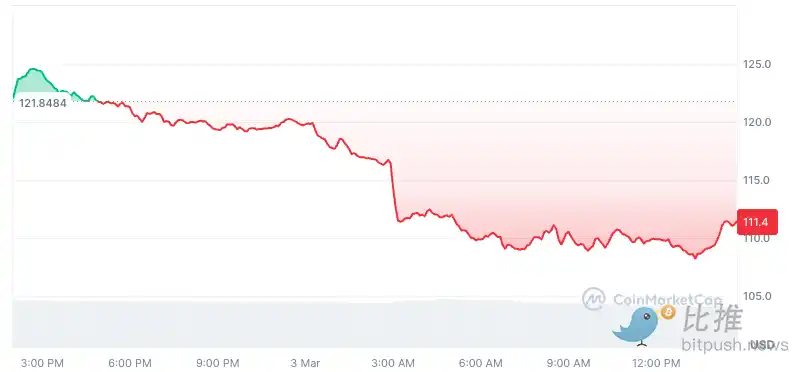
Following the announcement, the AAVE token price dropped over 11%.
As the most successful DAO (decentralized autonomous organization) in DeFi history, the flagship of DeFi with nearly $27 billion in TVL, is going through a profound internal turmoil.
From Revenue Attribution Dispute to Bundled Voting
The seeds of this crisis were sown as early as December last year.
At that time, Aave Labs, without governance discussion, switched the front-end interface's transaction aggregator from ParaSwap to CoW Swap. Fees that were supposed to go to the DAO treasury now flowed into Aave Labs' account.
Faced with criticism, Aave founder Stani Kulechov's response was: the front-end interface was built by Labs, so the revenue naturally belongs to Labs; only the smart contracts and liquidity pools belong to the DAO. This explanation may hold legally, but it sparked discontent within the community.
To quell the dispute, Aave Labs proposed a proposal called "Aave Will Win" in February this year. The proposal mainly includes: requesting DAO approval for around $51 million to be used for V4 development, in exchange for transferring all future revenue from Aave branded products to the DAO, and establishing Aave V4 as the sole technical foundation, gradually phasing out V3.
The issue is that these three matters were bundled together. Support revenue going to the DAO but think the fund size is too large? No choice. Believe V3 still holds value and should not be sidelined? Equally no choice. It's either all or nothing.
ACI's Grievance: Opaque Voting
In ACI's exit statement, the most crucial allegation is that a significant portion of the support for the proposal came from addresses associated with Aave Labs. The interim check vote only passed with a slim 52.58% majority, and ACI believes the outcome might have been different without these "self-votes."
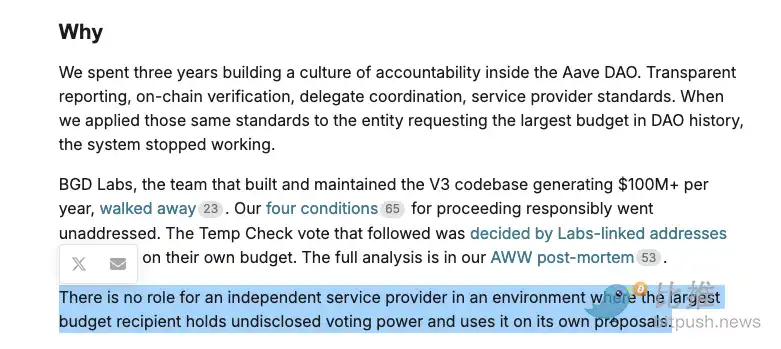
ACI founder Marc Zeller wrote, "If a major budget recipient can abuse their undisclosed voting power to push through their proposal forcefully, then independent service providers lose their purpose in the DAO."
ACI did not fail to attempt to address the issue. Before the vote, it laid out four conditions, including stricter on-chain milestone tracking, limiting self-voting by budget recipients, etc., but none were adopted.
This conflict reflects structural issues in DAO governance.
Aave Labs holds the codebase, brand domain, social media, and development narrative power. BGD Labs maintains the flagship V3 version—it contributed over 75% of the protocol's revenue and 97% of the total deposits. ACI is responsible for governing coordination and business development, claiming to have driven 61% of governance actions in the past three years, helping increase Aave's DeFi market share from less than 50% to over 65%.
These three teams were supposed to balance each other out. However, with BGD and ACI exiting successively, the remaining power center, no matter how it postures, is hard to trust completely.
In response to ACI's exit announcement, Stani Kulechov stated, "Thank Marc for his contributions over the years; the protocol will continue to operate as normal."
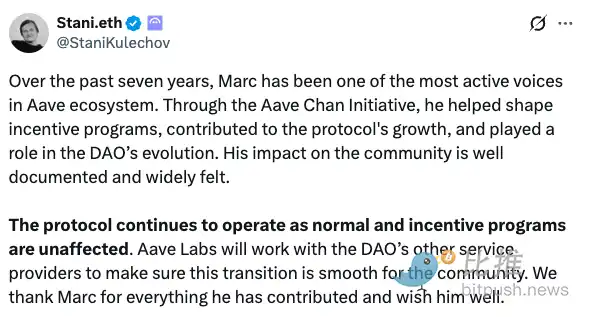
But this response did not address the core issue: when the person most capable of assessing V3's technical risks has exited, how can the DAO confidently bet its future on untested V4?
Another noteworthy detail is that institutional investor Blockchain Capital later revealed that, due to the custody platform not supporting snapshot voting, their held AAVE could not participate. This reveals another reality of DAO governance: while ostensibly decided collectively by token holders, voting power often tends to concentrate in the hands of a few.
DAO Governance Dilemma
ACI indicates that during the next four months of the transition period, governance dashboards, incentive frameworks, committee roles, and other tools and responsibilities will be transferred or open-sourced. However, some things are difficult to transfer: three years of accumulated governance experience, familiarity with protocol details, and the interpersonal network for coordinating different stakeholders.
Data shows that over the past three years, ACI has spent $4.6 million DAO on helping GHO stablecoin grow from $35 million to $527 million. Who will take over this work in the future remains unknown.
The recent turmoil at Aave is essentially a microcosm of the DAO governance dilemma.
In theory, a DAO is a community of token holders. However, in practice, governance is often dominated by the founding team, early investors, and core developers. These roles are both rule-makers and enforcers, and sometimes recipients of the budget. When conflicts of interest arise, whether "procedural justice" is sufficient becomes a contentious issue.
A DeFi practitioner commented, "This is not a matter of right or wrong, but when interests and positions are at odds, the existing governance mechanisms do not provide an effective way to resolve them."
What's next?
The revision of the "Aave Will Win" proposal during the ARFC phase will be the first window to observe the situation's direction. If Kulechov's promised "structural improvements" can be implemented, such as splitting the bundled proposal, clarifying voting behavior boundaries, it may bring this turmoil to a close.
If a consensus cannot be reached, the most extreme possibility is that BGD and ACI will start afresh and fork out a new protocol. Despite the high liquidity barrier, it is not impossible—core developers and governance teams simultaneously exiting provide the technical foundation and community basis for the fork.
For Aave, the immediate issue is how to fill the void left by the departure of two core teams. The longer-term issue is how to find a more sustainable balance between the founder's vision, core developers' interests, and community will. If the paradox of "centralization of power" cannot be resolved, even the strongest protocol may lose its first-mover advantage in endless infighting.
You may also like

ChainCatcher Hong Kong Themed Forum Highlights: Decoding the Growth Engine Under the Integration of Crypto Assets and Smart Economy

Why can this institution still grow by 150% when the scale of leading crypto VCs has shrunk significantly?

Anthropic's $1 trillion, compared to DeepSeek's $100 billion

Geopolitical Risk Persists, Is Bitcoin Becoming a Key Barometer?

Annualized 11.5%, Wall Street Buzzing: Is MicroStrategy's STRC Bitcoin's Savior or Destroyer?

An Obscure Open Source AI Tool Alerted on Kelp DAO's $292 million Bug 12 Days Ago

Mixin has launched USTD-margined perpetual contracts, bringing derivative trading into the chat scene.
The privacy-focused crypto wallet Mixin announced today the launch of its U-based perpetual contract (a derivative priced in USDT). Unlike traditional exchanges, Mixin has taken a new approach by "liberating" derivative trading from isolated matching engines and embedding it into the instant messaging environment.
Users can directly open positions within the app with leverage of up to 200x, while sharing positions, discussing strategies, and copy trading within private communities. Trading, social interaction, and asset management are integrated into the same interface.
Based on its non-custodial architecture, Mixin has eliminated friction from the traditional onboarding process, allowing users to participate in perpetual contract trading without identity verification.
The trading process has been streamlined into five steps:
· Choose the trading asset
· Select long or short
· Input position size and leverage
· Confirm order details
· Confirm and open the position
The interface provides real-time visualization of price, position, and profit and loss (PnL), allowing users to complete trades without switching between multiple modules.
Mixin has directly integrated social features into the derivative trading environment. Users can create private trading communities and interact around real-time positions:
· End-to-end encrypted private groups supporting up to 1024 members
· End-to-end encrypted voice communication
· One-click position sharing
· One-click trade copying
On the execution side, Mixin aggregates liquidity from multiple sources and accesses decentralized protocol and external market liquidity through a unified trading interface.
By combining social interaction with trade execution, Mixin enables users to collaborate, share, and execute trading strategies instantly within the same environment.
Mixin has also introduced a referral incentive system based on trading behavior:
· Users can join with an invite code
· Up to 60% of trading fees as referral rewards
· Incentive mechanism designed for long-term, sustainable earnings
This model aims to drive user-driven network expansion and organic growth.
Mixin's derivative transactions are built on top of its existing self-custody wallet infrastructure, with core features including:
· Separation of transaction account and asset storage
· User full control over assets
· Platform does not custody user funds
· Built-in privacy mechanisms to reduce data exposure
The system aims to strike a balance between transaction efficiency, asset security, and privacy protection.
Against the background of perpetual contracts becoming a mainstream trading tool, Mixin is exploring a different development direction by lowering barriers, enhancing social and privacy attributes.
The platform does not only view transactions as execution actions but positions them as a networked activity: transactions have social attributes, strategies can be shared, and relationships between individuals also become part of the financial system.
Mixin's design is based on a user-initiated, user-controlled model. The platform neither custodies assets nor executes transactions on behalf of users.
This model aligns with a statement issued by the U.S. Securities and Exchange Commission (SEC) on April 13, 2026, titled "Staff Statement on Whether Partial User Interface Used in Preparing Cryptocurrency Securities Transactions May Require Broker-Dealer Registration."
The statement indicates that, under the premise where transactions are entirely initiated and controlled by users, non-custodial service providers that offer neutral interfaces may not need to register as broker-dealers or exchanges.
Mixin is a decentralized, self-custodial privacy wallet designed to provide secure and efficient digital asset management services.
Its core capabilities include:
· Aggregation: integrating multi-chain assets and routing between different transaction paths to simplify user operations
· High liquidity access: connecting to various liquidity sources, including decentralized protocols and external markets
· Decentralization: achieving full user control over assets without relying on custodial intermediaries
· Privacy protection: safeguarding assets and data through MPC, CryptoNote, and end-to-end encrypted communication
Mixin has been in operation for over 8 years, supporting over 40 blockchains and more than 10,000 assets, with a global user base exceeding 10 million and an on-chain self-custodied asset scale of over $1 billion.

$600 million stolen in 20 days, ushering in the era of AI hackers in the crypto world
Vitalik's 2026 Hong Kong Web3 Summit Speech: Ethereum's Ultimate Vision as the "World Computer" and Future Roadmap
On the same day Aave introduced rsETH, why did Spark decide to exit?
Full Post-Mortem of the KelpDAO Incident: Why Did Aave, Which Was Not Compromised, End Up in Crisis Situation?

After a $290 million DeFi liquidation, is the security promise still there?
ZachXBT's post ignites RAVE nearing zero, what is the truth behind the insider control?

Vitalik 2026 Hong Kong Web3 Carnival Speech Transcript: We do not compete on speed; security and decentralization are the core
In-depth Analysis of RAVE Events: Short Squeeze, Crash, and Quantitative Financial Models of Liquidity Manipulation

Eve of Ceasefire, US Military Fires on Iranian Vessel | Rewire News Morning Brief

Figma's stock price drops over 7%, will Claude Design be the terminator?




 App
App