

Telegram 2025 Financial Report Puzzle: Revenue Soars by 65%, Yet Plagued by $200 Million Loss Due to TON?


Original Article Title: "Telegram's 'Crypto Accounting': Surging Revenue Behind Net Loss and $450 Million Token Sale Controversy"
Original Article Author: Zen, PANews
Telegram recently found itself back in the spotlight due to a set of financial information released to investors: the revenue trend is upwards, but the net profit is heading downwards. The key variable here is not a slowdown in user growth, but rather the downward trend of TON's price, which has "penetrated" asset-side volatility into the profit and loss statement.
Moreover, the sale of over $450 million worth of TON tokens has prompted observers to re-examine its relationship with the TON ecosystem and its boundaries.
Telegram's Revenue Surges While Net Loss Persists Due to TON Price Decline
According to FT's report, in the first half of 2025, Telegram saw a significant leap in revenue. Unaudited financial reports indicate that the company's revenue in the first half reached $8.7 billion, a 65% year-on-year increase, well above the $5.25 billion in the first half of 2024; achieving nearly $4 billion in operating profit.
Looking at the revenue breakdown, Telegram's advertising revenue grew by 5% to reach $1.25 billion; premium subscription revenue surged by 88% to reach $2.23 billion, nearly double the same period last year. However, compared to these two, the key factor behind Telegram's revenue growth mainly came from an exclusive agreement signed with the TON blockchain—a deal that made TON the exclusive blockchain infrastructure of the Telegram Mini Program ecosystem, bringing in close to $3 billion in related revenue for Telegram.
Therefore, overall, Telegram continued the strong growth trend sparked by the mini-game craze of 2024 in the first half of last year—in 2024, Telegram achieved its first-ever annual profit, with a profit of $540 million, and total revenue reached $14 billion, far exceeding the $3.43 billion in 2023.
Out of the $14 billion in revenue in 2024, about half came from its so-called "partnerships and ecosystem," roughly $2.5 billion from advertising, and $2.92 billion from its premium subscription service. Evidently, part of Telegram's growth is attributed to a significant increase in paying users, further boosted by the revenue from its cryptocurrency-related collaborations.
However, the high volatility of cryptocurrency has also brought risks to Telegram. Despite achieving nearly $400 million in operating profit in the first half of 2025, Telegram still recorded a net loss of $222 million. Insiders say this is because the company had to revalue its holdings of Ton tokens. Due to the continued slump of altcoins in 2025, the Ton token price kept falling throughout the year, dropping by over 73% at its lowest point.
Shipping Out $450 Million: Cash Out or Uphold Decentralization?
Having witnessed the prolonged price decline of altcoins and the widespread unrealized losses of many DAT-listed companies, retail investors were not particularly surprised by Telegram's loss due to the depreciation of virtual assets. What caught the community off guard and caused displeasure was a Financial Times report stating that Telegram had engaged in significant sell-offs, with its TON token sales exceeding $450 million. This amount surpassed 10% of the token's current circulating market cap.
As a result, the TON price kept dropping. Coupled with Telegram's massive token sell-off, some TON community members and investors began questioning and debating over its "coin selling for cash-out" practices and whether it amounted to a betrayal of Ton investors.
According to a public statement from Manuel Stotz, Chairman of the TON Treasury Company TONStrategy (NASDAQ: TONX), all TON tokens sold by Telegram are subject to a four-year staggered unlock schedule. In other words, these tokens cannot be circulated on the secondary market in the short term, thus avoiding immediate selling pressure.
Furthermore, Stotz stated that the primary buyers engaged by Telegram are long-term investment entities, including the Stotz-led TONX company. They acquired these tokens for long-term holding and staking purposes. TONX, led by Stotz and a dedicated TON ecosystem investment entity listed in the U.S., will use the purchased Telegram chips mainly for long-term strategic purposes rather than speculative trading.
Stotz also emphasized that Telegram's net holdings of Ton tokens did not significantly decrease after the transactions and might have even increased. This is because Telegram exchanged part of its existing holdings for locked-up token distributions and continues to receive new TON income through business activities like ad revenue sharing, thereby maintaining a high position overall.
Telegram's long-standing business model of acquiring TON tokens had previously raised concerns among some community members that the company held an excessively high token percentage, which could hinder TON's decentralization. Telegram's founder Pavel Durov took this concern seriously and had announced back in 2024 that the team would limit Telegram's share of TON to no more than 10%. Any excess holdings beyond this threshold would be sold to long-term investors to broaden token distribution and raise development funds for Telegram.
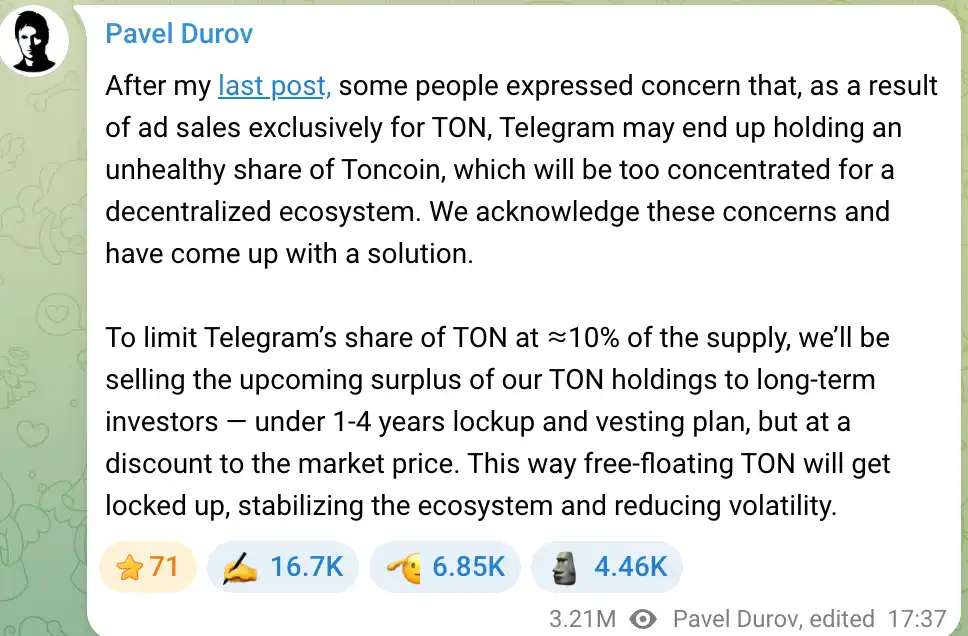
Durov emphasized that these sales would be conducted at a slight discount to market price, with lock-up and vesting periods to prevent short-term selling pressure, safeguarding the stability of the TON ecosystem. This plan aims to prevent TON from being concentrated in Telegram's hands, triggering concerns about price manipulation, and maintain the project's decentralized purpose. Therefore, Telegram's coin sales are more like part of an asset restructuring and liquidity management, rather than a simple opportunistic sell-off at a high price.
It is worth noting that while the continuous decline in TON's price in 2025 has brought depreciation pressure to Telegram's financial statements, the long-term close relationship between Telegram and TON has also created a symbiotic situation.
Through deep involvement in the TON ecosystem, Telegram has gained a new source of revenue and product highlights, but also faces the financial impact of crypto market fluctuations. This "double-edged sword" effect is also a factor that investors must consider when evaluating Telegram's value as Telegram considers an IPO.
Telegram's IPO Prospects
With improved financial performance and business diversification, Telegram's IPO prospects have become a market focus. Since 2021, the company has raised over $1 billion through multiple rounds of bond issuance and issued another $1.7 billion in convertible bonds in 2025, attracting international institutions such as BlackRock and Abu Dhabi Mubadala.
These fundraising measures have not only provided Telegram with capital but are also seen as preparation for an IPO. However, Telegram's path to listing is not easy, as its debt arrangements, regulatory environment, and founder factors will all influence the IPO process.
Telegram currently has two main outstanding bonds: one is a 7% coupon bond due in March 2026, and the other is a 9% coupon convertible bond due in 2030. In the $1.7 billion bond offering, around $955 million was used to replace old bonds, and $745 million was new capital for the company.
The special feature of the convertible bond is the IPO conversion clause: if the company goes public before 2030, investors can redeem/convert at about 80% of the IPO price, equivalent to a 20% discount. In other words, these investors are betting that Telegram will successfully IPO and achieve a significant valuation premium.
Currently, Telegram has prematurely redeemed or repaid most of the bonds due in 2026 through the 2025 debt restructuring. Durov publicly stated that the old debts from 2021 have been mostly repaid and do not pose a current risk. In response to Telegram's $500 million Russian bond freeze, he stated that Telegram does not rely on Russian capital and that there are no Russian investors in the recent $1.7 billion bond issuance.
Therefore, Telegram's main debt due now is the 2030 convertible bond, leaving a relatively generous window for going public. However, many investors still expect Telegram to seek a public listing around 2026-2027, achieve debt-to-equity conversion, and open up new financing channels. Missing this window could mean the company will face long-term debt interest pressure in the future and may lose the opportunity to transition to equity financing.
When investors assess Telegram's IPO value, they also focus on its profit outlook and fee structure. Telegram currently has approximately 1 billion monthly active users and an estimated 450 million daily active users, with its large user base providing room for commercialization. Despite rapid business growth in the past two years, Telegram still needs to prove that its business model can sustain profitability.
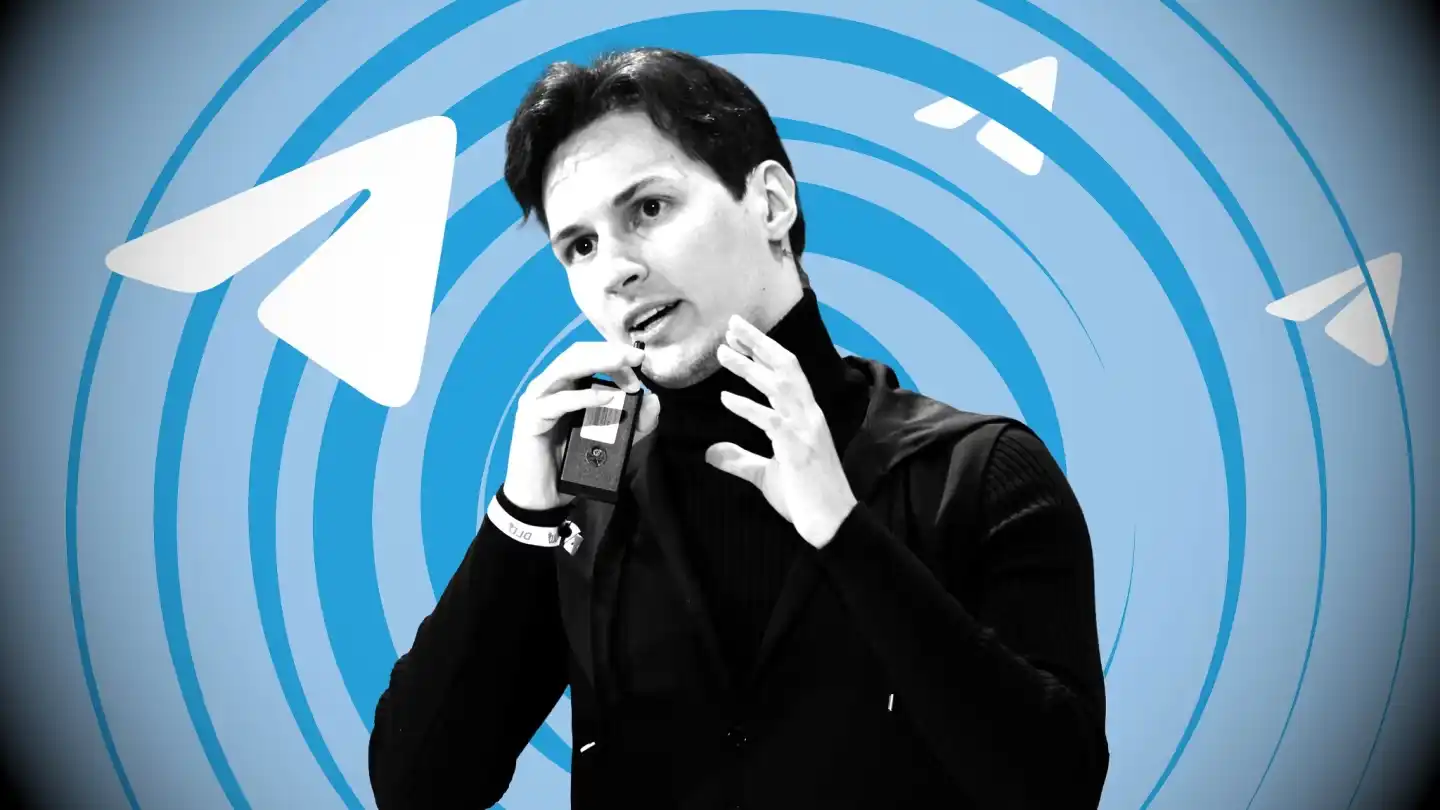
The good news is that Telegram currently has full control over its ecosystem, with Durov recently emphasizing that he remains the company's sole shareholder, and creditors are not involved in corporate governance.
Therefore, Telegram may be able to, without being constrained by short-term shareholder demands, sacrifice some short-term profits to gain long-term user stickiness and ecosystem prosperity. This "delayed gratification" strategy aligns with Durov's consistent product philosophy and will be a core part of telling the growth story in the IPO journey to investors.
However, it is important to emphasize that an IPO is not only determined by financial and debt structures. The Financial Times points out that Telegram's potential IPO plans are currently affected by the legal proceedings against Durov in France, and the related uncertainties make the IPO timeline unclear. Telegram has also acknowledged in its communications with investors that this investigation could pose a hurdle.
You may also like

BVNK Founder: Three Stages of Stablecoin Development

The truth about Trump's son's Bitcoin game: he made a staggering $100 million while retail investors lost $500 million

What Is Futures Trading? Hours, Platforms, and How to Start Trade Futures(2026 Guide)
Learn how to start futures trading, understand trading hours, and choose the best futures trading platform. Includes real data, strategies, and ways to maximize returns with rebates.

The Rise of Composable RWA

MAGA Up 350% in 24 Hours, PEPE Up 46% in One Day: Which Memecoins Are Next in 2026?
MAGA +350% in 24hrs. PEPE +46% in one day. RAVE +4,500% then -90%. In 2026's memecoin market, the gains are real. So are the traps? Here's how to tell the difference before you buy.

RCD Espanyol vs Real Madrid: Can the Pericos Delay the Inevitable?
RCD Espanyol vs Real Madrid lineups, standings, and stats for May 3, 2026. Real Madrid visits RCDE Stadium as Barcelona closes in on the LALIGA title. Full preview inside.
MegaETH goes live with an FDV exceeding 2 billion USD. Which ecological projects are worth paying attention to?

Dialogue with "Wood Sister" Cathie Wood: The next bull market is about to arrive

Can prediction markets win the competition for perpetual contracts?

Who is trading on Trade.xyz?

Binance quietly placed a bet on a leading large model company

Best Crypto Discord Server 2026: Why Jacob’s Crypto Clan Is Gaining Massive Attention
Jacob’s Crypto Clan has grown into one of the most active crypto Discord communities, with over 45K members and continuing to expand. This rapid growth reflects strong demand for structured trading insights and real-time collaboration.

Tom Lee Buying ETH: Why Wall Street’s Loudest Ethereum Bull Keeps Doubling Down
Tom Lee keeps buying ETH through every dip, every drawdown, and every moment of market doubt. Inside the strategy that's turning Ethereum into a treasury asset — and what it signals for the rest of the market.

Stripe Sessions 2026: AI Agent, Global Payments, and Invisible Crypto Infrastructure

Where will South Korea's cryptocurrency taxation head?

Legendary investor Naval: Apple is dead, SaaS will follow suit, and entrepreneurs have 18 months to reshape their moats

Morning Report | Visa includes Polygon in its global stablecoin settlement program; MoonPay invests $100 million to acquire security company Sodot; Digital wallet platform Belo completes $14 million Series A financing

Full text of the Federal Reserve's decision: Holding steady for the third consecutive time but increasing divisions
BVNK Founder: Three Stages of Stablecoin Development
The truth about Trump's son's Bitcoin game: he made a staggering $100 million while retail investors lost $500 million
What Is Futures Trading? Hours, Platforms, and How to Start Trade Futures(2026 Guide)
Learn how to start futures trading, understand trading hours, and choose the best futures trading platform. Includes real data, strategies, and ways to maximize returns with rebates.
The Rise of Composable RWA
MAGA Up 350% in 24 Hours, PEPE Up 46% in One Day: Which Memecoins Are Next in 2026?
MAGA +350% in 24hrs. PEPE +46% in one day. RAVE +4,500% then -90%. In 2026's memecoin market, the gains are real. So are the traps? Here's how to tell the difference before you buy.
RCD Espanyol vs Real Madrid: Can the Pericos Delay the Inevitable?
RCD Espanyol vs Real Madrid lineups, standings, and stats for May 3, 2026. Real Madrid visits RCDE Stadium as Barcelona closes in on the LALIGA title. Full preview inside.


