How a Harmless "AI Trading Tool" Became a $Million Crypto Bubble: The Clawdbot Fiasco Explained


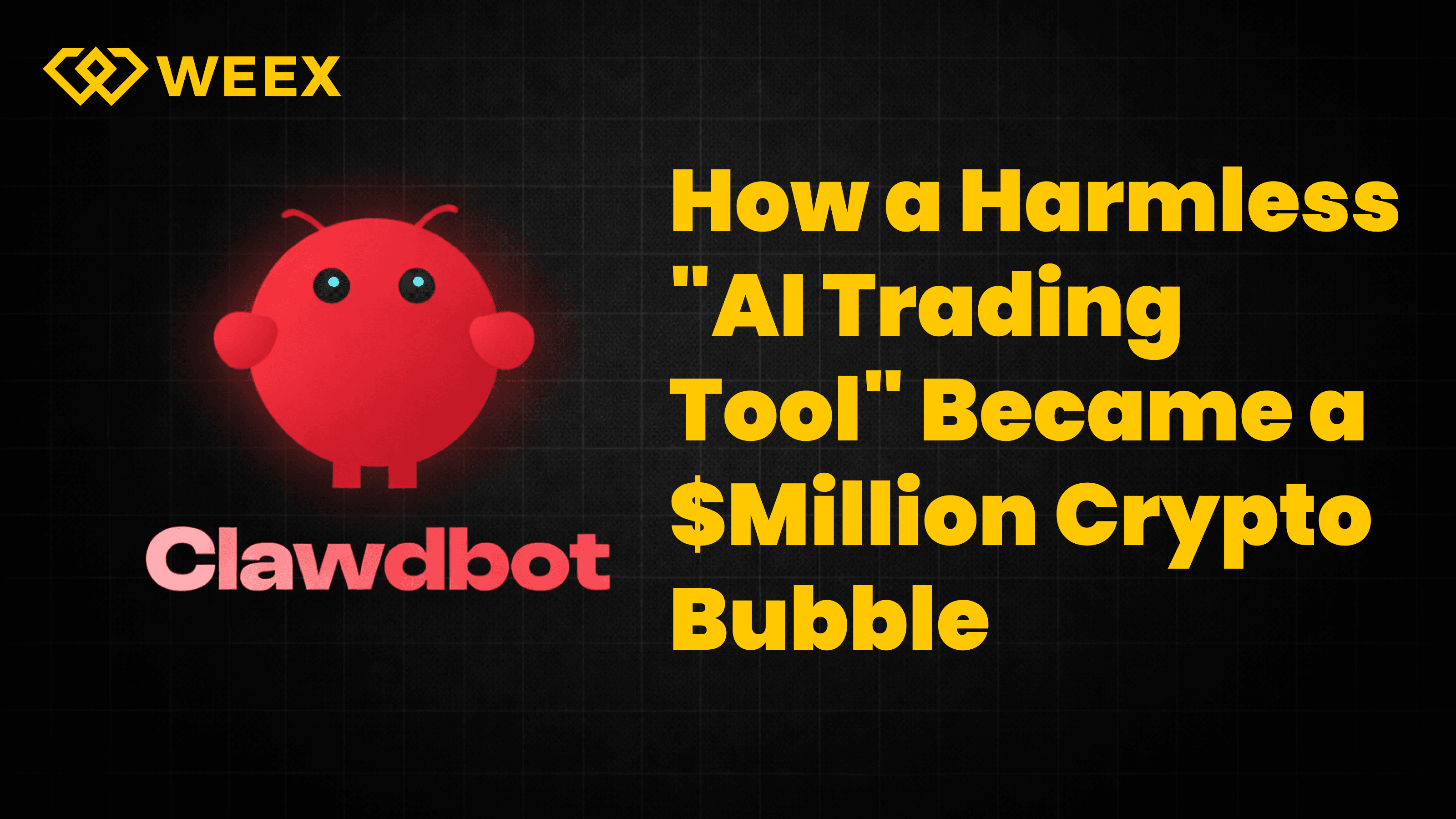
In the fast-moving world of crypto and AI, not everything that goes viral reflects reality. Clawdbot, an open-source developer tool built to automate tasks with no financial ambitions or connection to cryptocurrency, was quickly framed as a potential AI crypto trading bot. Within days, it became the center of a speculative frenzy, its name hijacked by traders chasing hype rather than utility.
This article examines how Clawdbot spiraled into a multi-million-dollar altcoin mirage, illustrating how attention can be mistaken for legitimacy, association for value, and even experienced traders can fall prey to FOMO. The project’s journey from neutral tool to viral sensation highlights how crypto narratives emerge, spread, and distort market perception.
How a Developer Tool Went Viral — And Why Crypto Traders Got It Wrong
What followed was a familiar pattern in crypto markets. As Clawdbot’s visibility surged, attention itself began to function as a signal — discussion turned into narrative, and narrative into perceived opportunity.
Traders interpreted virality as potential upside. Emotion replaced analysis. This is the key difference between narrative and fundamentals: fundamentals rely on real utility, while narrative can temporarily create value from belief alone.
In Clawdbot’s case, social media momentum created the illusion that owning something associated with the project could be profitable — even though no official asset existed.
The $CLAWD Token That Never Existed: How Hype Created a Million-Dollar Mirage
Once the narrative took hold, the shift from attention to speculation was immediate.
As the Clawdbot name spread, a token using the same branding appeared on-chain. There was no official announcement and no claimed endorsement — only timing. In the fast-moving world of altcoin trading, proximity to a trending name often substitutes for legitimacy.
Confusion amplified the effect. During Clawdbot’s rebrand to Moltbot, accounts tied to the original name were quickly impersonated, and a meme token commonly referred to as $CLAWD began circulating.
The token offered no utility or governance. It relied purely on implication — the name, the moment, and the hype. Traders were not buying function, but association.
Within a short window, $CLAWD surged to a multi-million-dollar valuation, driven entirely by momentum rather than fundamentals — a financialized placeholder designed to absorb narrative heat before clarity arrived.
48 Hours of Madness: Trading Volume Soared 2000% Despite Zero Utility
The contrast between market behavior and underlying reality was stark.
While $CLAWD experienced sharp price swings and rapidly rising valuations, Clawdbot itself remained unchanged. There was no official whitepaper, no token model, no roadmap, and no economic design of any kind. The project’s creator repeatedly and publicly stated that no token launch was planned, explicitly disavowing any associated cryptocurrencies.
Despite this absence of fundamentals, trading activity intensified. Volume increased, prices moved quickly, and valuation was inferred not from utility or adoption, but from hype and name recognition alone. Price discovery unfolded without value discovery.
This disconnect reflects a recurring feature of speculative markets: a bubble in cryptocurrency can form independently of substance — as long as belief persists.
When FOMO Turns Into Emotional Spillover
When belief finally broke, optimism quickly gave way to frustration.
Despite repeated and public statements from the Clawdbot creator denying any involvement with $CLAWD or plans to launch a token, some traders redirected their losses toward the project itself. Anger and disappointment spilled beyond the market and onto the developer, who was accused of “abandoning” or “killing” the narrative.
This reaction reflects a well-documented psychological pattern in speculative environments: misplaced attribution, where losses driven by hype are externalized rather than reexamined. Instead of questioning assumptions, participants search for a responsible party outside the market.
At this stage, markets are no longer responding to information. They are responding to emotion. FOMO mutates into regret, defensiveness, and escalation, as rational evaluation gives way to blame and retroactive justification.
The Real Lesson: How Crypto's Narrative Addiction Distorts Reality
The Clawdbot episode reveals a fundamental truth of crypto markets: narratives often move faster than facts. Traders respond to hype and virality, not utility, turning stories into perceived opportunities.
Even when creators clearly disclaim any financial product, attention alone can create real-world consequences. FOMO and belief can drive prices, volumes, and emotional spillovers far beyond any substance.
For WEEX users, the takeaway is simple: stay grounded. In a market driven by speed and sentiment, long-term advantage belongs to those who can separate signal from noise, narrative from execution, and hype from real, verifiable performance.
About WEEX
Founded in 2018, WEEX has developed into a global crypto exchange with over 6.2 million users across more than 150 countries. The platform emphasizes security, liquidity, and usability, providing over 1,200 spot trading pairs and offering up to 400x leverage in crypto futures trading. In addition to traditional spot and derivatives markets, WEEX is expanding rapidly in the AI era — delivering real-time AI news, empowering users with AI trading tools, and exploring innovative trade-to-earn models that make intelligent trading more accessible to everyone. Its 1,000 BTC Protection Fund further strengthens asset safety and transparency, while features such as copy trading and advanced trading tools allow users to follow professional traders and experience a more efficient, intelligent trading journey.
You may also like

AI Crypto Trading in 2026: How AI Agents Use Stablecoins for Capital Management and Settlement
Learn how AI agents use stablecoins for crypto trading in 2026 — managing capital, settling transactions, and operating across exchanges and DeFi protocols.
AI Trading's Ultimate Test: Empower Your AI Strategy with Tencent Cloud to Win $1.88M & a Bentley
AI traders! Win $1.88M & a Bentley by crushing WEEX's live-market challenge. Tencent Cloud powers your AI Trading bot - can it survive the Feb 9 finals?

How a Risk-Controlled AI Crypto Trading Bot Protects Capital in Real Markets
Ritmex demonstrates how disciplined risk control and structured signals can make an AI crypto trading bot more stable and reliable on WEEX, highlighting the importance of combining execution discipline with scalable AI trading systems.

How a Structured AI Crypto Trading Bot Won at the WEEX Hackathon
Crypto_Trade shows how structured inputs and controlled adaptability can build a more stable and reliable AI crypto trading bot within the WEEX AI Trading Hackathon, highlighting a practical path toward scalable AI trading systems.

How a Fully Automated AI Trading Bot Won at WEEX Hackathon (From 0 to AI Agent)
Nick’s journey on WEEX shows that successful AI Trading isn’t just about strategy ideas—but about structured AI agents, disciplined execution, and continuous adaptation in real market conditions.
Best AI Crypto Trading Bot? Inside the AI Trading System That Ranked Top 3 on WEEX
Discover the best AI crypto trading bot on WEEX. Learn how AI trading works, how to trade automatically, and why this system stands out among top AI trading apps.

OpenClaw and AI Bots: From AI Trading to BTC Liquidations in the Crypto Gold Rush
AI crypto trading bots like OpenClaw and AI trading apps are reshaping digital markets. From BTC liquidations to crypto bubble charts, automated trading is expanding alongside free crypto airdrops, affiliate programs, LALIGA partnerships, and tokenized gold markets.

From Human Strategy to AI Trading Bot: How Shadow Trading AI Won 2nd Place in the WEEX Hackathon
Ivan’s Shadow Trading AI secured second place in the WEEX AI Trading Hackathon, demonstrating how AI trading systems built on real market expertise can perform under live market conditions.

Who Will Control AI? Why Decentralized AI May Be the Only Alternative to Government and Big Tech
AI has become critical infrastructure, and governments and corporations are competing to control it. Centralized development and regulation are entrenching existing power structures. The Web3 community is building a decentralized alternative — distributed compute, token incentives, and community governance — before that window closes.

WEEX AI Hackathon: How Did This AI Trading Winner Succeed?
A self-taught AI trading enthusiast achieved top-10 results at the WEEX AI Hackathon. Learn about the mindset, AI tools, and lessons behind this impressive performance.
Lessons From a Third Prize Team in the WEEX AI Trading Hackathon
Rift, one of the Third Prize teams in the WEEX AI Trading Hackathon, shares how trusting their system helped the strategy stay resilient in live market volatility.
Champion Crowned at WEEX AI Hackathon: Revealing Strategy That Won $600K
A trader with only 6 months of AI trading experience won $600,000 at the WEEX AI Hackathon. Discover the strategy, tools, and lessons behind this breakthrough victory.

4 AI Trading Strategy Lessons from WEEX Hackathon Finalist
Finalist Bambi shares how AI tools helped turn real trading experience into an automated strategy, why survival-first risk control shaped the system’s design, and how the approach will evolve ahead of WEEX AI Trading Hackathon Season 2.
What Is OpenClaw? How The AI Agent Could Automate Crypto Trading Through APIs
OpenClaw is a rapidly growing AI agent on GitHub that can automate tasks and even execute crypto trades through exchange APIs. Learn how OpenClaw works, how it connects to exchanges, and the risks traders should understand before using AI trading agents.

WEEX AI Hackathon Champions Crowned, Revealing Future of AI Trading
The first-ever WEEX AI Hackathon has concluded, with 10 winners emerging from over 200 global teams. Beyond its $1.8 million prize pool, the event marked a milestone—proving that the future of AI trading belongs to accessible, AI-powered innovation.

Lessons From a Top 10 AI Trading Strategy in the WEEX AI Hackathon
A Top 10 finalist in the WEEX AI Hackathon shares how a market-neutral AI trading system competed against high-leverage strategies in live crypto markets.
From 27th to 4th: The AI Trading "Survivor Strategy" Behind a WEEX Hackathon Comeback
After a logic failure dropped him to 27th place, ClubW_9Kid rebuilt his AI trading framework and finished 4th in the WEEX AI Hackathon. In this interview, he explains the lessons behind disciplined AI execution, risk control, and why survival beats complexity in algorithmic trading.
What Is Vibe Coding? How AI Is Changing Web3 & Crypto Development
What is vibe coding? Learn how AI coding tools are lowering the barrier to Web3 development and enabling anyone to build crypto applications.
AI Crypto Trading in 2026: How AI Agents Use Stablecoins for Capital Management and Settlement
Learn how AI agents use stablecoins for crypto trading in 2026 — managing capital, settling transactions, and operating across exchanges and DeFi protocols.
AI Trading's Ultimate Test: Empower Your AI Strategy with Tencent Cloud to Win $1.88M & a Bentley
AI traders! Win $1.88M & a Bentley by crushing WEEX's live-market challenge. Tencent Cloud powers your AI Trading bot - can it survive the Feb 9 finals?
How a Risk-Controlled AI Crypto Trading Bot Protects Capital in Real Markets
Ritmex demonstrates how disciplined risk control and structured signals can make an AI crypto trading bot more stable and reliable on WEEX, highlighting the importance of combining execution discipline with scalable AI trading systems.
How a Structured AI Crypto Trading Bot Won at the WEEX Hackathon
Crypto_Trade shows how structured inputs and controlled adaptability can build a more stable and reliable AI crypto trading bot within the WEEX AI Trading Hackathon, highlighting a practical path toward scalable AI trading systems.
How a Fully Automated AI Trading Bot Won at WEEX Hackathon (From 0 to AI Agent)
Nick’s journey on WEEX shows that successful AI Trading isn’t just about strategy ideas—but about structured AI agents, disciplined execution, and continuous adaptation in real market conditions.
Best AI Crypto Trading Bot? Inside the AI Trading System That Ranked Top 3 on WEEX
Discover the best AI crypto trading bot on WEEX. Learn how AI trading works, how to trade automatically, and why this system stands out among top AI trading apps.