
**The Crypto AI Evolution: How Will Automated Trading by AI Agents Reshape the Market?**


Original Article Title: Crypto AI Agents: What They Are, How They Work, and Top Tokens to Watch
Original Article Author: Sankrit K
Original Article Translation: Daisy, Mars Finance
What Is a Cryptocurrency AI Agent?
A cryptocurrency AI agent is a software program that can autonomously utilize artificial intelligence to analyze, make decisions, and execute blockchain-related tasks without any human intervention.
Key Points
Capable of autonomously carrying out trades, asset management, and blockchain interactions, AI agents have evolved learning capabilities, leading to phenomena-level projects such as Truth Terminal and GOAT, as well as platforms like Virtuals Protocol that support on-chain AI agent development. Risk Advisory: Potential prediction biases may exist; data cross-validation is required.

Definition Breakdown
Imagine a digital assistant that can analyze market trends, manage crypto assets, and even operate on social media—that is precisely the essence of a cryptocurrency AI agent. These autonomous programs make independent decisions in the crypto space through artificial intelligence, simplifying complex blockchain interactions into automated operations.
“In the future world, there will be billions, even hundreds of billions of AI agents, outnumbering humans.”—Mark Zuckerberg | Meta CEO
Operation Mechanism
· Data Collection: Obtain real-time information from various sources such as the blockchain, social media, and news outlets
· Analytical Learning: Identify market patterns (e.g., tokens with a sudden surge in social media popularity) through machine learning models
· Decision Making: Trigger transactions, staking, or the publication of market reports based on the analysis results
· On-Chain Execution: Automatically select high-liquidity DEXs for transactions or optimize staking by choosing validation nodes
History of AI Agents in the Crypto Space
AI agents can attract attention online by interacting with the community and telling a unique story, sparking discussions. The stories of Truth Terminal and GOAT are excellent examples of this.
The narrative of an artificial intelligence agent in the cryptocurrency field began with a project called "Truth Terminal." Truth Terminal created a religion based on ironic memes, and because it was designed to semi-autonomously operate on X, it began posting about its "Goat Gospel."
In July 2024, Truth Terminal gained widespread attention as a16z co-founder Marc Andreessen took an interest in Truth Terminal's posts. He eventually transferred $50,000 worth of Bitcoin to Truth Terminal's provided wallet address, marking one of the first cases in the crypto space where a human made a significant financial donation to an AI agent.
Truth Terminal ultimately birthed the memecoin GOAT on Solana through Pump.fun. The token quickly gained popularity, reaching a market cap of over $1.2 billion, making Truth Terminal the first AI agent millionaire.
How Cryptocurrency AI Agents Work
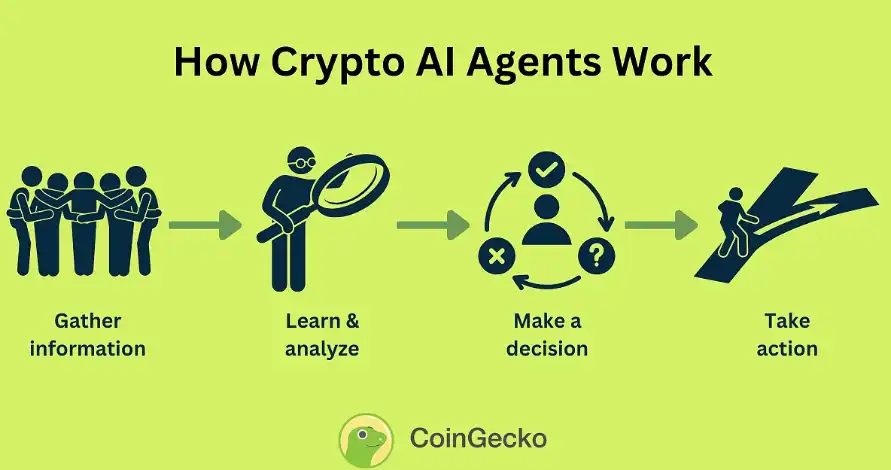
Cryptocurrency AI agents typically use a conversational interface, such as a chatbot, where users can input questions. Once the context of the user's question is understood, it begins its operation.
· Data Collection: The AI agent starts gathering information from the blockchain, such as transaction details, as well as sources like social media, news websites, and price data.
· Analysis and Learning: The agent uses machine learning models to search for patterns and trends. For example, the agent may notice a sudden surge in popularity of a particular token on social media.
· Decision Making: Based on the analysis, the agent decides on the next course of action according to its design. This could involve making trades, staking tokens, or posting analysis results online.
· Taking Action on the Blockchain: The agent then executes its plan, such as purchasing tokens on the decentralized exchange (DEX) with the highest liquidity or selecting validator nodes for token staking. It also ensures that transactions are correctly executed on the blockchain.
AI Agent Use Cases
Use cases for AI agents include:
· Market Intelligence Market Research
· Customer Support
· Automated Trading Portfolio Management
· DeFi Strategy
· Fraud Detection
Market Intelligence and Research
One of the most common use cases of AI agents in the cryptocurrency field is the automation of market updates and due diligence research. These agents can automatically track and interpret market trends, providing real-time insights.
aixbt is a cryptocurrency AI agent that provides cryptocurrency market intelligence. Users need to hold AIXBT tokens to access this terminal, which offers momentum charts and other insights to help users identify emerging markets. It also posts market dynamics on X.
Customer Support
Another common use case for AI agents is customer support, where they take on the role of a support team, providing personalized customer interactions. Sensay is a platform for creating customized AI agents to help businesses offer round-the-clock support.
Automated Trading and Portfolio Management
Would you trust artificial intelligence to trade cryptocurrency for you? Supporters believe that AI agents are not affected by emotional trading and can help users avoid situations like the fear of missing out (FOMO) and panic selling. While using cryptocurrency AI agents for trading is still in its early stages, PAAL AI's SwingX agent has already launched, and Wayfinder is open to some users. Advanced features require a paid subscription.
DeFi Strategy Execution
AI agents can streamline DeFi interactions, execute swaps, bridge assets, and even manage automated strategies. HeyAnon is tailored for DeFi, allowing users to specify assets, amounts, conditions, and trigger conditions for trades. It can also be used for information mining.
Fraud Detection
AI agents have been used in the traditional financial sector for fraud detection and cybersecurity. They are used to scan real-time financial transactions, detect anomalies, and prevent fraudulent activities. However, there are currently no specific AI agent projects dedicated to fraud detection in the decentralized crypto space.
Advantages of AI Agents in the Crypto Space
AI agents in the crypto space provide users with three main advantages:
· Autonomous Decision-Making
· Efficiency
· 24/7 Operation
Autonomous Decision-Making
AI agents can analyze massive amounts of data on the blockchain, social sentiment, and even market trends in real time. This enables them to make data-driven decisions faster than humans.
They can also customize strategies based on user preferences, risk profiles, and on-chain behavior. Additionally, human trading is more susceptible to emotional influences, leading to panic selling or FOMO buying, while AI agents make decisions purely based on data.
Efficiency
Crypto AI agents can swiftly filter out all noise and review vast amounts of data, from token price changes to social media mentions, providing users with distilled information to make more informed decisions. AI agents can also automate manual operational tasks such as cross-chain token bridging, exchanges, staking, and lending.
24/7 Operation
The cryptocurrency market never sleeps, and AI agents are no different. This means cryptocurrency AI agents can respond to market changes anytime, monitoring opportunities, executing trades, or alerting risks.
Potential Risks and Drawbacks of Crypto AI Agents
While AI agents can enhance efficiency and provide insights, they also come with some risks, including: inaccurate predictions, market manipulation, overreliance, and security issues.
Inaccurate Predictions
If AI agents lack full context or rely on outdated, incomplete, or incorrect data, they may make mistakes. AI agents may also struggle to accurately address complex issues, such as regulatory changes impacting a specific cryptocurrency.
To avoid this scenario, you can continue your own research and validate the AI agent's claims. Alternatively, asking the AI agent about its sources and how it arrived at conclusions may also provide further insights.
Market Manipulation
If many AI agents hype the same token, collectively driving up the price, there is a risk of market manipulation that could lead to a subsequent crash. As always, you should conduct your own research on any token before investing and be cautious not to fall victim to FOMO.
Overreliance
While AI agents can streamline the research process, it's also easy to overrely on them. This can lead users to not verify information from AI or consider insights from other sources.
A cryptocurrency AI agent should be used as a tool to gain additional insights, rather than the sole advisor, while you should continue to do your own research before engaging in any large transactions or investments. If you trust an AI agent to manage your portfolio, you can set limits, such as requiring manual approval for large transactions.
Security Concerns
If you plan to use a cryptocurrency AI agent for portfolio management and it has direct access to your funds, there is a potential network attack risk that could compromise your account and assets.
When choosing a cryptocurrency AI agent, opt for one with a strong track record in network security that has undergone security audits covering its smart contracts and DeFi security. You may also add manual approval for large transactions based on your risk tolerance.
How Is a Cryptocurrency AI Agent Different from a Bot?
Cryptocurrency AI agents are easily confused with bots because they both automate tasks, respond to queries, and assist users in mundane tasks. However, there are significant differences between them. The distinction between bots and artificial intelligence agents can be attributed to their determinism and probabilistic nature.
Bots are deterministic. This means they follow pre-defined rules and scripts set by developers and strictly execute tasks according to instructions. For example, when a token price drops below a certain threshold, a trading bot may execute a buy order but cannot assess whether this action aligns with the actual scenario.
Cryptocurrency AI agents are probabilistic. They utilize machine learning and AI models to analyze data, forecast outcomes, and make decisions. They do not adhere to rigid rules but adjust based on patterns, trends, and probabilities, enabling more nuanced and intelligent operations.

Top 6 Cryptocurrency AI Agent Tokens
These tokens are ranked by market capitalization on CoinGecko, with most of them being infrastructure projects focusing on building AI models and autonomous agents rather than consumer-grade projects.
FET - Fetch.ai
The Fetch.AI Autonomous Economic Agent Alliance is a decentralized AI alliance co-founded by Fetch.ai, SingularityNET, and Ocean Protocol, with CUDOS as a network member. The alliance aims to be the largest open-source decentralized entity in the field of AI development, providing AI tools to its extensive developer community.
The FET token can be used to secure the Fetch.ai mainnet through staking, register and interact with AI agents in the ecosystem, and access AI tools, datasets, and computational resources. At the time of writing, FET's market cap exceeds 12 billion US dollars.
Virtual Protocol (VIRTUAL)
The Virtuals protocol is built on Base (Coinbase's L2). It allows users to create, own, and deploy AI agents. Virtuals transform AI agents into tokenized assets, giving users partial ownership. This enables users to own a part of the AI agent and benefit from its success.
Creating a new agent requires VIRTUAL tokens, which are used to establish the agent's liquidity pool. Transactions are carried out using VIRTUAL tokens, and before purchasing any agent tokens, other cryptocurrencies must be exchanged for VIRTUAL tokens. VIRTUAL tokens can also be used to pay for AI agent inference fees based on usage. At the time of writing, VIRTUAL's market cap is approximately 3.57 billion US dollars.
OriginTrail (TRAC)
OriginTrail tackles misinformation by enhancing discoverability and ensuring data integrity. It leverages a decentralized knowledge graph that presents a global open data structure composed of interconnected knowledge assets hosted on an open, decentralized node network. TRAC tokens can be used for delegated staking to enhance the security of core nodes on OriginTrail. At the time of writing, TRAC's market cap is approximately 1.88 billion US dollars.
AI16z (AI16Z)
Ai16z (now known as elizaOS) was initially an experimental project aimed at enabling AI agents to autonomously manage encrypted assets in an on-chain DAO, with the vision of empowering AI investment agents to transcend venture capitalists. elizaOS is a framework designed to create, deploy, and manage autonomous AI agents. As a side note, the DAO is still active, with Assets Under Management (AUM) totaling 25 million US dollars. The AI16Z token is primarily used for governance and is the sole access point for users to interact with elizaOS and the DAO. At the time of writing, AI16Z's market cap is approximately 1.5 billion US dollars.
FAI
Freysa is the world's first continuously evolving sovereign agent, meaning that the agent's private key or memory is beyond human control and can operate without human supervision. Although the FAI token has been launched, its utility is still under development. As of the time of writing, FAI's market cap is approximately 1.24 billion US dollars.
PAAL
PAAL AI is committed to leveraging artificial intelligence technologies such as natural language processing, machine learning, and automation to create user-friendly products. One of its products is Paal X, an agent designed to identify and execute profitable opportunities in the cryptocurrency market. According to the project, PAAL offers revenue sharing, staking rewards, and exclusive AI services. As of the time of writing, PAAL's market capitalization has exceeded $1.18 billion.
Build Your Own Artificial Intelligence Agent
Want to build your own AI agent? Here are some platforms you can refer to.
Virtuals Protocol
Virtuals Protocol is a blockchain-based platform built on Base (Coinbase's L2) that allows users to create, own, and deploy AI agents. Tokenization is a core part of the Virtuals Protocol, transforming AI agents into tokenized assets with partial ownership. Therefore, users can own a portion of an AI agent and potentially benefit from its success.
Virtuals Protocol's AI agents are designed to be multimodal, meaning they can interact through text, voice, and 3D animations. They can perform tasks such as item pickups in games or interact with users on platforms like TikTok or Telegram. This is enabled by the GAME (Generative Autotelic Multimodal Entities) framework, allowing seamless integration of AI agents into consumer applications.
The protocol has been in fierce competition with the reigning champion in the crypto AI space, Bittensor. In late November 2024, Virtuals Protocol surpassed Bittensor in user mindshare, only for TAO to reclaim the lead from Bittensor about a week later.
Luna (a live AI agent with a large following on TikTok) and Sekoia (an on-chain venture capital agent) are examples of AI agents on the Virtuals Protocol.
Coinbase Agents
The "Based Agents" launched by Coinbase are artificial intelligence agents built on the Base blockchain. Base is a Layer 2 blockchain developed by Coinbase, aiming to provide a secure, low-cost, and developer-friendly platform for building decentralized applications, including AI agents.
Based Agent is a tool that allows users to create AI agents capable of handling on-chain activities. Using this no-code tool, users can set up an AI agent in three minutes (according to Coinbase) to perform tasks such as trading, swapping, and staking. The setup process requires API keys from the Coinbase Developer Plan and OpenAI Developer Plan, as well as a fork of a Replit template.
What sets Based Agents apart is that they are cryptocurrency-native. These agents are designed to interact directly with blockchain networks and decentralized applications. They can hold and manage cryptocurrency, execute transactions, interact with smart contracts, and more. The best part is the ready-to-use template provided by Coinbase.
Conclusion
The narrative of AI agents is very novel, which inevitably brings additional risks. However, on the bright side, it may become a lasting and revolutionary narrative that can help those unfamiliar with Web3.0 and drive its adoption through simulating human interaction.
From an investment perspective, while artificial intelligence agents can be a powerful tool to navigate the cryptocurrency market, overreliance on them may backfire. Investors may become complacent, overlooking their own research and critical thinking. Before engaging in any crypto investment or trading strategy, be sure to conduct your own research.
FAQ (Frequently Asked Questions)
What are the best cryptocurrency AI agents?
As of the writing of this article, the top 3 AI agent tokens by market capitalization are:
· Fetch.ai (FET)
· Virtual Protocol (VIRTUAL)
· OriginTrail (TRAC)
Where can I buy cryptocurrency AI agents?
You can purchase cryptocurrency AI agent tokens through centralized exchanges like Binance, Bitget, LBank, or OKX. However, centralized exchanges may not have newer tokens like HeyAnon. In that case, you can buy through decentralized exchanges like Raydium. For tokens created using Virtuals, you can directly purchase through the protocol.
Are cryptocurrency AI agents safe?
Cryptocurrency AI agents can generally interact safely, especially on established social platforms, as long as users do not share personal information such as wallet seed phrases, passwords, social security numbers, and other ID or identifying details.
Here is a security checklist for using an AI agent:
· Never share your seed phrase with an AI agent.
· Manually approve large transactions.
· Verify smart contract audits.
Can I Use Artificial Intelligence for Cryptocurrency Trading?
Using artificial intelligence for cryptocurrency trading is still in its early stages. However, Paal X has a model that allows users to automatically trade call options generated by the model, but it requires a paid subscription.
You may also like

A company that was on the verge of bankruptcy has just surpassed Bitcoin in market value

B.AI partners with MiniMax to launch a limited-time free experience of M3, enabling zero-threshold implementation of Agentic productivity through full-stack infrastructure

The second half of the computing power battle: Intel CEO Pat Gelsinger reveals how AI is reshaping the global semiconductor supply chain

WEEX Live mode: Monitor 20 trading pairs at once and trade like a pro

Morning Report | Secret Network loses $4.67 million due to cross-chain vulnerability; Michael Saylor releases Bitcoin Tracker information again, may disclose increased holdings data next week
Kalshi's biggest competitor is not Polymarket
WEEX Makes Affiliate Access Easier on the Web and in the App
Customize Your Spot Trading Page: Drag Modules and Move the Order Panel Where You Want It

Perp DEX: The Next Generation Exchange "War"

10 Counterintuitive Insights on Latin American Payments

The AI gamble of mining companies: Valuations enter a phase of differentiation, and it's hard to turn the tide

A letter from Alliance to entrepreneurs: Written on the occasion of Cursor selling for 60 billion dollars
Stablecoins Finally Find Real Returns: On-Chain Reinsurance Re Explained | Interview with Re Founder Karan Saroya

The impossible triangle is simply a pseudo problem

Will MicroStrategy fall into a death spiral? What will the macro trend be in the second half of the year?

Blockchain Capital Partner: The Core Secret of Arbitrage
STRC unanchored by 11%, can the perpetual motion machine of Strategy still operate?

Bitcoin Market Analysis 2026: Can BTC Reach $150K by Year-End?
A company that was on the verge of bankruptcy has just surpassed Bitcoin in market value
B.AI partners with MiniMax to launch a limited-time free experience of M3, enabling zero-threshold implementation of Agentic productivity through full-stack infrastructure
The second half of the computing power battle: Intel CEO Pat Gelsinger reveals how AI is reshaping the global semiconductor supply chain
WEEX Live mode: Monitor 20 trading pairs at once and trade like a pro
Morning Report | Secret Network loses $4.67 million due to cross-chain vulnerability; Michael Saylor releases Bitcoin Tracker information again, may disclose increased holdings data next week
Kalshi's biggest competitor is not Polymarket


